
Anker F3000 vs Anker SOLIX 3,072Wh: Which Backup Bet?
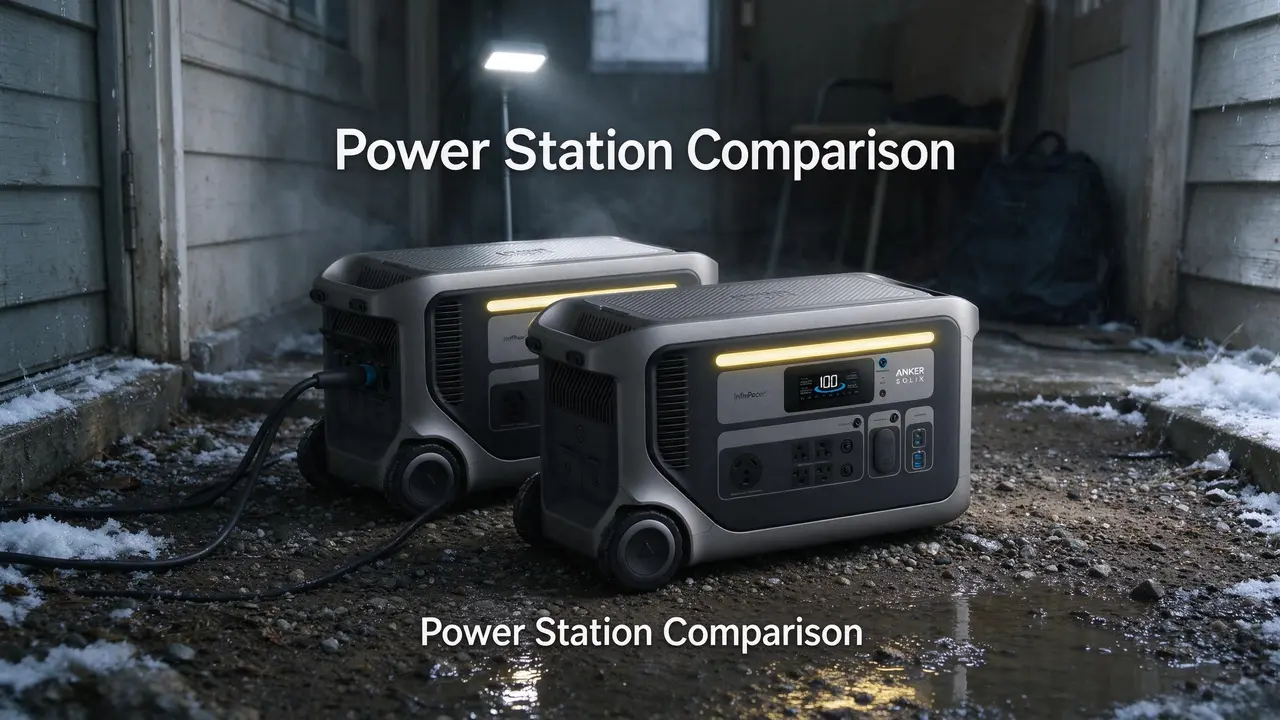
Two Anker units, same 3,600 W output, wildly different price tags — and one of them carries a spec sheet that doesn't add up. Here's how to read the $1,548.99 vs $3,198.99 gap before you spend.
Updated
At a glance
Two Anker units, same 3,600 W output, wildly different price tags — and one of them carries a spec sheet that doesn't add up. Here's how to read the $1,548.99 vs $3,198.99 gap before you spend.
Two listings, two different jobs
This page contains affiliate links; we may earn a commission at no cost to you. That doesn't change what we recommend — it just keeps the lights on.
If you're shopping a 3,072Wh Anker for home backup, these two listings look like siblings: both rate 3,600 W continuous, both weigh 91.5 lb, both carry a 3,072 in the name. Then you hit the prices and the math stops cooperating.
The Anker F3000 Portable Power Station, 3,072Wh lists at $1,548.99. The Anker 3,072Wh LiFePO4 Battery, Expandable to 24kWh, 6,000W Fast lists at $3,198.99 — roughly double, for a unit whose listing capacity field reads 72 Wh. That number is almost certainly a listing error, but I can't verify what it should be, so I'm not going to pretend I can. Treat the battery's usable capacity as n/a (not on file) until Anker publishes a clean figure.
Here's the honest framing: one of these is a complete power station you can plug a fridge into tonight. The other is sold as an expandable battery module with a double-voltage hub in the box. They are not interchangeable purchases, and this page is not for you if you already own an F3000 and just want a second battery — that's a compatibility question, not a comparison.
Before you scroll: if you already own a compatible Anker station and want the Double Voltage Hub for 240V loads, the SOLIX battery is the only one of these two that adds that capability. If you don't, skip it — the hub is dead weight without a host station.
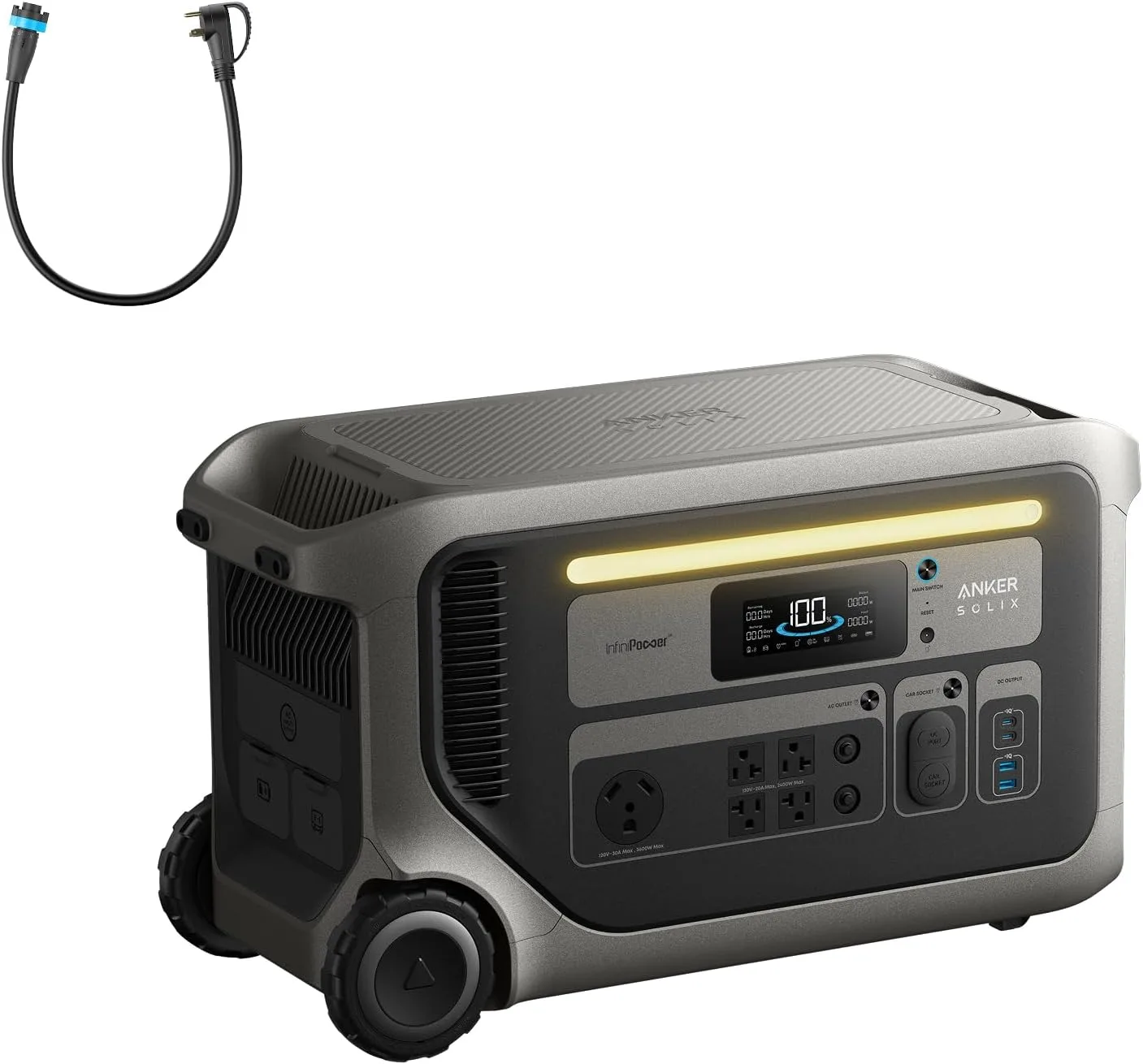
Anker F3000 Portable Power Station, 3,072Wh
Highlights
- 3072Wh rated capacity
- 3600W continuous AC
- 7200W surge
- LiFePO4 chemistry
- Up to 2400W solar input
- 91.5 lb (~41.5 kg)
Best for
- F3000: longer outages or higher continuous loads (still not whole-home wiring)
- RV / off-grid days where recharge speed matters as much as Wh
- Best parked near the vehicle or cabin — not a long carry to a tent
Strengths
- F3000: 3072Wh pack with 3600W continuous / 7200W surge — size loads to both numbers
- 91.5 lb (~41.5 kg) is a park-and-use chassis — plan a short path, not a trail hike
- 3600W continuous headroom covers more small appliances than 1kW-class inverters
- About $1548.99 list in the Hub catalog — confirm live retail before you buy
Watch-outs · not ideal when
- At 91.5 lb (~41.5 kg), F3000 is a poor tent-hike companion — plan a cart or leave it in the vehicle
- High continuous output on F3000 tempts big loads — Wh still runs out on kettles and A/C
- Rated 2400W solar on F3000 is optimistic; shade and cables cut real watts
- LiFePO4 helps longevity, but F3000 still hates freezing charge temps on winter trips
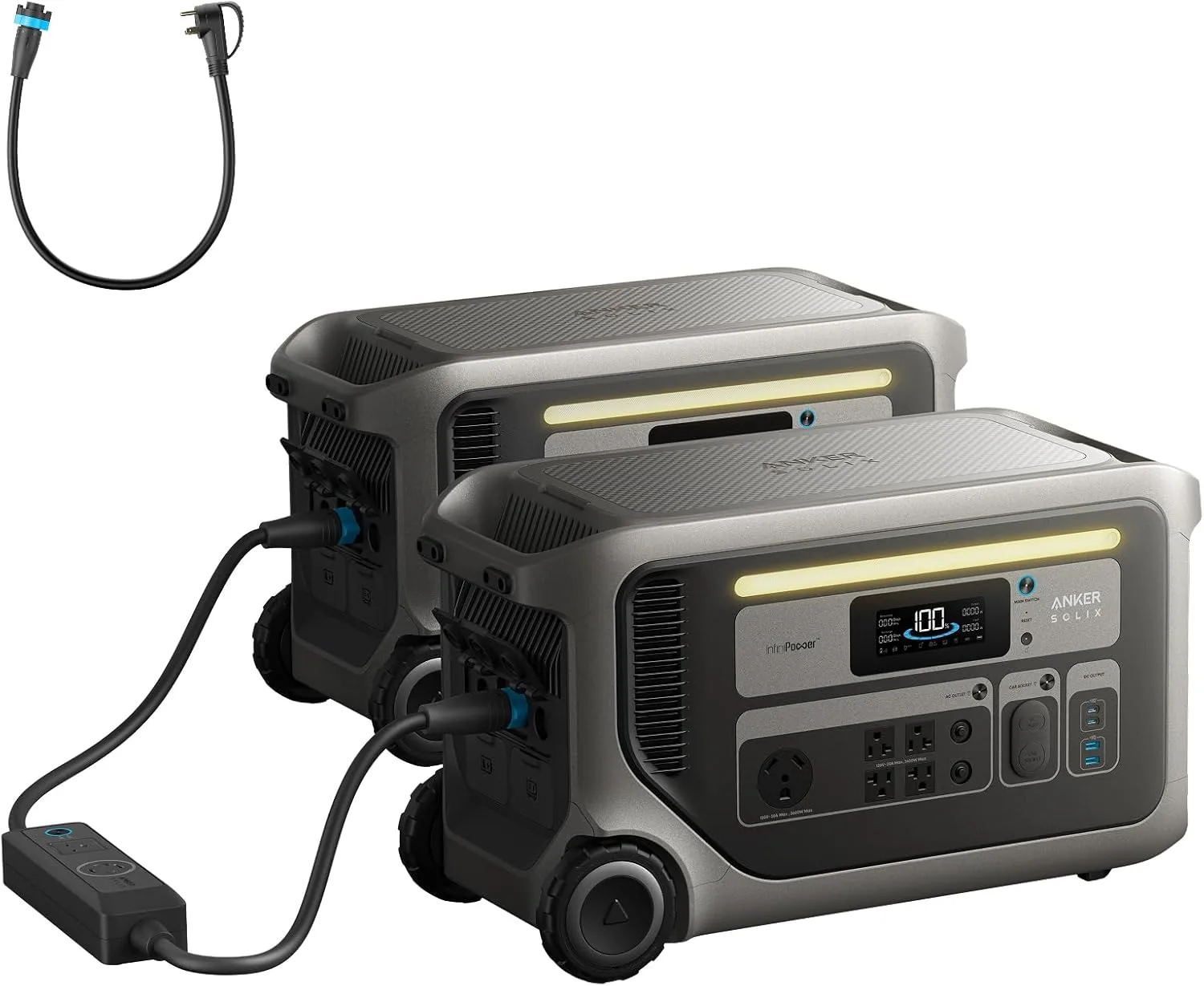
Anker 3,072Wh LiFePO4 Battery, Expandable to 24kWh, 6,000W Fast Recharging, Solar
Highlights
- 72Wh rated capacity
- 3600W continuous AC
- LiFePO4 chemistry
- 91.5 lb (~41.5 kg)
- About $3198.99 list
Best for
- SOLIX F3002: phones, cameras and a laptop on short trips
- Travel kits when you need quiet pack power, not appliance runtime
- Brief desk backup for router and lights — not a fridge for days
Strengths
- SOLIX F3002: 3600W continuous on a 72Wh pack — more headroom for small appliances than 1kW-class peers
- 91.5 lb (~41.5 kg) is a park-and-use chassis — plan a short path, not a trail hike
- 3600W continuous headroom covers more small appliances than 1kW-class inverters
- About $3198.99 list in the Hub catalog — confirm live retail before you buy
Watch-outs · not ideal when
- At 91.5 lb (~41.5 kg), SOLIX F3002 is a poor tent-hike companion — plan a cart or leave it in the vehicle
- Usable energy on SOLIX F3002 is below the 72Wh label once the inverter is working
- Solar input unpublished for SOLIX F3002 — do not assume a same-day off-grid refill
- Airline and pack limits may still block SOLIX F3002 even when the weight looks friendly
Spec snapshot
Everything below comes from the listings. Where a field is missing or looks wrong, it says so rather than guessing. Weight is in pounds; capacity in Wh; output in continuous watts.
Method disclosure: owner themes are drawn from the F3000's Amazon review base (multiple reviews; exact count not on file) and from the SOLIX battery's single rating (no review text). Specs are from Amazon listings as of the date of this writing; no lab testing was performed. Ratings are listing aggregates, not owner proof.
One note on the second row: the listing's capacity field reads 72 Wh against a product name that says 3,072Wh. That is a data error on the listing, not a real 72 Wh battery. Treat capacity as n/a (not on file) until Anker publishes a clean figure. The same row's 3,600 W and 91.5 lb describe the module as listed, but on a battery module those figures only matter once it's paired into a system — they are not a standalone device rating. Historical lows, for context only and never in the table: F3000 has touched $1,448.99; the SOLIX battery has touched $2,999.99. Ratings are listing aggregates, not owner proof. The second unit's 5.0 comes from a single rating — that is not evidence of anything.
| Product | Price | Capacity (Wh) | Output (W) | Weight (lb) | Rating | Hub included | Compatibility |
|---|---|---|---|---|---|---|---|
| Anker F3000 Portable Power Station, 3,072Wh | $1548.99 | 3072 Wh | 3600 W | 91.5 lb | 4.4 | No | Standalone station |
| Anker 3,072Wh LiFePO4 Battery, Expandable to 24kWh, 6,000W Fast | $3198.99 | n/a (listing error) | 3600 W (system) | 91.5 lb | 5 (single rating) | Yes (Double Voltage Hub) | Requires compatible Anker station |
Where the money went
Four configuration differences do most of the work here, and they explain why the price gap isn't just markup.
- Box contents: the F3000 ships as a working station — TT-30 charging cable, AC cable, high-voltage solar cable, manual, warranty card. The SOLIX battery ships with a Double Voltage Hub, which is the part that lets paired units feed 240V loads. That hub is likely a major part of the price gap, and it's also the reason the battery is useless to you if you don't already have a compatible station.
- AC outlets: the F3000 lists AC×3. The SOLIX battery lists AC×1. Neither listing confirms USB-C or USB-A, so I'm not claiming either way — check the port panel yourself before buying for a specific device.
- Solar input: the F3000 lists dual PV inputs (165V and 60V) and up to 2,400 W of solar recharging. The SOLIX battery's listing repeats the same 2,400 W solar language, which reads like shared platform copy rather than a spec written for a battery module.
- Recharge path: both listings cite 6,000 W combined generator-plus-solar input. On the F3000 that's a station feature you can use day one. On the battery, that input only matters once it's paired into a system.
The spec that decides it
Two numbers settle most of this.
First, capacity you can actually use. The F3000's 3,072 Wh is a published, coherent figure, and owners describe real loads against it — a 13k roof AC on low cool through a night, a fridge at 190 W for a listed 42 hours, roughly 60% of a home's essentials in a simulated outage. The SOLIX battery's capacity field is unusable as listed, so I can't tell you what it holds. That alone disqualifies it as a standalone backup purchase.
Second, continuous output versus what it's paired with. Both say 3,600 W. But 3,600 W on a station means you can run a space heater or a microwave directly. On a battery module, that number describes the system it joins, not a device you can use alone. If your outage plan is 'plug the fridge in and go,' only one of these does that.
What owners actually report
The F3000 has a deep review base and the themes are consistent. The SOLIX battery has one rating and no owner text on file, so there is nothing to summarize — I'd rather say that than dress up a single star count as consensus.
- F3000, runtime: multiple owners describe running an RV roof AC overnight, and one reports a fridge at 190 W lasting about 42 hours — matching the listing's claim.
- F3000, standby: a five-day hold on charge came up more than once, which matters for a unit that sits idle between storms.
- F3000, friction: bulk is the repeated complaint. The 6-inch wheels help, but owners still call it hefty, especially with an expansion battery attached. Wi-Fi dropouts also show up, which undercuts app monitoring.
- F3000, solar setup: owners flag that maxing both PV inputs takes homework, and the included 400 W panel is heavy enough that some leave it home.
- SOLIX battery: no owner themes on file. Feedback is thin — one rating, no review text. Treat any hands-on claim about this unit, including mine, with caution.
Buy the one that…
Buy the Anker F3000 Portable Power Station, 3,072Wh if you need a working backup you can roll to the fridge tonight — and skip it if you can't lift 91.5 lb or you want a grab-and-go solar kit, because the included panel is the weak link.
Buy the Anker 3,072Wh LiFePO4 Battery, Expandable to 24kWh, 6,000W Fast only if you already run a compatible Anker station and specifically want the Double Voltage Hub for 240V loads — and walk away if you're buying your first backup unit, because the listed capacity doesn't reconcile and there's no owner evidence to lean on.
Neither is a whole-home answer on its own. For that, size against your actual critical loads first — our guide to sizing a power station for home backup walks through the watt-meter step — and read up on LFP versus NMC before you commit, since cycle life is where the money really goes.
Frequently asked
Can the F3000 run a full-size fridge?
The listing claims a 190 W fridge for 42 hours, and owners report similar. A modern fridge cycling at 100–200 W average is within its 3,600 W continuous rating; a startup surge is the thing to check.
Is the SOLIX battery a 72 Wh unit?
No — that's a listing data error against a 3,072Wh product name. Capacity is n/a (not on file) until Anker publishes a clean figure.
Do I need the Double Voltage Hub?
Only if you want 240V output from paired units. It's included with the battery listing, and it's likely a major part of why that listing costs more.
Which one for an RV?
The F3000, on the strength of owner reports of overnight roof-AC runtime and the 30A output. The battery module has no owner evidence for RV use.
Can I add the SOLIX battery to an F3000 later?
The listing says it requires a compatible Anker station, but compatibility details aren't spelled out. Check Anker's documentation for your specific model before buying.
What's the return window and warranty?
The F3000 listing mentions a warranty card but doesn't state terms; the SOLIX battery listing doesn't specify either. Check the current Amazon listing or Anker's site for the exact policy.
Method and sources
Model names and list prices come from the WattPicks catalog at build time. WattPicks does not run its own laboratory tests on power stations, and nothing on this page is presented as a measured result — it is catalog-backed buying guidance.
Read our methodology for how the catalog is normalized, and about WattPicks for who publishes it.