
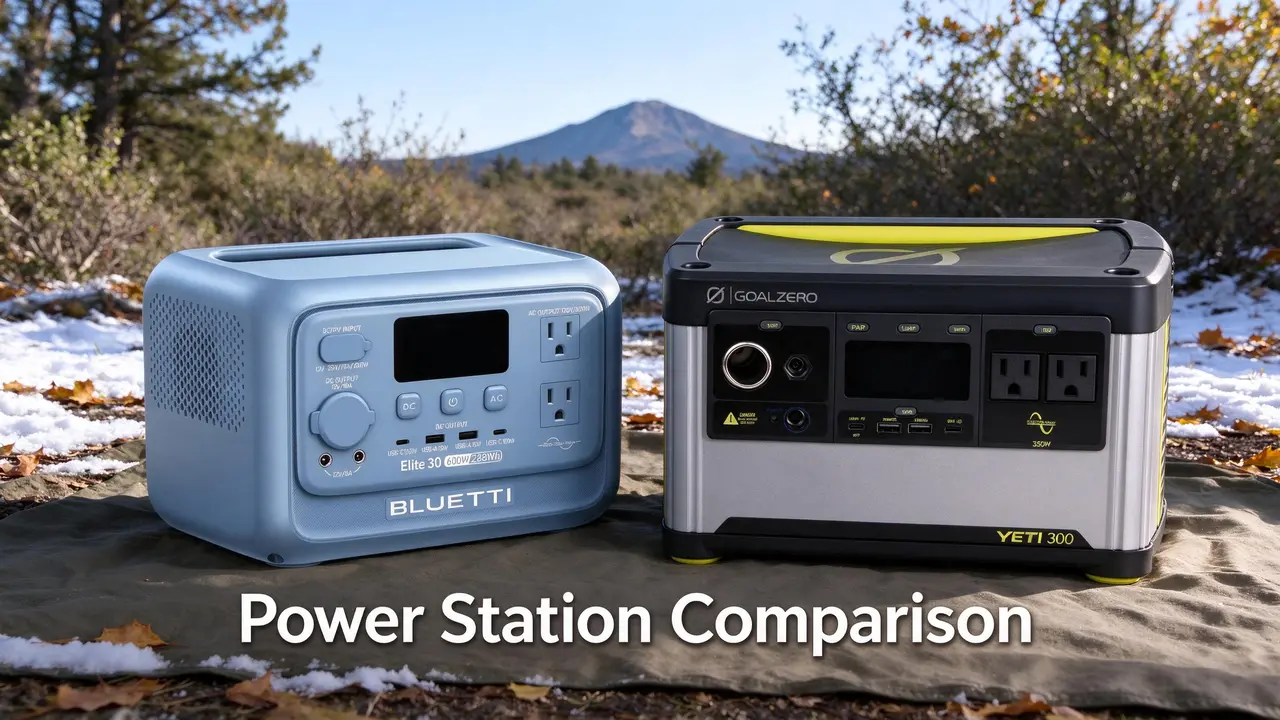
BLUETTI Elite 30 V2 vs Goal Zero Yeti 300: Small Backup Duel
Two ~300Wh stations, two different bets: the BLUETTI pushes 600W and LFP speed, the Goal Zero leans on USB-C ports and a lower list price. Here's which small backup actually fits your outage plan.
Updated
At a glance
Two ~300Wh stations, two different bets: the BLUETTI pushes 600W and LFP speed, the Goal Zero leans on USB-C ports and a lower list price. Here's which small backup actually fits your outage plan.
- BLUETTI's bet: more continuous watts and LFP cycle life for UPS-style duty.
- Goal Zero's bet: lighter carry, more documented USB-C ports, lower list price.
- Shared limit: ~300Wh is a bridge, not a whole-home solution.
Same money, different bets
At roughly $350–$400, these two compact stations are not really competing for the same job. The BLUETTI Elite 30 V2 bets on output and chemistry: 600W continuous from a 288Wh LiFePO4 pack, plus a fast wall-charge claim and an app that shows live wattage. The Goal Zero Yeti 300 bets on portability and ports: 297Wh, 350W continuous, 13.7 lb, and a listed set of three USB-C, two USB-A, and one car port.
That split matters more than the 9Wh capacity gap. If your outage plan is a networking stack, a CPAP, or a laptop that needs a real AC outlet, the BLUETTI's 600W ceiling gives you headroom the Yeti 300's 350W does not. If your plan is charging phones, tablets, and a fan from a bag, the Goal Zero's lower list price and explicit USB-C count are the more useful spec sheet.
This is a two-way pick, not a ranking. Neither station is a whole-home backup, and neither should be asked to run a space heater or a microwave. The question is which small bet fits the loads you actually own.
- BLUETTI's bet: more continuous watts and LFP cycle life for UPS-style duty.
- Goal Zero's bet: lighter carry, more documented USB-C ports, lower list price.
- Shared limit: ~300Wh is a bridge, not a whole-home solution.
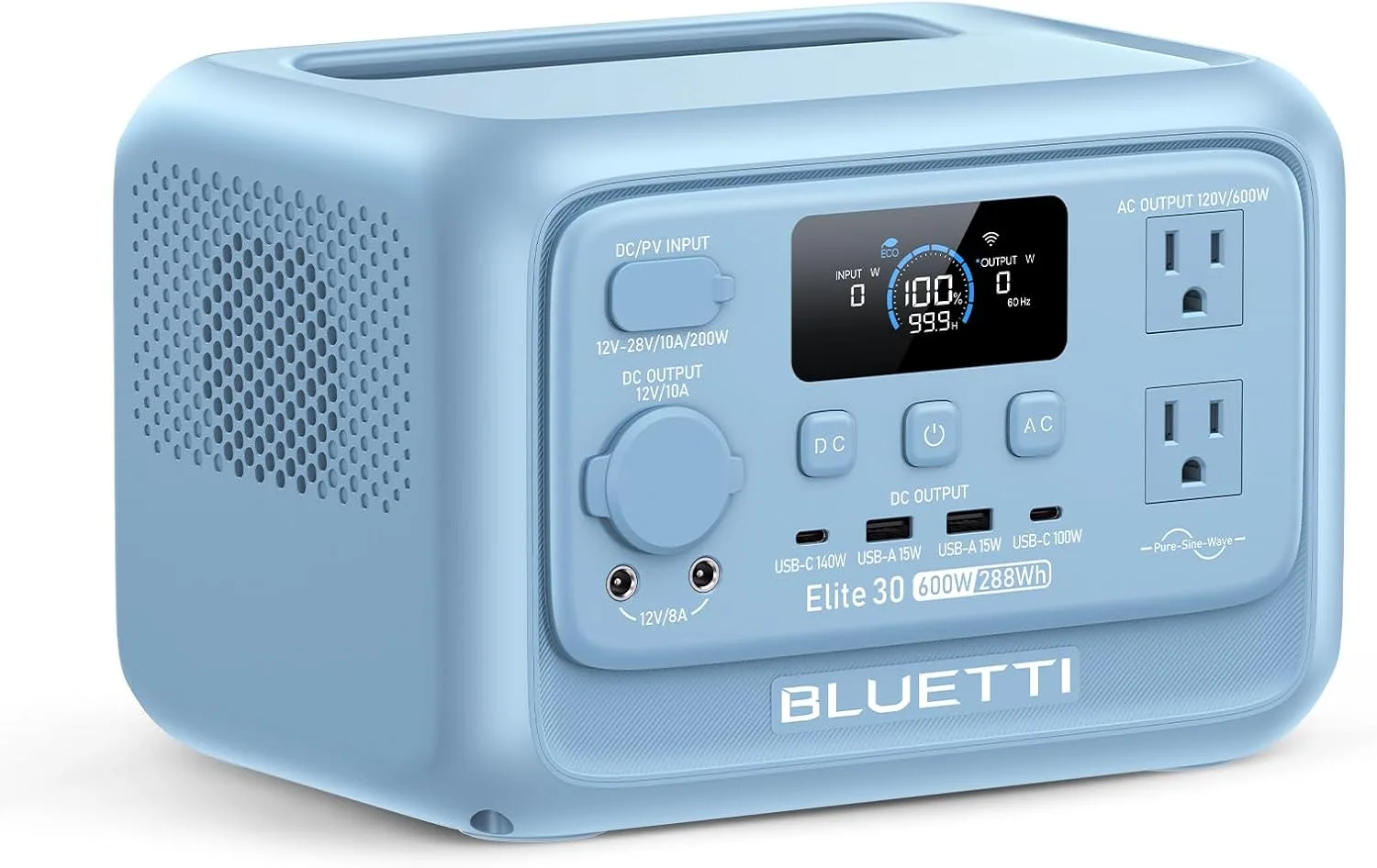
BLUETTI Elite 30 V2 Portable Power Station 288Wh 600W LFP Solar Generator
Highlights
- 288Wh rated capacity
- 600W continuous AC
- LiFePO4 chemistry
- Up to 200W solar input
- 9.5 lb (~4.3 kg)
- About $399 list
Best for
- Elite 30 V2: phones, cameras and a laptop on short trips
- Travel kits when you need quiet pack power, not appliance runtime
- Brief desk backup for router and lights — not a fridge for days
Strengths
- Elite 30 V2: 288Wh / 600W continuous — treat as electronics and light loads, not a tool inverter
- 9.5 lb (~4.3 kg) is the lightest-class carry in this band — easier stairs and car packing
- 10ms-class UPS switchover on the listing — useful when a router restart would hurt
- About $399 list in the Hub catalog — confirm live retail before you buy
Watch-outs · not ideal when
- Elite 30 V2's small Wh class empties fast with a kettle, hair dryer or space heater
- Usable energy on Elite 30 V2 is below the 288Wh label once the inverter is working
- Rated 200W solar on Elite 30 V2 is optimistic; shade and cables cut real watts
- Airline and pack limits may still block Elite 30 V2 even when the weight looks friendly
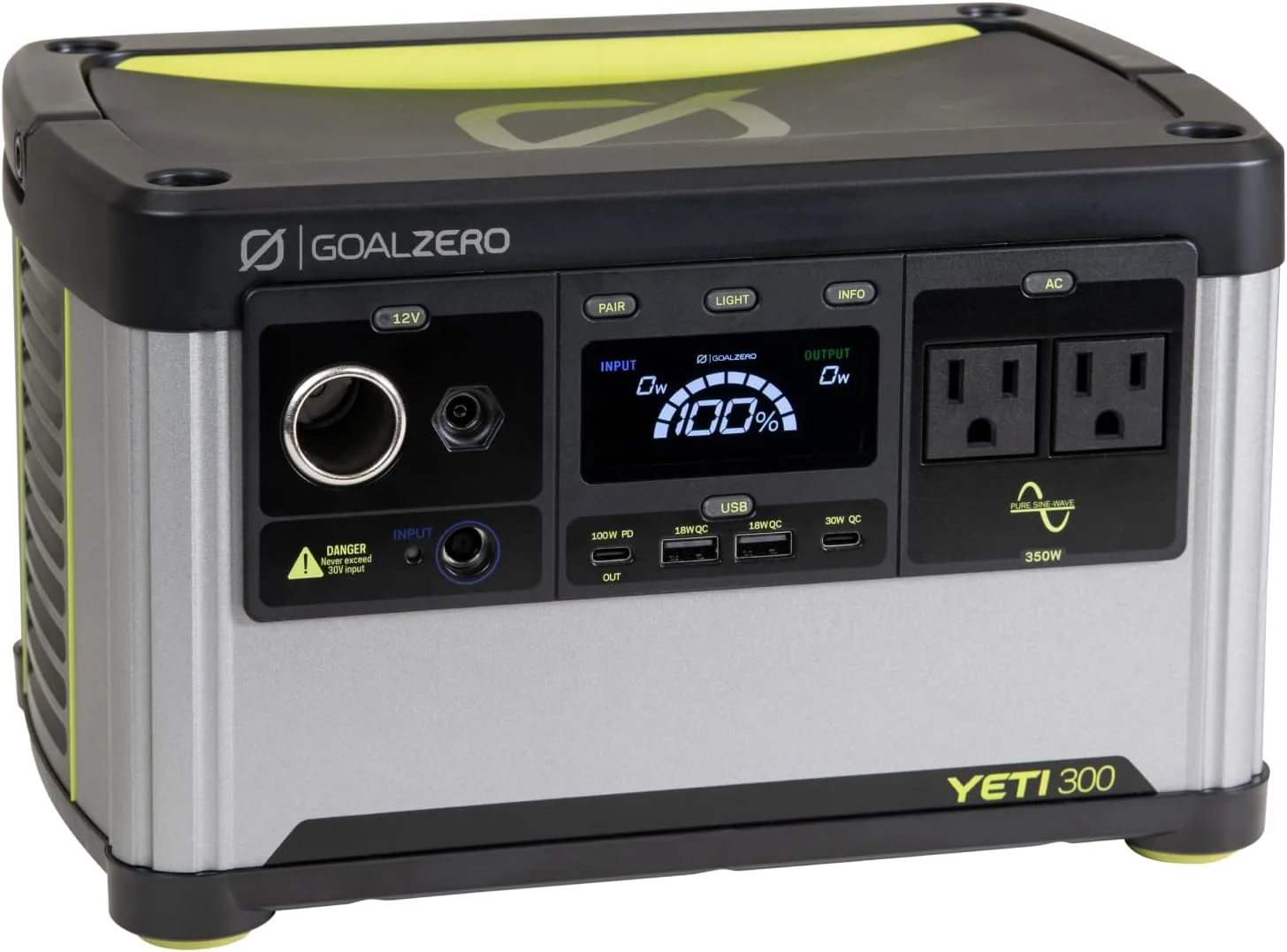
Goal Zero Yeti 300 Portable Power Station
Highlights
- 297Wh rated capacity
- 350W continuous AC
- 600W surge
- LiFePO4 chemistry
- Up to 200W solar input
- 13.7 lb (~6.2 kg)
Best for
- Yeti 300: phones, cameras and a laptop on short trips
- Travel kits when you need quiet pack power, not appliance runtime
- Brief desk backup for router and lights — not a fridge for days
Strengths
- Yeti 300: 297Wh pack with 350W continuous / 600W surge — size loads to both numbers
- 13.7 lb (~6.2 kg) is the lightest-class carry in this band — easier stairs and car packing
- Yeti 300 uses LiFePO4 — cycle-life claims usually beat older NMC marketing lines
- Owners on file: 1/5 · 36 helpful — I was stoked for this product given its light weight and functionality but I am incredibly…
Watch-outs · not ideal when
- Yeti 300's small Wh class empties fast with a kettle, hair dryer or space heater
- 350W continuous will not hold heating elements or many compressor surges for long
- Rated 200W solar on Yeti 300 is optimistic; shade and cables cut real watts
- Airline and pack limits may still block Yeti 300 even when the weight looks friendly
Owner voices
Short takes from public retail reviews — paraphrased or translated when long or non-English; meaning kept close to the original.
“1/5 · 36 helpful — I was stoked for this product given its light weight and functionality but I am incredibly disappointed. I took this out on 2 separate camping trips and it died both nights charging a single phone.…”
“3/5 · 9 helpful — I have a laptop and T Mobile whole house wifi connected. I use it to power my "mobile office". It powers the 2 devices for about 4 hours - then it is at 10% remaining. It works, it's quiet but I expe…”
“5/5 · 7 helpful — I have owned many goal zero products over the years and have found them to be among the best in the industry. While there are cheaper options out there, the quality doesn't match up to Goal Zero. The…”
Methodology and disclosure
This comparison is grounded in listing specs from the WattPicks catalogue and owner themes from high-helpful reviews on file for both units. Those are home-user checks and owner tallies, not lab-bench measurements — I am not claiming instrumented re-tests, and the listing star averages are labeled as aggregates, not owner proof. Prices are list prices; sale stickers and historical lows are excluded from the table on purpose.
Avery Nolan is the WattPicks founding editor covering portable power station capacity, output, and price-per-Wh guidance across the catalogue — no lab claims.
As an Amazon Associate, WattPicks earns from qualifying purchases. Picks here are fit-led, not commission-led.
Scoreboard on those weights — BLUETTI Elite 30 V2 Portable Power Station 288Wh 600W LFP Solar (list $399): High where list price and published capacity match the job, Med on continuous watts; Goal Zero Yeti 300 Portable Power Station (list $349.95): High on continuous watts and ports, Med on price. That is why the pick splits by job rather than one universal winner.
Spec snapshot
Prices are list prices from the WattPicks catalogue, not current sale stickers. Ratings are listing aggregates only — they are not owner proof, and the Goal Zero's 107 ratings are thin enough that I would treat the number as a rough signal rather than a verdict. Weight is in pounds; capacity and output are as listed.
| Product | List price | Capacity (Wh) | Output (W) | Weight (lb) | Rating |
|---|---|---|---|---|---|
| BLUETTI Elite 30 V2 Portable Power Station 288Wh 600W LFP Solar | $399 | 288 Wh | 600 W | 9.5 lb | 5.00 |
| Goal Zero Yeti 300 Portable Power Station | $349.95 | 297 Wh | 350 W | 13.7 lb | 4.02 |
Where the money went
Four configuration differences explain most of the price gap, and they point in opposite directions.
Output headroom. The BLUETTI lists 600W continuous; the Goal Zero lists 350W continuous with a 600W surge figure. For a ~150W networking load, both are comfortable. For a small kettle or a hair tool, only the BLUETTI's continuous rating is in the same conversation — and even then, owners report high-draw devices tripping it.
Chemistry and cycle life. Both listings name LiFePO4. The BLUETTI frames it around partial-charge UPS duty; the Goal Zero lists 4,000+ cycles and a 10-year daily-use claim. On paper these are close; the buyer impact is the same — you can leave either at partial charge without the calendar-life penalty of older lithium-ion.
Ports. The Goal Zero's listing is explicit: USB-C×3, USB-A×2, car×1. The BLUETTI's port count is not on file, so I will not claim it lacks USB-C — I simply cannot compare that row. If USB-C count is a deciding factor for you, that asymmetry favors the Goal Zero on documented specs.
Weight and charging. The BLUETTI is 9.5 lb; the Goal Zero is 13.7 lb. The Goal Zero claims 0–100% in about 50 minutes in high-speed mode; the BLUETTI claims 380W wall input and 0–80% in 45 minutes. Both fast-charge claims have caveats in owner reports, covered below.
- Continuous output: 600W (BLUETTI) vs 350W (Goal Zero) — the widest real gap.
- Documented USB-C: n/a for BLUETTI, ×3 for Goal Zero.
- Weight: 9.5 lb vs 13.7 lb — a 4.2 lb carry difference.
- List price: $399 vs $349.95 — about $49 apart, same budget tier.
The spec that decides it
If I had to pick one number, it is continuous AC output. The BLUETTI's 600W rating covers a small server, a networking stack, a laptop plus monitor, or a CPAP with a DC converter — loads that sit well under its ceiling. The Goal Zero's 350W rating covers phones, laptops, fans, and a TV, but leaves little headroom for anything with a heating element or a motor start.
The second deciding number is weight, and it cuts the other way. At 9.5 lb the BLUETTI is a one-hand carry; at 13.7 lb the Goal Zero is a two-hand or shoulder-strap carry. If the station lives in a closet for outages, weight barely matters. If it rides in a truck or a backpack, 4.2 lb is a real daily tax.
- Pick on 600W vs 350W if you own any AC load above ~300W.
- Pick on 9.5 lb vs 13.7 lb if the station travels weekly.
- Do not pick on the 9Wh capacity gap — it is noise.
Real owner trade-offs
The BLUETTI's owner themes skew toward UPS duty. Multiple high-helpful reviewers describe replacing an aging CyberPower unit and getting roughly double the runtime on a ~150W mixed load — one reports about 2.4 hours where the old UPS gave a bit over one. A home-server owner praises clean sine output and switchover fast enough that the server never restarted. The caveats are equally specific: one detailed critical review measured wall charging at only ~200W instead of the advertised 380W, with 0–100% taking over two hours, and the unit shutting down immediately when a small heater drew power. CPAP campers report the standard AC plug draining the battery overnight, with a separately purchased DC converter cutting that to about 55% per night with humidifier and heated hose on.
The Goal Zero's owner themes are thinner and more mixed. Positive reviews describe fast recharge to full in under an hour, a laptop-plus-wifi mobile office running about four hours before hitting 10%, and a two-hour wifi-and-TV run during an apartment outage. The critical side is blunt: one high-helpful 1-star review reports the unit dying both nights on two separate camping trips while charging a single phone. A car-charging owner blew a fuse when the charge rate was set too high and only got reliable top-ups after lowering it. With 107 ratings, the listing aggregate of 4 is a small sample — I would weight the repeated runtime complaints more heavily than the star average.
- BLUETTI strength: UPS-style runtime on ~150W loads, clean sine output, fast switchover.
- BLUETTI caveat: advertised 380W charging not reproduced by one detailed reviewer; high-draw shutdowns.
- Goal Zero strength: sub-hour recharge, light carry, documented USB-C ports.
- Goal Zero caveat: repeated short-runtime complaints under light loads; fuse blow at high car-charge rate.
Buy the one that…
Buy the BLUETTI Elite 30 V2 if your small backup has a job that needs real AC headroom — a home server, a networking stack, a CPAP with a DC converter, or a laptop plus monitor — and you can live with the possibility that wall charging runs slower than the listing claims. It is the better fit for a closet UPS that occasionally travels.
Buy the Goal Zero Yeti 300 if the station mostly charges USB devices, rides in a bag or truck, and you want the lower list price plus a documented USB-C count. Skip it if you need all-night phone charging or a full day of laptop work without a recharge — the runtime complaints are too consistent to ignore.
Walk away from both if you need to run a space heater, a microwave, or anything above ~600W continuous. That is a different class of station, and neither of these is it.
- BLUETTI: buy for AC headroom and UPS duty; skip if advertised charge speed is non-negotiable.
- Goal Zero: buy for light carry and USB-C ports; skip if runtime under load is the priority.
- Both: skip if your load exceeds 600W continuous.
Frequently asked
Can either run a CPAP overnight?
The BLUETTI can, but owners report the standard AC plug draining the 288Wh pack overnight — a separately purchased DC converter is what makes all-night use practical. The Goal Zero's 297Wh pack and 350W output are not backed by CPAP-specific owner reports on file, so I would not promise an overnight run.
Which is cheaper per Wh?
On nameplate math, the Goal Zero is $1.18/Wh against the BLUETTI's $1.39/Wh. That is a list-price comparison, not a usable-capacity claim.
Will either run a space heater?
No. Owners report the BLUETTI shutting down on a 1650W heater, and the Goal Zero's 350W continuous rating is well below any space heater's draw.
Method and sources
Model names and list prices come from the WattPicks catalog at build time. WattPicks does not run its own laboratory tests on power stations, and nothing on this page is presented as a measured result — it is catalog-backed buying guidance.
Read our methodology for how the catalog is normalized, and about WattPicks for who publishes it.