
BLUETTI Elite 200 V2 vs EcoFlow DELTA 3 Max Plus: Which 2 kWh Backup Bet Fits You?
Two ~2 kWh stations, a $1,000 price gap, and very different bets on what backup should cost. One is the value play with a solar caveat; the other buys expandability and a claimed 10 ms transfer. Here is how to pick.
Updated
At a glance
Two ~2 kWh stations, a $1,000 price gap, and very different bets on what backup should cost. One is the value play with a solar caveat; the other buys expandability and a claimed 10 ms transfer. Here is how to pick.
- BLUETTI bets on price-per-Wh and raw AC headroom: $0.43/Wh rated, 2600 W continuous.
- EcoFlow bets on expandability and fast transfer: 3000 W continuous, a claimed 10 ms UPS switchover, up to 10 kWh with extra batteries.
Same money? No — same class, different bets
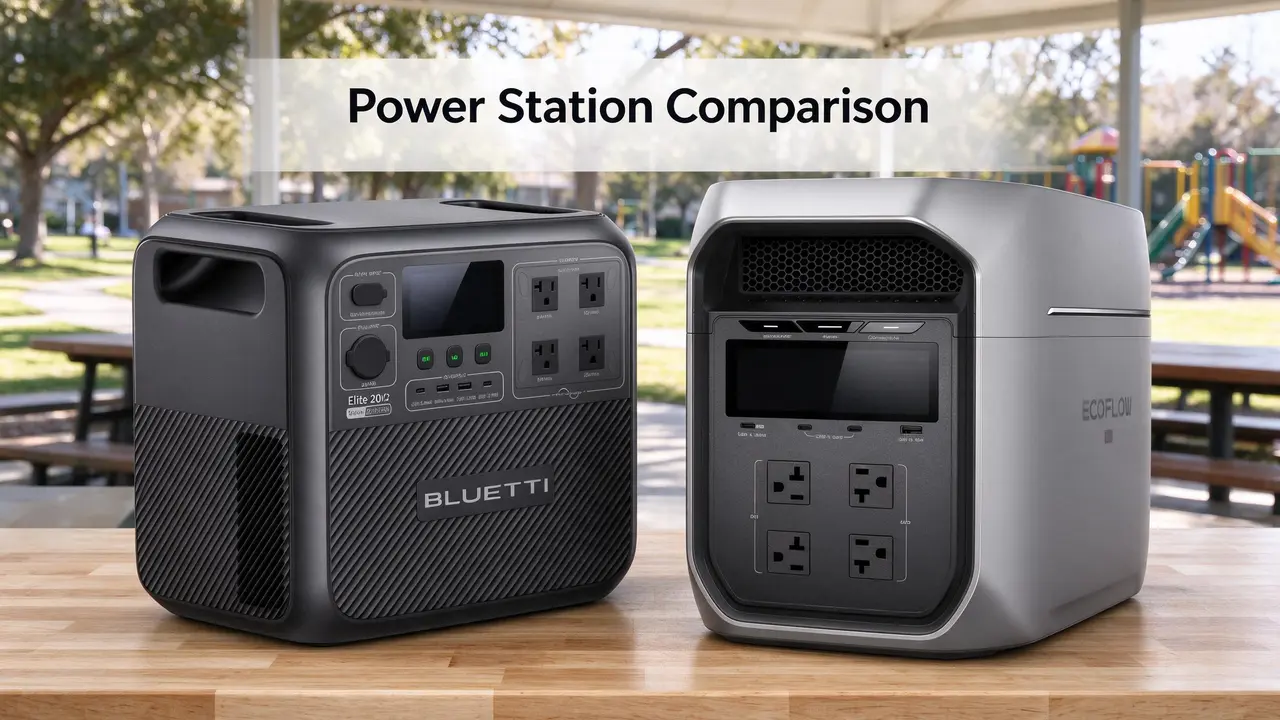
If you are shopping a ~2 kWh power station for outages, these two land in the same capacity class but not the same budget. The BLUETTI Elite 200 V2 lists at $899; the EcoFlow DELTA 3 Max Plus lists at $1899. That is roughly a $1,000 gap for about the same rated energy.
So the real question is not which is bigger. It is what the extra money buys you, and whether your outage plan actually needs it. This page is not for whole-home backup through a transfer switch — neither unit is a substitute for a generator and panel work. It is for fridge, CPAP, router, lights, and a few appliances.
Disclosure: picks here are fit-led, not commission-led. As an Amazon Associate, WattPicks earns from qualifying purchases. Prices and ratings are as of the time of writing; check current listings before you buy.
- BLUETTI bets on price-per-Wh and raw AC headroom: $0.43/Wh rated, 2600 W continuous.
- EcoFlow bets on expandability and fast transfer: 3000 W continuous, a claimed 10 ms UPS switchover, up to 10 kWh with extra batteries.
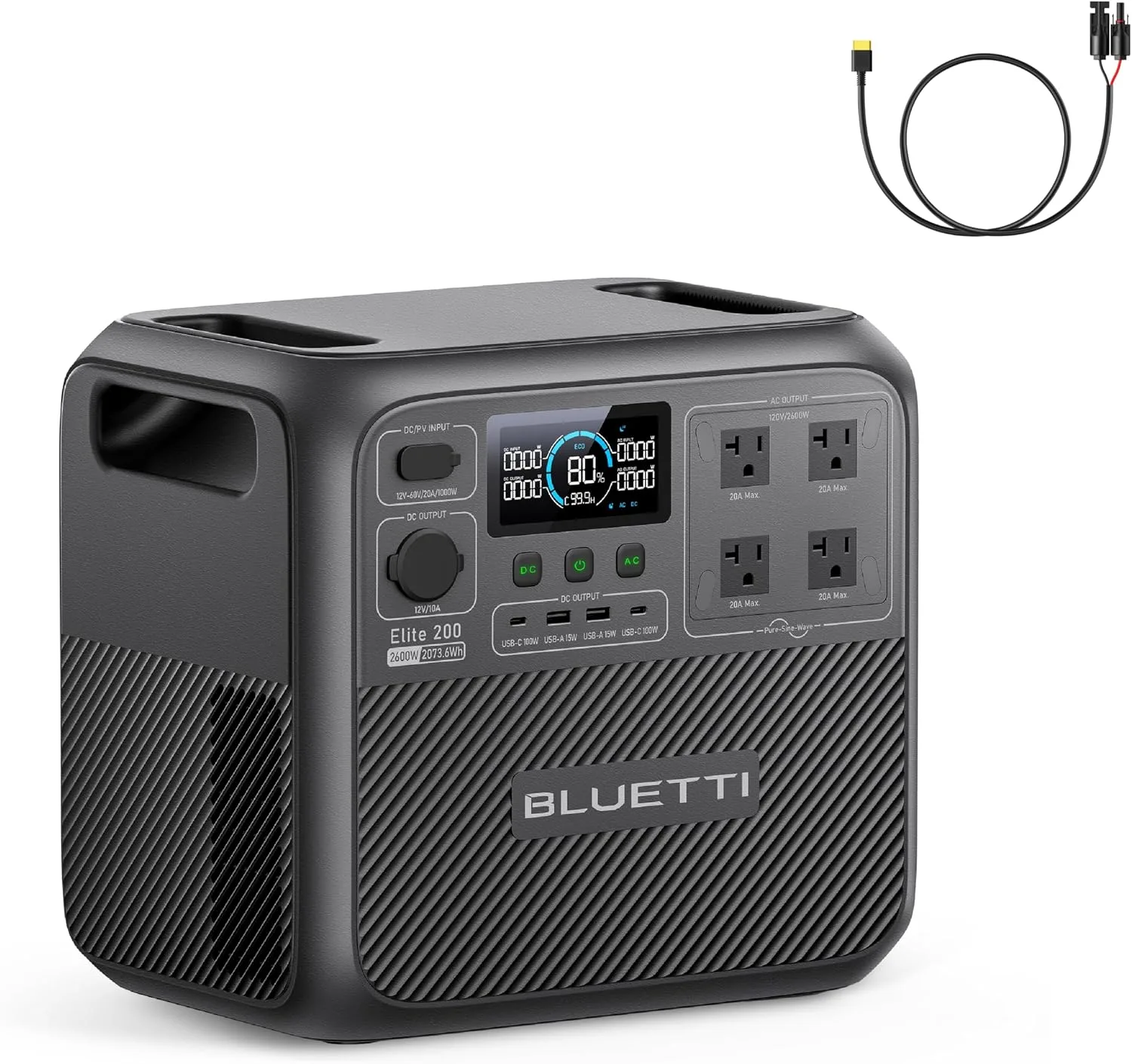
BLUETTI Elite 200 V2
Highlights
- 2074Wh rated capacity
- 2600W continuous AC
- LiFePO4 chemistry
- Up to 1000W solar input
- 53.4 lb (~24.2 kg)
- About $899 list
Best for
- Elite 200 V2: longer outages or higher continuous loads (still not whole-home wiring)
- RV / off-grid days where recharge speed matters as much as Wh
- Best parked near the vehicle or cabin — not a long carry to a tent
Strengths
- Elite 200 V2: 2600W continuous on a 2074Wh pack — more headroom for small appliances than 1kW-class peers
- 53.4 lb (~24.2 kg) is a park-and-use chassis — plan a short path, not a trail hike
- 2600W continuous headroom covers more small appliances than 1kW-class inverters
- About $899 list in the Hub catalog — confirm live retail before you buy
Watch-outs · not ideal when
- At 53.4 lb (~24.2 kg), Elite 200 V2 is a poor tent-hike companion — plan a cart or leave it in the vehicle
- High continuous output on Elite 200 V2 tempts big loads — Wh still runs out on kettles and A/C
- Rated 1000W solar on Elite 200 V2 is optimistic; shade and cables cut real watts
- LiFePO4 helps longevity, but Elite 200 V2 still hates freezing charge temps on winter trips
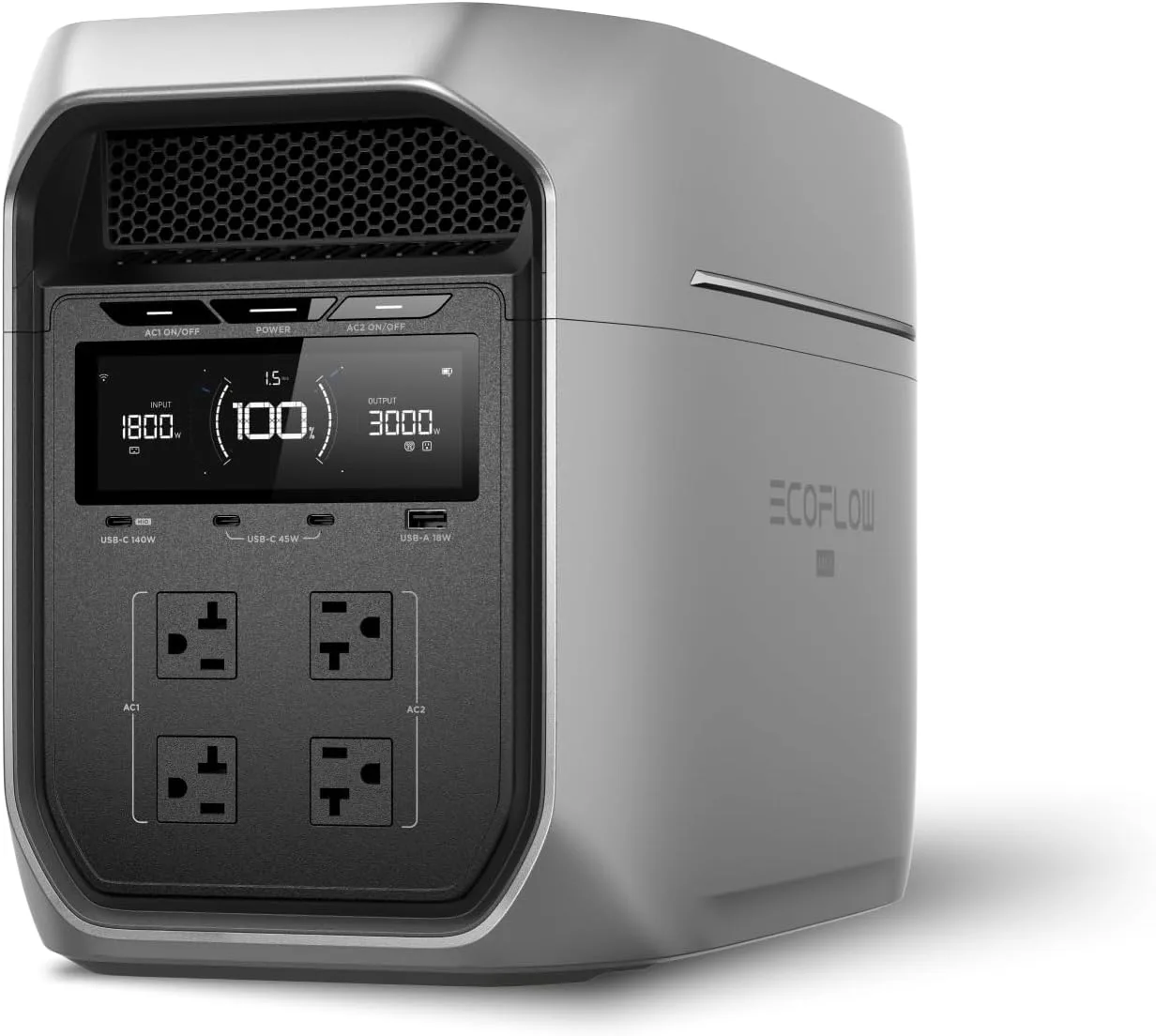
EcoFlow DELTA 3 Max Plus
Highlights
- 2048Wh rated capacity
- 3000W continuous AC
- 6000W surge
- LiFePO4 chemistry
- 48.7 lb (~22.1 kg)
- About $1899 list
Best for
- DELTA 3 Max Plus: longer outages or higher continuous loads (still not whole-home wiring)
- RV / off-grid days where recharge speed matters as much as Wh
- Best parked near the vehicle or cabin — not a long carry to a tent
Strengths
- DELTA 3 Max Plus: 2048Wh pack with 3000W continuous / 6000W surge — size loads to both numbers
- 48.7 lb (~22.1 kg) is a park-and-use chassis — plan a short path, not a trail hike
- 3000W continuous headroom covers more small appliances than 1kW-class inverters
- Owners on file: 5/5 · 6 helpful — I waited a while to leave this review. I bought this power station for one reason which was…
Watch-outs · not ideal when
- At 48.7 lb (~22.1 kg), DELTA 3 Max Plus is a poor tent-hike companion — plan a cart or leave it in the vehicle
- High continuous output on DELTA 3 Max Plus tempts big loads — Wh still runs out on kettles and A/C
- Solar input unpublished for DELTA 3 Max Plus — do not assume a same-day off-grid refill
- LiFePO4 helps longevity, but DELTA 3 Max Plus still hates freezing charge temps on winter trips
Spec snapshot: what the listings actually say
Prices below are list prices from the catalogue, not current deal stickers. Ratings are listing aggregates, not owner proof. Where a spec is not published, the cell says n/a rather than guessing.
Method note: specs are from manufacturer listings; owner themes are paraphrased from high-helpful reviews on file (107 ratings for the EcoFlow, 950 for the BLUETTI, pulled at the time of writing). No bench testing was performed. Review counts are listing metadata, not owner-proof evidence.
| Product | List price | Capacity (Wh) | Output (W) | Weight (lb) | Rating |
|---|---|---|---|---|---|
| BLUETTI Elite 200 V2 | $899 | 2074 Wh | 2600 W | 53.4 lb | 5.00 |
| EcoFlow DELTA 3 Max Plus | $1,899 | 2048 Wh | 3000 W | 48.7 lb | 5.00 |
Where the money went: four configuration calls
The capacity numbers are nearly identical — 2074 Wh versus 2048 Wh. The price gap is not in the battery. It is in how each unit is built to be used. Here is the quick scan:
- Inverter headroom: EcoFlow lists 3000 W continuous and a 3800 W X-Boost mode for motor loads. BLUETTI lists 2600 W continuous with a 3900 W power-lifting mode. Both are high for this class; the EcoFlow number is higher on paper.
- Transfer speed: EcoFlow publishes a 10 ms switchover for UPS-style backup. BLUETTI's listing does not publish a transfer time — n/a (not on file). If you are backing up a desktop or medical device, that published number matters; a fridge tolerates seconds.
- Expansion: EcoFlow lists expandable capacity up to 10 kWh with extra batteries. BLUETTI's listing does not list battery expansion — n/a (not on file). This is the biggest structural difference.
- Ports: BLUETTI lists AC×4; USB-C and USB-A are unknown in the catalogue, so I will not claim either way. EcoFlow lists AC×4, USB-C×1, USB-A×1. If you need onboard USB-C, the EcoFlow listing confirms it; the BLUETTI listing is silent.
| Feature | BLUETTI Elite 200 V2 | EcoFlow DELTA 3 Max Plus |
|---|---|---|
| Inverter headroom | 2600 W continuous; 3900 W power-lifting mode (listing claim) | 3000 W continuous; 3800 W X-Boost mode (listing claim) |
| Transfer speed | n/a (not published) | 10 ms switchover (listing claim; not independently verified) |
| Expansion | n/a (not published) | Up to 10 kWh with extra batteries |
| Ports | AC×4; USB-C/USB-A not published | AC×4, USB-C×1, USB-A×1 |
The spec that decides it: price per Wh vs. expansion
On rated dollars per watt-hour, the BLUETTI is the clear value: $0.43/Wh versus $0.93/Wh for the EcoFlow. That is the number to anchor on if your plan is one box, a few loads, and a budget. Note that usable capacity may be lower than rated, so treat these as list-price ratios, not measured runtimes.
But the EcoFlow's $1,000 premium is not just a bigger inverter. It is the option to add batteries later and grow toward 10 kWh without replacing the head unit. If you expect to size up after one outage season, that changes the math.
Neither unit is a whole-home solution. If you are weighing a transfer switch or smart panel, that is a different guide — start with transfer switch vs. smart panel wiring before you buy either of these.
Real owner trade-offs
These are themes from high-helpful reviews on file, paraphrased — not lab scores. The BLUETTI has a much deeper review base; the EcoFlow's consensus is thinner, so treat its long-term picture as less corroborated. Review counts are listing metadata, not owner-proof evidence.
One reconciliation: some EcoFlow owners describe UPS-style switchover, but the listing does not publish a transfer time (n/a). Treat those reports as owner impressions, not a verified 10 ms spec.
- BLUETTI owners repeatedly praise the high-wattage inverter for microwaves, coffee makers, and air fryers, and several describe seamless UPS-style switchover for Wi-Fi and computers. The recurring caveat: no user-set state-of-charge limits when charging from solar, which one owner argues undercuts the claimed cycle life.
- BLUETTI weight comes up often — around 53.4 lb. Handles help, but older owners describe it as at the limit of what they want to move. One owner's refrigerator test fell well short of the advertised 35 hours, closer to 17.
- EcoFlow owners like using it as a buffer between a truck and a camper, setting a charge limit to avoid overloading the vehicle outlets. One 12-hour pre-test with a cooler, fan, and purifier used only 19% of the battery.
- EcoFlow caveats: weight with an extra battery (one owner put it on rolling platforms), only four front outlets, and a thin review count — 107 ratings versus 950 for the BLUETTI.
Buy the one that…
Buy the BLUETTI Elite 200 V2 if your priority is the lowest rated cost per Wh in this class and you can live without published expansion or user charge limits. It is enough for a fridge, router, lights, CPAP, and short bursts of high-wattage cooking — not for multi-day whole-home coverage.
Buy the EcoFlow DELTA 3 Max Plus if you want a published 10 ms transfer (a listing claim, not independently verified), a path to 10 kWh with extra batteries, and confirmed onboard USB-C — and you are willing to pay roughly double per Wh for that flexibility. It is enough for an RV buffer or a staged backup plan; it is not enough to replace a generator for central AC or an electric furnace.
Walk away from both if you need a hardwired transfer switch, a smart panel, or a warranty document you can read before purchase. Neither listing publishes a full warranty PDF in the data on file — check the manufacturer page directly before you commit.
If budget is tight, BLUETTI wins on rated $/Wh; if you need growth or a published transfer time, EcoFlow wins.
Don't buy if: per-unit deal-breakers
These are the specific limits that should stop a purchase, not just tilt it.
- Don't buy the BLUETTI Elite 200 V2 if you need a published transfer time for sensitive electronics — its listing does not publish one (n/a).
- Don't buy the BLUETTI Elite 200 V2 if you plan to expand capacity later — its listing does not list battery expansion (n/a).
- Don't buy the BLUETTI Elite 200 V2 if you want to set a charge limit — owners report no user-set state-of-charge limits when charging from solar.
- Don't buy the BLUETTI Elite 200 V2 if you plan to rely on portable solar — owners note a 60 V input limit and 1000 W max solar, which is hard to hit with portable panels.
- Don't buy the EcoFlow DELTA 3 Max Plus if you need a verified transfer time — the 10 ms figure is a listing claim, not independently verified, and owner reports are impressions.
- Don't buy the EcoFlow DELTA 3 Max Plus if you need a deep owner track record — its review base is thin (107 ratings vs. 950 for the BLUETTI).
- Don't buy the EcoFlow DELTA 3 Max Plus if you need more than four front outlets or easy portability with an extra battery — owners note both as pain points.
Load vs. runtime: a concrete illustration
To make the scenario concrete, here is a rough math example using typical draws. These are illustrative estimates, not measured runtimes — your appliances will vary.
Assume a fridge cycling at ~100 W average, a router at ~10 W, and a CPAP at ~40 W (without humidifier). That is ~150 W continuous. At 2048–2074 Wh rated capacity, ideal runtime is roughly 13–14 hours. Real-world efficiency (inverter losses, cycling) typically cuts that by 10–20%, so plan on ~10–12 hours. That matches the BLUETTI owner who saw closer to 17 hours for a fridge alone (likely a more efficient fridge or conservative cycling).
Add a 900 W microwave for 10 minutes and you burn ~150 Wh — about an hour of that baseline load. This is why high-wattage bursts matter: they eat capacity fast. For multi-day outages, neither unit is a whole-home solution; you will need conservation cycles or a generator.
CPAP edge case: a 40 W CPAP for 8 hours uses ~320 Wh, or about 15% of either battery. That is very doable for one night. But if you use a heated humidifier (adds ~100 W), the draw triples — plan accordingly.
Frequently asked
What are the warranty terms for each unit?
Neither listing publishes full warranty terms in the data on file. Check the manufacturer's page directly before purchase — warranty length and coverage are not confirmed here.
How loud are these units when running or charging?
No noise specs (dB) are published in the listings on file. Owner reviews do not provide consistent noise reports. If noise is critical (e.g., bedroom CPAP use), check owner reviews or ask the manufacturer.
Can I charge the EcoFlow while powering devices (pass-through charging)?
The EcoFlow listing does not explicitly state pass-through charging capability in the data on file. Some owners describe using it as a buffer while charging from a vehicle, which implies pass-through, but this is not a confirmed spec. The BLUETTI listing is also silent on pass-through.
Can either run a full-size refrigerator overnight?
On paper, yes for a short window. One BLUETTI owner measured closer to 17 hours than the advertised 35; plan conservation cycles. The EcoFlow's 2048 Wh is in the same range, but its owner reports are thinner.
Which is easier to move?
EcoFlow lists 48.7 lb; BLUETTI lists 53.4 lb. Both are two-hand lifts for most adults. If stairs are involved, neither is a carry-on.
Do I need extra batteries?
Only if you expect multi-day outages. The EcoFlow lists expansion to 10 kWh; the BLUETTI listing does not list expansion — n/a (not on file).
What about solar charging?
BLUETTI owners note a 60 V input limit and 1000 W max solar, which is hard to hit with portable panels. EcoFlow owners describe charging from two 220 W panels in about 6 hours. Neither is a rooftop array substitute.
Method and sources
Model names and list prices come from the WattPicks catalog at build time. WattPicks does not run its own laboratory tests on power stations, and nothing on this page is presented as a measured result — it is catalog-backed buying guidance.
Read our methodology for how the catalog is normalized, and about WattPicks for who publishes it.