
BLUETTI Elite 200 V2 vs EcoFlow DELTA 3 Max: Same Money, Different Bets
Two 2kWh-class LFP stations, two very different priorities. BLUETTI bets on raw output and value; EcoFlow bets on fast charging and app control. Here's how to pick.
Updated
At a glance
Two 2kWh-class LFP stations, two very different priorities. BLUETTI bets on raw output and value; EcoFlow bets on fast charging and app control. Here's how to pick.
- BLUETTI bet: 2600W continuous, $0.43/Wh nameplate, 53.4 lb — output and value over portability.
- EcoFlow bet: 2400W continuous, $0.59/Wh nameplate, 44.8 lb — speed and app control over raw wattage.
Same money, different bets
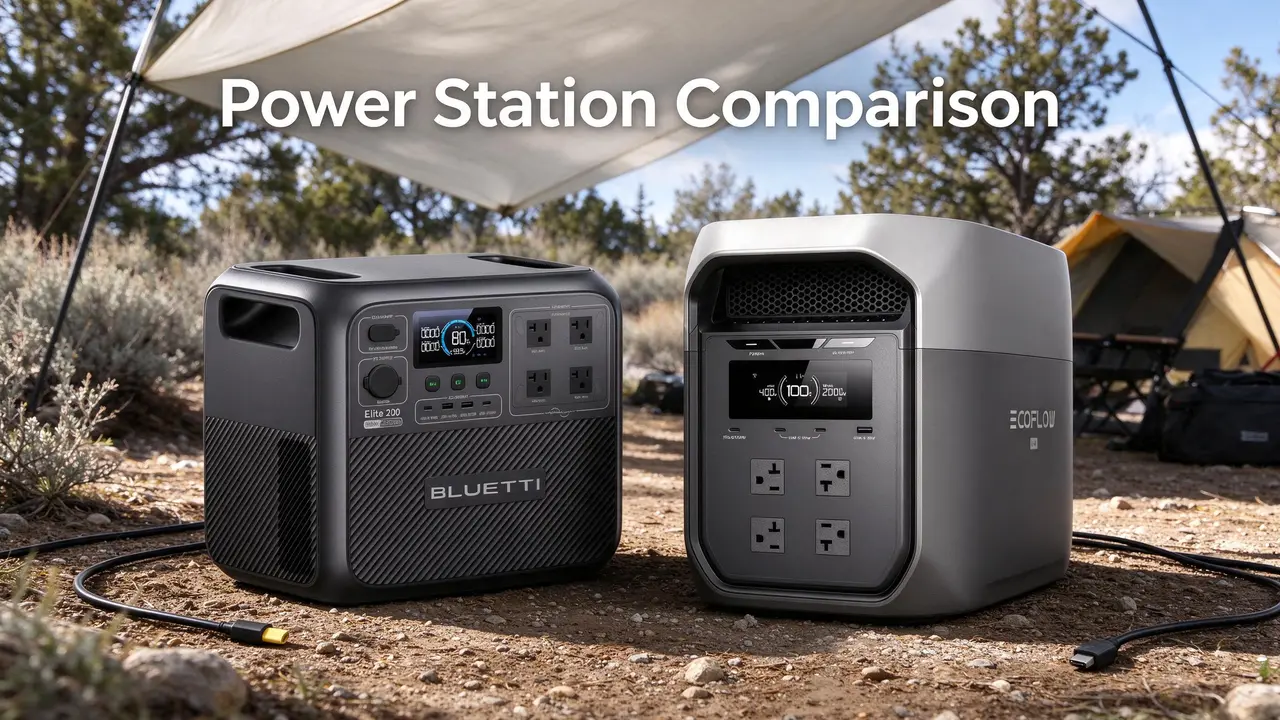
At list price these two land in the same budget bracket, but they are not the same tool. The BLUETTI Elite 200 V2 leans toward value and output: more continuous watts, a lower nameplate cost per Wh, and a body that owners describe as surprisingly compact for its capacity. The EcoFlow DELTA 3 Max leans toward speed and ecosystem: faster AC recharge, a ~10ms transfer time for UPS duty, and an app that owners actually use.
This is not a page for someone who needs a 3,000Wh whole-home solution or a sub-20 lb camping cube. Both units sit in the 2kWh class, both use LiFePO4, and both will run a fridge or a CPAP. The decision comes down to which trade-off you can live with: BLUETTI's heavier build and missing charge-limit controls, or EcoFlow's higher price and 100W USB ceiling.
I'm Avery Nolan, founding editor at WattPicks. My checks here are home-user style, grounded in owner themes on file and listing specs — not lab-bench measurements. Owner themes are drawn from forum and retail reviews on file; they are not independently measured tests. As an Amazon Associate, WattPicks earns from qualifying purchases. Picks are fit-led, not commission-led: commission differences between these two products were set aside when choosing the pick logic; the deciding factors are the specs and owner themes below.
- BLUETTI bet: 2600W continuous, $0.43/Wh nameplate, 53.4 lb — output and value over portability.
- EcoFlow bet: 2400W continuous, $0.59/Wh nameplate, 44.8 lb — speed and app control over raw wattage.
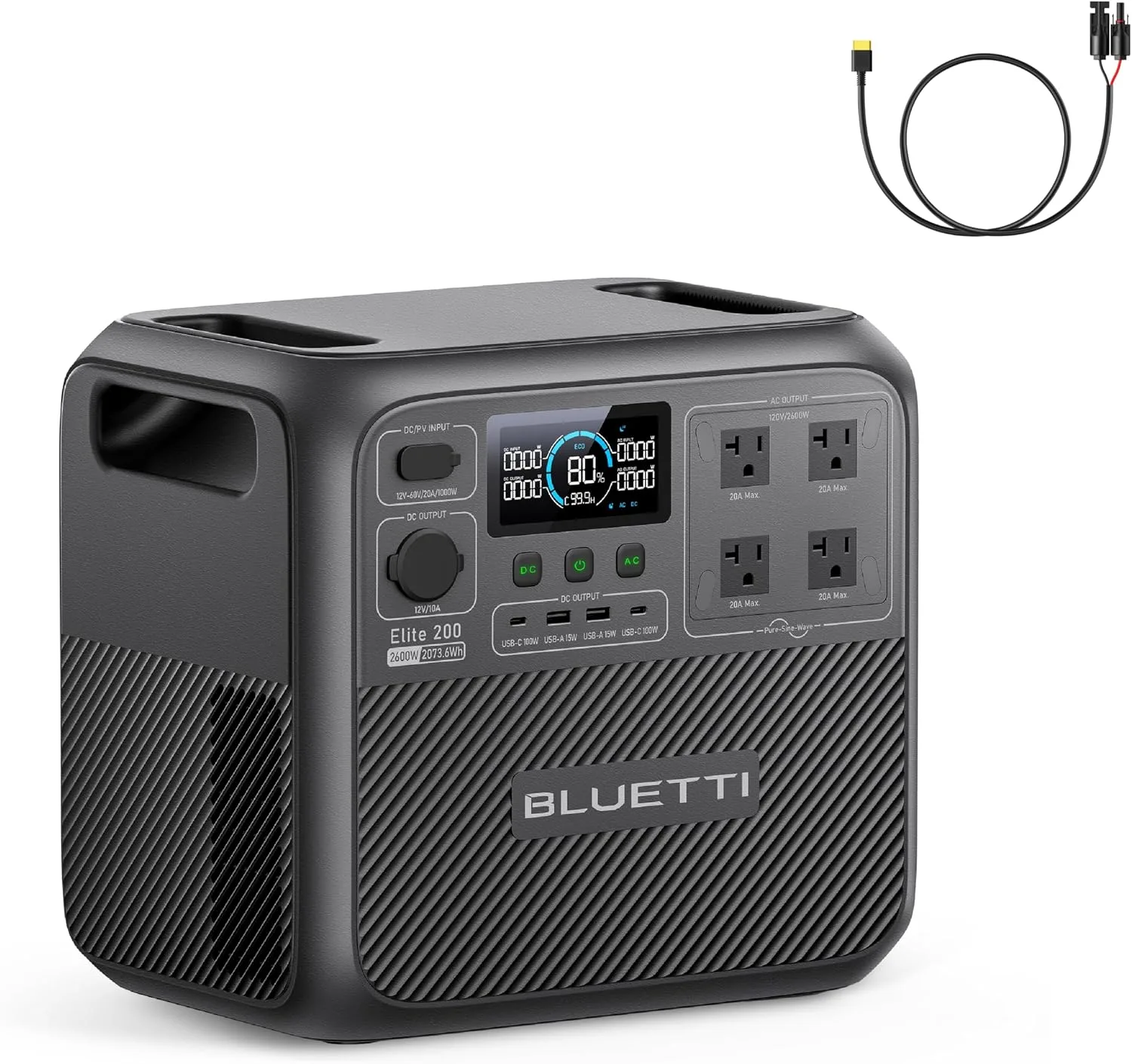
BLUETTI Elite 200 V2
Highlights
- 2074Wh rated capacity
- 2600W continuous AC
- LiFePO4 chemistry
- Up to 1000W solar input
- 53.4 lb (~24.2 kg)
- About $899 list
Best for
- Elite 200 V2: longer outages or higher continuous loads (still not whole-home wiring)
- RV / off-grid days where recharge speed matters as much as Wh
- Best parked near the vehicle or cabin — not a long carry to a tent
Strengths
- Elite 200 V2: 2600W continuous on a 2074Wh pack — more headroom for small appliances than 1kW-class peers
- 53.4 lb (~24.2 kg) is a park-and-use chassis — plan a short path, not a trail hike
- 2600W continuous headroom covers more small appliances than 1kW-class inverters
- About $899 list in the Hub catalog — confirm live retail before you buy
Watch-outs · not ideal when
- At 53.4 lb (~24.2 kg), Elite 200 V2 is a poor tent-hike companion — plan a cart or leave it in the vehicle
- High continuous output on Elite 200 V2 tempts big loads — Wh still runs out on kettles and A/C
- Rated 1000W solar on Elite 200 V2 is optimistic; shade and cables cut real watts
- LiFePO4 helps longevity, but Elite 200 V2 still hates freezing charge temps on winter trips
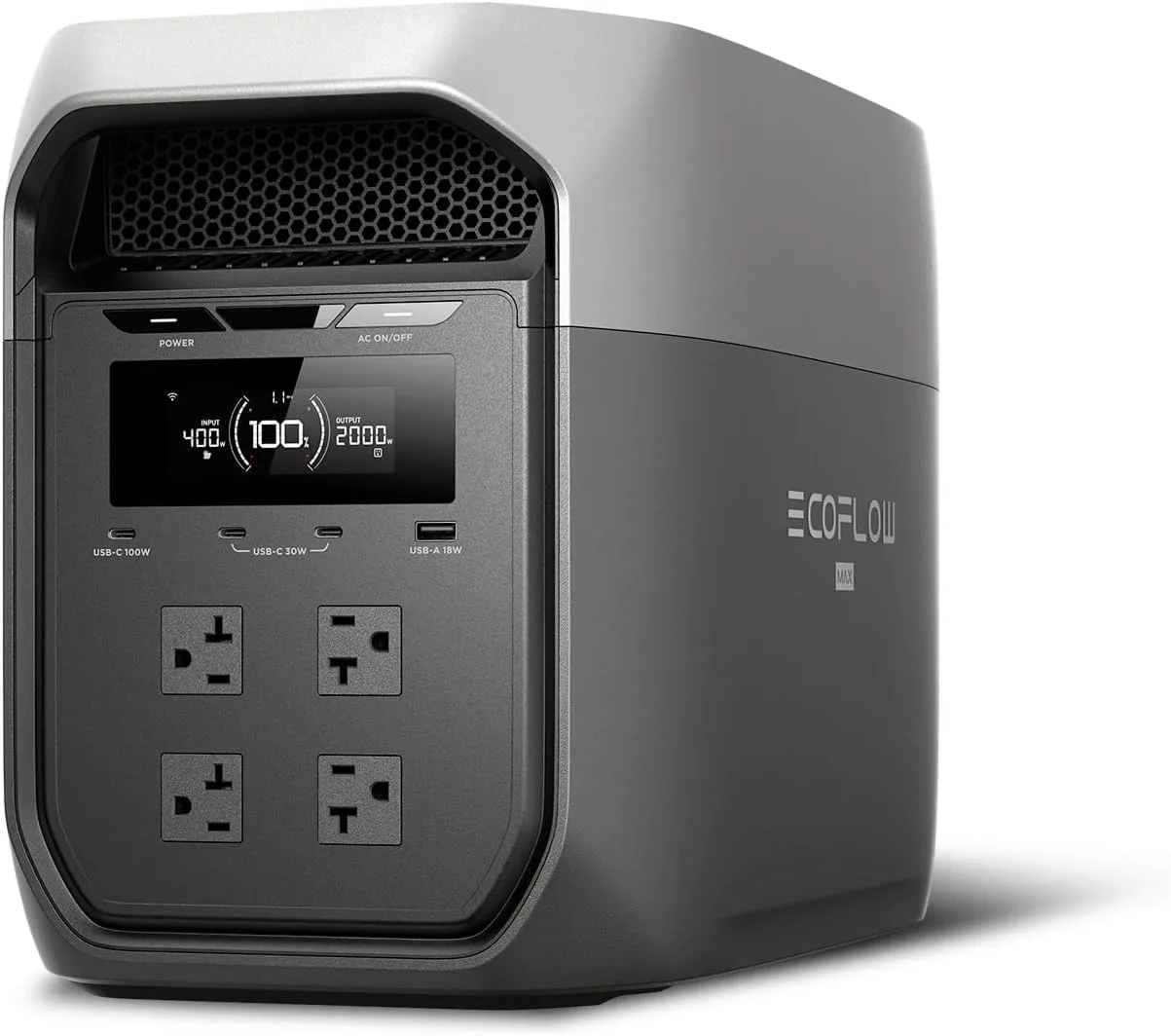
EcoFlow DELTA 3 Max Portable Power Station, 2048Wh LFP Battery
Highlights
- 2048Wh rated capacity
- 2400W continuous AC
- 4800W surge
- LiFePO4 chemistry
- Up to 500W solar input
- 44.8 lb (~20.3 kg)
Best for
- DELTA 3 Max: longer outages or higher continuous loads (still not whole-home wiring)
- RV / off-grid days where recharge speed matters as much as Wh
- Best parked near the vehicle or cabin — not a long carry to a tent
Strengths
- DELTA 3 Max: 2048Wh pack with 2400W continuous / 4800W surge — size loads to both numbers
- 44.8 lb (~20.3 kg) is a park-and-use chassis — plan a short path, not a trail hike
- 10ms-class UPS switchover on the listing — useful when a router restart would hurt
- About $1199 list in the Hub catalog — confirm live retail before you buy
Watch-outs · not ideal when
- At 44.8 lb (~20.3 kg), DELTA 3 Max is a poor tent-hike companion — plan a cart or leave it in the vehicle
- High continuous output on DELTA 3 Max tempts big loads — Wh still runs out on kettles and A/C
- Rated 500W solar on DELTA 3 Max is optimistic; shade and cables cut real watts
- LiFePO4 helps longevity, but DELTA 3 Max still hates freezing charge temps on winter trips
Spec snapshot
Prices are list prices from the WattPicks catalogue; ratings are listing aggregates, not owner proof. Weight is in pounds. Where a spec is not on file, it reads n/a.
| Product | List price | Capacity (Wh) | Output (W) | Weight (lb) | Rating |
|---|---|---|---|---|---|
| BLUETTI Elite 200 V2 | $899 | 2074 Wh | 2600 W | 53.4 lb | 5.00 |
| EcoFlow DELTA 3 Max Portable Power Station, 2048Wh LFP Battery | $1,199 | 2048 Wh | 2400 W | 44.8 lb | 5.00 |
Where the money went
Four configuration differences explain most of the $300 gap. First, continuous output: BLUETTI rates the Elite 200 V2 at 2600W, EcoFlow rates the DELTA 3 Max at 2400W. That 200W edge matters if you run a microwave and a coffee maker on the same circuit, though both units have a surge mode that owners mention for motor starts.
Second, charging speed. EcoFlow's X-Stream gets the DELTA 3 Max from 0–80% in about 1.13 hours on AC per the listing; BLUETTI claims 0–80% in 50 minutes with dual AC+DC charging, or a full charge in 2 hours on AC alone. To compare like for like, look at AC-only: EcoFlow's ~1.13 hr to 80% versus BLUETTI's 2 hr to full on AC. BLUETTI's 50-minute figure requires simultaneous AC and DC input, so it is not an AC-only number. Owners on both sides describe recharge as fast enough to recover from an outage in an afternoon, but EcoFlow's app-based scheduling is the more polished experience.
Third, UPS behavior. EcoFlow publishes a ~10ms transfer time, and owners use it as a desk UPS for PCs and routers. BLUETTI owners also report seamless UPS use, but the listing does not publish a transfer-time figure — treat that as n/a (not on file) rather than a win for either side.
Fourth, ports and app. EcoFlow lists AC×4, USB-C×1, and USB-A×1, plus the EcoFlow app with storm guard. BLUETTI lists AC×4; USB-C and USB-A counts are not on file, so I won't claim absence. BLUETTI owners do mention an app with charge-level settings, but the solar charge-limit gap is a repeated caveat. Bottom line on ports and app: EcoFlow wins on documented port count and app polish; BLUETTI's port situation is simply not on file, so don't treat that as a loss — just an unknown.
- Output: 2600W (BLUETTI) vs 2400W (EcoFlow) — BLUETTI wins on headroom for simultaneous cooking loads.
- Recharge (AC-only): EcoFlow 0–80% in ~1.13 hr; BLUETTI 2 hr to full on AC. BLUETTI's 50-min figure is dual AC+DC, not AC-only.
- UPS: EcoFlow publishes ~10ms; BLUETTI transfer time n/a (not on file).
- App: EcoFlow app + storm guard is a repeated owner positive; BLUETTI app exists but solar SoC limits are missing.
The spec that decides it
For most buyers, the deciding number is weight. The DELTA 3 Max is 44.8 lb; the Elite 200 V2 is 53.4 lb. That 8.6 lb gap is the difference between one-person carry and a two-hand lift for stairs, and owners on both sides mention weight as a real factor. If the station lives in a garage or on a cart, BLUETTI's extra output wins. If it moves between rooms, vehicles, or campsites, EcoFlow's lighter body is the practical pick.
The second deciding spec is nameplate cost per Wh. BLUETTI is $0.43/Wh; EcoFlow is $0.59/Wh. That is not a lab-measured usable-energy comparison — it is list price divided by listed capacity. On that basis, BLUETTI is the cheaper way to buy 2kWh, and the gap is large enough to fund a solar panel or two.
- Buy BLUETTI if the station stays put and you want maximum continuous watts per dollar.
- Buy EcoFlow if you will carry it weekly and value the lighter body plus app control.
RV and campsite scenario
RV and campsite duty adds one question the weight/output trade-off doesn't answer: how you'll recharge off-grid. Neither unit includes solar panels, so budget for a panel separately if that's the plan. And check the cold-weather caveat below before you rely on either one for a winter trip.
Real owner trade-offs
BLUETTI owners praise the capacity-to-size ratio and the cooking-load headroom — one ran toast and coffee together, another ran an electric pressure cooker alongside an air fryer. The repeated caveat is solar charging behavior: without user-settable state-of-charge limits, the pack can sit near 100% all afternoon when PV input exceeds load, which undercuts the long cycle-life claim. On fridge runtime, an owner test on file found a full-size fridge ran closer to 17 hours than the advertised 35 — that is an owner-reported result, not a lab measurement, and the gap likely reflects a fuller fridge, a hotter room, or a different duty cycle than the advertised test. Plan conservation cycles for multi-day outages.
EcoFlow owners consistently cite fast recharge and the ~10ms UPS transfer. One owner theme on file describes keeping a PC, modem, and routers online through a pulled-plug test; another owner theme describes running a 36°F portable fridge for a little over five days on one charge. The common complaint is the 100W USB output ceiling — owners want a 140W USB-C port for faster laptop charging. Runtime is also load-dependent: one owner theme on file measured roughly six hours at heavy draw.
- BLUETTI owner theme: great for cooking loads and UPS duty; solar SoC limits and fridge runtime are the honest gaps.
- EcoFlow owner theme: fast recharge and app control are the wins; USB-C wattage and heavy-load runtime are the limits.
Cold weather, expansion, and noise
Three more anxiety points worth checking before you buy. Cold-weather capacity loss: LiFePO4 packs lose usable capacity in freezing temperatures, and neither listing publishes a cold-weather derating curve, so treat winter capacity as n/a (not on file) for both. If you plan to leave the station in an unheated garage or RV, expect less usable energy than the nameplate and keep the unit above freezing where possible.
Expansion battery cost: neither listing on file shows a first-party expansion battery price, so I can't compare that path — if you need more than 2kWh later, price the expansion option for each brand before you commit. Noise under load: neither listing publishes a fan-noise figure in dB, so that is also n/a (not on file). Owners on both sides mention fan noise during heavy draw, but without a published number it's not a deciding spec.
Who should not buy either
Skip both if you need more than 2kWh for whole-home backup, a sub-30 lb camping cube, or published cold-weather derating curves to size a winter system. Also skip if you require first-party expansion battery pricing before you commit — neither listing on file shows it. Before purchase, verify the current price, the AC-only recharge time, and whether the app exposes solar charge limits on the unit you're considering.
Scenario-to-metric guide
Match your main use case to the spec that should drive the decision.
| Use case | Deciding metric | Pick |
|---|---|---|
| Garage or cabin backup (station stays put) | Continuous output and $/Wh | BLUETTI Elite 200 V2 |
| RV or campsite (carried weekly) | Weight and app control | EcoFlow DELTA 3 Max |
| Desk UPS for PC and router | Published transfer time | EcoFlow DELTA 3 Max (BLUETTI transfer time n/a) |
Buy the one that…
…keeps its feet on the floor and runs high-wattage appliances: the BLUETTI Elite 200 V2. Its 2600W continuous output and $0.43/Wh nameplate make it the better value for a garage, cabin, or tailgate setup where weight is not the enemy. Skip it if you need fine-grained solar charge limits out of the box or expect a full-size fridge to coast for a day and a half without conservation.
…moves with you and needs to be back online fast: the EcoFlow DELTA 3 Max. The 44.8 lb body, ~10ms UPS transfer, and app-based storm guard make it the easier station to live with daily. Skip it if your workflow depends on high-wattage USB-C charging or you need the lowest possible cost per Wh — the BLUETTI is cheaper on that measure.
- Walk away from both if you need more than 2kWh for whole-home backup or a sub-30 lb camping cube.
- Neither unit includes solar panels; budget for a panel separately if off-grid charging is the plan.
Frequently asked
Can the BLUETTI Elite 200 V2 run a full-size refrigerator overnight?
An owner test on file reports closer to 17 hours than the advertised 35 on a full-size fridge, so overnight is realistic but a full day is not without conservation cycles or extra solar. That is an owner-reported result, not a lab measurement.
Which is cheaper per Wh?
On nameplate list price, the BLUETTI Elite 200 V2 is $0.43/Wh versus $0.59/Wh for the EcoFlow DELTA 3 Max. That is list price divided by listed capacity, not a usable-energy measurement.
Can either unit act as a UPS?
EcoFlow publishes a ~10ms transfer time and owners use it for PCs and routers. BLUETTI owners also report seamless UPS use, but the transfer time is n/a (not on file).
How do these handle cold weather?
Neither listing publishes a cold-weather derating curve, so winter capacity is n/a (not on file) for both. Expect less usable energy below freezing and keep the unit above freezing where possible.
Method and sources
Model names and list prices come from the WattPicks catalog at build time. WattPicks does not run its own laboratory tests on power stations, and nothing on this page is presented as a measured result — it is catalog-backed buying guidance.
Read our methodology for how the catalog is normalized, and about WattPicks for who publishes it.