
BLUETTI Elite 100 V2 vs EcoFlow DELTA 3: 1024Wh Duel
Two 1,024 Wh stations, same 1,800 W output, but $200 apart. One bets on fast recharge and a readable display; the other on port count and a lower list price. Here's which fits your outage or campsite.
Updated
At a glance
Two 1,024 Wh stations, same 1,800 W output, but $200 apart. One bets on fast recharge and a readable display; the other on port count and a lower list price. Here's which fits your outage or campsite.
- BLUETTI Elite 100 V2: $899 list, 1,024 Wh, 1,800 W, 25 lb, 4.5 listing aggregate (1,839 ratings).
- EcoFlow DELTA 3: $699 list, 1,024 Wh, 1,800 W, 27.6 lb, 4.7 listing aggregate (1,386 ratings).
- List prices above are the figures used throughout this comparison; any lower prices seen elsewhere are sale events, not the basis for the $/Wh math here.
Same money? Not quite — and the bets differ
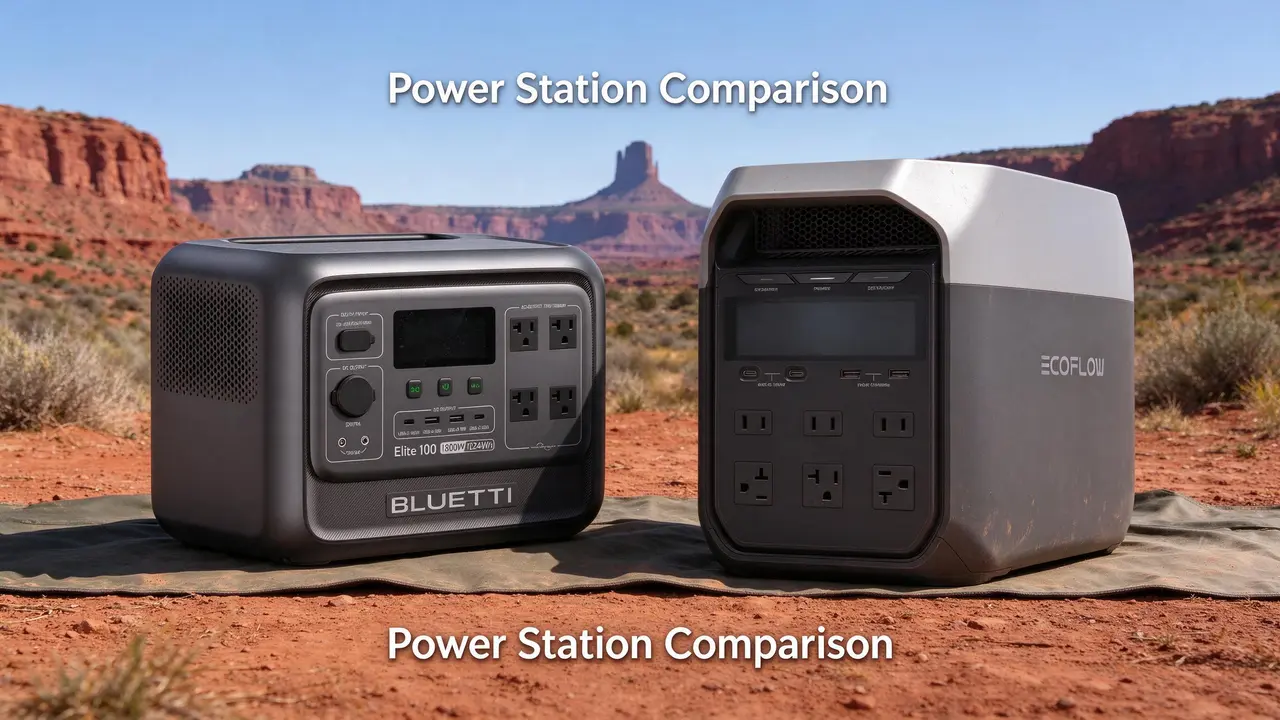
At list, the EcoFlow DELTA 3 is $699 and the BLUETTI Elite 100 V2 is $899. Both are 1,024 Wh units with 1,800 W continuous AC output, so the $200 gap buys you configuration choices, not raw capacity. The BLUETTI bets on recharge speed and a side-mounted live display; the EcoFlow bets on port count, a lower entry price, and expandability.
This is not a whole-home backup comparison. Neither unit will run a central AC or an electric range for long. It's a fit question for camping, van life, outage backup for a fridge and router, and remote work — where 1,024 Wh is enough for a night of small loads, not a weekend of high-draw appliances.
For the median buyer — someone who wants a fridge, router, and a few devices to ride out a short outage or a weekend trip — the EcoFlow DELTA 3 is the default pick: it costs $200 less, publishes a full port map, and lists a battery-expansion path. Choose the BLUETTI only if fast recharge or the side display is a must-have.
- BLUETTI Elite 100 V2: $899 list, 1,024 Wh, 1,800 W, 25 lb, 4.5 listing aggregate (1,839 ratings).
- EcoFlow DELTA 3: $699 list, 1,024 Wh, 1,800 W, 27.6 lb, 4.7 listing aggregate (1,386 ratings).
- List prices above are the figures used throughout this comparison; any lower prices seen elsewhere are sale events, not the basis for the $/Wh math here.
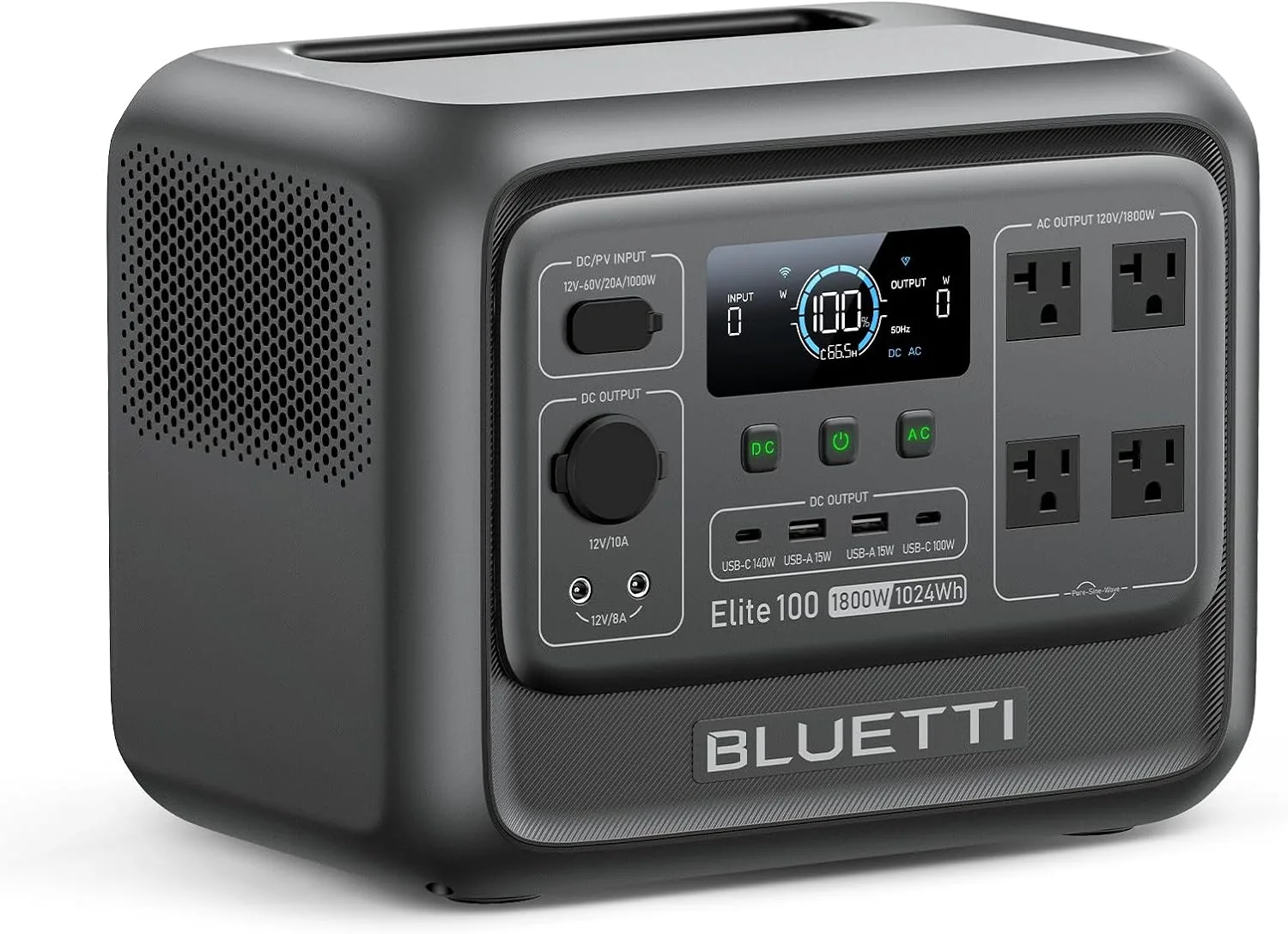
BLUETTI Elite 100 V2
Highlights
- 1024Wh rated capacity
- 1800W continuous AC
- LiFePO4 chemistry
- Up to 1000W solar input
- 25 lb (~11.3 kg)
- About $899 list
Best for
- Elite 100 V2: weekend camping when 25 lb carry weight matters as much as 1024Wh
- Essentials bridge at home (fridge cycles, router) when sized to the Wh
- Solar top-ups up to ~1000W when panels and weather cooperate
Strengths
- Elite 100 V2: 1800W continuous on a 1024Wh pack — more headroom for small appliances than 1kW-class peers
- 25 lb (~11.3 kg) is the lightest-class carry in this band — easier stairs and car packing
- 10ms-class UPS switchover on the listing — useful when a router restart would hurt
- About $899 list in the Hub catalog — confirm live retail before you buy
Watch-outs · not ideal when
- Elite 100 V2 is still a bridge for essentials — not a transfer-switch whole-home system
- Usable energy on Elite 100 V2 is below the 1024Wh label once the inverter is working
- Rated 1000W solar on Elite 100 V2 is optimistic; shade and cables cut real watts
- LiFePO4 helps longevity, but Elite 100 V2 still hates freezing charge temps on winter trips
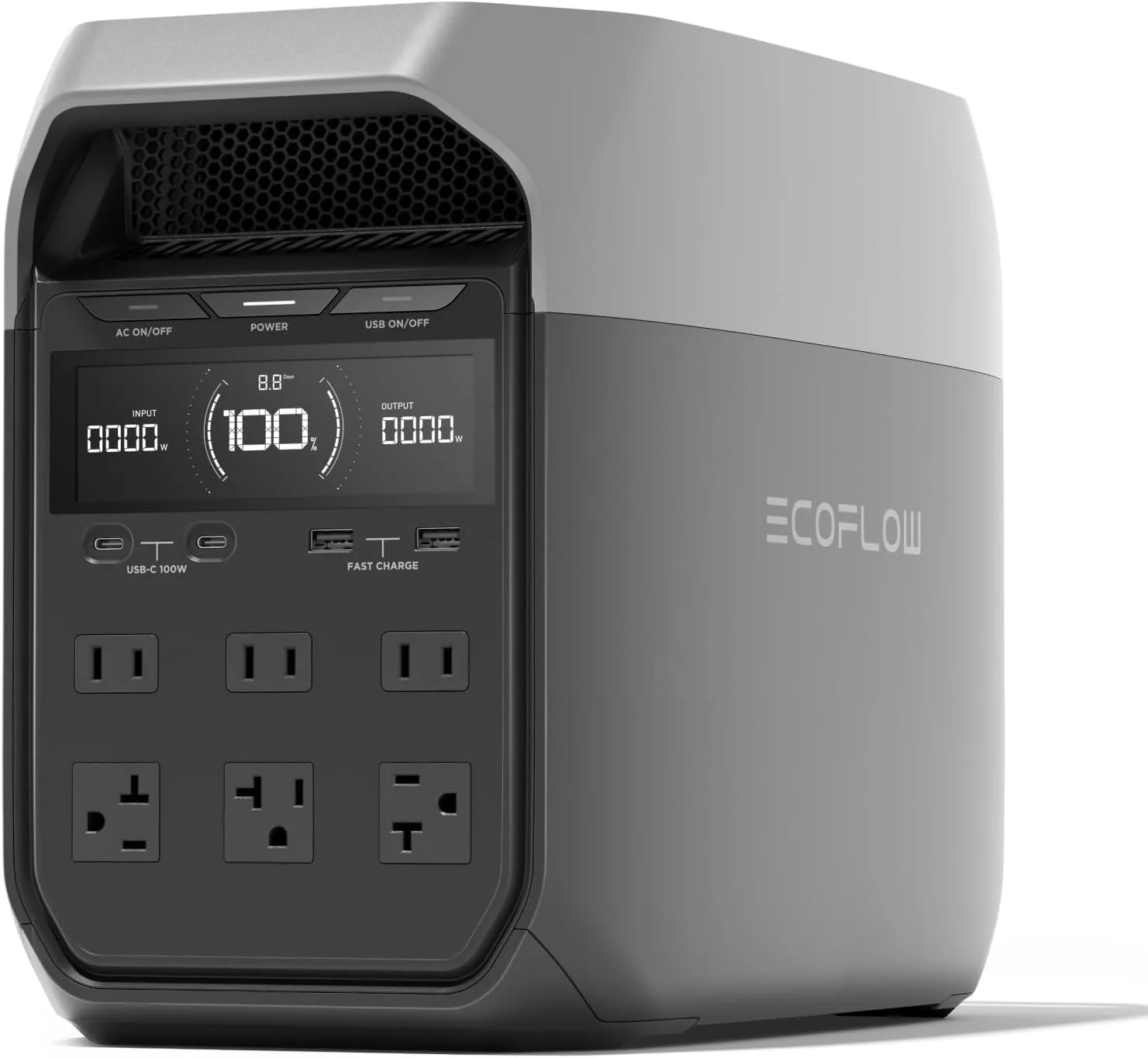
EcoFlow DELTA 3
Highlights
- 1024Wh rated capacity
- 1800W continuous AC
- 3600W surge
- LiFePO4 chemistry
- Up to 500W solar input
- 27.6 lb (~12.5 kg)
Best for
- DELTA 3: small appliances and tools that need ~1800W continuous, not just phone charging
- Essentials bridge at home (fridge cycles, router) when sized to the Wh
- Solar top-ups up to ~500W when panels and weather cooperate
Strengths
- DELTA 3: 1024Wh pack with 1800W continuous / 3600W surge — size loads to both numbers
- 27.6 lb (~12.5 kg) sits in the solo car-camp carry carry band for weekend moves
- 10ms-class UPS switchover on the listing — useful when a router restart would hurt
- About $699 list in the Hub catalog — confirm live retail before you buy
Watch-outs · not ideal when
- DELTA 3 is still a bridge for essentials — not a transfer-switch whole-home system
- Usable energy on DELTA 3 is below the 1024Wh label once the inverter is working
- Rated 500W solar on DELTA 3 is optimistic; shade and cables cut real watts
- LiFePO4 helps longevity, but DELTA 3 still hates freezing charge temps on winter trips
Method and disclosure
This comparison uses listing specs and owner themes from Amazon review packs on file. It is not a lab-bench measurement, and no instrumented re-test was run. Star averages are listing aggregates, not owner proof. As an Amazon Associate, WattPicks earns from qualifying purchases; picks here are fit-led, not commission-led.
Avery Nolan is the WattPicks founding editor covering portable power station capacity, output, and price-per-Wh guidance across the catalogue — no lab claims.
Owner-review sample: the themes below are drawn from the review packs on file for each listing at the time of writing; exact sample sizes and dates are not published here, so treat them as directional patterns rather than a statistically weighted survey. The High/Med scoreboard is a simple fit weighting, not a verdict: High means the published spec clearly matches a common job (list price, capacity, continuous watts, or ports); Med means the spec is adequate but not the unit's strength. BLUETTI Elite 100 V2 (list $899): High where list price and published capacity match the job, Med on continuous watts. EcoFlow DELTA 3 (list $699): High on continuous watts and ports, Med on price. That is why the pick splits by job rather than one universal winner.
Spec snapshot: what the listings say
Both units share the same headline capacity and continuous output. The differences that matter are weight, price, and ports. The BLUETTI listing does not specify USB-C or USB-A counts, so those cells are n/a (not on file) rather than assumed absent.
| Product | List price | Capacity (Wh) | Output (W) | Weight (lb) | Rating |
|---|---|---|---|---|---|
| BLUETTI Elite 100 V2 | $899 | 1024 Wh | 1800 W | 25 lb | 5.00 |
| EcoFlow DELTA 3 | $699 | 1024 Wh | 1800 W | 27.6 lb | 5.00 |
Where the money went: four configuration calls
Port count is the clearest split. The EcoFlow listing specifies AC×6, USB-C×2, USB-A×2, and a car port. The BLUETTI listing specifies AC×4, with USB-C and USB-A counts not on file. If you're charging a family's worth of phones, tablets, and a laptop while running a fridge, the EcoFlow's published port map is easier to plan around.
Recharge speed is the BLUETTI's counterpunch. Its listing advertises 80% in roughly 45 minutes on 1,200 W TurboBoost AC charging. The EcoFlow listing advertises a full charge in 56 minutes on 1,500 W max AC input, with 80% in 30 minutes. On paper these are close; in owner notes, both brands' fast-charging claims are the most repeated positive theme.
Weight goes to the BLUETTI at 25 lb versus 27.6 lb — a 2.6 lb difference that matters if you're carrying it from van to campsite. The EcoFlow's extra weight buys the larger port array and a published expansion path up to 5 kWh with DELTA 3 / DELTA Pro 3 / DELTA 2 Max battery packs.
Price per nameplate Wh favors the EcoFlow at $0.68/Wh versus $0.88/Wh for the BLUETTI. That's the only $/Wh claim this article makes; usable-Wh math would require the same discharge assumptions for both, which the listings don't provide.
Warranty and returns: neither listing's warranty length or return window is on file here, so check the current product page before buying — don't assume a multi-year warranty from either brand. Fan noise is also not published as a dB figure for either unit; owner notes mention cooling fans cycling under load on both, so plan for some audible fan noise during fast charging or high-draw use.
- Ports: EcoFlow publishes AC×6, USB-C×2, USB-A×2, car×1; BLUETTI publishes AC×4 with USB counts n/a (not on file).
- Recharge: BLUETTI advertises 80% in ~45 min on 1,200 W AC; EcoFlow advertises full in 56 min on 1,500 W AC.
- Weight: BLUETTI 25 lb vs EcoFlow 27.6 lb.
- Expansion: EcoFlow lists battery expansion to 5 kWh; BLUETTI listing does not state an expansion path.
The spec that decides it: ports vs. recharge speed
For most buyers, the deciding difference is whether you need more outlets or faster top-ups. The EcoFlow's six AC outlets and published USB-C/USB-A counts make it the easier unit to live with when several people are charging at once. The BLUETTI's 45-minute 80% claim is the better fit if your pattern is: arrive, plug in, and need the station ready before the next session.
Neither listing publishes a surge rating, so this comparison stays on continuous 1,800 W. That's enough for a fridge (typically 100–200 W running), a CPAP (30–60 W), a router and modem (15–30 W), and a laptop (45–100 W) — not for a space heater or microwave for long stretches. The BLUETTI's Power Lifting mode is a surge-like feature for resistive loads, but owner notes describe it as minutes, not hours.
Owner trade-offs: what long-term users report
The BLUETTI notes skew toward musicians and remote-imaging trips — the buyer profile that benefits most from the fast-recharge and side-display combo. One owner ran a 100 W guitar amp and pedalboard for about eight hours and dropped only to roughly 59%, with the display showing ~30 W AC draw. Another powered a full astrophotography rig at ~34–60 W for a 6.5–8 hour night session. The caveats are at the DC end: the 12 V outlet runs warm above ~12 W, the small round DC sockets are easy to short, and a cooling-fan error flashed once on first solar hookup before clearing.
The EcoFlow notes skew toward van life and outage backup. One long-term van owner cycled from ~2% to full every five to eight days for over a year without failure, though the unit now stops at 99%. Another ran an electric blanket all night plus a fan and charged five devices simultaneously. A third used it as a sump pump backup for about 8 hours. The recurring caveat is capacity: it's a step up from a small station, not a whole-home solution, and runtime swings widely with the load.
- BLUETTI owner theme: fast recharge and a readable side display are the most-praised features; DC outlet heat and DC5521 short risk are the repeated gripes.
- EcoFlow owner theme: all-night small loads and mixed-device charging hold up; the 99% charge ceiling after a year is a minor long-term note.
- Both: listing star averages are aggregates, not proof of owner consensus.
Buy the one that…
Buy the EcoFlow DELTA 3 if you need more outlets, a lower list price, and a published expansion path — and if your loads are overnight small appliances, a fridge, a router, or a sump pump. Skip it if you need to run high-draw heating or large appliances for many hours; size up or plan to add batteries.
Buy the BLUETTI Elite 100 V2 if recharge speed and a live side-mounted display matter more than port count, and if you'll respect the DC outlet limits. Skip it if you want the lowest list price per nameplate Wh, or if you need a station you can leave depleted and grab in a hurry — charging takes real time on both, but the BLUETTI's fast-charge claim is its main selling point, not a guarantee for every mode.
Frequently asked
Can either run a fridge overnight?
Yes, on the owner evidence: the EcoFlow notes include a large portable fridge for 24 hours, and the BLUETTI notes include a 12 V fridge scenario on a smaller sibling. At 1,024 Wh, a typical fridge at 100–200 W running draw gives roughly 5–10 hours of compressor cycling, so overnight is realistic but not multi-day.
Which is better for CPAP?
Both list 1,800 W continuous, far above a CPAP's 30–60 W. The BLUETTI notes mention CPAP as a use case; the EcoFlow notes don't call it out specifically. Either works; the EcoFlow's extra AC outlets make it easier to add a phone and fan on the same unit.
Do I need a transfer switch for home backup?
For either unit, yes if you want to feed a house circuit safely. Neither listing includes a transfer switch, and neither is a substitute for a smart panel or interlock kit. This article compares portable use, not whole-home wiring.
What's missing from the listings?
Surge ratings, USB-C/USB-A counts for the BLUETTI, and usable-Wh figures for both are n/a (not on file). Don't assume absence — just don't plan around unpublished numbers.
Method and sources
Model names and list prices come from the WattPicks catalog at build time. WattPicks does not run its own laboratory tests on power stations, and nothing on this page is presented as a measured result — it is catalog-backed buying guidance.
Read our methodology for how the catalog is normalized, and about WattPicks for who publishes it.