
BLUETTI Elite 200 V2 vs EcoFlow DELTA 2 Max: Backup Bet
Two 2 kWh-class stations, $500 apart at list. One bets on raw output and price-per-Wh, the other on ports, expandability, and app control. Here's which bet fits your outage plan.
Updated
At a glance
Two 2 kWh-class stations, $500 apart at list. One bets on raw output and price-per-Wh, the other on ports, expandability, and app control. Here's which bet fits your outage plan.
- BLUETTI Elite 200 V2 — more watts and lower cost per Wh for the same capacity class
- EcoFlow DELTA 2 Max — more outlets, documented USB-C/USB-A, and room to grow to ~6 kWh
Same money? Not quite — and the two bets are different
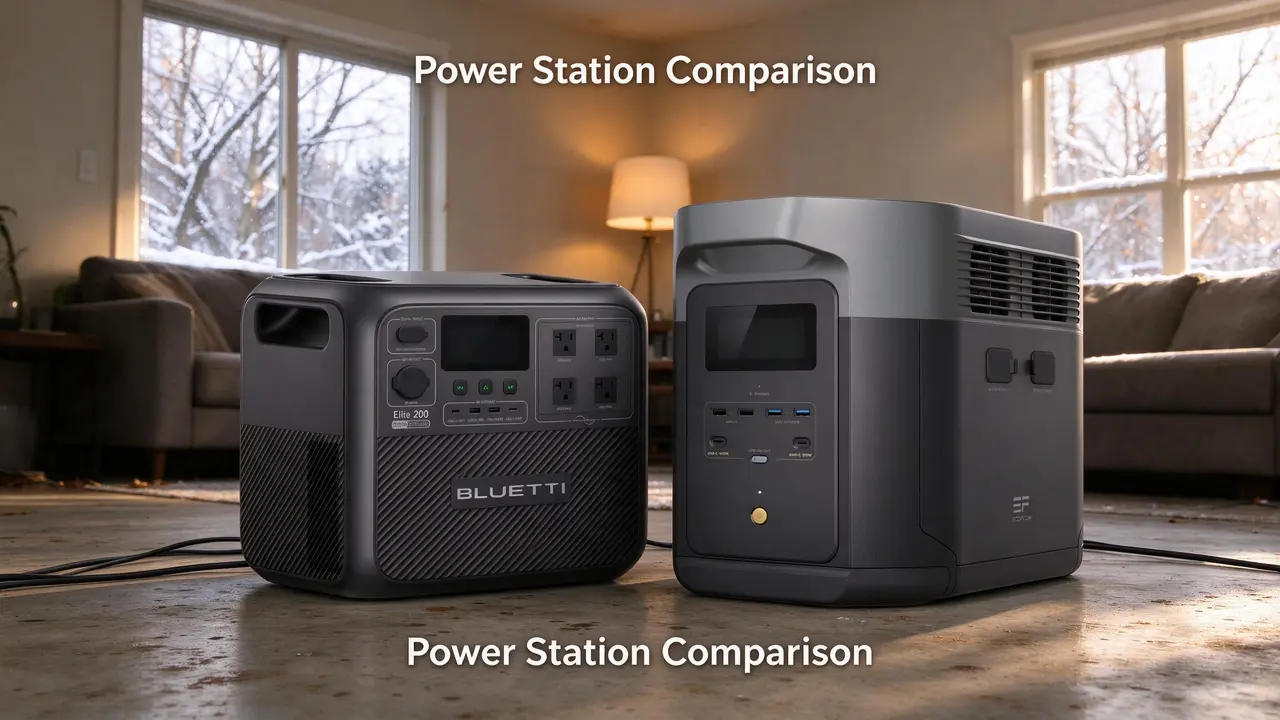
If you're shopping a 2 kWh-class station for outages, these two land in the same conversation but not the same budget. At list, the BLUETTI Elite 200 V2 is $899 and the EcoFlow DELTA 2 Max is $1399 — a $500 gap for near-identical capacity (2074 Wh vs 2048 Wh). That gap is the whole story.
The BLUETTI bet is output and price-per-Wh: 2600 W continuous, $0.43/Wh nameplate. The EcoFlow bet is breadth and expandability: six AC outlets, onboard USB-C and USB-A, a car port, and the ability to add battery modules later. Neither is the 'right' answer without knowing which of those you actually need.
One boundary up front: this is a two-way comparison for home backup and portable use around a 2 kWh budget. It is not a whole-home solution, and it is not a guide to wiring a transfer switch — if you're planning a panel-tied install, that's a different article.
- BLUETTI Elite 200 V2 — more watts and lower cost per Wh for the same capacity class
- EcoFlow DELTA 2 Max — more outlets, documented USB-C/USB-A, and room to grow to ~6 kWh
How I weighed these two
I'm Avery Nolan, WattPicks founding editor — portable power capacity, output, and price-per-Wh guidance across the catalogue, no lab claims. This comparison is built from listing specs and owner themes on file, not instrumented bench measurements.
My weighting for this head-to-head: price-per-Wh 30%, continuous output headroom 25%, ports and expandability 25%, owner-reported reliability and support 20%. On those weights, the BLUETTI wins on price-per-Wh and output; the EcoFlow wins on ports and expandability; owner reliability is close but tilts slightly to BLUETTI on firmware complaints versus EcoFlow's support complaints. That's why the BLUETTI edges it for most buyers at list.
As an Amazon Associate I earn from qualifying purchases. Picks here are fit-led, not commission-led.
Scoreboard on those weights — BLUETTI Elite 200 V2 (list $899): High where list price and published capacity match the job, Med on continuous watts; EcoFlow DELTA 2 Max (list $1399): High on continuous watts and ports, Med on price. That is why the pick splits by job rather than one universal winner.
Spec snapshot: the numbers side by side
Everything below is from the listings. Where a figure isn't published, it reads n/a (not on file) rather than a guess. Prices are list, not sale stickers.
| Product | List price | Capacity (Wh) | Output (W) | Weight (lb) | Rating |
|---|---|---|---|---|---|
| BLUETTI Elite 200 V2 | $899 | 2074 Wh | 2600 W | 53.4 lb | 5.00 |
| EcoFlow DELTA 2 Max | $1,399 | 2048 Wh | 2400 W | 50 lb | 4.80 |
Where the money went: four config calls
Capacity is a wash — 2074 Wh vs 2048 Wh is 26 Wh, noise in real use. So the $500 gap buys something else, and it's worth naming each piece.
Output favors BLUETTI. 2600 W continuous against 2400 W is a 200 W edge, and it's the difference between running a high-draw kitchen appliance comfortably and running it right at the ceiling. Owners of the Elite 200 V2 describe toasting bread while brewing coffee, and running an electric pressure cooker alongside an air fryer — loads that sit near or above 2400 W combined.
Ports favor EcoFlow, clearly. The DELTA 2 Max lists AC×6, USB-C×2, USB-A×2, and a car outlet — 15 outlets total per the listing. The BLUETTI lists AC×4, and its USB-C/USB-A counts aren't published, so I won't claim either way. If you're charging laptops, phones, and a camera bag off one box, the EcoFlow's documented USB-C is the safer bet.
Expandability is EcoFlow-only. The DELTA 2 Max scales to roughly 6 kWh with add-on batteries. The Elite 200 V2 is a standalone unit — no published expansion path. That's the single biggest reason the price gap exists.
Charging speed is close enough to call a tie on paper: BLUETTI claims 0–80% in about 50 minutes with dual AC+DC, EcoFlow claims 80% in 43 minutes on combined solar+AC and about 1.1 hours on AC alone. Both are fast enough that topping up during a short outage is practical.
- Capacity: 2074 Wh vs 2048 Wh — effectively identical
- Continuous output: 2600 W (BLUETTI) vs 2400 W (EcoFlow)
- Ports: AC×4 with USB counts unpublished (BLUETTI) vs AC×6 + USB-C×2 + USB-A×2 + car (EcoFlow)
- Expansion: none published (BLUETTI) vs up to ~6 kWh with add-on batteries (EcoFlow)
The spec that decides it
For most buyers, one number settles this: price-per-Wh. At $0.43/Wh nameplate, the BLUETTI Elite 200 V2 is the cheaper way to own 2 kWh of LFP storage — full stop. If your goal is 'keep the fridge and a few lights alive during an outage, at the lowest entry cost,' the math points one way.
The second deciding spec is expandability. If you expect to grow into a 4–6 kWh setup over a couple of years, the DELTA 2 Max's add-on battery path is worth the premium, because buying a second standalone station later usually costs more than adding a module.
A note on the ratings: both show a 4.7 listing aggregate, but that's a listing figure, not proof of owner satisfaction. The owner themes below are the more useful signal.
Real owner trade-offs
The review packs on file tell a consistent story on each side — and neither is clean.
On the BLUETTI side, the recurring praise is output headroom and fast top-ups. One owner ran a full home-office rack — PCs, switches, NAS, modem, PoE cameras — as a UPS and reported seamless switchover when the plug was pulled, plus a ~10 W idle draw that keeps capacity from bleeding away. The recurring complaint is software: no user-settable state-of-charge limits when charging from solar, so the battery sits at 99–100% all day, which undercuts the claimed 6,000-cycle life. A separate owner found the advertised 35-hour fridge runtime didn't hold — a full-size fridge drew it down in about 17 hours.
On the EcoFlow side, the praise centers on charging speed and app control. One owner used it as an EPS for a gas furnace and got about 7 hours of blower runtime in winter at 70°F, switching over without a hiccup. Another ran a mini-fridge for 53 hours and a stand-up freezer for 26 hours — roughly double the on-screen estimate, because compressors cycle. The complaints are support and integration: one owner during a hurricane blackout got no technical help for days while fighting Smart Generator error codes, and another waited six days for a real answer. A few owners also noted the unit occasionally not auto-starting solar charging until the cable was reconnected.
Read those together and the trade-off is clear: BLUETTI's weak spot is firmware flexibility; EcoFlow's is the support and accessory ecosystem around the box.
- BLUETTI owner theme: strong output headroom and UPS behavior; no solar SoC limits; fridge runtime shorter than advertised
- EcoFlow owner theme: fast charging and excellent app; support response slow; Smart Generator and solar auto-start glitches reported
Buy the one that…
Buy the BLUETTI Elite 200 V2 if you want the most watts and the lowest cost per Wh in this class, you're running high-draw kitchen appliances or an office rack as a UPS, and you don't need to expand past 2 kWh. Skip it if granular solar charge control matters to you, or if you're counting on the full advertised fridge runtime for a multi-day outage.
Buy the EcoFlow DELTA 2 Max if you need documented USB-C and USB-A ports, a car outlet, and a path to ~6 kWh via add-on batteries — and you're willing to pay $500 more at list for that flexibility. Skip it if dependable support during an outage is a hard requirement, or if you plan to pair it with a Smart Generator, given the integration complaints on file.
If neither profile fits — say you need 3+ kWh from day one, or a panel-tied transfer switch — this pair isn't your shortlist. Start with a sizing guide before you spend.
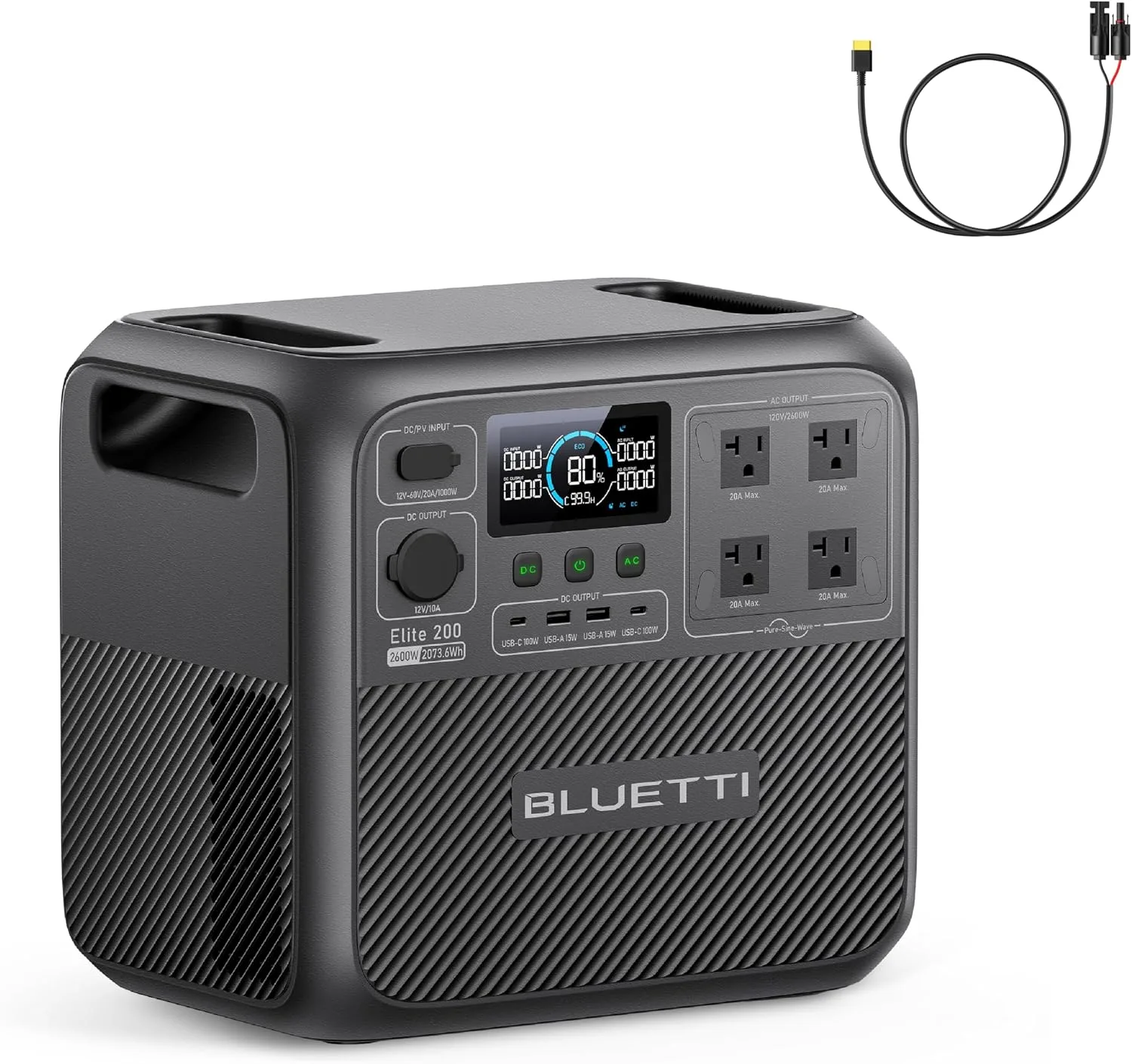
BLUETTI Elite 200 V2
Highlights
- 2074Wh rated capacity
- 2600W continuous AC
- LiFePO4 chemistry
- Up to 1000W solar input
- 53.4 lb (~24.2 kg)
- About $899 list
Best for
- Elite 200 V2: longer outages or higher continuous loads (still not whole-home wiring)
- RV / off-grid days where recharge speed matters as much as Wh
- Best parked near the vehicle or cabin — not a long carry to a tent
Strengths
- Elite 200 V2: 2600W continuous on a 2074Wh pack — more headroom for small appliances than 1kW-class peers
- 53.4 lb (~24.2 kg) is a park-and-use chassis — plan a short path, not a trail hike
- 2600W continuous headroom covers more small appliances than 1kW-class inverters
- About $899 list in the Hub catalog — confirm live retail before you buy
Watch-outs · not ideal when
- At 53.4 lb (~24.2 kg), Elite 200 V2 is a poor tent-hike companion — plan a cart or leave it in the vehicle
- High continuous output on Elite 200 V2 tempts big loads — Wh still runs out on kettles and A/C
- Rated 1000W solar on Elite 200 V2 is optimistic; shade and cables cut real watts
- LiFePO4 helps longevity, but Elite 200 V2 still hates freezing charge temps on winter trips
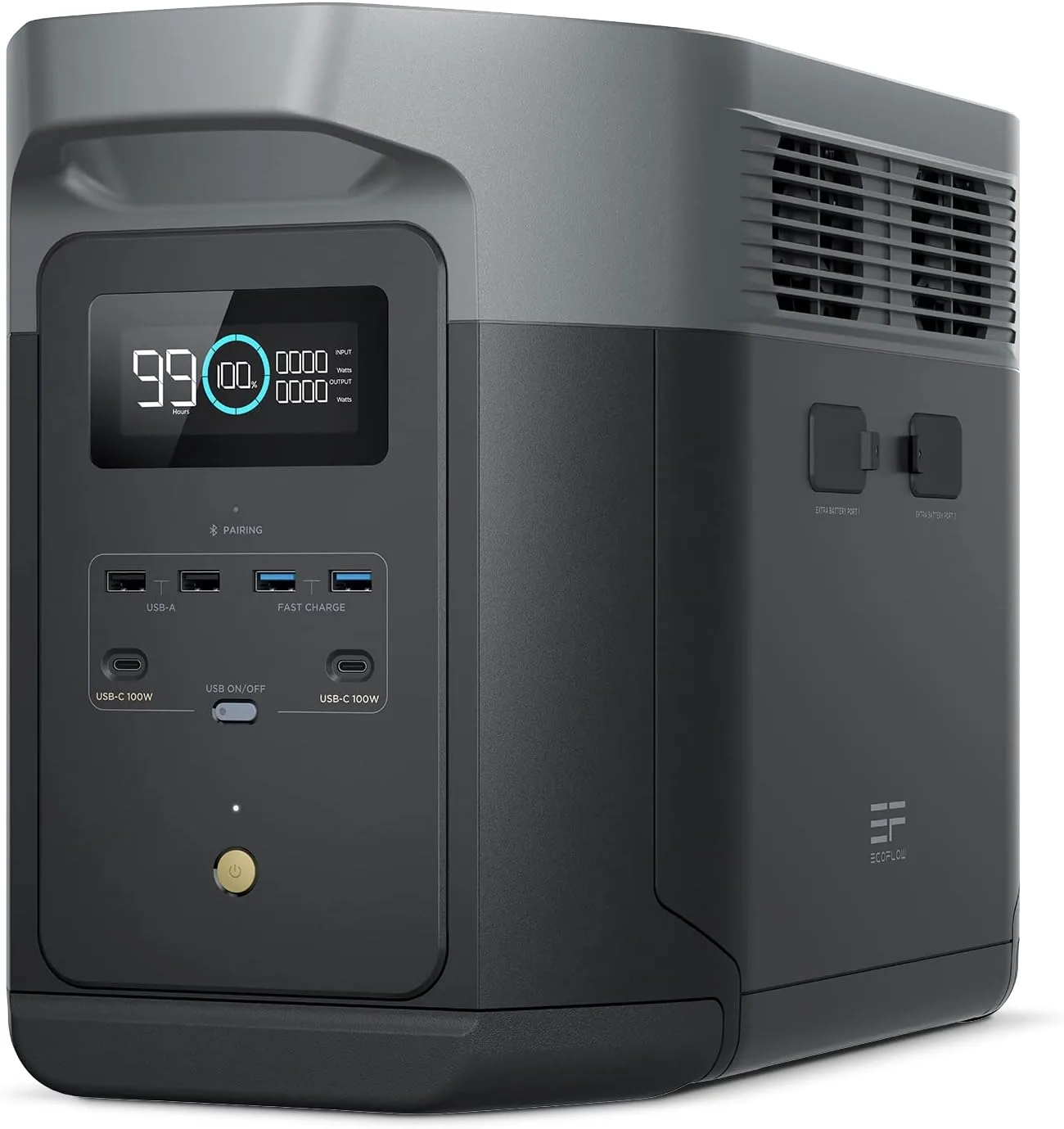
EcoFlow DELTA 2 Max
Highlights
- 2048Wh rated capacity
- 2400W continuous AC
- 4800W surge
- LiFePO4 chemistry
- Up to 1000W solar input
- 50 lb (~22.7 kg)
Best for
- DELTA 2 Max: longer outages or higher continuous loads (still not whole-home wiring)
- RV / off-grid days where recharge speed matters as much as Wh
- Best parked near the vehicle or cabin — not a long carry to a tent
Strengths
- DELTA 2 Max: 2048Wh pack with 2400W continuous / 4800W surge — size loads to both numbers
- 50 lb (~22.7 kg) is a park-and-use chassis — plan a short path, not a trail hike
- 2400W continuous headroom covers more small appliances than 1kW-class inverters
- About $1399 list in the Hub catalog — confirm live retail before you buy
Watch-outs · not ideal when
- At 50 lb (~22.7 kg), DELTA 2 Max is a poor tent-hike companion — plan a cart or leave it in the vehicle
- High continuous output on DELTA 2 Max tempts big loads — Wh still runs out on kettles and A/C
- Rated 1000W solar on DELTA 2 Max is optimistic; shade and cables cut real watts
- LiFePO4 helps longevity, but DELTA 2 Max still hates freezing charge temps on winter trips
Frequently asked
Can the BLUETTI Elite 200 V2 run a full-size fridge overnight?
Owners report roughly 17 hours on a full-size fridge in real use, short of the advertised 35 hours. Plan for a shorter window or conservation cycles.
Does the EcoFlow DELTA 2 Max have USB-C?
Yes — the listing shows USB-C×2 and USB-A×2, plus a car outlet. The BLUETTI's USB-C/USB-A counts aren't published, so I can't confirm either way for that unit.
Which is cheaper per Wh?
The BLUETTI Elite 200 V2 at $0.43/Wh nameplate, versus $0.68/Wh for the DELTA 2 Max at list.
Can I expand either one later?
The DELTA 2 Max scales to about 6 kWh with add-on batteries. The Elite 200 V2 has no published expansion path.
Method and sources
Model names and list prices come from the WattPicks catalog at build time. WattPicks does not run its own laboratory tests on power stations, and nothing on this page is presented as a measured result — it is catalog-backed buying guidance.
Read our methodology for how the catalog is normalized, and about WattPicks for who publishes it.