
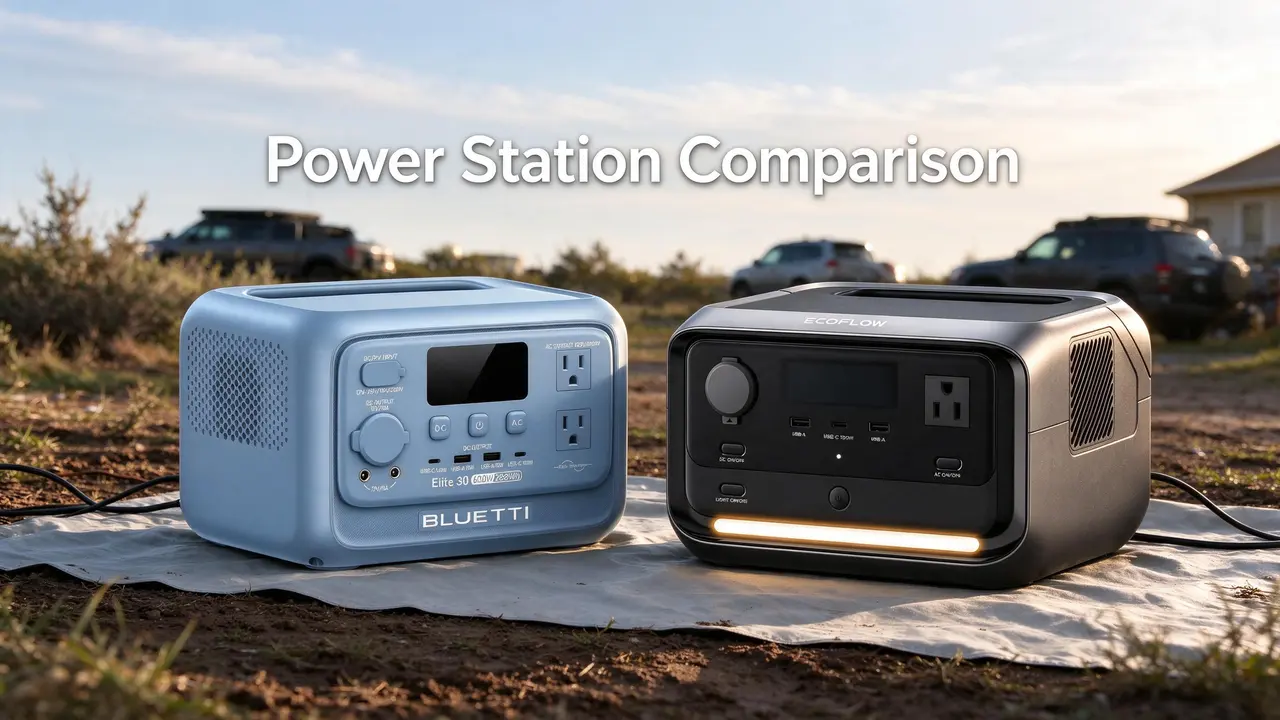
BLUETTI Elite 30 V2 vs EcoFlow RIVER 3 Plus: Small Station Duel
Two ~290 Wh mini stations, both 600 W, both LiFePO4 — but they bet your money differently. One leans on UPS duty and fast wall charging; the other on price per Wh, ports, and expandability. Here's which one fits your outage plan.
Updated
At a glance
Two ~290 Wh mini stations, both 600 W, both LiFePO4 — but they bet your money differently. One leans on UPS duty and fast wall charging; the other on price per Wh, ports, and expandability. Here's which one fits your outage plan.
- BLUETTI's bet: pay more per Wh, get a UPS-first box with fast wall recharge and a homelab-friendly sine output story.
- EcoFlow's bet: pay less per Wh, get more outlets, onboard USB-C, and a path to 858 Wh via add-on batteries.
Same money, different bets
If you're shopping a ~300 Wh mini station for outages, camping, or a desk UPS, these two land in the same budget band — $399 for the BLUETTI Elite 30 V2, $299 for the EcoFlow RIVER 3 Plus. Both are 600 W continuous, both use LiFePO4, both weigh under 11 lb. The spec sheet looks like a tie. It isn't.
The BLUETTI bets on UPS duty and fast wall charging: a 10 ms switchover claim, a 380 W AC input claim, and owner reports of running homelab gear and CPAP through the night. The EcoFlow bets on price per Wh and ports: $1.05/Wh vs $1.39/Wh on nameplate, three AC outlets, onboard USB-C, and an expandable battery ecosystem. Neither is a whole-home backup — this is a small-load page, not a furnace-and-fridge plan.
- BLUETTI's bet: pay more per Wh, get a UPS-first box with fast wall recharge and a homelab-friendly sine output story.
- EcoFlow's bet: pay less per Wh, get more outlets, onboard USB-C, and a path to 858 Wh via add-on batteries.
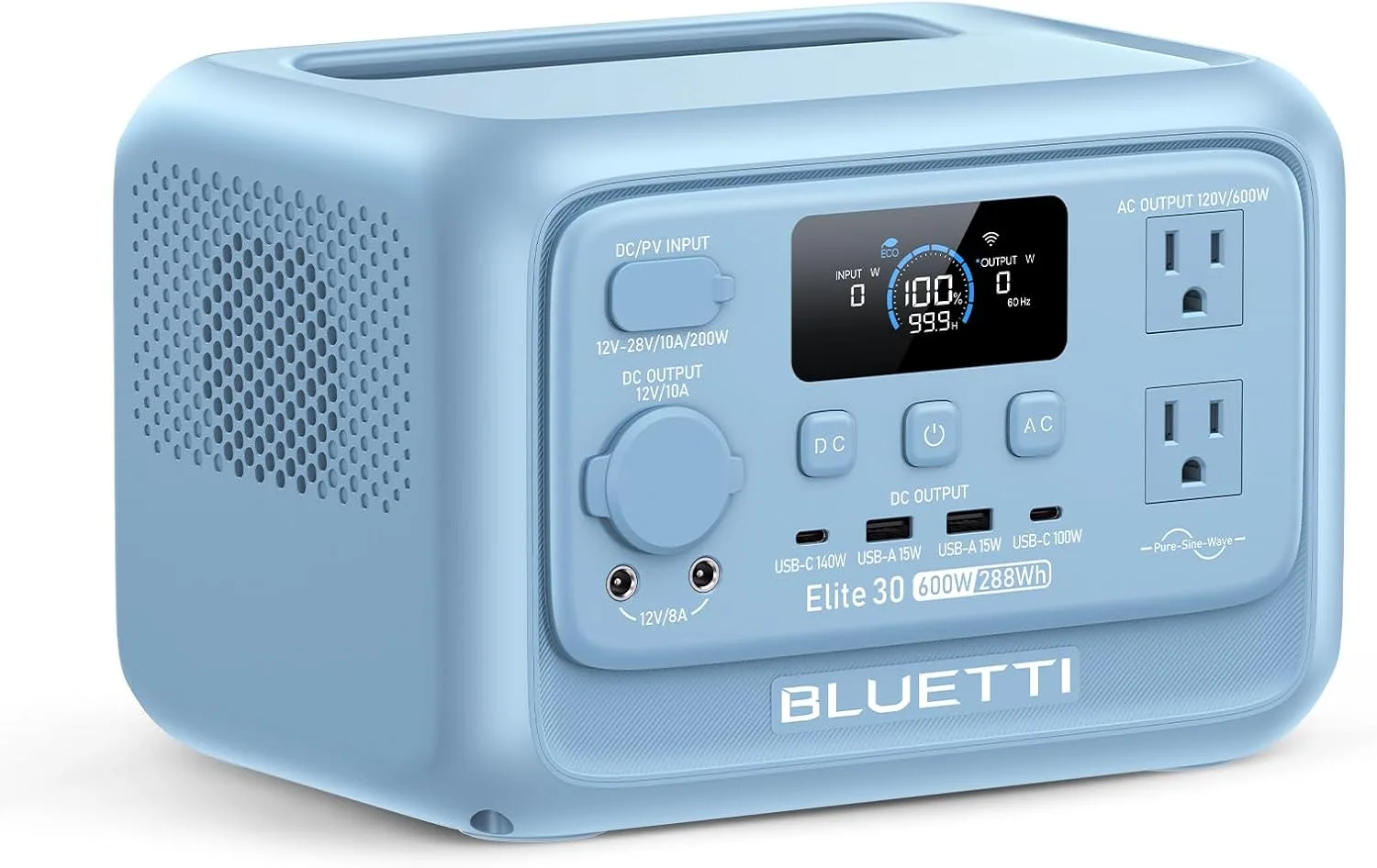
BLUETTI Elite 30 V2 Portable Power Station 288Wh 600W LFP Solar Generator
Highlights
- 288Wh rated capacity
- 600W continuous AC
- LiFePO4 chemistry
- Up to 200W solar input
- 9.5 lb (~4.3 kg)
- About $399 list
Best for
- Elite 30 V2: phones, cameras and a laptop on short trips
- Travel kits when you need quiet pack power, not appliance runtime
- Brief desk backup for router and lights — not a fridge for days
Strengths
- Elite 30 V2: 288Wh / 600W continuous — treat as electronics and light loads, not a tool inverter
- 9.5 lb (~4.3 kg) is the lightest-class carry in this band — easier stairs and car packing
- 10ms-class UPS switchover on the listing — useful when a router restart would hurt
- About $399 list in the Hub catalog — confirm live retail before you buy
Watch-outs · not ideal when
- Elite 30 V2's small Wh class empties fast with a kettle, hair dryer or space heater
- Usable energy on Elite 30 V2 is below the 288Wh label once the inverter is working
- Rated 200W solar on Elite 30 V2 is optimistic; shade and cables cut real watts
- Airline and pack limits may still block Elite 30 V2 even when the weight looks friendly
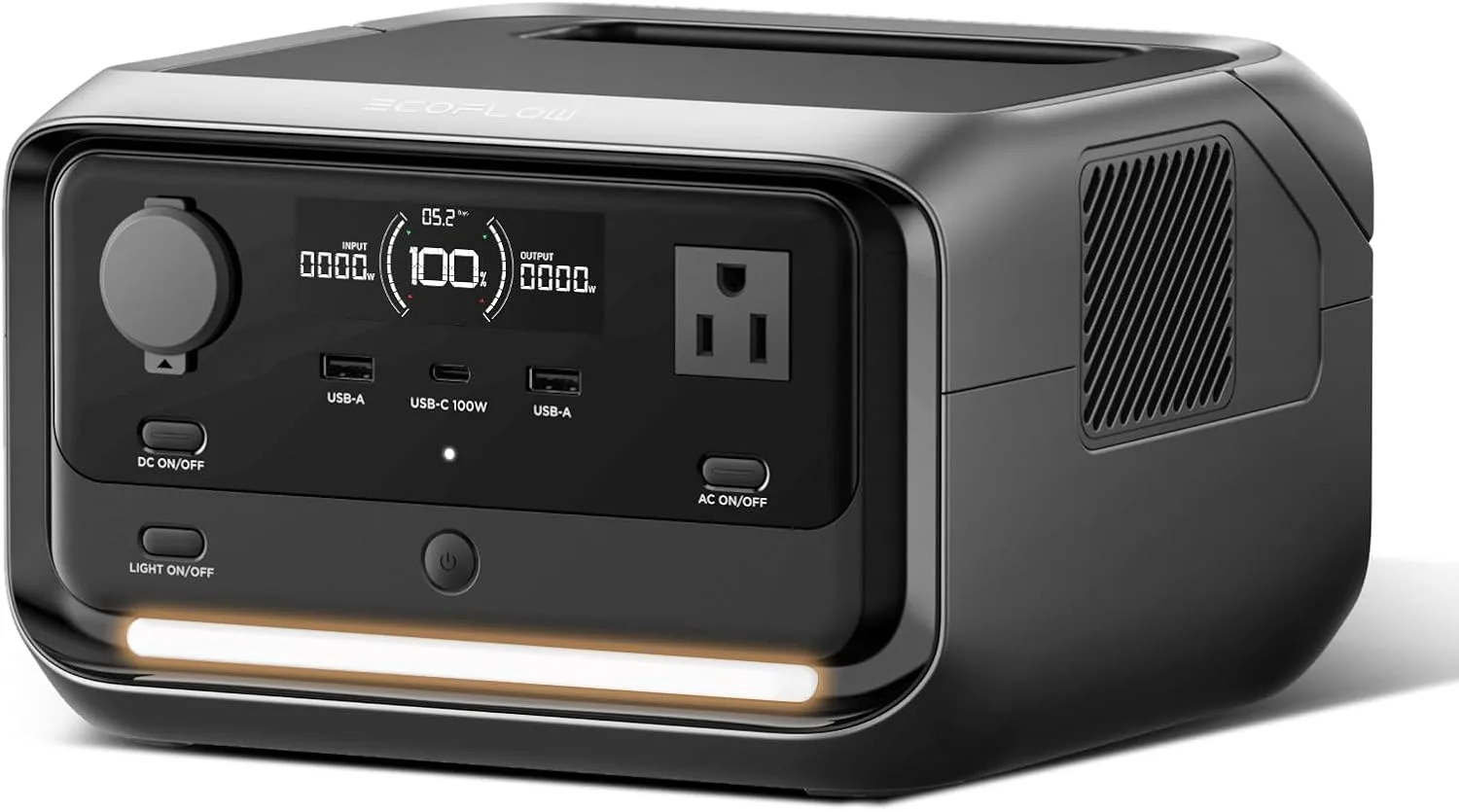
EcoFlow RIVER 3 Plus
Highlights
- 286Wh rated capacity
- 600W continuous AC
- 1200W surge
- LiFePO4 chemistry
- Up to 220W solar input
- 10.4 lb (~4.7 kg)
Best for
- RIVER 3 Plus: phones, cameras and a laptop on short trips
- Travel kits when you need quiet pack power, not appliance runtime
- Brief desk backup for router and lights — not a fridge for days
Strengths
- RIVER 3 Plus: 286Wh pack with 600W continuous / 1200W surge — size loads to both numbers
- 10.4 lb (~4.7 kg) is the lightest-class carry in this band — easier stairs and car packing
- 10ms-class UPS switchover on the listing — useful when a router restart would hurt
- About $299 list in the Hub catalog — confirm live retail before you buy
Watch-outs · not ideal when
- RIVER 3 Plus's small Wh class empties fast with a kettle, hair dryer or space heater
- Usable energy on RIVER 3 Plus is below the 286Wh label once the inverter is working
- Rated 220W solar on RIVER 3 Plus is optimistic; shade and cables cut real watts
- Airline and pack limits may still block RIVER 3 Plus even when the weight looks friendly
Methodology and disclosure
I'm Avery Nolan, WattPicks founding editor. This comparison uses listing specs and owner review themes on file — home-user checks, not lab-bench measurements. Ratings are listing aggregates, not owner proof. As an Amazon Associate, WattPicks earns from qualifying purchases; picks here are fit-led, not commission-led.
Scoreboard on those weights — BLUETTI Elite 30 V2 Portable Power Station 288Wh 600W LFP Solar (list $399): High where list price and published capacity match the job, Med on continuous watts; EcoFlow RIVER 3 Plus (list $299): High on continuous watts and ports, Med on price. That is why the pick splits by job rather than one universal winner.
Spec snapshot
Numbers below are from the listings on file. Prices are list prices, not deal stickers. Ratings are listing aggregates, not owner proof.
| Product | List price | Capacity (Wh) | Output (W) | Weight (lb) | Rating |
|---|---|---|---|---|---|
| BLUETTI Elite 30 V2 Portable Power Station 288Wh 600W LFP Solar | $399 | 288 Wh | 600 W | 9.5 lb | 5.00 |
| EcoFlow RIVER 3 Plus | $299 | 286 Wh | 600 W | 10.4 lb | 5.00 |
Where the money went
Four configuration differences actually move the decision. Start with price per Wh: EcoFlow is $1.05/Wh on nameplate, BLUETTI is $1.39/Wh. That's the clearest gap on the sheet, and it's why the EcoFlow wins the value column outright.
Ports are the second split. The EcoFlow lists AC×3, USB-C×1, USB-A×2 — enough to run a router, a laptop, and a phone charger without a power strip. BLUETTI's port lineup isn't published in the data on file, so I can't claim what it has or lacks; treat that as n/a (not on file) rather than a strike against it.
Recharge speed is the third. BLUETTI claims 380 W AC input and 0–80% in 45 minutes; EcoFlow claims 0–100% in about an hour on AC. On paper they're close, but one high-helpful BLUETTI owner reported charging at only ~200 W, so the claim isn't universal. EcoFlow's DC input is capped around 100 W, which matters if you plan to solar-charge from a single 100 W panel.
The fourth is expandability. EcoFlow sells EB300 (286 Wh) and EB600 (572 Wh) add-on batteries, stacking to 858 Wh. BLUETTI's listing doesn't describe an expansion path. If you want to grow capacity without buying a second station, that's a real EcoFlow advantage.
- Price per Wh: EcoFlow $1.05/Wh vs BLUETTI $1.39/Wh — EcoFlow is the cheaper nameplate build.
- Outlets: EcoFlow lists 3 AC + 1 USB-C + 2 USB-A; BLUETTI ports n/a (not on file).
- Recharge: BLUETTI claims 380 W AC / 0–80% in 45 min; EcoFlow claims 0–100% in ~1 hr AC, ~100 W DC cap.
- Expansion: EcoFlow stacks to 858 Wh with EB300/EB600; BLUETTI expansion n/a (not on file).
The spec that decides it
For most buyers, the deciding spec is price per Wh against the load you actually need to ride out. At 288 Wh and 286 Wh, these two are functionally the same tank — a 100 W load runs roughly 2.5 hours on either before inverter losses, and a 25 W networking load stretches to many hours. The EcoFlow does that for $100 less on list.
The second deciding spec is UPS behavior. Both claim sub-10 ms switchover, and owners on both sides report keeping routers and servers alive without reboots. If UPS duty is the whole job, the BLUETTI's homelab owner reports are stronger and more specific — but the EcoFlow's are credible too, and it costs less. The BLUETTI only pulls ahead if you specifically value its fast wall-charge claim and can verify it on arrival.
- Buy on $/Wh if your loads are small and predictable: EcoFlow wins at $1.05/Wh.
- Buy on UPS confidence if you're protecting a server: BLUETTI's owner reports are more detailed, but verify charging speed in the return window.
Real owner trade-offs
The BLUETTI owner pack skews toward UPS and CPAP use. One high-helpful owner replaced an aging CyberPower UPS and got roughly double the runtime on a ~150 W load of Ubiquiti gear and a NAS desktop, praising the clean sine output and fast switchover. A CPAP camper found that AC drains the battery overnight but a separate DC converter used only ~55% per night with the humidifier on. The caveat side is real: one critical reviewer measured ~200 W charging instead of 380 W and got only 42 minutes on a basic CPAP, and a small heater shut the unit down immediately. Phantom drain when AC/DC buttons are left on, and a very bright night screen, come up more than once.
The EcoFlow pack skews toward networking UPS and 12V cooler duty. One owner ran a 25 W server/network load for about two hours and called the switchover fast enough to keep computers alive; another kept a 12V cooler running for hours and recharged from the car outlet between stops. A 113 W backup setup (internet, TV, Firestick, light) ran about two hours without a glitch. The caveats: one high-helpful owner had both units shut down intermittently, though the factory replaced them and the new ones worked; DC input is capped near 100 W, so a single 100 W panel recharges slowly; and X-Boost's 1,200 W surge claim is marketing — devices over 600 W may run only briefly. Price also fluctuates, so timing matters.
- BLUETTI owners: strong UPS/homelab and CPAP-with-DC reports; watch charging speed and high-draw shutdowns.
- EcoFlow owners: solid networking UPS and 12V cooler use; watch QC on intermittent shutdowns and the 100 W DC cap.
Buy the one that…
Buy the EcoFlow RIVER 3 Plus if you want the most capacity per dollar, need three AC outlets and onboard USB-C, or plan to expand to 858 Wh later with an add-on battery. It's the better value on nameplate $/Wh and the more flexible port setup — just size your solar panel above 100 W if off-grid recharge matters.
Buy the BLUETTI Elite 30 V2 if your primary job is UPS duty for a server or network stack and you want the stronger owner track record on clean sine output and fast wall charging — but test the charge rate and a high-draw device in the return window, and plan on a DC converter for CPAP. Skip both if you need to run heaters, full-size fridges, or anything that pulls more than 600 W continuous; this class isn't built for that.
- EcoFlow if: value per Wh, ports, or expansion matter most.
- BLUETTI if: UPS duty for sensitive gear is the whole job and you'll verify charging speed early.
- Skip both if: your outage plan includes heaters, full-size fridges, or loads above 600 W continuous.
Frequently asked
Can either run a CPAP overnight?
Yes, with caveats. BLUETTI owners report ~55% battery use per night on DC with humidifier on; AC drains it overnight. EcoFlow owners report CPAP use for outages, but the 286 Wh tank means humidifier-off and DC are safer bets on both.
Which charges faster from the wall?
BLUETTI claims 0–80% in 45 minutes at 380 W; EcoFlow claims 0–100% in about an hour. One BLUETTI owner measured only ~200 W, so verify on arrival.
Can I expand capacity later?
EcoFlow yes — EB300/EB600 stack to 858 Wh. BLUETTI expansion is n/a (not on file).
Will either run a space heater?
No. Both are 600 W continuous; a 1,500 W heater exceeds that, and BLUETTI owners report shutdowns on high-draw devices.
Method and sources
Model names and list prices come from the WattPicks catalog at build time. WattPicks does not run its own laboratory tests on power stations, and nothing on this page is presented as a measured result — it is catalog-backed buying guidance.
Read our methodology for how the catalog is normalized, and about WattPicks for who publishes it.