
BLUETTI Elite 300 vs EcoFlow Delta 3 Ultra: Backup Bet
Two 3kWh-class stations, $100 apart, betting on different things: BLUETTI packs the capacity into 58 lb with an RV shore-power outlet, while EcoFlow buys you 3,600 W and wheels. Here's which bet pays off for your essentials outage.
Updated
At a glance
Two 3kWh-class stations, $100 apart, betting on different things: BLUETTI packs the capacity into 58 lb with an RV shore-power outlet, while EcoFlow buys you 3,600 W and wheels. Here's which bet pays off for your essentials outage.
Same money, different bets
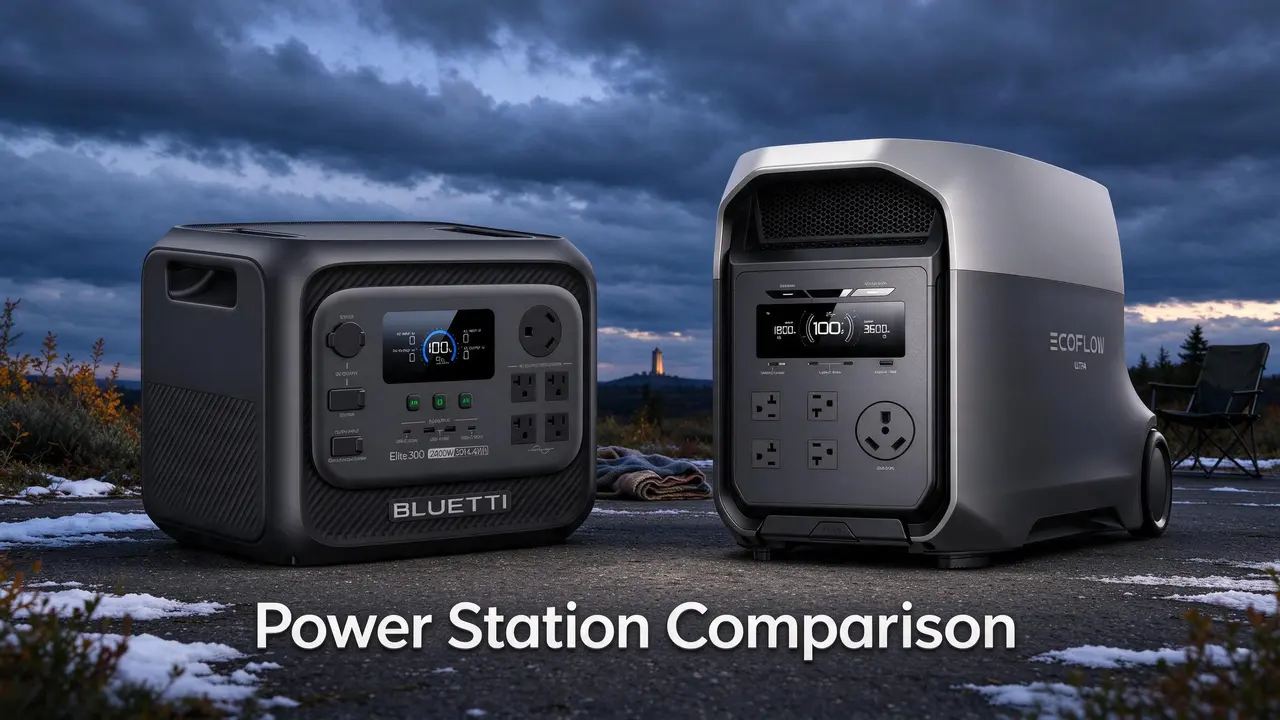
These two land $100 apart at list — $1,699 for the BLUETTI Elite 300 Portable Power Station for RV & Home Backup 3014.4Wh, $1,599 for the EcoFlow Delta 3 Ultra 3072Wh Portable Power Station, 2400W AC Output. That's close enough that price shouldn't decide it for you. What decides it is what each brand spent the money on.
BLUETTI's bet is density and RV plumbing: a 3,014 Wh pack squeezed into 58 lb with a TT-30 shore-power outlet and a 30A 12V DC feed. EcoFlow's bet is headroom and ergonomics: 3,600 W continuous, 7,200 W surge, and wheels under a 72.1 lb body. One is a grab-and-go box you can carry through a doorway; the other is a small appliance you roll.
This is a home-backup and RV comparison, not a camping-tote shootout — if you need something one person can sling into a truck bed weekly, both of these are heavier than that job wants.
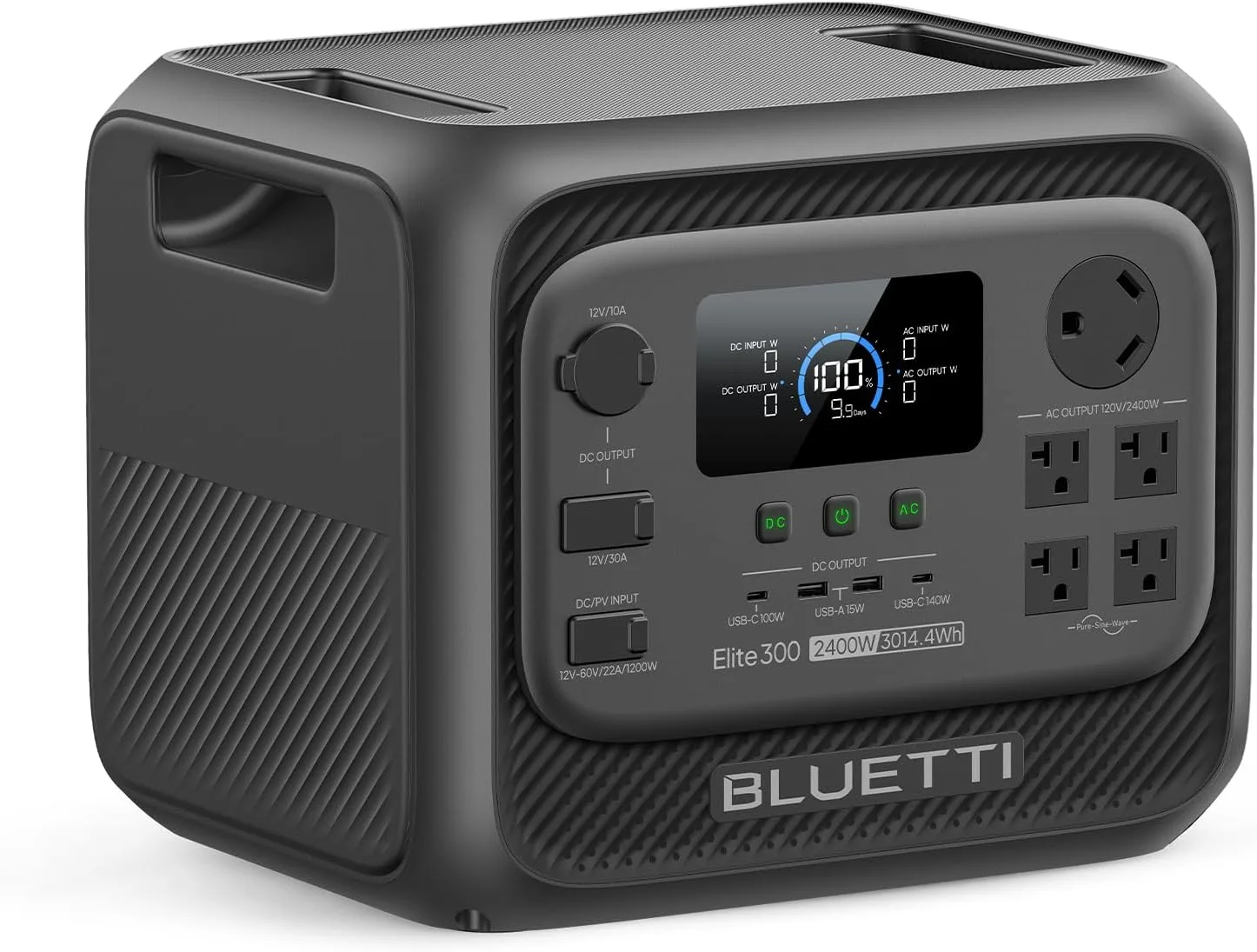
BLUETTI Elite 300 Portable Power Station for RV & Home Backup 3014.4Wh
Highlights
- 3014Wh rated capacity
- 2400W continuous AC
- LiFePO4 chemistry
- 58 lb (~26.3 kg)
- About $1699 list
Best for
- Elite 300: longer outages or higher continuous loads (still not whole-home wiring)
- RV / off-grid days where recharge speed matters as much as Wh
- Best parked near the vehicle or cabin — not a long carry to a tent
Strengths
- Elite 300: 2400W continuous on a 3014Wh pack — more headroom for small appliances than 1kW-class peers
- 58 lb (~26.3 kg) is a park-and-use chassis — plan a short path, not a trail hike
- 10ms-class UPS switchover on the listing — useful when a router restart would hurt
- About $1699 list in the Hub catalog — confirm live retail before you buy
Watch-outs · not ideal when
- At 58 lb (~26.3 kg), Elite 300 is a poor tent-hike companion — plan a cart or leave it in the vehicle
- High continuous output on Elite 300 tempts big loads — Wh still runs out on kettles and A/C
- Solar input unpublished for Elite 300 — do not assume a same-day off-grid refill
- LiFePO4 helps longevity, but Elite 300 still hates freezing charge temps on winter trips
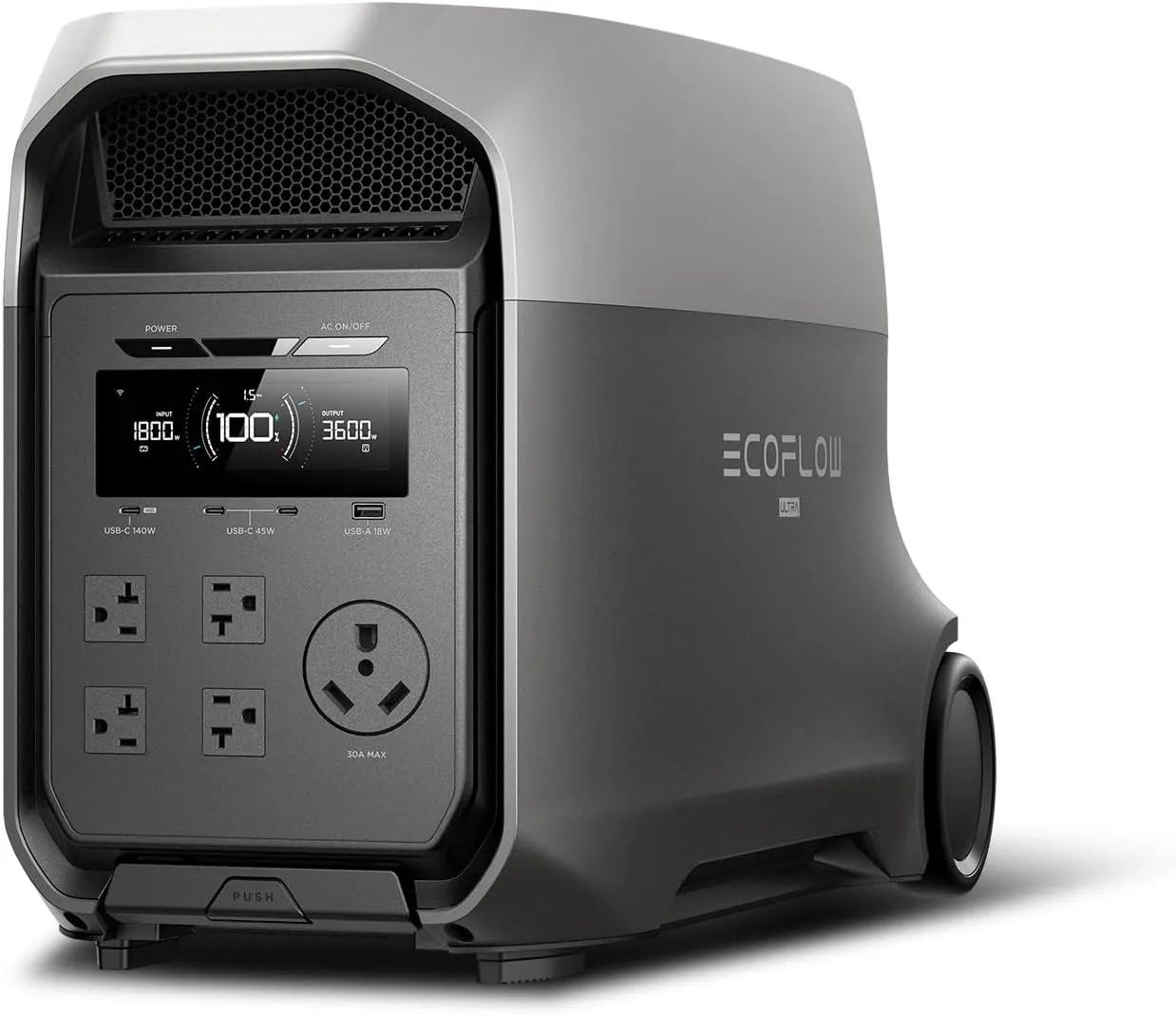
EcoFlow Delta 3 Ultra 3072Wh Portable Power Station, 3600W AC Output
Highlights
- 3072Wh rated capacity
- 3600W continuous AC
- 7200W surge
- LiFePO4 chemistry
- Up to 3200W solar input
- 72.1 lb (~32.7 kg)
Best for
- DELTA 3 Ultra: longer outages or higher continuous loads (still not whole-home wiring)
- RV / off-grid days where recharge speed matters as much as Wh
- Best parked near the vehicle or cabin — not a long carry to a tent
Strengths
- DELTA 3 Ultra: 3072Wh pack with 3600W continuous / 7200W surge — size loads to both numbers
- 72.1 lb (~32.7 kg) is a park-and-use chassis — plan a short path, not a trail hike
- 3600W continuous headroom covers more small appliances than 1kW-class inverters
- About $1599 list in the Hub catalog — confirm live retail before you buy
Watch-outs · not ideal when
- At 72.1 lb (~32.7 kg), DELTA 3 Ultra is a poor tent-hike companion — plan a cart or leave it in the vehicle
- High continuous output on DELTA 3 Ultra tempts big loads — Wh still runs out on kettles and A/C
- Rated 3200W solar on DELTA 3 Ultra is optimistic; shade and cables cut real watts
- LiFePO4 helps longevity, but DELTA 3 Ultra still hates freezing charge temps on winter trips
How I weighed these two
I'm Avery Nolan, founding editor at WattPicks, covering portable power capacity, output, and price-per-Wh across the catalogue. This comparison is grounded in the listing specs on file plus owner review themes from high-helpful reviews — home-user checks, not lab-bench measurements.
The weighting that drove the verdict: continuous output headroom 30%, capacity and $/Wh 20%, weight and mobility 20%, port fit for the job (RV vs general) 15%, owner-reported reliability themes 15%. EcoFlow wins on output and $/Wh; BLUETTI wins on weight and RV port fit. The output gap is the single largest swing, which is why EcoFlow takes the value edge for whole-home backup while BLUETTI remains the better RV and grab-and-go pick.
As an Amazon Associate, WattPicks earns from qualifying purchases. Picks here are fit-led, not commission-led.
Scoreboard on those weights — BLUETTI Elite 300 Portable Power Station for RV & Home Backup 3014.4Wh (list $1699): High where list price and published capacity match the job, Med on continuous watts; EcoFlow Delta 3 Ultra 3072Wh Portable Power Station, 3600W AC Output (list $1599): High on continuous watts and ports, Med on price. That is why the pick splits by job rather than one universal winner.
Spec snapshot
Everything below is from the listings, not from a bench. Ratings are the listing aggregates, which tell you volume of feedback, not proof of performance.
| Product | List price | Capacity (Wh) | Output (W) | Weight (lb) | Rating |
|---|---|---|---|---|---|
| BLUETTI Elite 300 Portable Power Station for RV & Home Backup 3014.4Wh | $1,699 | 3014 Wh | 2400 W | 58 lb | 4.00 |
| EcoFlow Delta 3 Ultra 3072Wh Portable Power Station, 3600W AC Output | $1,599 | 3072 Wh | 3600 W | 72.1 lb | 5.00 |
Where the money went
Four places the $1,600-ish budget got allocated differently.
Capacity and price per watt-hour. EcoFlow edges it: $0.52/Wh against BLUETTI's $0.56/Wh on nameplate math, and 58 more Wh of capacity. It's a rounding-error gap in real use — 3,014 vs 3,072 Wh is under 2% — so don't buy on this alone.
Output headroom. This is the widest gap. EcoFlow's 3,600 W continuous (7,200 W surge) will run a griddle and a smart oven at once, which owners describe doing for over half an hour with roughly 70% left. BLUETTI's 2,400 W continuous (4,800 W surge per the listing) is plenty for a fridge, router, lights, and CPAP — but it's a lower ceiling, and one owner found a 500 W dehumidifier wouldn't start cleanly because of a soft-start ramp.
Ports and RV wiring. BLUETTI carries a TT-30 RV outlet plus 30A 12V DC output — the reason RV owners gravitate to it. EcoFlow lists AC×4, USB-C×1, USB-A×1, and a car port; BLUETTI's USB-C and USB-A counts aren't on file, so I won't claim either way. If you're plugging in a camper's shore cord, BLUETTI's the more direct fit.
Mobility. EcoFlow spends weight on wheels and a telescoping handle; BLUETTI spends it on a narrower body with integral handles. 58 lb vs 72.1 lb is a real difference on stairs — but 72 lb on wheels beats 58 lb in your arms across a garage floor.
- Nameplate $/Wh: EcoFlow $0.52, BLUETTI $0.56 — EcoFlow is the cheaper-per-Wh unit on the lock card
- Continuous output: 3,600 W vs 2,400 W — the biggest functional delta
- RV shore power: BLUETTI TT-30 + 30A 12V DC; EcoFlow lists a car port and four AC outlets
- Neither model offers battery expansion — capacity is capped on both
The spec that decides it
Two numbers matter more than the rest.
Continuous output is the first. If your outage plan includes a space heater, a microwave, or two cooking appliances at once, 3,600 W is the difference between running them and tripping. BLUETTI's 2,400 W covers the essentials list — fridge, lights, router, TV, CPAP — comfortably, and owners report exactly that. But it's not the unit for simultaneous high-draw cooking.
Weight and form factor is the second. 58 lb with a narrow body is carryable by a fit adult for short moves; 72.1 lb is not something you want to lift onto a shelf, which is why EcoFlow's wheels matter. If the station lives in a closet and comes out twice a year, BLUETTI's lighter body wins. If it lives in a garage and gets rolled to the kitchen, EcoFlow's wheels win.
One caveat on both: neither has expansion ports. If you're planning to grow capacity later, this pair isn't the answer — you'd be looking at expandable siblings instead.
Real owner trade-offs
The review themes on file line up with the spec story, with a few honest wrinkles.
On the BLUETTI side, owners consistently praise the compact 3kWh body and the UPS handoff — one ran a continuous 2,400 W multi-appliance load for about half an hour without issue, and another kept a fridge, fans, and phones going for a full day during an outage. The recurring complaint is the solar input window: the voltage ceiling is low enough that some rigid panels can't reach the advertised solar wattage, and more than one owner flagged that settings and firmware updates live behind the app. A 4-star reviewer also noted the soft-start behavior on inductive loads.
On the EcoFlow side, the pass-through mode gets the most praise — under utility power the inverter stays out of the loop, so it's quiet, and the switchover on outage is described as seamless. Owners report running an 1,800 W griddle and an 1,800 W oven together, and a space heater for three hours. The caveats are real: firmware updates cut the AC output, which is a problem if you're backing up a server or medical device, and the app's animated assistant is intrusive until you disable it. One owner also noted the button layout differs from other Delta 3 units.
Both listing aggregates sit in the mid-4s — 4.7 for BLUETTI across 254 ratings, 4.6 for EcoFlow across 168. Treat those as volume signals, not proof.
- BLUETTI owners: compact body and clean UPS transfer are the recurring wins; narrow solar voltage window and app-gated settings are the recurring gripes
- EcoFlow owners: true AC pass-through and simultaneous high loads are the wins; firmware updates dropping AC output and app quirks are the gripes
Buy the one that…
Buy the BLUETTI Elite 300 Portable Power Station for RV & Home Backup 3014.4Wh if you want a 3kWh box you can actually carry, and your plan is fridge-plus-essentials backup or RV shore power off portable panels. Skip it if you need to run big inductive loads for long stretches or want to add batteries later.
Buy the EcoFlow Delta 3 Ultra 3072Wh Portable Power Station, 3600W AC Output if your outage list includes simultaneous high-draw appliances, or if the station will live on a garage floor and get rolled rather than lifted. Skip it if you're backing up a server or health device and can't tolerate firmware updates cutting AC output, or if you need expandable capacity.
Neither is the right call if you're shopping for a camping tote — both are too heavy for that job. And if you're still working out how much capacity your outage actually needs, our guide to sizing a power station for home backup walks through the load math before you spend.
Frequently asked
Can either one run a space heater?
EcoFlow lists 3,600 W continuous, which covers most space heaters; BLUETTI's 2,400 W continuous covers smaller heaters but not simultaneously with other high-draw loads. Check your heater's wattage against the continuous rating, not the surge.
Will either run a refrigerator through an outage?
Yes — both are in the 3kWh class, and BLUETTI owners specifically report a full day of fridge, fans, and phone charging. The caveat is inductive startup: BLUETTI's soft-start ramp tripped one owner's dehumidifier, so test your fridge before an outage if you can.
Can I add batteries later?
Not on either of these two models. Both are capped at their built-in capacity; expandable versions are separate SKUs.
Which recharges faster from AC?
EcoFlow owners report roughly 90 minutes to full from the box; BLUETTI lists 0–80% in as fast as 78 minutes. Both are quick — don't pick on this alone.
Method and sources
Model names and list prices come from the WattPicks catalog at build time. WattPicks does not run its own laboratory tests on power stations, and nothing on this page is presented as a measured result — it is catalog-backed buying guidance.
Read our methodology for how the catalog is normalized, and about WattPicks for who publishes it.