
BLUETTI Elite 400 vs EcoFlow DELTA Pro 3: Backup Pick
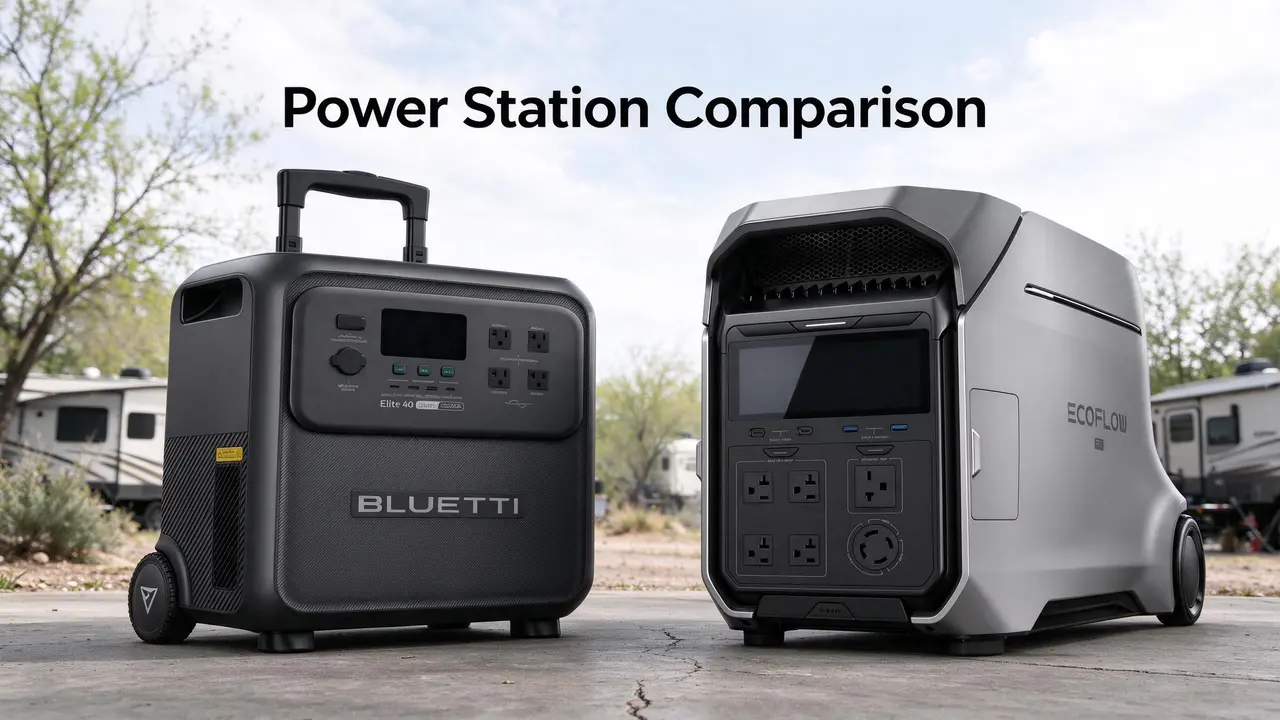
Two 4kWh-class LFP stations, $2,200 apart. The BLUETTI Elite 400 bets on battery-per-dollar and a roll-it trolley; the EcoFlow DELTA Pro 3 bets on 4000 W output, 240V split-phase, and stackable expansion. Here is which backup actually fits your house or your rig.
Updated
At a glance
Two 4kWh-class LFP stations, $2,200 apart. The BLUETTI Elite 400 bets on battery-per-dollar and a roll-it trolley; the EcoFlow DELTA Pro 3 bets on 4000 W output, 240V split-phase, and stackable expansion. Here is which backup actually fits your house or your rig.
Same money class, two different bets
If you are shopping the 4kWh tier, these two land in the same conversation and then split hard. The BLUETTI Elite 400 Portable Power Station with AC Cable 3840Wh 2600W LFP puts its budget into battery capacity and a trolley you can roll to the basement door. The EcoFlow DELTA Pro 3 Portable Power Station, 4096Wh puts its budget into a 4000 W inverter, 240V split-phase output, and a stackable expansion path toward whole-home backup.
That is the whole trade in one line: more stored energy per dollar versus more watts and more room to grow. Neither is a camping-first box, and neither is a grab-and-go unit you carry up stairs without thinking about it. This comparison is for people wiring a backup plan, not for a weekend cooler run.
One disclosure up front: picks here are fit-led, and this page carries Amazon Associates links. Specs and prices come from the listings; owner impressions come from Amazon review themes on file (accessed May 2025), and those checks are home-user reads, not lab-bench measurements. Prices and specs are as of May 2025; check the listing for current pricing and bundle.
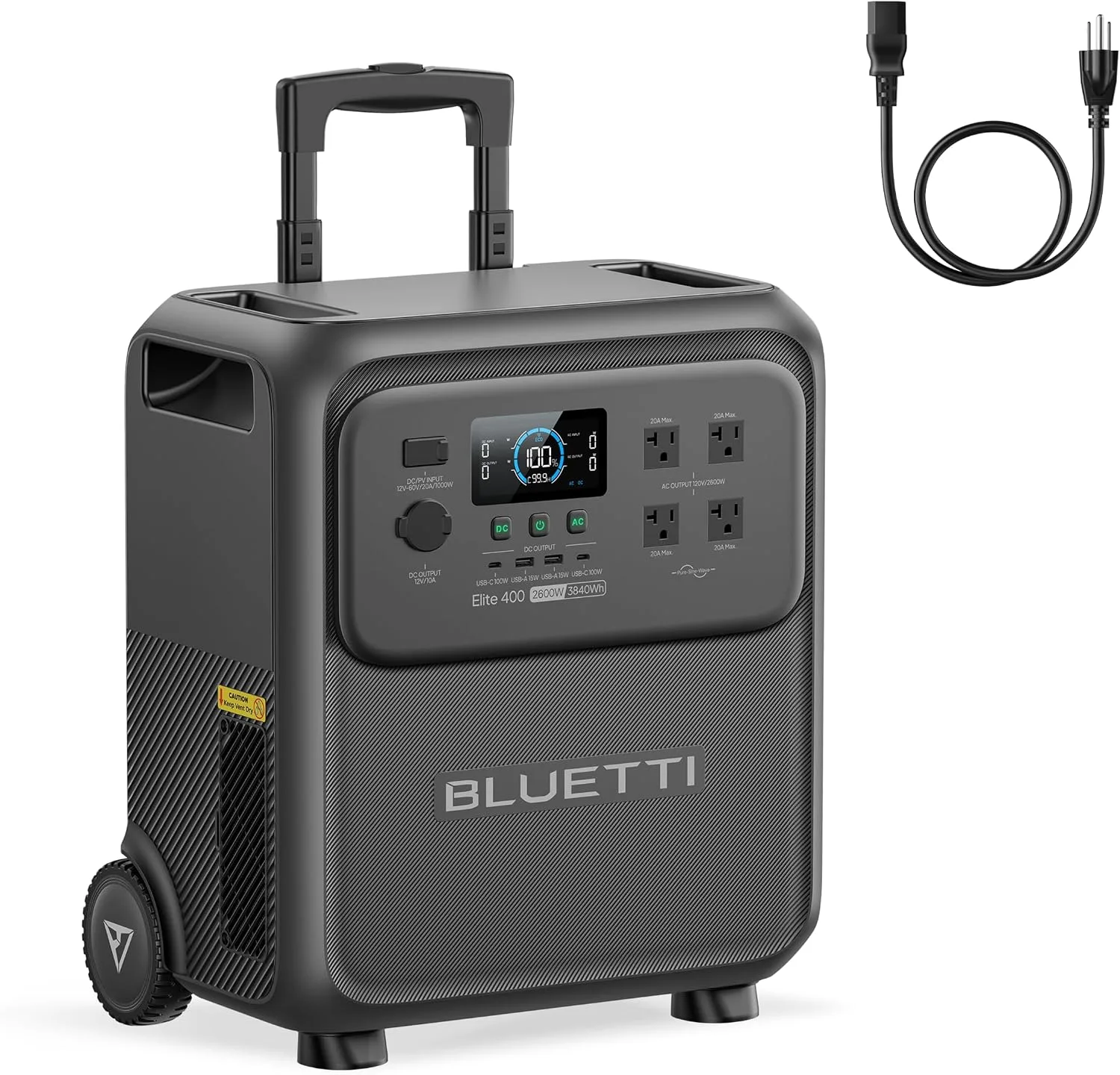
BLUETTI Elite 400 Portable Power Station with AC Cable 3840Wh 2600W LFP
Highlights
- 3840Wh rated capacity
- 2600W continuous AC
- LiFePO4 chemistry
- 86 lb (~39.0 kg)
- About $1499 list
Best for
- Elite 400: longer outages or higher continuous loads (still not whole-home wiring)
- RV / off-grid days where recharge speed matters as much as Wh
- Best parked near the vehicle or cabin — not a long carry to a tent
Strengths
- Elite 400: 2600W continuous on a 3840Wh pack — more headroom for small appliances than 1kW-class peers
- 86 lb (~39.0 kg) is a park-and-use chassis — plan a short path, not a trail hike
- 15ms-class UPS switchover on the listing — useful when a router restart would hurt
- About $1499 list in the Hub catalog — confirm live retail before you buy
Watch-outs · not ideal when
- At 86 lb (~39.0 kg), Elite 400 is a poor tent-hike companion — plan a cart or leave it in the vehicle
- High continuous output on Elite 400 tempts big loads — Wh still runs out on kettles and A/C
- Solar input unpublished for Elite 400 — do not assume a same-day off-grid refill
- LiFePO4 helps longevity, but Elite 400 still hates freezing charge temps on winter trips
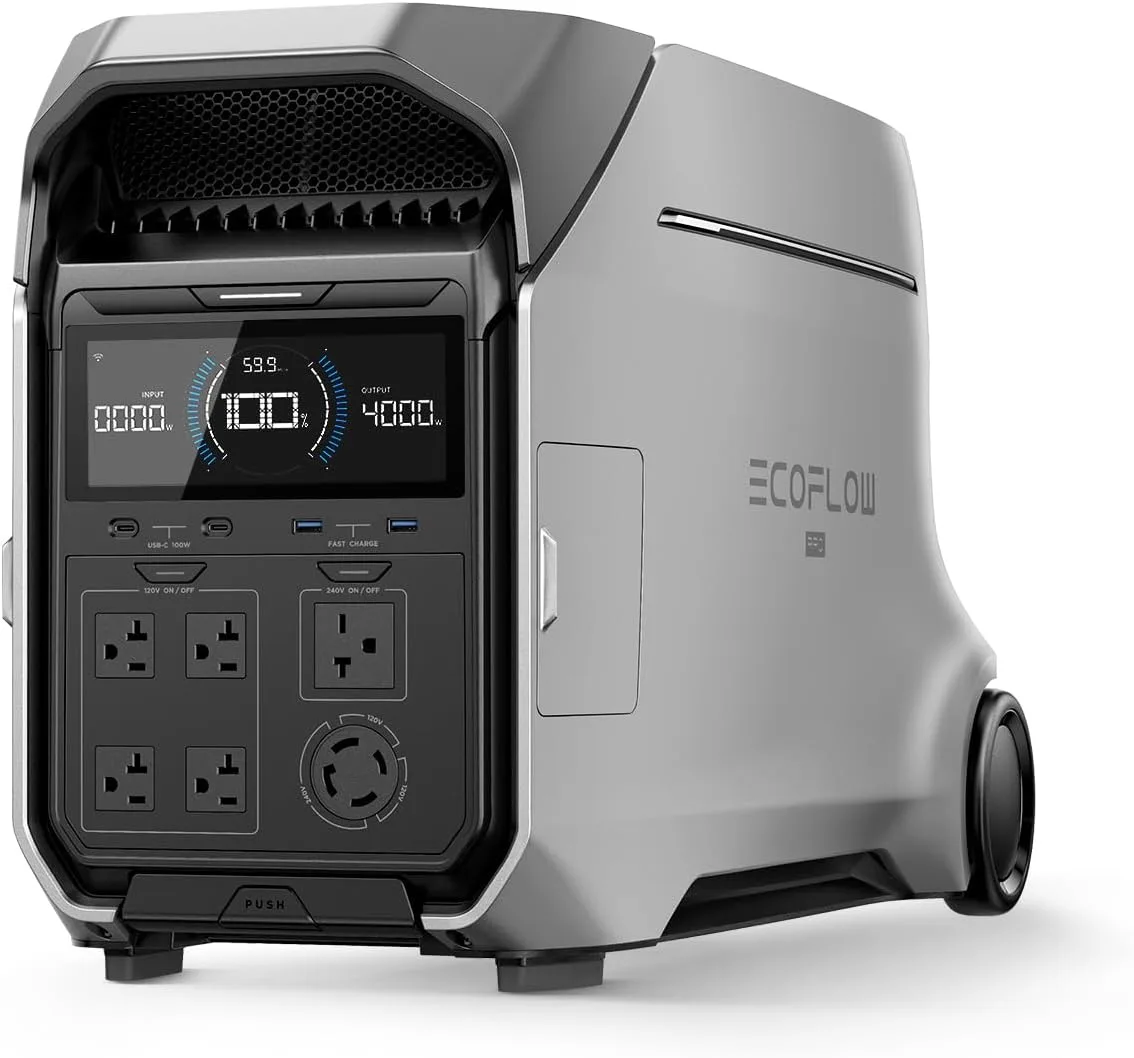
EcoFlow DELTA Pro 3 Portable Power Station, 4096Wh
Highlights
- 4096Wh rated capacity
- 4000W continuous AC
- 8000W surge
- LiFePO4 chemistry
- Up to 2600W solar input
- 113.5 lb (~51.5 kg)
Best for
- DELTA Pro 3: longer outages or higher continuous loads (still not whole-home wiring)
- RV / off-grid days where recharge speed matters as much as Wh
- Best parked near the vehicle or cabin — not a long carry to a tent
Strengths
- DELTA Pro 3: 4096Wh pack with 4000W continuous / 8000W surge — size loads to both numbers
- 113.5 lb (~51.5 kg) is a park-and-use chassis — plan a short path, not a trail hike
- 10ms-class UPS switchover on the listing — useful when a router restart would hurt
- About $3699 list in the Hub catalog — confirm live retail before you buy
Watch-outs · not ideal when
- At 113.5 lb (~51.5 kg), DELTA Pro 3 is a poor tent-hike companion — plan a cart or leave it in the vehicle
- High continuous output on DELTA Pro 3 tempts big loads — Wh still runs out on kettles and A/C
- Rated 2600W solar on DELTA Pro 3 is optimistic; shade and cables cut real watts
- LiFePO4 helps longevity, but DELTA Pro 3 still hates freezing charge temps on winter trips
Spec snapshot: what the listings actually say
Prices below are list prices, not sale stickers. Ratings are listing aggregates, not proof of owner consensus.
The gap that matters most is not capacity — it is 2600 W versus 4000 W continuous, and 86 lb versus 113.5 lb. On nameplate dollars per watt-hour, the Elite 400 is the cheaper unit at $0.39/Wh against $0.90/Wh for the DELTA Pro 3. That $/Wh figure is arithmetic from list price and capacity, not a street-price quote — and it is the one place where capacity does matter: you are paying roughly 2.3× per stored watt-hour for the DELTA Pro 3's watts, 240V, and expansion, not for its 4096 Wh.
| Product | List price | Capacity (Wh) | Output (W) | Weight (lb) | Rating |
|---|---|---|---|---|---|
| BLUETTI Elite 400 Portable Power Station with AC Cable 3840Wh 2600W LFP | $1,499 | 3840 Wh | 2600 W | 86 lb | 5.00 |
| EcoFlow DELTA Pro 3 Portable Power Station, 4096Wh | $3,699 | 4096 Wh | 4000 W | 113.5 lb | 4.80 |
Where the money went: four configuration calls
Capacity is nearly a wash — 3840 Wh against 4096 Wh is about 6% apart, and you will not feel that in an outage. The dollars went elsewhere.
Output is the first real split. The Elite 400's 2600 W continuous covers a fridge, lights, router, and a space heater or microwave one at a time. The DELTA Pro 3's 4000 W continuous, with 240V split-phase on the listing, is built to carry a well pump or a central AC circuit — loads the Elite 400 should not be asked to start.
Expansion is the second. The DELTA Pro 3 stacks extra batteries and pairs with EcoFlow's smart panel for a whole-home path; the Elite 400 has no battery expansion port, and at least one owner found that out after purchase. If you plan to grow, that is close to disqualifying.
Recharge and controls round it out. The Elite 400 lists 80% in about 70 minutes on combined AC plus solar, and a full charge in roughly 2.5 hours on a standard 1800 W outlet. The DELTA Pro 3 lists fast AC charging and dual solar inputs, plus a 10 ms UPS switchover against the Elite 400's 15 ms — both fine for routers and desktops, neither a substitute for a licensed transfer switch install.
- Capacity: 3840 Wh vs 4096 Wh — roughly 6% apart, not a deciding factor
- Continuous output: 2600 W vs 4000 W — the real dividing line for pumps and central AC
- Expansion: none on the Elite 400; stackable batteries and smart-panel pairing on the DELTA Pro 3
- Recharge: Elite 400 lists 80% in ~70 min AC+solar; DELTA Pro 3 lists fast AC plus two solar inputs
Runtime sanity check: will it last your outage?
Capacity numbers are abstract until you convert them to hours. A typical fridge draws a few hundred watts while the compressor runs and far less while it cycles; a router and modem add roughly 10–20 W. If you assume a combined average draw of about 150 W for a fridge plus router, the Elite 400's 3840 Wh works out to roughly 25 hours of run time on paper, and the DELTA Pro 3's 4096 Wh to roughly 27 hours. At a heavier 300 W average — fridge cycling harder in a heat wave, plus lights and a fan — those figures halve to roughly 13 and 14 hours.
Those are arithmetic estimates from listed capacity, not measured run times, and inverter losses will shave them further. The point is the shape of the answer: for a fridge-and-router outage, both units cover a day comfortably and the 6% capacity gap is noise. If your outage plan includes a space heater, a microwave, or a well pump, the deciding number is continuous watts, not watt-hours — and that is where the two units part ways.
Cold weather and cloudy stretches are the other reality check. LFP capacity drops in freezing temperatures, and solar-only recharge slows on overcast days — neither listing states cold-weather derating figures, so plan on a generator or wall outlet as your primary recharge and treat solar as a top-up.
The spec that decides it
For most buyers, continuous watts decide this, not watt-hours. A fridge cycling at a few hundred watts and a router are easy for either unit. A 240V well pump, a central AC, or a whole subpanel is a DELTA Pro 3 job — the Elite 400's 2600 W ceiling is the wall you hit.
The second deciding number is weight. At 86 lb the Elite 400 is heavy but rollable on its trolley; at 113.5 lb the DELTA Pro 3 is a fixture. If your plan involves a basement, a garage, and a truck bed in the same week, that 27 lb gap changes how often you actually use the thing.
- Elite 400 owners: capacity and fast wall charging praised; weight and app-only setup criticized
- DELTA Pro 3 owners: 240V output and UPS switchover praised; weight, app, and warranty logistics criticized
What owners actually report
The Elite 400's review themes skew toward long, light-to-medium draws. Owners describe running a camp trailer's 15k BTU A/C for about three hours with the compressor cycling, and carrying LED lights, heated blankets, phones, and a Starlink Mini through a two-day tent trip. One owner kept a fridge and WiFi alive for roughly four hours of an outage. The recurring complaint is weight, followed by app dependency for setup — one high-helpful owner flags that as a real problem in a grid-down emergency.
The DELTA Pro 3's themes skew toward whole-home work. One owner ran a house for three days during a storm with an extra battery stacked to 8,000 Wh, and another used the 30A outlet to run a 240V well pump. UPS switchover drew praise for keeping a desktop from rebooting. The caveats are louder here: back-breaking weight, a divisive app, and one high-helpful owner report of an Error 71 BMS lock that turned into a three-week hazardous-materials shipping ordeal. That is an isolated report, not a pattern — but the shipping complexity for a 113.5 lb lithium pack is real regardless.
- Elite 400 owners: capacity and fast wall charging praised; weight and app-only setup criticized
- DELTA Pro 3 owners: 240V output and UPS switchover praised; weight, app, and warranty logistics criticized
RV use: pedestal power and 12V loads
If your backup plan is a travel trailer or fifth wheel, the decision shifts. A 30A RV pedestal is 120V at up to 30A — about 3,600 W — so the Elite 400's 2600 W continuous covers most 30A loads one at a time, but not a 30A pedestal at full draw. The DELTA Pro 3's 4000 W continuous and 240V split-phase output can handle a 30A pedestal and larger RV loads, but at 113.5 lb it is a fixture in the bay, not a carry-along.
For 12V loads — lights, vent fans, a water pump — both units need a 12V adapter or a DC-to-DC converter, which the listings do not include. Check the manufacturer documentation for 12V output options before you plan a rig build around either unit.
Buy the one that…
Buy the BLUETTI Elite 400 Portable Power Station with AC Cable 3840Wh 2600W LFP if your outage plan is a fridge, a router, lights, a CPAP, and a space heater — and you want the most stored energy per dollar with a trolley that rolls. Skip it if you need to start a well pump, run a central AC circuit, or add batteries later; the 2600 W ceiling and the missing expansion port will stop you.
Buy the EcoFlow DELTA Pro 3 Portable Power Station, 4096Wh if you are building toward a subpanel or smart-panel install and need 4000 W continuous plus 240V split-phase, and the unit can live in one place. Skip it if portability is the point, if you want on-unit controls without a phone, if a three-week warranty shipping fight would wreck your month — that risk is documented, not hypothetical — or if your only loads are a fridge and a router: you would be paying roughly 2.3× per stored watt-hour for watts and expansion you never use.
Frequently asked
Can the Elite 400 run a 240V well pump?
No — it lists 2600 W continuous on 120V, and a 240V pump needs the DELTA Pro 3's split-phase output.
Is the DELTA Pro 3 worth $2,200 more?
Only if you need 4000 W continuous, 240V, or expansion. On stored energy alone, the Elite 400 gives you 3840 Wh for $1499.
Can I add batteries to the Elite 400?
No expansion port is listed, and one owner confirmed that after purchase. The DELTA Pro 3 stacks extra batteries.
Which is easier to move?
The Elite 400 at 86 lb on a trolley. The DELTA Pro 3 at 113.5 lb is a fixture, and owners call it back-breaking to lift.
Do I need a transfer switch to back up my house?
Yes — neither unit replaces a licensed transfer switch install. The DELTA Pro 3's 240V split-phase output and smart-panel pairing are what make a subpanel path possible, but the wiring still has to be done by a qualified electrician.
Can I pair either unit with a generator?
The listings do not state generator-pairing specs for either unit, so check the manufacturer documentation before planning a generator-plus-battery setup.
Method and sources
Model names and list prices come from the WattPicks catalog at build time. WattPicks does not run its own laboratory tests on power stations, and nothing on this page is presented as a measured result — it is catalog-backed buying guidance.
Read our methodology for how the catalog is normalized, and about WattPicks for who publishes it.