
BLUETTI EB3A vs EcoFlow RIVER 3 Plus: Budget Power Station Duel
Two 300Wh-class budget stations, same 600W ceiling, different bets. One leans on fast AC charging and an advertised UPS mode; the other adds a USB-C port and a published $299 list price. Here's how to pick.
Updated
At a glance
Two 300Wh-class budget stations, same 600W ceiling, different bets. One leans on fast AC charging and an advertised UPS mode; the other adds a USB-C port and a published $299 list price. Here's how to pick.
- EB3A: faster AC recharge, advertised UPS mode, fan noise and random-shutdown reports in owner reviews; price not on file.
- RIVER 3 Plus: more capacity, USB-C onboard, expandable battery option, but 100W DC input limit and $299 list.
Same money, different bets
As an Amazon Associate I earn from qualifying purchases. Recommendations here are based on fit and the evidence below — not commission size.
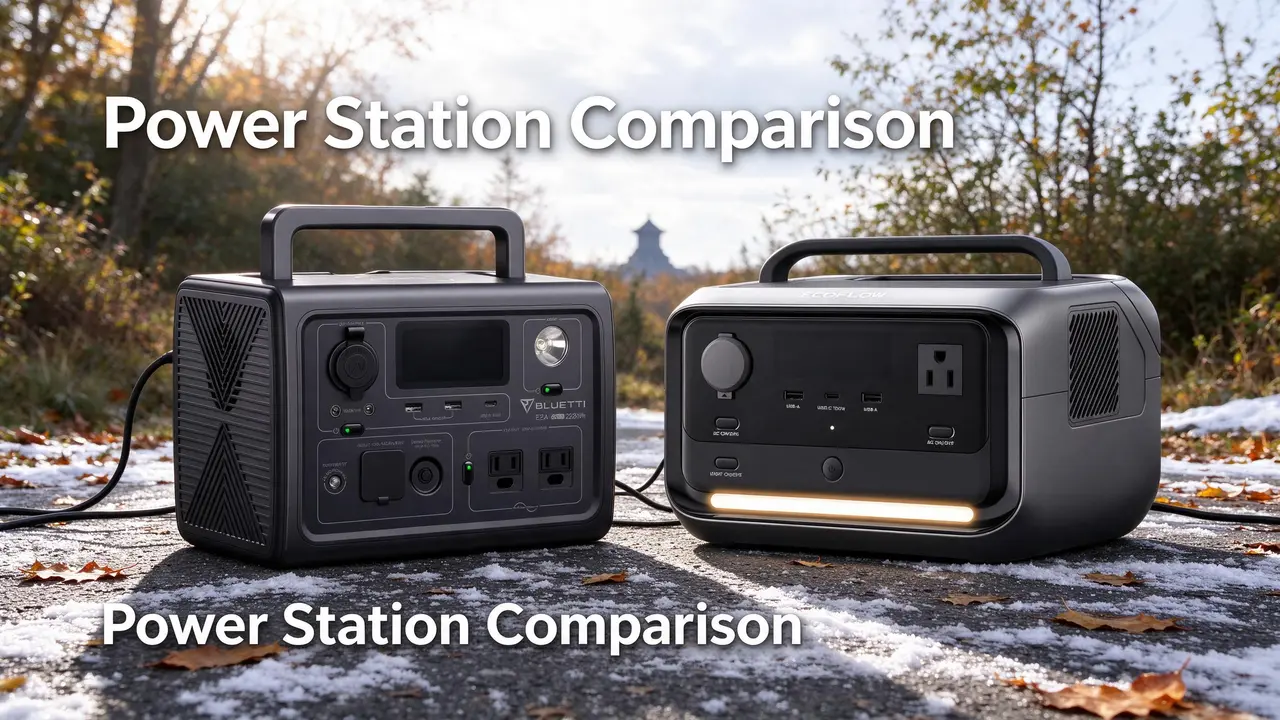
If you're shopping the 300Wh class, the BLUETTI EB3A Portable Power Station and the EcoFlow RIVER 3 Plus share a 600W continuous AC ceiling. The question isn't which is bigger — it's which trade-off you can live with.
The EB3A bets on fast AC charging and an advertised UPS pass-through mode, with a 268Wh LiFePO4 pack. Its price is not on file in the listing data used here, so we can't confirm a street price or a budget bracket — check the current price before deciding. The RIVER 3 Plus bets on a slightly larger 286Wh pack, an onboard USB-C port, and a 5-year service commitment — but it carries a $299 list price and a DC input cap that owners keep bumping into.
This is a head-to-head for campers, CPAP users, and short-outage backup buyers. It is not a whole-home backup guide, and neither unit is built to run a fridge or a space heater for hours.
- EB3A: faster AC recharge, advertised UPS mode, fan noise and random-shutdown reports in owner reviews; price not on file.
- RIVER 3 Plus: more capacity, USB-C onboard, expandable battery option, but 100W DC input limit and $299 list.
Spec snapshot
Numbers below come from the product listings, not from bench measurements. Where a figure isn't published, it's marked n/a.
| Product | List price | Capacity (Wh) | Output (W) | Weight (lb) | Rating |
|---|---|---|---|---|---|
| BLUETTI EB3A Portable Power Station | $219 | 268 Wh | 600 W | 10.1 lb | 4.62 |
| EcoFlow RIVER 3 Plus | $299 | 286 Wh | 600 W | 10.4 lb | 5.00 |
What the extra money buys
The RIVER 3 Plus lists at $299; the EB3A's price is not on file, so we can't put a dollar figure on the gap. What we can compare is configuration — the differences that explain why one costs more on paper.
Capacity: the RIVER 3 Plus lists 286Wh against the EB3A's 268Wh — about 18Wh more, or roughly 7% more nameplate energy. That's not a night-and-day difference, but it matters if you're running a CPAP or a cooler right at the edge of runtime.
Ports: the RIVER 3 Plus lists AC×3, USB-C×1, and USB-A×2. The EB3A lists AC×2, USB-A×2, and a car port; USB-C is not confirmed on the listing, so don't count on it. If you need native USB-C PD, the EcoFlow is the safer bet.
Recharge path: BLUETTI advertises AC full charge in about 45 minutes at up to 350W input, and the owner notes back up roughly 1 hour 20 minutes in silent mode. EcoFlow advertises 0–100% in about 1 hour via X-Stream, but owners repeatedly flag the ~100W DC input limit — a single 100W solar panel or a car 12V outlet won't replenish fast.
Warranty and service: EcoFlow lists a 5-year service term in the box contents. BLUETTI's listing does not publish a full warranty document in the data on file — treat that as a gap to confirm before buying, not a confirmed term. Warranty terms can also vary by region and registration, so confirm with the seller.
- Capacity: 286Wh (EcoFlow) vs 268Wh (BLUETTI) — small edge to EcoFlow.
- AC outlets: 3 (EcoFlow) vs 2 (BLUETTI).
- USB-C: confirmed onboard on EcoFlow; not confirmed on BLUETTI listing.
- DC/solar input: EcoFlow owners report ~100W cap; BLUETTI supports up to 200W solar per listing.
The spec that decides it — by buyer type
There's no single deciding spec for everyone in this class. Which number matters depends on how you'll use the unit.
Weekend campers and short-outage backup buyers: recharge speed from the wall is the deciding spec. A 268Wh or 286Wh pack is small enough that you'll be topping it up often, and the EB3A's fast AC charging (roughly 45 minutes per listing, ~1h20m in silent mode per owner notes) is a real convenience advantage. If you're recharging from solar or a car instead, the EB3A's 200W solar support per listing beats the RIVER 3 Plus's ~100W DC cap.
Desk-UPS and home-office buyers: UPS reliability is the deciding spec, not recharge speed. The RIVER 3 Plus lists a <10ms switchover and owners describe glitch-free transitions for internet and TV gear at ~113W. The EB3A also advertises a UPS mode, and some owners praise it, but critical reviews report random shutdowns and drops to 0% below 50–60% charge — a reliability risk if you're backing up a desktop or NAS.
If you need native USB-C and a slightly larger pack, the EcoFlow wins on paper. If you need the fastest wall recharge and can tolerate fan noise, the BLUETTI is the more practical pick.
How long will it actually run?
Use this table to self-check runtime. The math is simple: nameplate watt-hours × 0.85 (a rough inverter and conversion loss) ÷ device watts = estimated hours. These are estimates, not bench results, and real runtime varies with load, temperature, and battery age.
LiFePO4 packs like these typically degrade gradually — expect a few percent of capacity loss per year under normal use, more if you store them full and hot. Neither listing publishes a cycle-life figure in the data on file, so treat longevity as a general LiFePO4 expectation rather than a confirmed spec. Cold weather also cuts usable capacity — campers should expect noticeably shorter runtime below freezing.
- EB3A: strong CPAP and solar pass-through reports; fan noise and random-shutdown risk in critical reviews.
- RIVER 3 Plus: glitch-free UPS for low-draw gear; 100W DC input limit and occasional AC shutdowns reported.
| Device | Typical draw (W) | Est. hours on EB3A (268Wh) | Est. hours on RIVER 3 Plus (286Wh) |
|---|---|---|---|
| CPAP (humidifier off) | ~25 W | ~9.1 h | ~9.7 h |
| Box fan (medium) | ~40 W | ~5.7 h | ~6.1 h |
| Laptop (charging) | ~60 W | ~3.8 h | ~4.1 h |
| Router + modem | ~15 W | ~15.2 h | ~16.2 h |
| Full-size fridge | ~150 W running, higher surge | Not recommended | Not recommended |
Two worked scenarios
Weekend camper topping up nightly: you drive to a site, run lights and a fan overnight, and recharge from the car or a single solar panel the next day. Here the RIVER 3 Plus's extra 18Wh is minor, but its ~100W DC input cap means a slow refill — the EB3A's faster AC charging (if you have shore power) or its 200W solar support (per listing) wins. For this buyer, recharge speed beats the capacity edge.
Desk UPS for a home office: you want seamless switchover for a router, monitor, and laptop during short outages. The RIVER 3 Plus's advertised <10ms switchover and owner reports of glitch-free low-draw UPS behavior make it the safer pick; the EB3A's random-shutdown reports below 50–60% charge are a real risk here. For this buyer, reliability beats recharge speed.
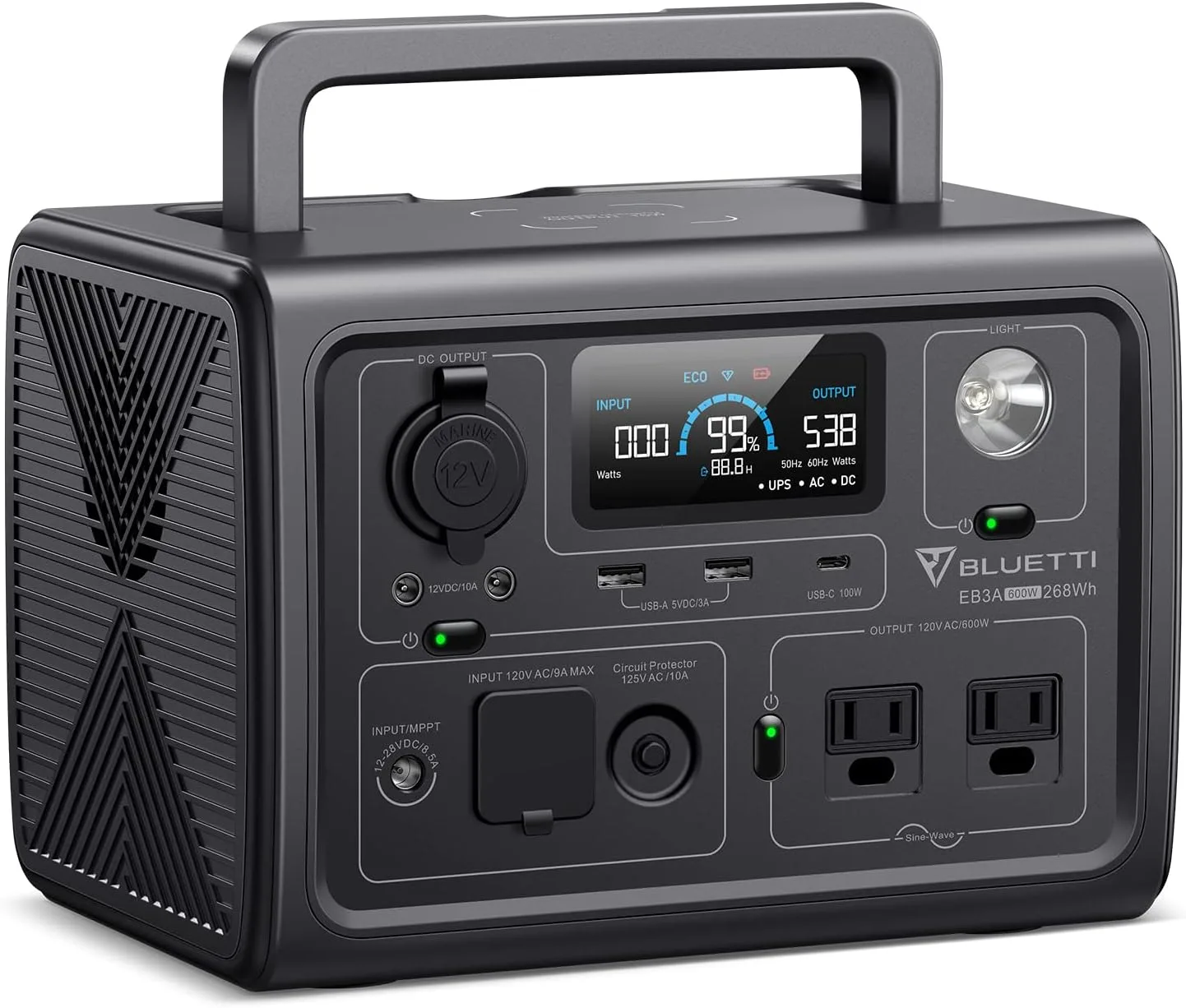
BLUETTI EB3A Portable Power Station
Highlights
- 268Wh rated capacity
- 600W continuous AC
- 1200W surge
- LiFePO4 chemistry
- Up to 200W solar input
- 10.1 lb (~4.6 kg)
Best for
- EB3A: phones, cameras and a laptop on short trips
- Travel kits when you need quiet pack power, not appliance runtime
- Brief desk backup for router and lights — not a fridge for days
Strengths
- EB3A: 268Wh pack with 600W continuous / 1200W surge — size loads to both numbers
- 10.1 lb (~4.6 kg) is the lightest-class carry in this band — easier stairs and car packing
- EB3A uses LiFePO4 — cycle-life claims usually beat older NMC marketing lines
Watch-outs · not ideal when
- EB3A's small Wh class empties fast with a kettle, hair dryer or space heater
- Usable energy on EB3A is below the 268Wh label once the inverter is working
- Rated 200W solar on EB3A is optimistic; shade and cables cut real watts
- Airline and pack limits may still block EB3A even when the weight looks friendly
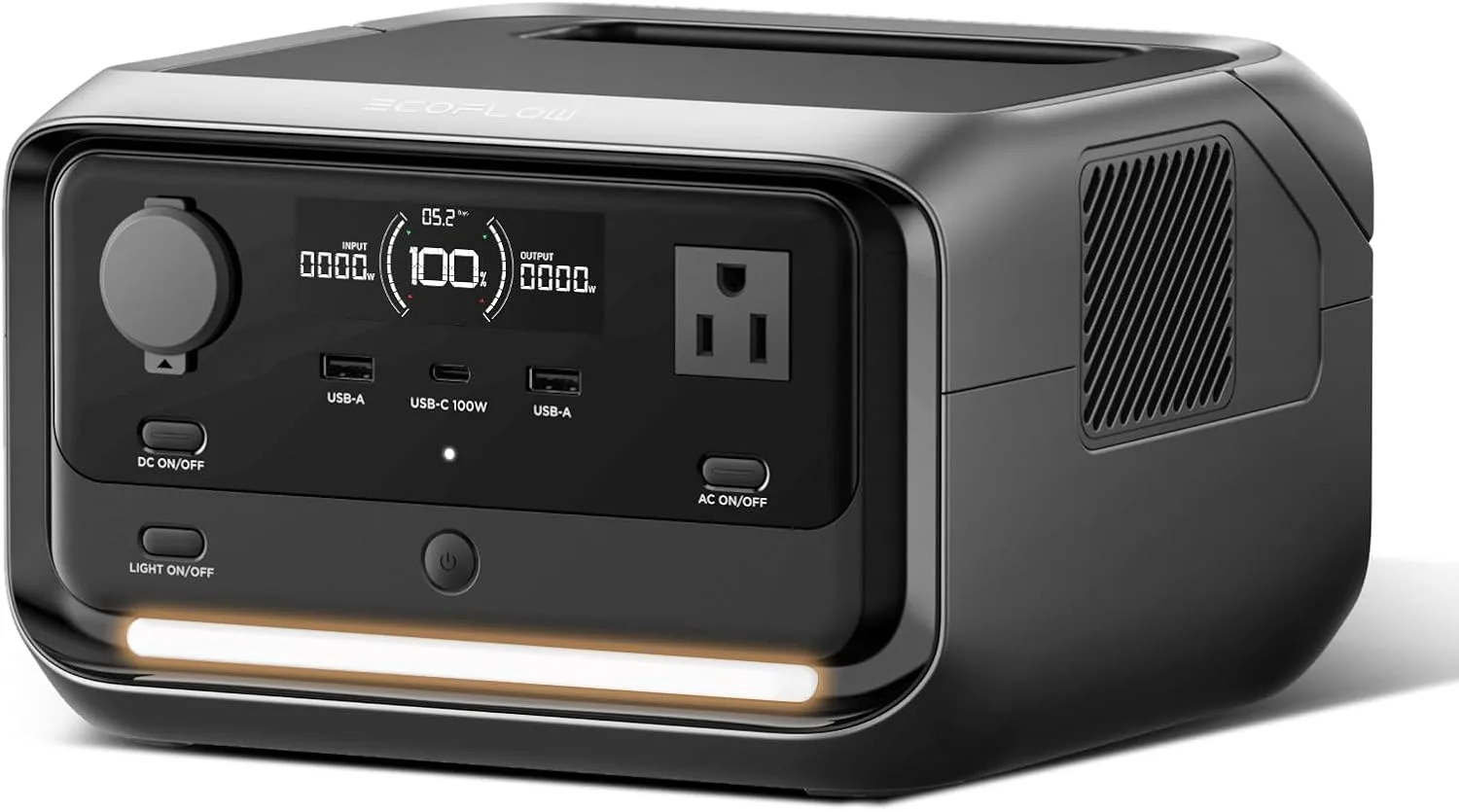
EcoFlow RIVER 3 Plus
Highlights
- 286Wh rated capacity
- 600W continuous AC
- 1200W surge
- LiFePO4 chemistry
- Up to 220W solar input
- 10.4 lb (~4.7 kg)
Best for
- RIVER 3 Plus: phones, cameras and a laptop on short trips
- Travel kits when you need quiet pack power, not appliance runtime
- Brief desk backup for router and lights — not a fridge for days
Strengths
- RIVER 3 Plus: 286Wh pack with 600W continuous / 1200W surge — size loads to both numbers
- 10.4 lb (~4.7 kg) is the lightest-class carry in this band — easier stairs and car packing
- 10ms-class UPS switchover on the listing — useful when a router restart would hurt
- About $299 list in the Hub catalog — confirm live retail before you buy
Watch-outs · not ideal when
- RIVER 3 Plus's small Wh class empties fast with a kettle, hair dryer or space heater
- Usable energy on RIVER 3 Plus is below the 286Wh label once the inverter is working
- Rated 220W solar on RIVER 3 Plus is optimistic; shade and cables cut real watts
- Airline and pack limits may still block RIVER 3 Plus even when the weight looks friendly
Real owner trade-offs
Owner feedback on both units is mixed, and the themes matter more than the star averages. This is the one place we consolidate owner reports — the FAQ below sticks to listing facts and the scenarios above.
EB3A owners praise CPAP runtime (one reported 10.5 hours with the heater off, still 15–20% left after a 9.5-hour night) and solar pass-through for a box fan. But fan noise is a repeated complaint — even in silent mode, owners describe a high-pitched ramp-up and controller buzz. More seriously, multiple critical reviews report units shutting down randomly and dropping to 0% below 50–60% charge, even with tiny loads. The app can also drain the battery if left connected.
RIVER 3 Plus owners like the compact size, the intuitive app, and the UPS mode for home office gear. The recurring frustration is the ~100W DC input cap — one camper noted they couldn't get more than 100W from a single solar panel or car outlet, which slowed replenishment. A few owners report intermittent AC shutdowns and needed replacements; customer service can be hard to reach, though one owner praised the replacement process once contact was made.
Buy the one that…
Buy the BLUETTI EB3A Portable Power Station if you want the fastest wall recharge in this class, you're mostly running light loads (phones, fans, CPAP with heater off), and you can accept audible fan noise and the risk of a bad unit. Skip it if you need rock-solid UPS reliability for a desktop or NAS, if native USB-C is a must, or if you need a confirmed price and warranty before buying — neither is on file.
Buy the EcoFlow RIVER 3 Plus if you want a slightly larger pack, confirmed USB-C, a 5-year service term, and a UPS mode that owners describe as glitch-free for low-draw gear. Skip it if you plan to recharge primarily from a single 100W solar panel or a car outlet — the ~100W DC input cap will frustrate you — or if $299 list is above your budget.
Who this is NOT for
If you need to run a fridge, space heater, or whole-home circuits, neither unit is appropriate — step up to a larger model. If you require a confirmed warranty term and a published price before purchase, the EB3A's listing data on file doesn't provide either; verify with the seller first. And if you need native USB-C without checking, the EB3A's listing doesn't confirm it.
Verify before you buy
Because the EB3A's price and warranty aren't in the listing data on file, close those gaps before you commit. A few minutes of checking prevents a bad surprise.
- Price: confirm the current EB3A street price at checkout — it's not on file here, so don't assume it's cheaper than the RIVER 3 Plus's $299 list.
- Warranty: ask the seller for the EB3A's written warranty term and length; terms can vary by region and registration.
- Return window: check the return policy on both units, especially if you're buying the EB3A and want to test for random shutdowns during the return period.
- Cold weather: if you camp below freezing, expect reduced usable capacity from either LiFePO4 pack — plan extra margin.
Frequently asked
Can either unit run a full-size refrigerator?
No — both are 600W continuous, and a fridge's startup surge plus multi-hour runtime will exceed what a 268–286Wh pack can deliver. Owners on both sides say step up to a larger model for fridge backup.
How long will the EB3A run a CPAP?
Owner notes report about 10.5 hours with the humidifier off, with 15–20% remaining after a 9.5-hour night. Runtime varies with pressure settings and heater use.
Does the RIVER 3 Plus have USB-C?
Yes — the listing confirms USB-C×1. The EB3A's listing does not confirm USB-C, so don't assume it.
Which recharges faster from solar?
The EB3A supports up to 200W solar input per listing; RIVER 3 Plus owners report a ~100W DC input cap. For solar-heavy use, the BLUETTI has the edge on paper.
Can I pair either unit with an existing 100W solar panel or my car's 12V outlet?
Yes — both accept DC input, but the RIVER 3 Plus's ~100W DC cap means a single 100W panel or car outlet will recharge it slowly; the EB3A's 200W solar support per listing lets you add a second panel for faster refill.
Method and sources
Model names and list prices come from the WattPicks catalog at build time. WattPicks does not run its own laboratory tests on power stations, and nothing on this page is presented as a measured result — it is catalog-backed buying guidance.
Read our methodology for how the catalog is normalized, and about WattPicks for who publishes it.