
DJI Power 2000 vs EcoFlow DELTA 3 Max: Outage Backup Pick
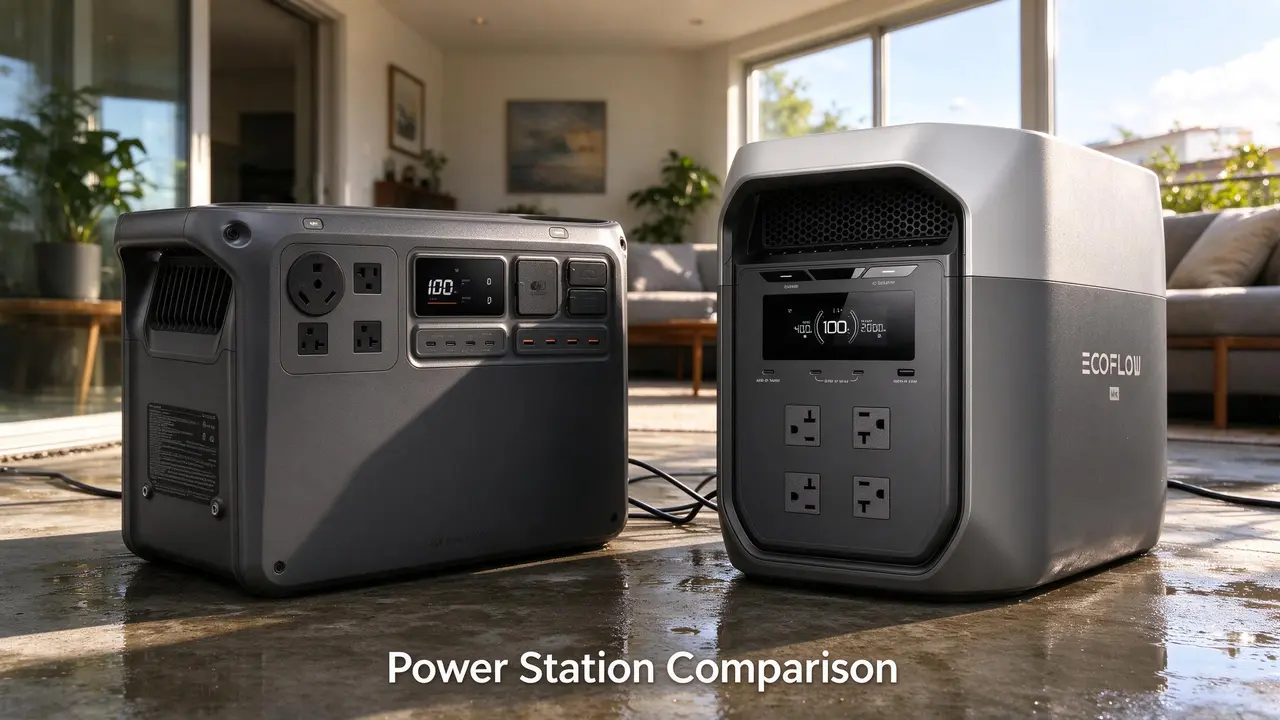
Two 2048 Wh LFP stations, one $162 apart. The DJI wins on price and USB-C count; the EcoFlow wins on continuous output and UPS polish. Here is how to pick for your outage.
Updated
At a glance
Two 2048 Wh LFP stations, one $162 apart. The DJI wins on price and USB-C count; the EcoFlow wins on continuous output and UPS polish. Here is how to pick for your outage.
Same money, different bets
As an Amazon Associate I earn from qualifying purchases. Recommendations here are based on fit and the evidence below — not commission size.
You are shopping a 2048 Wh LFP station for outages, and these two land in the same budget bracket — $1,036.99 for the DJI Power 2000 Portable Power Station, 2048Wh LFP Battery versus $1,199 for the EcoFlow DELTA 3 Max Portable Power Station, 2048Wh LFP Battery. That $162 gap is not huge, but the two units spend it differently.
The DJI bets on price and port count: four USB-C and four USB-A ports, a 2000 W continuous inverter, and a 10 ms UPS mode. The EcoFlow bets on headroom and polish: 2400 W continuous, a 10 ms transfer time, an app with Storm Guard, and a lighter 44.8 lb body. Neither is a whole-home solution — this page is about keeping a fridge, router, and a few electronics alive, not running a furnace or central AC.
Scenario split: if your backup is home-only and your loads stay under 2000 W, the DJI's price and ports win. If you also camp or tailgate and want one box that can run a bigger single appliance, the EcoFlow's extra headroom and lighter body justify the premium.
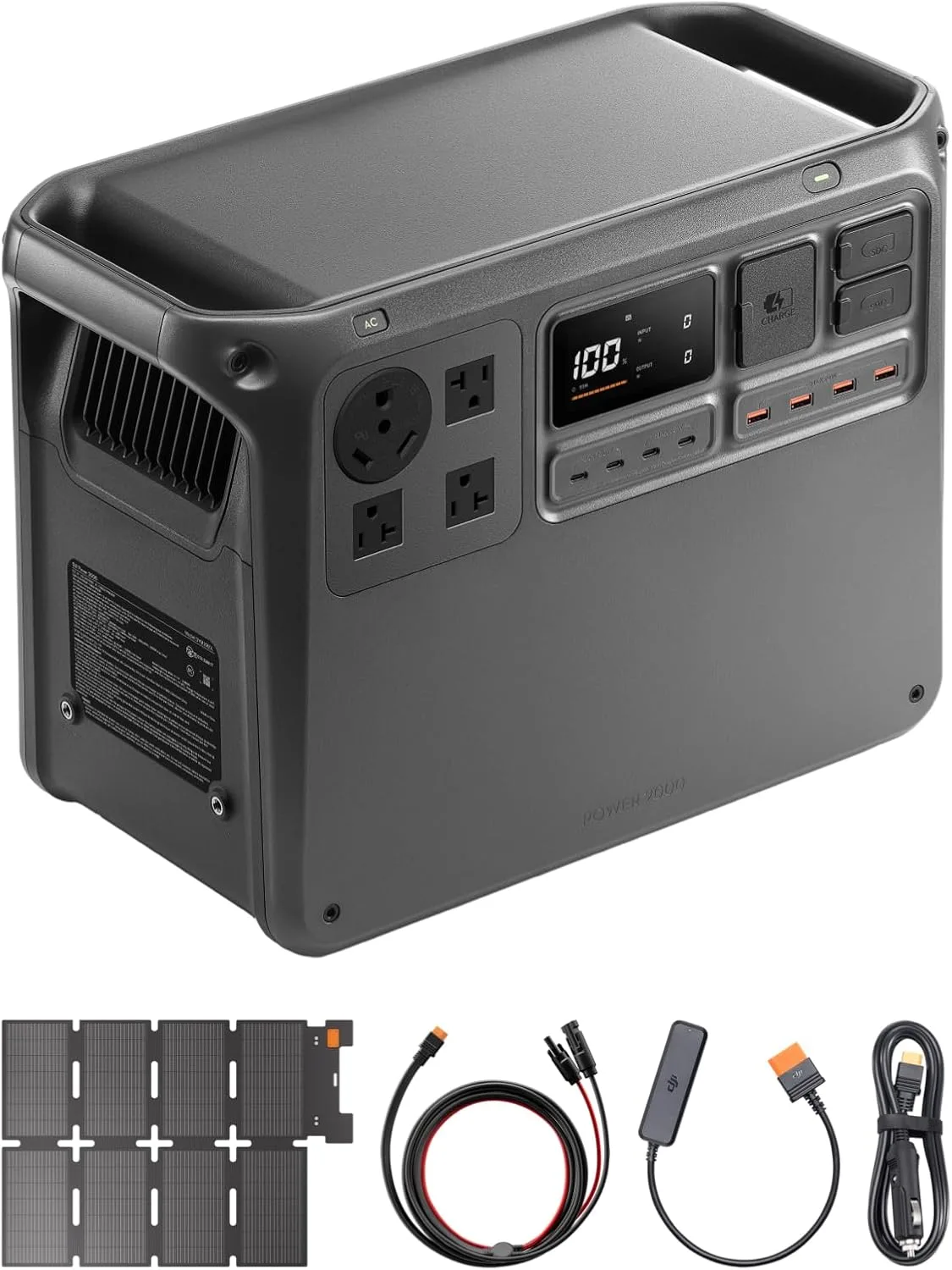
DJI DJI Power 2000
Highlights
- 2048Wh rated capacity
- 2000W continuous AC
- LiFePO4 chemistry
- 48.5 lb (~22.0 kg)
- About $1036.99 list
Best for
- Power 2000: longer outages or higher continuous loads (still not whole-home wiring)
- RV / off-grid days where recharge speed matters as much as Wh
- Best parked near the vehicle or cabin — not a long carry to a tent
Strengths
- Power 2000: 2000W continuous on a 2048Wh pack — more headroom for small appliances than 1kW-class peers
- 48.5 lb (~22.0 kg) is a park-and-use chassis — plan a short path, not a trail hike
- 2000W continuous headroom covers more small appliances than 1kW-class inverters
- Owners on file: 5/5 · 13 helpful — This product is perfect for camping, or also if you are looking for a back up at home, it…
Watch-outs · not ideal when
- At 48.5 lb (~22.0 kg), Power 2000 is a poor tent-hike companion — plan a cart or leave it in the vehicle
- High continuous output on Power 2000 tempts big loads — Wh still runs out on kettles and A/C
- Power 2000: solar/car charging is accessory-dependent on the listing — not a built-in published input ceiling
- LiFePO4 helps longevity, but Power 2000 still hates freezing charge temps on winter trips
Owner voices
Short takes from public retail reviews — paraphrased or translated when long or non-English; meaning kept close to the original.
“5/5 · 13 helpful — This product is perfect for camping, or also if you are looking for a back up at home, it can stand a fan for 10 hours, and it get recharge really fast, lest than 2 hours for the full charge. I live…”
“1/5 · 5 helpful — Maybe I am doing something wrong or maybe its a bad unit. I bought the power 1000 and long story short I have an error code of 2 and 62. I got this unit because I am homeless and needed to power thin…”
“5/5 · 4 helpful — This portable generator is quiet, efficient and powerful. I purchased the modal that came with a solar panel and it is solid material and seems more sturdy than I’d expected. I ended up purchasing th…”
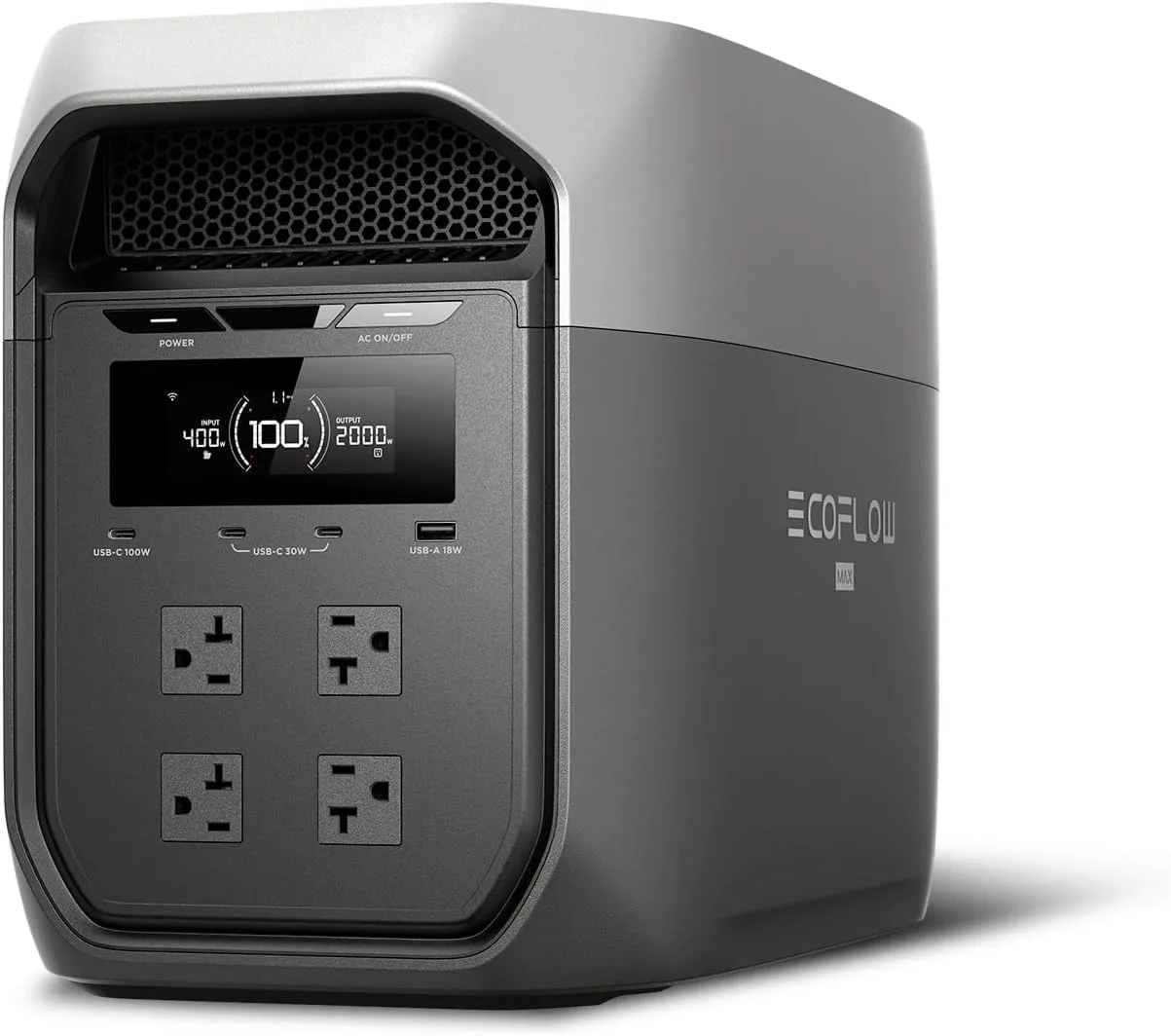
EcoFlow DELTA 3 Max Portable Power Station, 2048Wh LFP Battery
Highlights
- 2048Wh rated capacity
- 2400W continuous AC
- 4800W surge
- LiFePO4 chemistry
- Up to 500W solar input
- 44.8 lb (~20.3 kg)
Best for
- DELTA 3 Max: longer outages or higher continuous loads (still not whole-home wiring)
- RV / off-grid days where recharge speed matters as much as Wh
- Best parked near the vehicle or cabin — not a long carry to a tent
Strengths
- DELTA 3 Max: 2048Wh pack with 2400W continuous / 4800W surge — size loads to both numbers
- 44.8 lb (~20.3 kg) is a park-and-use chassis — plan a short path, not a trail hike
- 10ms-class UPS switchover on the listing — useful when a router restart would hurt
- About $1199 list in the Hub catalog — confirm live retail before you buy
Watch-outs · not ideal when
- At 44.8 lb (~20.3 kg), DELTA 3 Max is a poor tent-hike companion — plan a cart or leave it in the vehicle
- High continuous output on DELTA 3 Max tempts big loads — Wh still runs out on kettles and A/C
- Rated 500W solar on DELTA 3 Max is optimistic; shade and cables cut real watts
- LiFePO4 helps longevity, but DELTA 3 Max still hates freezing charge temps on winter trips
Spec snapshot
Both units are 2048 Wh LFP, so capacity is a wash. The table below uses list prices and listing specs only; the EcoFlow's current deal price is not used here because it is not the list price.
| Product | List price | Capacity (Wh) | Output (W) | Weight (lb) | Rating |
|---|---|---|---|---|---|
| DJI Power 2000 Portable Power Station, 2048Wh LFP Battery | $1,036.99 | 2048 Wh | 2000 W | 48.5 lb | 4.50 |
| EcoFlow DELTA 3 Max Portable Power Station, 2048Wh LFP Battery | $1,199 | 2048 Wh | 2400 W | 44.8 lb | 5.00 |
Where the money went
Four configuration differences explain most of the price gap. First, continuous output: the EcoFlow's 2400 W inverter gives you roughly 400 W more headroom than the DJI's 2000 W. That matters if you want to run a space heater, a large microwave, or a power tool alongside a fridge. The DJI's 2000 W is fine for a fridge (typically 100–200 W running, with a startup surge), a router, fans, and electronics, but it will trip on bigger resistive loads.
Second, ports. The DJI carries AC×4, USB-C×4, and USB-A×4. The EcoFlow carries AC×4, USB-C×1, and USB-A×1. If your outage kit is phones, tablets, laptops, and a drone, the DJI's USB-C count is a real convenience — you can charge four USB-C devices without a hub. The EcoFlow's single USB-C port is the weak spot one experienced owner flagged, wishing for a 140 W USB output next to the 100 W port.
Third, weight and placement. The EcoFlow is 44.8 lb; the DJI is 48.5 lb. Neither is a one-hand carry, but the EcoFlow's lighter body and app-based monitoring make it easier to treat as a semi-stationary UPS. The DJI's weight came up even in positive owner reviews as a lug-it-carefully unit.
Fourth, solar and accessories. The DJI's solar charging is not turnkey: multiple owners had to buy an MPPT solar adapter separately, and one noted the car-charger cable arrived in a separate box later. The EcoFlow's solar input spec is not on file, so treat solar expansion as unverified — confirm the exact input wattage on the manufacturer spec sheet before purchase rather than assuming parity.
- Continuous output: EcoFlow 2400 W vs DJI 2000 W — the EcoFlow runs bigger single loads.
- USB-C ports: DJI 4 vs EcoFlow 1 — the DJI is better for a multi-device charging table.
- Weight: EcoFlow 44.8 lb vs DJI 48.5 lb — both are two-hand units, EcoFlow is easier to reposition.
- Solar: DJI needs a separately sold MPPT adapter per owner reports; EcoFlow solar input unverified — confirm on the spec sheet.
The spec that decides it
For most outage buyers, the deciding number is continuous output, not capacity. Both are 2048 Wh, so runtime on the same load is close. The EcoFlow's 2400 W continuous means you can run a fridge and a microwave, or a fridge and a space heater, without overloading the inverter. The DJI's 2000 W continuous is enough for a fridge plus electronics, but it will not carry a 1500 W space heater and a 1000 W microwave at the same time.
The second deciding factor is UPS behavior. Both list a 10 ms transfer time — that is a manufacturer listing claim, not a lab-verified number — which is fast enough for a PC and router to ride through an outage without rebooting. The EcoFlow's app and Storm Guard add remote monitoring and status checks that owners specifically praised; the DJI has no comparable app feature on file. If you want to check battery state from your phone during a storm, the EcoFlow is the more polished UPS substitute.
How we compared (method and weighting)
This is a review-synthesis comparison, not a hands-on lab test. We did not run either unit on a bench. Instead, we reconciled two evidence streams: (1) manufacturer listing specs and list prices, and (2) owner reviews and owner notes, which we paraphrase and label as owner themes rather than verified measurements. Where a spec is not on file — the EcoFlow solar input — we mark it unverified and tell you to confirm it on the spec sheet before purchase.
To decide which unit wins for a given buyer, we weighted the four configuration differences by how often they change an outage outcome, then traced each to a High/Med/Low execution score. This is the scoreboard behind the pick:
Continuous output — High weight. EcoFlow 2400 W vs DJI 2000 W. Execution: EcoFlow High (runs fridge plus a bigger single load); DJI Med (fine for fridge plus electronics, trips on stacked resistive loads).
Ports — Med weight. DJI 4× USB-C vs EcoFlow 1× USB-C. Execution: DJI High (multi-device table without a hub); EcoFlow Low (single USB-C is the flagged weak spot).
Weight and placement — Low weight. EcoFlow 44.8 lb vs DJI 48.5 lb. Execution: EcoFlow Med (easier to reposition as a semi-stationary UPS); DJI Med (two-hand carry either way).
Solar and accessories — Med weight. DJI needs a separately sold MPPT adapter per owner reports. Execution: DJI Low (not turnkey); EcoFlow Unverified (solar input not on file — confirm before purchase).
Net: continuous output carries the most weight for outage buyers, which is why the EcoFlow is the default pick when budget allows; the DJI wins on ports and price when your loads stay under 2000 W.
- Evidence method: listing specs + owner-review synthesis; no hands-on bench testing.
- High weight: continuous output. Med: ports, solar. Low: weight/placement.
- Unverified items are labeled and flagged for pre-purchase confirmation.
Runtime math for a real outage
Capacity only means something once you convert your load list to watt-hours (Wh). Both units are 2048 Wh, so the same load list gives nearly the same runtime on either — the difference is whether the inverter can carry the load at all. Use these estimates to self-check your own kit, and remember usable capacity is less than nameplate after inverter losses.
Sample outage load list (estimated Wh/day): a full-size fridge at a 30–50% duty cycle drawing 100–200 W running averages roughly 720–2,400 Wh/day; a router at ~10 W is ~240 Wh/day; a laptop at ~50 W for 8 hours is ~400 Wh/day. That trio lands around 1,360–3,040 Wh/day depending on fridge duty cycle — so a 2048 Wh station covers roughly one day of a light fridge cycle, or less if the fridge runs hot. For a tighter estimate, assume a 150 W fridge running at 40% duty: 150 W × 0.4 × 24 h = 1,440 Wh/day, which leaves about 600 Wh for everything else after inverter losses.
Startup surge is the other half of the math. A fridge compressor can briefly pull several times its running wattage. The EcoFlow's 2400 W continuous gives about 400 W more headroom than the DJI's 2000 W for that surge plus anything else running at the same time — which is why the EcoFlow is the safer pick if you want the fridge and a second appliance on together.
| Load | Estimated draw | Estimated Wh/day | Notes |
|---|---|---|---|
| Full-size fridge (30–50% duty cycle) | 100–200 W running | ~720–2,400 Wh | Duty cycle drives the range; startup surge is higher |
| Router | ~10 W | ~240 Wh | Continuous 24 h |
| Laptop | ~50 W for 8 h | ~400 Wh | Charging plus use |
| Sample trio total | — | ~1,360–3,040 Wh/day | Compare to 2048 Wh nameplate; usable is lower after inverter losses |
Real owner trade-offs
The DJI's most-helpful owner review is a home-backup and camping story: a fan ran about ten hours on a charge, and the unit recharged to full in under two hours. That fast recharge is the detail I would repeat — short outages do not leave you waiting. Other owners describe it as quiet and more solidly built than expected. The caveats are weight and solar accessories. One critical review (the reviewer's own account, not independently verified) reported error codes and an 850 W gaming PC that would not run, with support unable to diagnose it and offering only a partial discount or return. That is one data point, but it is worth knowing if you plan to run a high-draw gaming rig.
The EcoFlow's top owner review is a UPS-substitute story: a PC, modem, and routers stayed up through outages on the 10 ms transfer, and the app's Storm Guard got specific praise. Multiple owners report a full recharge in a little over an hour. One long-time EcoFlow owner ran a 12V fridge at 36°F for a little over five days and called the unit a beast for powering loads — their only complaint was the single USB-C port. Build quality and capacity come up repeatedly; the honest watch-out is that it is a large box, so plan where it lives rather than hauling it daily.
- DJI owner theme: fast recharge (under two hours) and quiet operation; caveats are weight and a separately sold MPPT solar adapter.
- EcoFlow owner theme: 10 ms UPS transfer kept WiFi and PC up; caveat is a single USB-C port and semi-stationary weight.
Which one fits your outage
If your outage kit is a fridge, router, fans, and a family charging table, the DJI Power 2000 Portable Power Station, 2048Wh LFP Battery is the value pick: lower list price, four USB-C ports, and enough continuous output for that load list under 2000 W. Pass on it if you plan to stack a 1500 W space heater with a microwave, or if you want turnkey solar without sourcing an MPPT adapter.
If you want more inverter headroom, a polished UPS substitute with app monitoring, and a lighter body for semi-stationary placement, the EcoFlow DELTA 3 Max Portable Power Station, 2048Wh LFP Battery is the pick — provided the $162 premium over the DJI is not a hard ceiling and one USB-C port (or a hub) covers your devices.
Skip both if you need whole-home backup (these are not transfer-switch or panel solutions), if your only use is RV-only with high continuous loads, or if your budget is under $800. Also weigh LFP cycle life: both use LFP chemistry, which degrades gradually with full cycles and high heat, so capacity will fade over years of heavy use — plan for reduced runtime long-term rather than nameplate 2048 Wh forever.
Config/version caveat: bundles, regional SKUs, and firmware can change port counts, included cables, and app features. Confirm the exact bundle and region before purchase; the specs here reflect the listings as described.
Frequently asked
Can either unit run a full-size fridge during an outage?
Both are 2048 Wh and list continuous output above a typical fridge's running draw (100–200 W), so yes for a standard fridge, with runtime depending on duty cycle. The EcoFlow's 2400 W gives more startup-surge headroom.
Do I need to buy a solar adapter for the DJI?
Owner reports say yes — the MPPT solar adapter is sold separately, and one owner noted the car-charger cable arrived in a separate box. The EcoFlow's solar input is unverified — confirm the exact input wattage on the manufacturer spec sheet before purchase.
Which is better for a home office UPS?
The EcoFlow's 10 ms transfer (a manufacturer listing claim) and app monitoring make it the more polished UPS substitute; the DJI also lists 10 ms but has no comparable app feature on file.
Can the DJI run a gaming PC?
One critical owner review (not independently verified) reported an 850 W gaming PC would not run and hit error codes. Verify compatibility before buying if that is your load.
Method and sources
Model names and list prices come from the WattPicks catalog at build time. WattPicks does not run its own laboratory tests on power stations, and nothing on this page is presented as a measured result — it is catalog-backed buying guidance.
Read our methodology for how the catalog is normalized, and about WattPicks for who publishes it.