
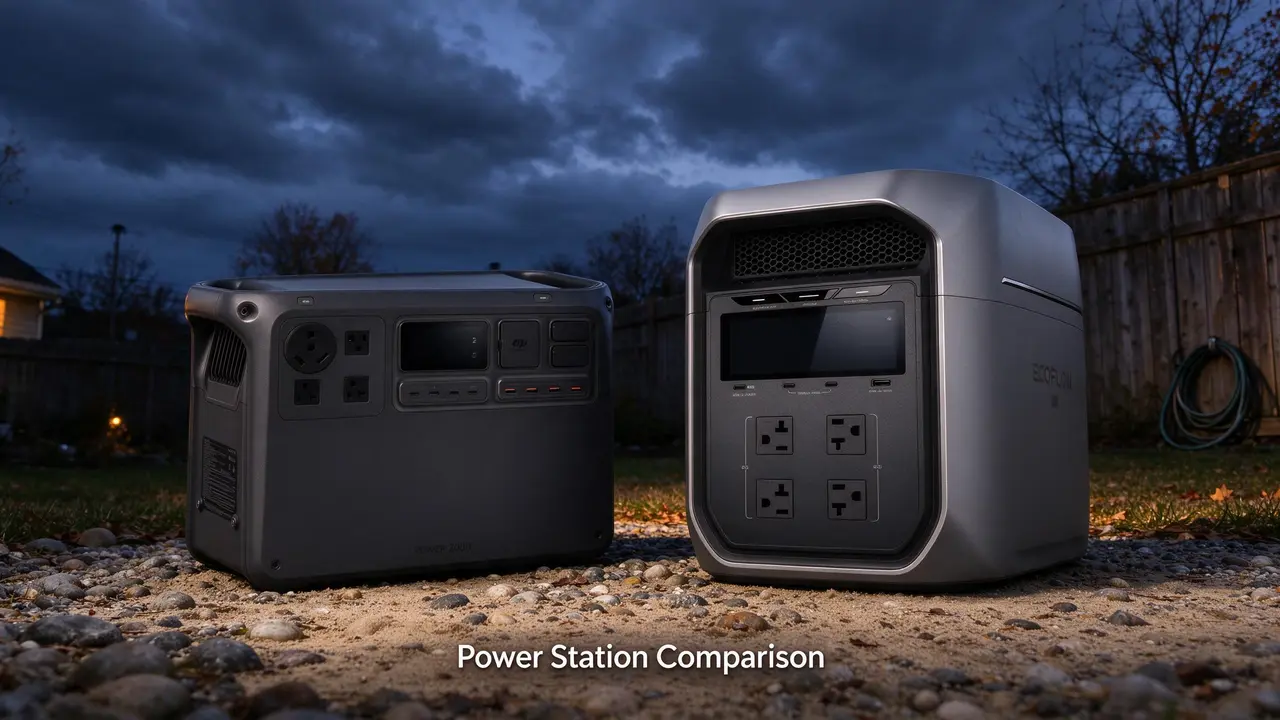
DJI Power 2000 vs EcoFlow DELTA 3 Max Plus: 2kWh Duel
Two 2,048 Wh LFP stations at very different prices. The DJI wins on dollars per watt-hour and USB-C count; the EcoFlow wins on continuous output and expandability. Here's how to pick.
Updated
At a glance
Two 2,048 Wh LFP stations at very different prices. The DJI wins on dollars per watt-hour and USB-C count; the EcoFlow wins on continuous output and expandability. Here's how to pick.
- DJI bet: capacity per dollar + port variety (USB-C×4, USB-A×4, AC×4)
- EcoFlow bet: continuous watts + expandable ecosystem (up to 10 kWh) + app control
Same money, different bets
As an Amazon Associate I earn from qualifying purchases. Recommendations here are based on fit and the evidence below — not commission size.
At $1,036.99 the DJI Power 2000 Portable Power Station, 2048Wh LFP Battery is the value play: same 2,048 Wh LFP capacity as the EcoFlow DELTA 3 Max Plus, but roughly $860 cheaper at list. The EcoFlow, at $1,899, asks you to pay for 3,000 W continuous output, expandability up to 10 kWh, and a more polished app experience.
This is not a case where both are equally good. The DJI bets you want maximum watt-hours per dollar and enough outlets to run a small apartment's essentials. The EcoFlow bets you need to run a 3,000 W load — a space heater, a large microwave, a welder — or plan to stack extra batteries later. If neither of those describes you, the DJI is the more sensible purchase.
One boundary up front: neither unit is a whole-home backup solution on its own. They're portable stations for circuits, not panel-level backup. If you're wiring a transfer switch, you're in a different product category.
- DJI bet: capacity per dollar + port variety (USB-C×4, USB-A×4, AC×4)
- EcoFlow bet: continuous watts + expandable ecosystem (up to 10 kWh) + app control
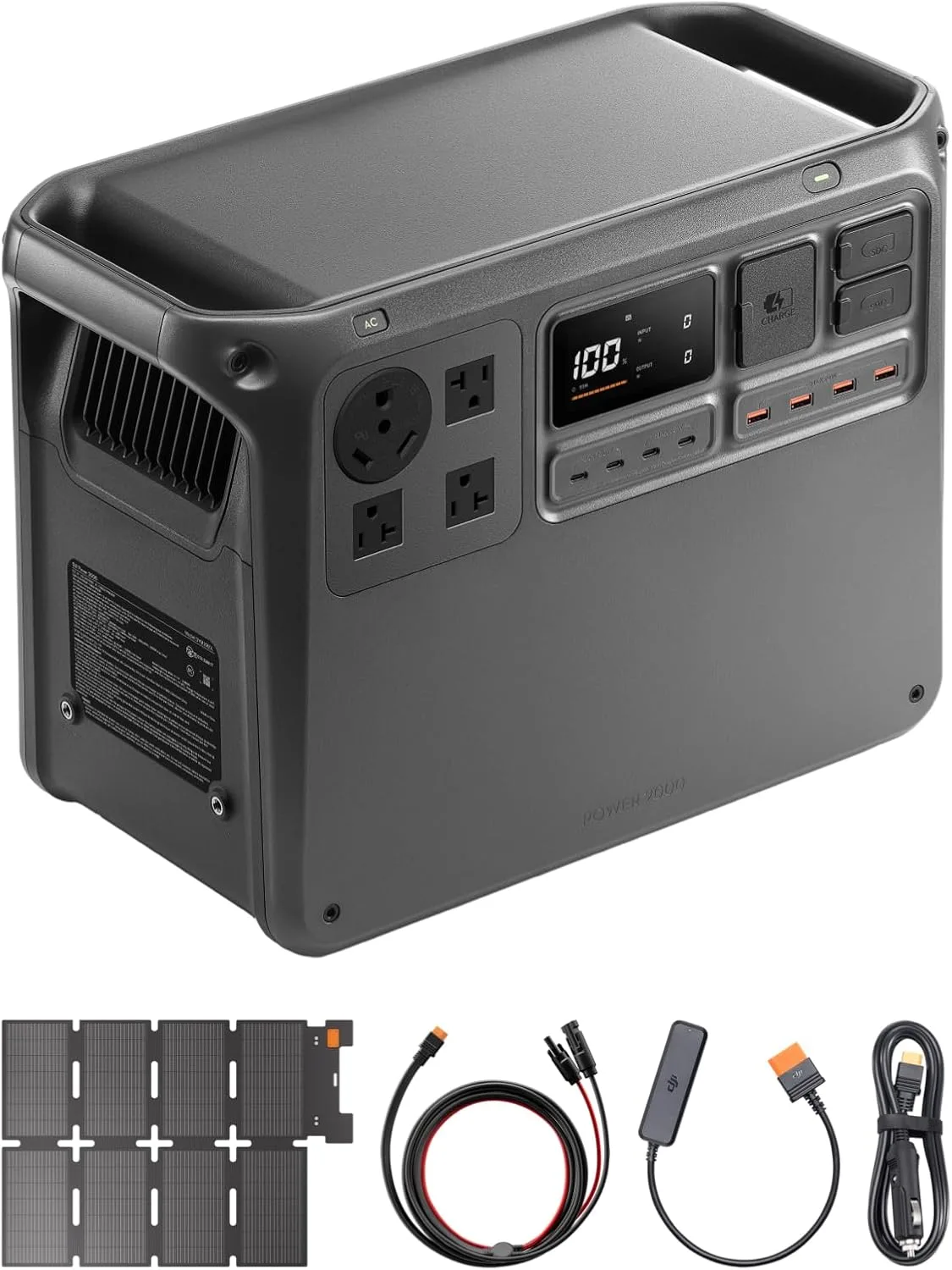
DJI DJI Power 2000
Highlights
- 2048Wh rated capacity
- 2000W continuous AC
- LiFePO4 chemistry
- 48.5 lb (~22.0 kg)
- About $1036.99 list
Best for
- Power 2000: longer outages or higher continuous loads (still not whole-home wiring)
- RV / off-grid days where recharge speed matters as much as Wh
- Best parked near the vehicle or cabin — not a long carry to a tent
Strengths
- Power 2000: 2000W continuous on a 2048Wh pack — more headroom for small appliances than 1kW-class peers
- 48.5 lb (~22.0 kg) is a park-and-use chassis — plan a short path, not a trail hike
- 2000W continuous headroom covers more small appliances than 1kW-class inverters
- Owners on file: 5/5 · 13 helpful — This product is perfect for camping, or also if you are looking for a back up at home, it…
Watch-outs · not ideal when
- At 48.5 lb (~22.0 kg), Power 2000 is a poor tent-hike companion — plan a cart or leave it in the vehicle
- High continuous output on Power 2000 tempts big loads — Wh still runs out on kettles and A/C
- Power 2000: solar/car charging is accessory-dependent on the listing — not a built-in published input ceiling
- LiFePO4 helps longevity, but Power 2000 still hates freezing charge temps on winter trips
Owner voices
Short takes from public retail reviews — paraphrased or translated when long or non-English; meaning kept close to the original.
“5/5 · 13 helpful — This product is perfect for camping, or also if you are looking for a back up at home, it can stand a fan for 10 hours, and it get recharge really fast, lest than 2 hours for the full charge. I live…”
“1/5 · 5 helpful — Maybe I am doing something wrong or maybe its a bad unit. I bought the power 1000 and long story short I have an error code of 2 and 62. I got this unit because I am homeless and needed to power thin…”
“5/5 · 4 helpful — This portable generator is quiet, efficient and powerful. I purchased the modal that came with a solar panel and it is solid material and seems more sturdy than I’d expected. I ended up purchasing th…”
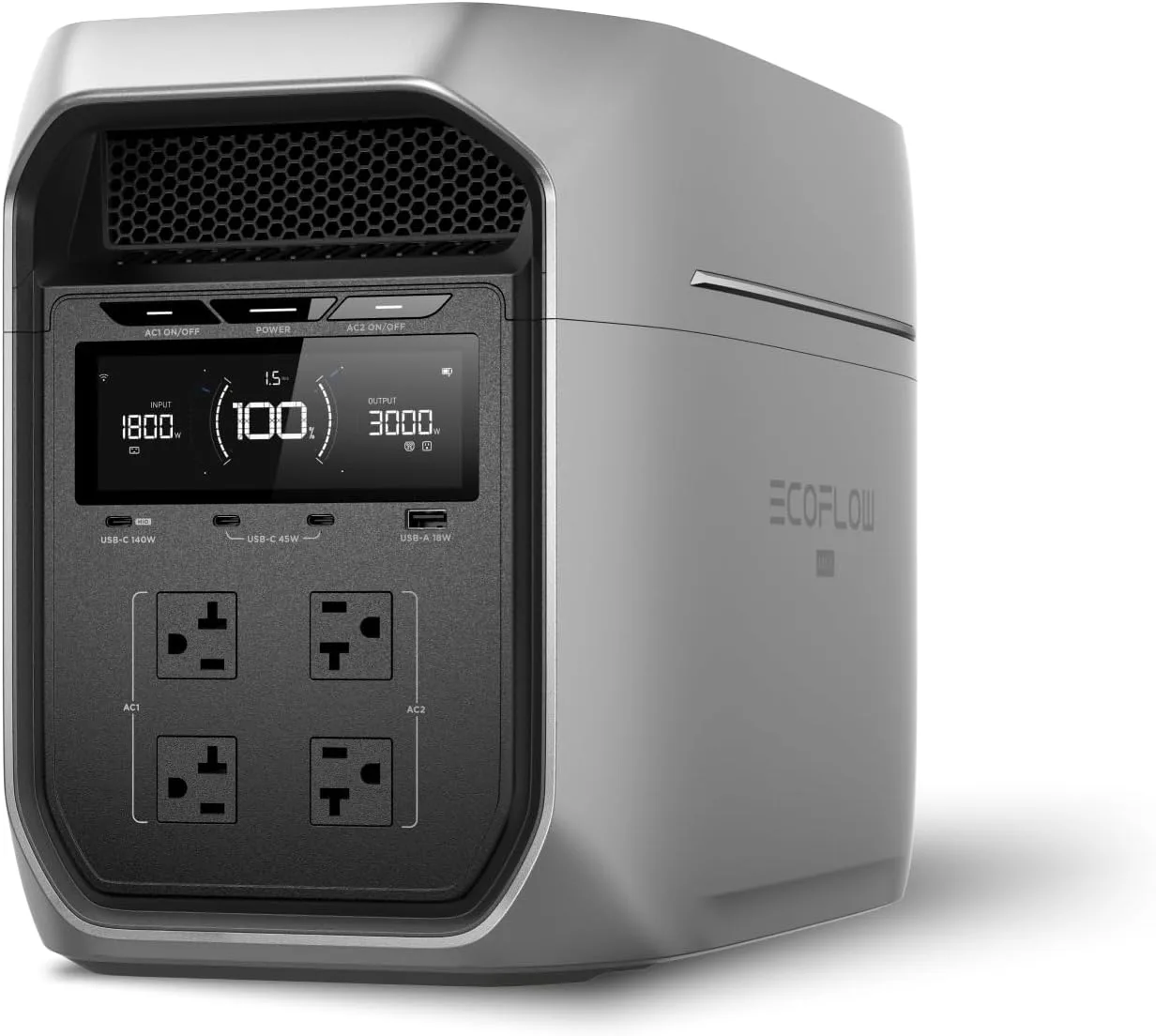
EcoFlow DELTA 3 Max Plus
Highlights
- 2048Wh rated capacity
- 3000W continuous AC
- 6000W surge
- LiFePO4 chemistry
- 48.7 lb (~22.1 kg)
- About $1899 list
Best for
- DELTA 3 Max Plus: longer outages or higher continuous loads (still not whole-home wiring)
- RV / off-grid days where recharge speed matters as much as Wh
- Best parked near the vehicle or cabin — not a long carry to a tent
Strengths
- DELTA 3 Max Plus: 2048Wh pack with 3000W continuous / 6000W surge — size loads to both numbers
- 48.7 lb (~22.1 kg) is a park-and-use chassis — plan a short path, not a trail hike
- 3000W continuous headroom covers more small appliances than 1kW-class inverters
- Owners on file: 5/5 · 6 helpful — I waited a while to leave this review. I bought this power station for one reason which was…
Watch-outs · not ideal when
- At 48.7 lb (~22.1 kg), DELTA 3 Max Plus is a poor tent-hike companion — plan a cart or leave it in the vehicle
- High continuous output on DELTA 3 Max Plus tempts big loads — Wh still runs out on kettles and A/C
- Solar input unpublished for DELTA 3 Max Plus — do not assume a same-day off-grid refill
- LiFePO4 helps longevity, but DELTA 3 Max Plus still hates freezing charge temps on winter trips
Spec snapshot
Prices are list; ratings are listing aggregates, not owner proof. Weight in pounds as listed.
| Product | List price | Capacity (Wh) | Output (W) | Weight (lb) | Rating |
|---|---|---|---|---|---|
| DJI Power 2000 Portable Power Station, 2048Wh LFP Battery | $1,036.99 | 2048 Wh | 2000 W | 48.5 lb | 4.50 |
| EcoFlow DELTA 3 Max Plus | $1,899 | 2048 Wh | 3000 W | 48.7 lb | 5.00 |
Where the money went
The $862 price gap buys you four things on the EcoFlow: 1,000 more continuous watts, expandability to 10 kWh via extra batteries, a 10 ms UPS transfer (the DJI also lists 10 ms), and app-based monitoring. The DJI counters with more USB ports — four USB-C and four USB-A versus one each on the EcoFlow — and a lower nameplate cost per watt-hour. Math: DJI $1,036.99 ÷ 2,048 Wh = $0.51/Wh; EcoFlow $1,899 ÷ 2,048 Wh = $0.93/Wh.
Charging speed is close on paper: DJI claims 80% in 55 minutes; EcoFlow claims 80% in 43 minutes. Both are fast enough that you won't notice the difference in daily use. The EcoFlow's five charging paths (AC, solar, car, Smart Generator, PV+car) are more flexible than the DJI's solar/car/AC setup, but the DJI includes a 100 W foldable solar panel and car cable in the box — the EcoFlow's solar panel is optional and sold separately.
Build and battery chemistry are a wash: both use LFP, both weigh about 48.5 lb. The EcoFlow's app is a real differentiator if you want to schedule charging or monitor from your phone; the DJI has no app ecosystem mentioned in the listing.
- Output: EcoFlow 3,000 W continuous vs DJI 2,000 W — matters for heaters, large microwaves, power tools
- Expandability: EcoFlow up to 10 kWh; DJI no listed expansion path
- Ports: DJI USB-C×4 + USB-A×4; EcoFlow USB-C×1 + USB-A×1 — DJI wins for device charging
- In the box: DJI includes 100 W solar panel + car cable; EcoFlow solar panel optional
The spec that decides it
Continuous output is the line in the sand. The EcoFlow's 3,000 W means it can run a 1,500 W space heater and a 1,200 W microwave simultaneously — or a 2,400 W table saw. The DJI's 2,000 W handles a refrigerator (600–800 W surge), a CPAP, lights, and a fan, but it will trip on a 2,500 W kettle or a large induction cooktop.
If your outage plan is 'keep the fridge cold, run the fan, charge the phones,' the DJI's 2,000 W is enough. If you need to run a portable heater or heavy power tools, the EcoFlow's extra 1,000 W is the reason to pay more. The second deciding spec is expandability: the EcoFlow can grow to 10 kWh with add-on batteries; the DJI cannot.
How we compared
We built this comparison from two evidence sources: (1) manufacturer listings for specs, prices, and in-box contents, and (2) owner-review themes from the listings, labeled as such rather than first-hand tests. We did not run lab benchmarks.
We weighted four factors for a typical buyer: output (High), expandability (High), ports (Medium), and price per watt-hour (High). The table below shows how each unit scores on those factors; the EcoFlow's higher output and expandability outweigh its higher cost per watt-hour for buyers who need that headroom, while the DJI wins on ports and price per watt-hour.
- DJI: fast recharge, quiet, good port variety; heavy, solar adapter may be extra, one error-code report
- EcoFlow: expandable, app control, strong RV backup stories; heavy, four AC outlets, adapter needed for some boilers
| Factor | Weight | DJI Power 2000 | EcoFlow DELTA 3 Max Plus |
|---|---|---|---|
| Output | High | 2,000 W continuous — enough for fridge, fan, lights, CPAP | 3,000 W continuous — runs heater + microwave together |
| Expandability | High | No listed expansion path | Up to 10 kWh with add-on batteries |
| Ports | Medium | USB-C×4, USB-A×4, AC×4 | USB-C×1, USB-A×1, AC×4 |
| Price per Wh | High | $0.51/Wh | $0.93/Wh |
Real owner trade-offs
The owner notes below are themes from listing reviews, not our own tests. Treat them as directional, not lab-grade.
DJI owners consistently mention fast recharge and quiet operation. Owners report running a fan for about ten hours during a home backup and recharging the unit in under two hours. Others praise the solar+car combo for hurricane season. The recurring caveat is weight — 48.5 lb is a two-hand lift — and solar charging may require an MPPT adapter sold separately. At least one owner reported error codes and an inability to power a gaming PC, with limited support resolution; treat that as an isolated but real data point.
EcoFlow owners skew toward RV and home backup use. Owners report charging a small RV battery from 35% to full in about six hours using two 220 W solar panels. Another owner ran a portable air cooler, a big fan, and an air purifier for 12 hours on 19% of the battery. The app and expandability come up repeatedly as reasons owners feel the premium is justified. Caveats: weight (around 48.7 lb plus extra batteries), only four AC outlets on the front, and some appliances like a natural gas combi boiler may need a neutral/ground plug adapter.
- DJI owner scenario: a fan ran ~10 hours during a backup, then recharged in under two hours; one owner hit error codes and couldn't power a gaming PC.
- EcoFlow owner scenario: an RV battery went from 35% to full in ~6 hours on two 220 W panels; another ran a cooler, fan, and purifier for 12 hours on 19%.
Runtime estimates
These are rough calculations from the 2,048 Wh capacity, assuming 85% inverter efficiency. Real runtime varies with load and temperature. The estimates are nearly identical because both units share the same capacity and chemistry; the EcoFlow's higher continuous output does not change runtime at a given load, but it lets you run heavier loads that the DJI cannot start.
| Load | Typical draw | DJI Power 2000 (est.) | EcoFlow DELTA 3 Max Plus (est.) |
|---|---|---|---|
| Refrigerator | 150 W average | ~11.6 hours | ~11.6 hours |
| CPAP (no humidifier) | 40 W | ~43.5 hours | ~43.5 hours |
| Router + modem | 15 W | ~116 hours | ~116 hours |
| Box fan | 70 W | ~24.9 hours | ~24.9 hours |
| Space heater | 1,500 W | ~1.2 hours | ~1.2 hours |
Buy the one that…
Buy the DJI Power 2000 Portable Power Station, 2048Wh LFP Battery if your outage loads stay under 2,000 W — fridge, fan, lights, CPAP, router, phones — and you want the lowest cost per watt-hour with the most USB ports. It's also the better camping companion thanks to the included 100 W solar panel and quieter operation.
Buy the EcoFlow DELTA 3 Max Plus if you need to run a space heater, a large microwave, or power tools near or above 3,000 W continuous, or if you plan to expand capacity later with extra batteries. The app and 10 kWh ceiling make it the more expandable home backup investment — provided you're willing to pay roughly double per watt-hour.
Skip both if you're wiring a transfer switch or smart panel for whole-home backup; these are portable stations, not panel-level solutions. And if 48 lb is too heavy to move, consider a smaller unit with a cart or a permanent install.
Frequently asked
Can the DJI Power 2000 run a space heater?
Yes, a 1,500 W heater is within its 2,000 W continuous rating, but runtime is short — about 1.2 hours at full draw. The EcoFlow's 3,000 W gives more headroom and can run a second appliance at the same time.
Do I need an extra adapter for solar on the DJI?
Some owners report needing an MPPT adapter sold separately, even though a 100 W panel is included. Check the box contents for your specific bundle before relying on solar charging.
How long will the EcoFlow run a refrigerator?
A typical fridge draws 600–800 W surge and 100–200 W running. At 150 W average, expect roughly 11–12 hours before efficiency losses — enough for an overnight outage, not a multi-day one without expansion.
Which is better for RV use?
The EcoFlow's expandability and app control give it an edge for longer trips; the DJI's included solar panel and lower price suit shorter weekend trips.
Method and sources
Model names and list prices come from the WattPicks catalog at build time. WattPicks does not run its own laboratory tests on power stations, and nothing on this page is presented as a measured result — it is catalog-backed buying guidance.
Read our methodology for how the catalog is normalized, and about WattPicks for who publishes it.