
DJI Power 2000 vs EcoFlow DELTA 2 Max: Backup Bet
Two 2048 Wh LFP stations, about $360 apart at list. One is the cheaper per-Wh buy with more USB ports; the other adds 400 W of continuous headroom, two more AC outlets, and expandable capacity. Here is which bet fits your outage.
Updated
At a glance
Two 2048 Wh LFP stations, about $360 apart at list. One is the cheaper per-Wh buy with more USB ports; the other adds 400 W of continuous headroom, two more AC outlets, and expandable capacity. Here is which bet fits your outage.
- DJI: cheaper per Wh, more USB ports, lighter by 1.5 lb
- EcoFlow: 400 W more continuous output, two more AC outlets, expandable bank
Same money? Not quite — and the bets differ
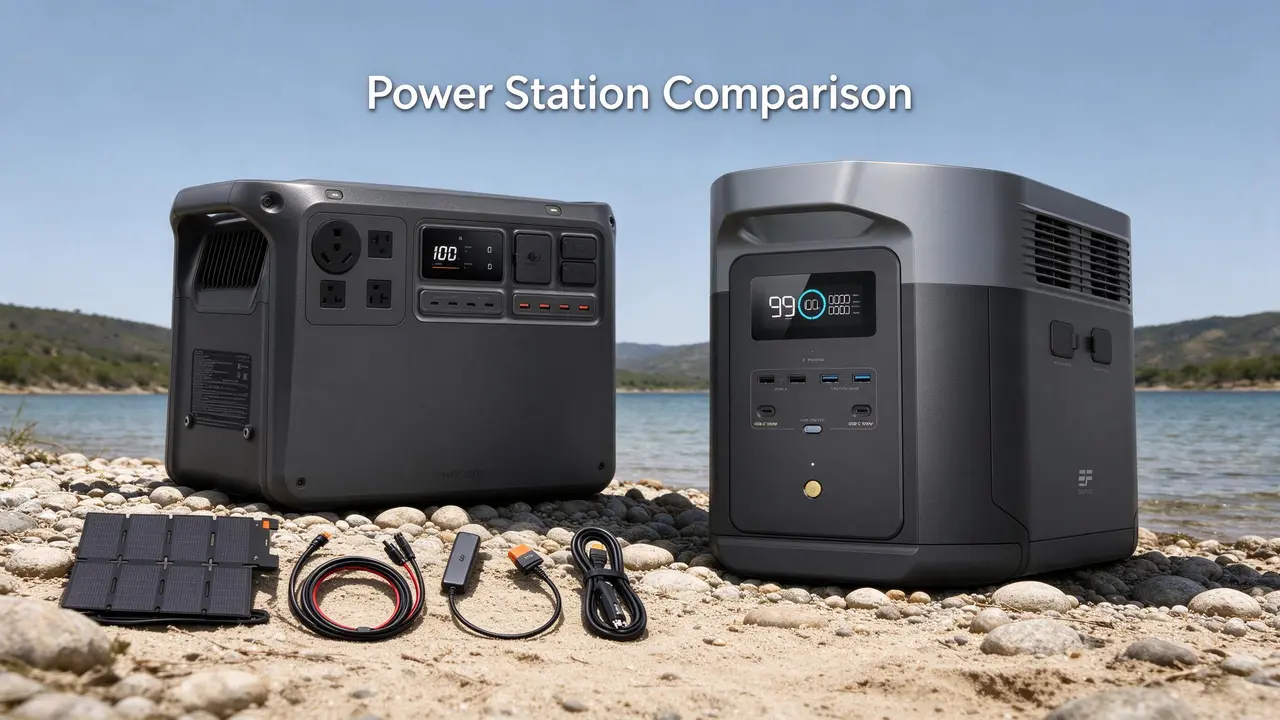
These two land in the same 2048 Wh class, but they are not the same purchase. At list, the DJI Power 2000 Portable Power Station, 2048Wh LFP Battery runs $1036.99 and the EcoFlow DELTA 2 Max runs $1399 — roughly $360 apart, which is real money at this tier.
The DJI bet is price per watt-hour plus port count: $0.51/Wh nameplate, four AC and four USB-C. The EcoFlow bet is headroom and growth: 2400 W continuous, six AC outlets, and the ability to stack extra batteries up to a much larger bank. If your outage plan is a fridge, a fan, and phones, the cheaper bet usually wins. If it includes a furnace blower, a sump pump, or a plan to expand, the EcoFlow's extra 400 W and outlet count start earning their premium.
One boundary up front: this is a two-way comparison for home backup and portable use, not a whole-home transfer-switch install guide. Neither unit replaces a standby generator for central AC or an electric range.
I am working from listing specs and owner themes on file — home-user checks, not lab-bench measurements. One Amazon Associates note: picks here are fit-led, not commission-led.
- DJI: cheaper per Wh, more USB ports, lighter by 1.5 lb
- EcoFlow: 400 W more continuous output, two more AC outlets, expandable bank
Spec snapshot
Prices are list; the EcoFlow's current deal price is not used here so the comparison stays apples-to-apples. Ratings are listing aggregates, not owner proof.
| Product | List price | Capacity (Wh) | Output (W) | Weight (lb) | Rating |
|---|---|---|---|---|---|
| DJI Power 2000 Portable Power Station, 2048Wh LFP Battery | $1,036.99 | 2048 Wh | 2000 W | 48.5 lb | 4.50 |
| EcoFlow DELTA 2 Max | $1,399 | 2048 Wh | 2400 W | 50 lb | 4.80 |
Where the extra $360 goes
Four configuration differences actually matter here, and they explain most of the price gap.
Output headroom. The EcoFlow's 2400 W continuous clears loads the DJI's 2000 W may not — a furnace blower plus a fridge on the same circuit, for instance. That is the single biggest functional delta.
Outlets. Six AC on the EcoFlow versus four on the DJI; the DJI counters with four USB-C and four USB-A versus the EcoFlow's two and two. If your backup load is phones, tablets, and laptops, the DJI's port mix is friendlier. If it is appliances, the EcoFlow's AC count wins.
Expandability. The EcoFlow accepts extra batteries to grow the bank well past 2048 Wh; the DJI, from the listing, is a standalone 2048 Wh unit. That matters if you plan to add capacity later rather than buy a bigger station up front.
Recharge and extras. Both recharge fast on wall power — owners on both sides clock full or near-full charges in roughly one to two hours. The DJI listing bundles a 100 W foldable solar panel and car cable in the combo; the EcoFlow does not include solar cables, and owners had to source the correct XT60i separately. On the DJI side, several owners note the MPPT solar adapter is sold separately even in the solar bundle — budget for it.
- EcoFlow wins: continuous W, AC outlet count, expandable capacity
- DJI wins: USB port count, lower list price, lighter by 1.5 lb
- Both: fast wall recharge; solar accessories are extra on each side
The spec that decides it
If I had to pick one number, it is continuous output: 2000 W on the DJI versus 2400 W on the EcoFlow. That 400 W gap is the difference between running a fridge and a space heater together and tripping the inverter.
The second deciding number is price per Wh: $0.51/Wh for the DJI versus $0.68/Wh for the EcoFlow at list. The DJI is the cheaper per-Wh buy in this pair — that is a nameplate figure, not a usable-Wh claim.
So the decision is not which is better. It is whether your outage load set needs more than 2000 W continuous and more than four AC outlets. If yes, pay for the EcoFlow. If no, the DJI does the same 2048 Wh job for less.
What owners actually report
Owner themes on file line up with the spec story, with caveats on both sides.
On the DJI, the high-helpful owner ran a fan for about ten hours during a home backup and recharged to full in under two hours on wall power — that matches the fast-recharge pitch. A solar-combo owner called it quiet and sturdy and easy to run out of the box. The caveats are weight (the same owner flagged it as heavy to move) and solar: multiple owners, including a four-star reviewer, note the MPPT adapter is not included. One high-helpful critical review is a genuine failure — error codes and an 850 W gaming PC that would not run, with support offering only a discount or return.
On the EcoFlow, a high-helpful owner charged 0 to 100% in about an hour and fifteen minutes, and another saw 80% in under an hour. Appliance tests in the notes: a mini-fridge ran 53 hours and a stand-up freezer 26 hours, roughly double the on-screen estimate because compressors cycle. A furnace owner got about seven hours of winter heat with automatic EPS cutover and checked input wattage remotely via the app. The caveats: around 50 lb is a two-hand lift, solar cables are not included, one owner had to reconnect the panel cable before charging started, and support is inconsistent — the top critical owner got no technical help during a multiday blackout, and another waited six days for a real answer.
Read those two critical stories side by side and the pattern is the same: the hardware mostly delivers, the support experience is the wildcard on both brands.
- DJI owner: fan ~10 h, full wall recharge under 2 h; heavy; MPPT adapter extra
- EcoFlow owner: 0-100% ~1h15m; freezer 26 h; furnace ~7 h on EPS; support inconsistent
Buy the one that…
Buy the DJI Power 2000 Portable Power Station, 2048Wh LFP Battery if your outage list is a fridge, a fan, lights, and a pile of USB devices, and you want the lower price per Wh with the friendlier port mix. Skip it if you need more than 2000 W continuous, more than four AC outlets, or a bank you can expand later — and budget for the MPPT adapter before you plan solar.
Buy the EcoFlow DELTA 2 Max if you are sizing against a furnace blower, a sump pump, or a load set that brushes 2000 W, or if you want to add batteries down the road. Skip it if the $360 premium buys headroom you will never use, or if your plan leans on the smart-generator ecosystem or fast crisis support — owners report both as unproven.
Neither is a whole-home solution. For that, look at transfer-switch and smart-panel sizing guides, and pair either station with a proper LFP cycle-life and UPS runtime explainer before you commit.
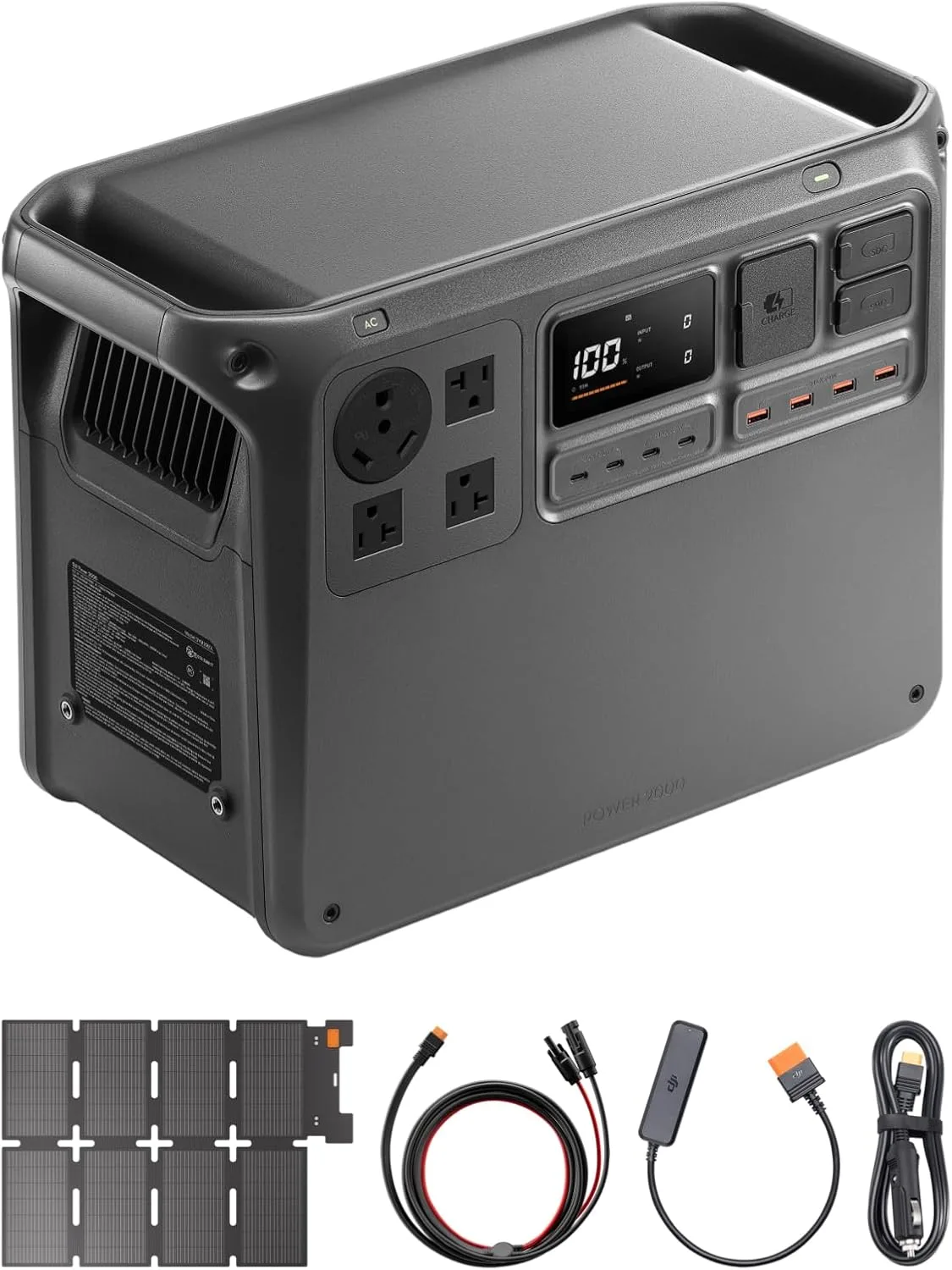
DJI DJI Power 2000
Highlights
- 2048Wh rated capacity
- 2000W continuous AC
- LiFePO4 chemistry
- 48.5 lb (~22.0 kg)
- About $1036.99 list
Best for
- Power 2000: longer outages or higher continuous loads (still not whole-home wiring)
- RV / off-grid days where recharge speed matters as much as Wh
- Best parked near the vehicle or cabin — not a long carry to a tent
Strengths
- Power 2000: 2000W continuous on a 2048Wh pack — more headroom for small appliances than 1kW-class peers
- 48.5 lb (~22.0 kg) is a park-and-use chassis — plan a short path, not a trail hike
- 2000W continuous headroom covers more small appliances than 1kW-class inverters
- Owners on file: 5/5 · 13 helpful — This product is perfect for camping, or also if you are looking for a back up at home, it…
Watch-outs · not ideal when
- At 48.5 lb (~22.0 kg), Power 2000 is a poor tent-hike companion — plan a cart or leave it in the vehicle
- High continuous output on Power 2000 tempts big loads — Wh still runs out on kettles and A/C
- Power 2000: solar/car charging is accessory-dependent on the listing — not a built-in published input ceiling
- LiFePO4 helps longevity, but Power 2000 still hates freezing charge temps on winter trips
Owner voices
Short takes from public retail reviews — paraphrased or translated when long or non-English; meaning kept close to the original.
“5/5 · 13 helpful — This product is perfect for camping, or also if you are looking for a back up at home, it can stand a fan for 10 hours, and it get recharge really fast, lest than 2 hours for the full charge. I live…”
“1/5 · 5 helpful — Maybe I am doing something wrong or maybe its a bad unit. I bought the power 1000 and long story short I have an error code of 2 and 62. I got this unit because I am homeless and needed to power thin…”
“5/5 · 4 helpful — This portable generator is quiet, efficient and powerful. I purchased the modal that came with a solar panel and it is solid material and seems more sturdy than I’d expected. I ended up purchasing th…”
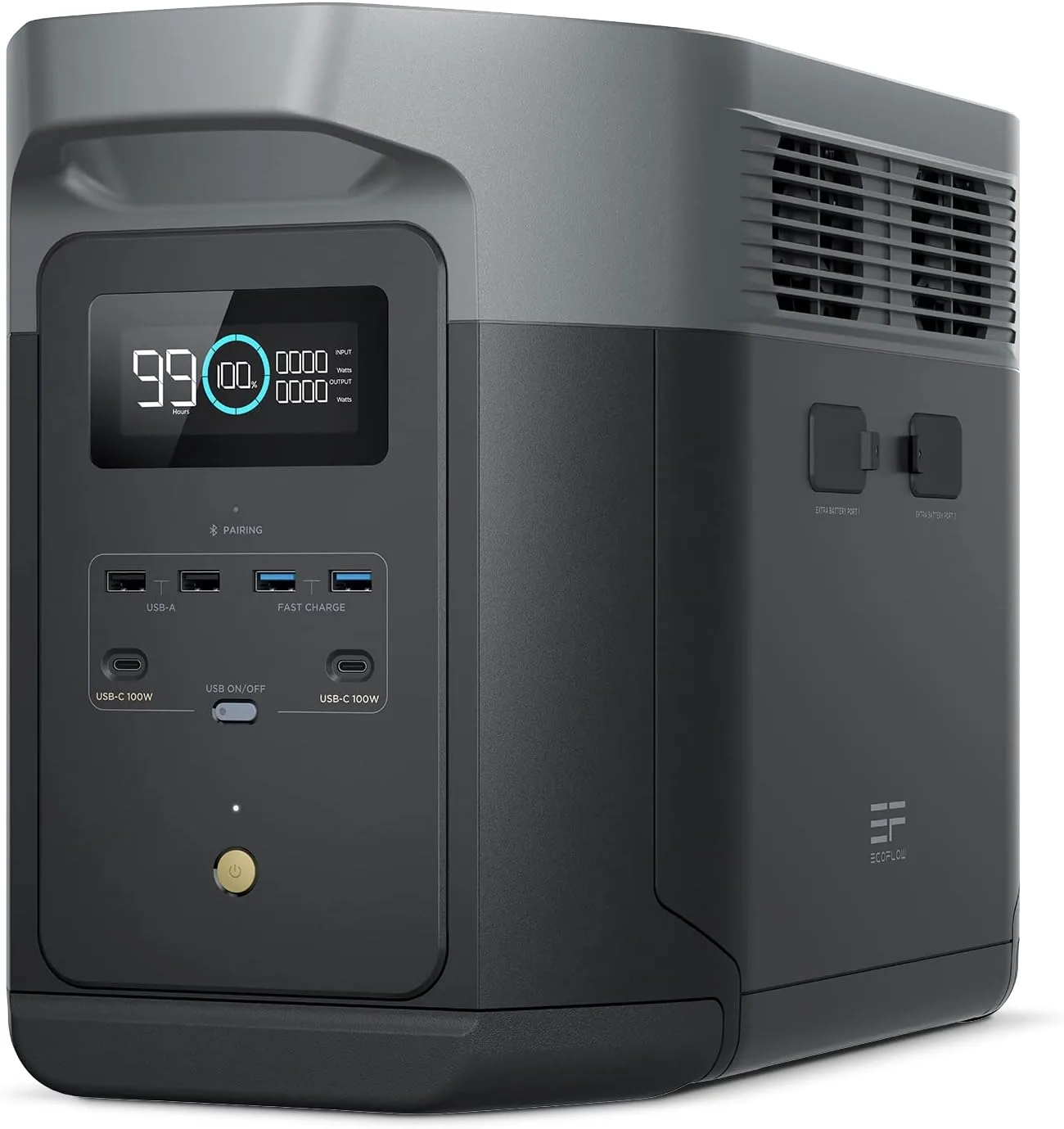
EcoFlow DELTA 2 Max
Highlights
- 2048Wh rated capacity
- 2400W continuous AC
- 4800W surge
- LiFePO4 chemistry
- Up to 1000W solar input
- 50 lb (~22.7 kg)
Best for
- DELTA 2 Max: longer outages or higher continuous loads (still not whole-home wiring)
- RV / off-grid days where recharge speed matters as much as Wh
- Best parked near the vehicle or cabin — not a long carry to a tent
Strengths
- DELTA 2 Max: 2048Wh pack with 2400W continuous / 4800W surge — size loads to both numbers
- 50 lb (~22.7 kg) is a park-and-use chassis — plan a short path, not a trail hike
- 2400W continuous headroom covers more small appliances than 1kW-class inverters
- About $1399 list in the Hub catalog — confirm live retail before you buy
Watch-outs · not ideal when
- At 50 lb (~22.7 kg), DELTA 2 Max is a poor tent-hike companion — plan a cart or leave it in the vehicle
- High continuous output on DELTA 2 Max tempts big loads — Wh still runs out on kettles and A/C
- Rated 1000W solar on DELTA 2 Max is optimistic; shade and cables cut real watts
- LiFePO4 helps longevity, but DELTA 2 Max still hates freezing charge temps on winter trips
Frequently asked
Can either run a refrigerator through a long outage?
Yes — the EcoFlow notes show a stand-up freezer at 26 hours and a mini-fridge at 53 hours, and the DJI notes show a fan at about ten hours. Fridge runtime depends on compressor cycling, so treat any single number as a rough guide.
Which recharges faster from the wall?
Owners on both sides report full or near-full charges in roughly one to two hours. The EcoFlow owner clocked 0 to 100% in about 1h15m; the DJI owner clocked under two hours.
Can the DJI be expanded like the EcoFlow?
From the listing, the DJI is a standalone 2048 Wh unit; the EcoFlow accepts extra batteries to grow the bank. If expansion is in your plan, that is the deciding difference.
Method and sources
Model names and list prices come from the WattPicks catalog at build time. WattPicks does not run its own laboratory tests on power stations, and nothing on this page is presented as a measured result — it is catalog-backed buying guidance.
Read our methodology for how the catalog is normalized, and about WattPicks for who publishes it.