
EcoFlow RIVER 2 vs BLUETTI EB3A: Small Power Station Duel
Two 243–268Wh stations, two different bets: the RIVER 2 trades output for portability, the EB3A trades weight for watts. Here's how to pick — and why you should confirm the EB3A price before you decide.
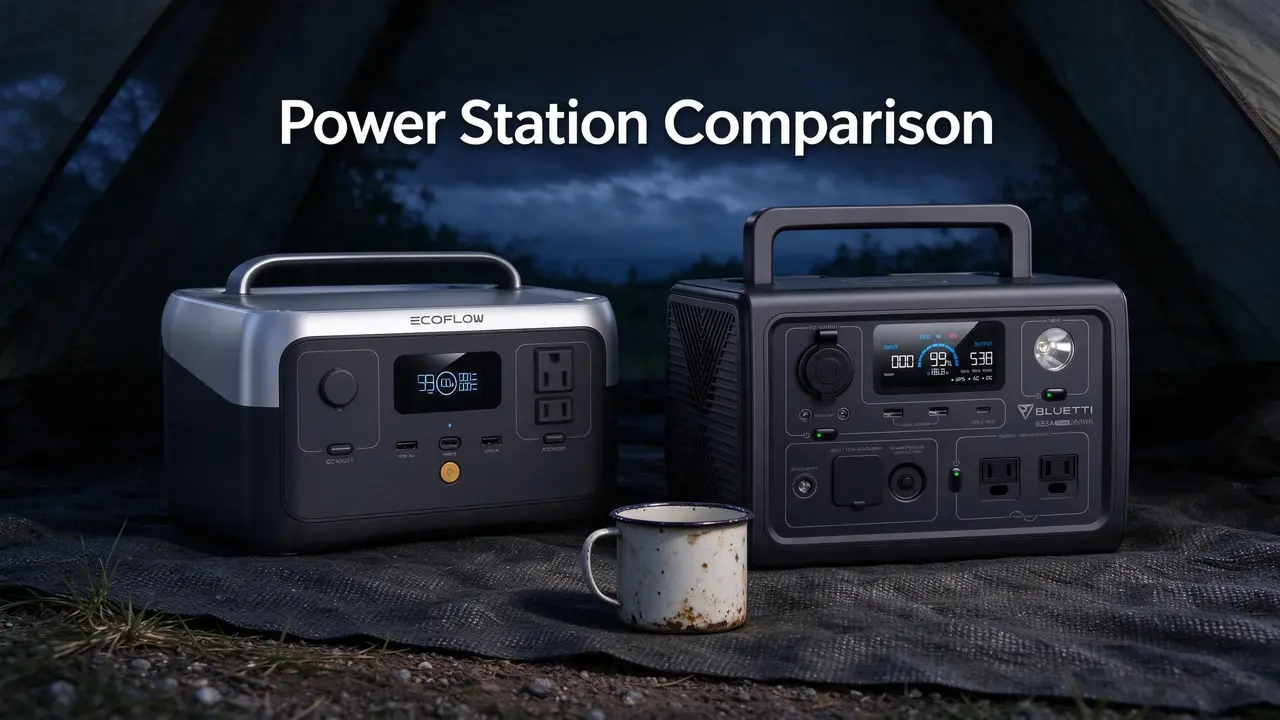
Updated
At a glance
Two 243–268Wh stations, two different bets: the RIVER 2 trades output for portability, the EB3A trades weight for watts. Here's how to pick — and why you should confirm the EB3A price before you decide.
- RIVER 2: lighter, faster to top up, lower continuous output ceiling.
- EB3A: heavier, higher continuous output, more appliance reach.
- Both: LiFePO4 chemistry, app monitoring, pass-through charging.
Two bets in the 243–268Wh class
If you're shopping the 243–268Wh class, these two keep surfacing. The EcoFlow RIVER 2 and the BLUETTI EB3A Portable Power Station are close in size and job, but they're not a straight price match: the RIVER 2 lists at $177.65, while the EB3A list price is not on file. Confirm the EB3A's current price before you anchor on a budget — the decision here is about which compromise you can live with, not which one is cheaper on paper.
The RIVER 2 bets on portability and speed: 243 Wh, 300 W continuous, 7.7 lb, and a wall recharge owners describe as roughly an hour. The EB3A bets on headroom: 268 Wh, 600 W continuous, 10.1 lb, and a wider spread of appliances it can actually start. One is a light-load station you'll carry without thinking; the other is a heavier box that can run a box fan or a CPAP overnight.
This is not a whole-home backup comparison, and neither unit is built for that. It's a question of whether your typical load is phones and a laptop, or a fan, a fridge, and a medical device.
- RIVER 2: lighter, faster to top up, lower continuous output ceiling.
- EB3A: heavier, higher continuous output, more appliance reach.
- Both: LiFePO4 chemistry, app monitoring, pass-through charging.
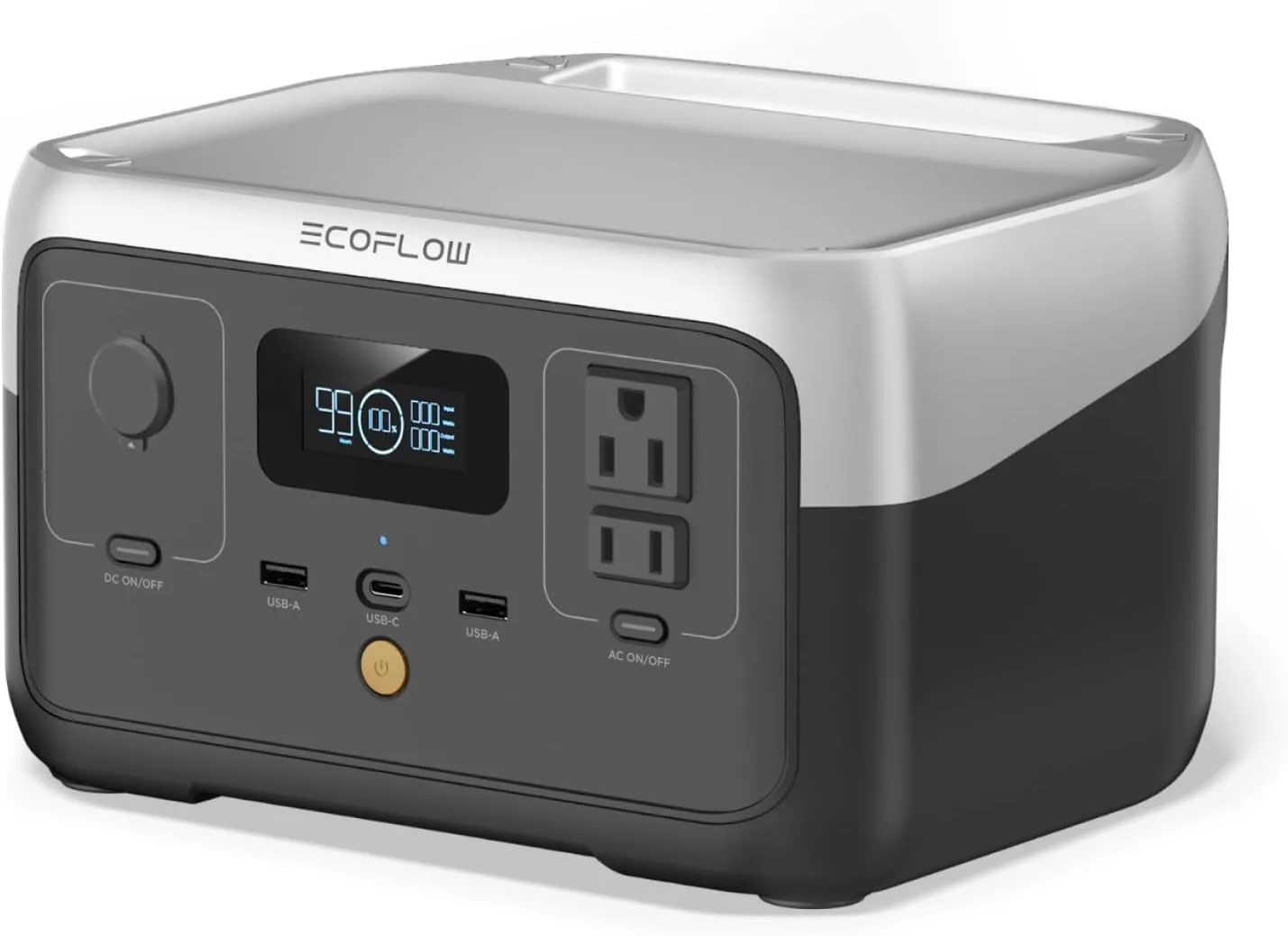
EcoFlow RIVER 2
Highlights
- 243Wh rated capacity
- 300W continuous AC
- 600W surge
- LiFePO4 chemistry
- Up to 110W solar input
- 7.7 lb (~3.5 kg)
Best for
- RIVER 2: phones, cameras and a laptop on short trips
- Travel kits when you need quiet pack power, not appliance runtime
- Brief desk backup for router and lights — not a fridge for days
Strengths
- RIVER 2: 243Wh pack with 300W continuous / 600W surge — size loads to both numbers
- 7.7 lb (~3.5 kg) is the lightest-class carry in this band — easier stairs and car packing
- RIVER 2 uses LiFePO4 — cycle-life claims usually beat older NMC marketing lines
- Owners on file: Theme: Small Appliances (53)
Watch-outs · not ideal when
- RIVER 2's small Wh class empties fast with a kettle, hair dryer or space heater
- 300W continuous will not hold heating elements or many compressor surges for long
- Rated 110W solar on RIVER 2 is optimistic; shade and cables cut real watts
- Airline and pack limits may still block RIVER 2 even when the weight looks friendly
Owner voices
Short takes from public retail reviews — paraphrased or translated when long or non-English; meaning kept close to the original.
“Theme: Phone Charging (126)”
“Theme: Small Appliances (53)”
“Theme: Backup Power (43)”
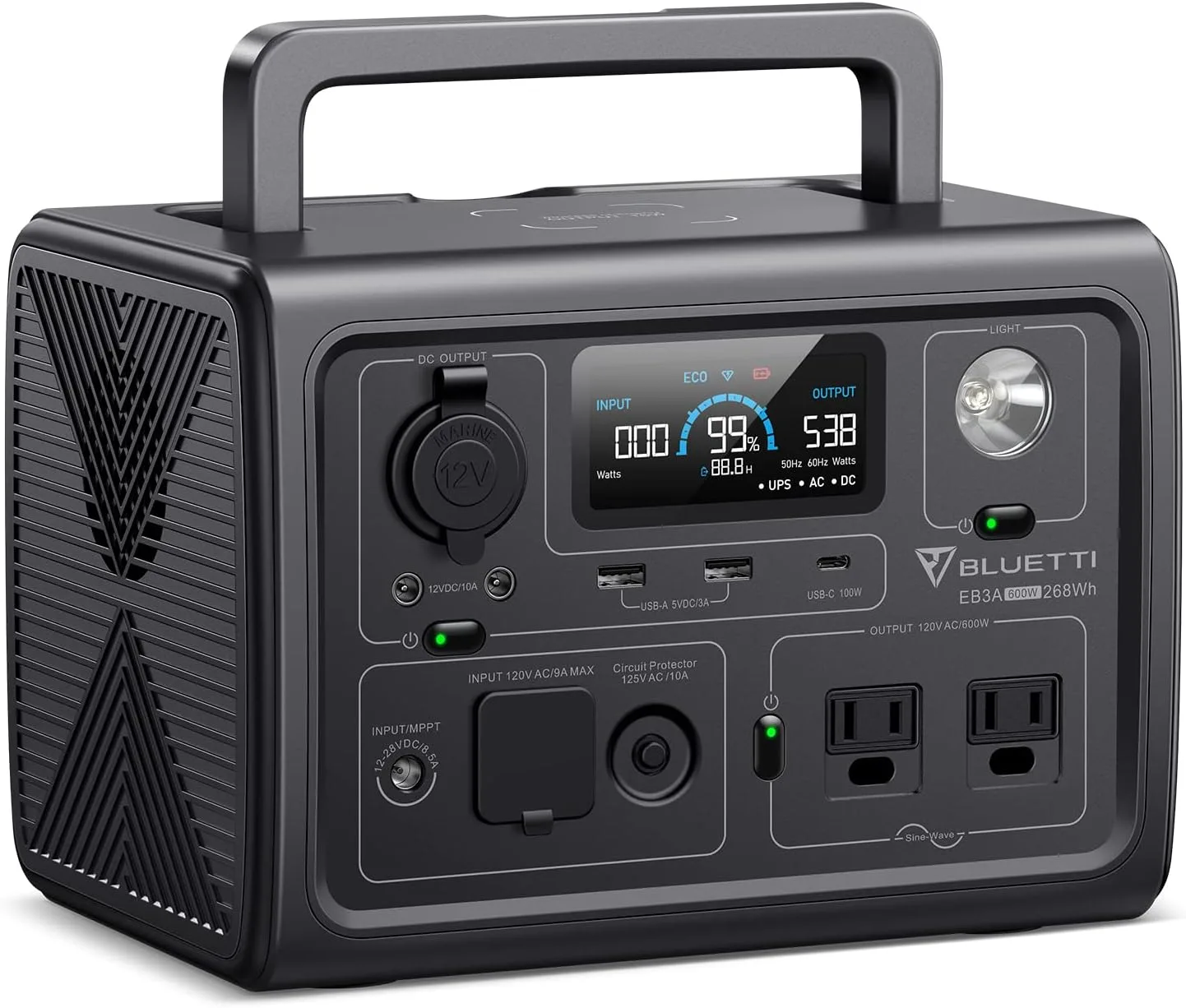
BLUETTI EB3A Portable Power Station
Highlights
- 268Wh rated capacity
- 600W continuous AC
- 1200W surge
- LiFePO4 chemistry
- Up to 200W solar input
- 10.1 lb (~4.6 kg)
Best for
- bluetti-eb3a: phones, cameras and a laptop on short trips
- Travel kits when you need quiet pack power, not appliance runtime
- Brief desk backup for router and lights — not a fridge for days
Strengths
- bluetti-eb3a: 268Wh pack with 600W continuous / 1200W surge — size loads to both numbers
- 10.1 lb (~4.6 kg) is the lightest-class carry in this band — easier stairs and car packing
- bluetti-eb3a uses LiFePO4 — cycle-life claims usually beat older NMC marketing lines
- Owners on file: Theme: Powering Appliances (106)
Watch-outs · not ideal when
- bluetti-eb3a's small Wh class empties fast with a kettle, hair dryer or space heater
- Usable energy on bluetti-eb3a is below the 268Wh label once the inverter is working
- Rated 200W solar on bluetti-eb3a is optimistic; shade and cables cut real watts
- Airline and pack limits may still block bluetti-eb3a even when the weight looks friendly
Owner voices
Short takes from public retail reviews — paraphrased or translated when long or non-English; meaning kept close to the original.
“Theme: Phone Charging (225)”
“Theme: Powering Appliances (106)”
“Theme: Outdoor Electronics (27)”
Methodology and disclosure
This comparison is grounded in listing specs from the WattPicks catalogue and owner themes from high-helpful reviews on file. Those are home-user checks, not lab-bench measurements — I'm not claiming instrumented test scores. Ratings shown are listing aggregates, not owner proof.
Avery Nolan is the WattPicks founding editor covering portable power station capacity, output, and price-per-Wh guidance across the catalogue — no lab claims.
As an Amazon Associate, WattPicks earns from qualifying purchases. Picks here are fit-led, not commission-led.
Spec snapshot
Prices and specs below come from the WattPicks catalogue and listing data on file. The EB3A list price is not on file, so it reads n/a rather than a guessed number — treat that as a gap to fill at checkout, not a signal that the EB3A is cheaper or pricier. Ratings are listing aggregates, not owner proof.
| Product | Price | Capacity (Wh) | Output (W) | Weight (lb) | Rating |
|---|---|---|---|---|---|
| EcoFlow RIVER 2 | $177.65 | 243 Wh | 300 W | 7.7 lb | 4.3 |
| BLUETTI EB3A Portable Power Station | n/a (not on file) | 268 Wh | 600 W | 10.1 lb | 4.1 |
Where the weight and watts went
Four configuration choices separate these two, and each one explains a chunk of the weight and the feature set. Since the EB3A list price isn't on file, this section focuses on what the hardware buys you rather than a dollar-for-dollar breakdown.
Output ceiling. The EB3A's 600 W continuous inverter is double the RIVER 2's 300 W. That's the single biggest functional gap: it's the difference between a station that runs a box fan all day and one that runs a laptop and a router. Owners on the EB3A side describe chainsaw chargers, portable fridges, and CPAP machines; RIVER 2 owners describe phones, laptops, LED lights, and a small camping fridge on DC.
Weight and footprint. The RIVER 2 is 7.7 lb and small enough to carry one-handed; the EB3A is 10.1 lb. Two and a half pounds doesn't sound like much until you're carrying it from a shed to a van every day. The RIVER 2 wins on grab-and-go ergonomics.
Recharge speed. Both recharge from AC in roughly an hour according to owner reports, which is unusually fast for this class. The RIVER 2's edge is that it's lighter to move to the outlet; the EB3A's edge is that it can take up to 200 W of solar input, so it can refill faster off-grid if you have the panels. With a 100–200 W panel, expect a full recharge in roughly 2–3 hours for the EB3A and 3–5 hours for the RIVER 2, depending on sun and panel output.
Ports and extras. The RIVER 2 lists AC×6; the EB3A lists AC×2, USB-A×2, and a car port, plus a wireless charging pad on top. Those port counts are per listing and not independently verified — check the current product page before you count on them. If the listing holds, the RIVER 2 spreads its 300 W across more outlets, so you can plug in several low-draw devices at once, while the EB3A concentrates its 600 W on fewer AC outlets but adds the wireless pad and a live-draw screen. USB-C status is not confirmed on file for either unit, so I'm not going to claim absence.
- 600 W vs 300 W continuous — the deciding spec for appliance loads.
- 7.7 lb vs 10.1 lb — the deciding spec for daily carry.
- Both recharge in about an hour from AC per owner reports.
- EB3A adds a wireless pad and up to 200 W solar input; RIVER 2 lists more AC outlets.
The spec that decides it
For most buyers, the 600 W vs 300 W continuous output gap is the one that matters. A typical box fan pulls around 70 W, a CPAP with the humidifier off pulls roughly 30–60 W, and a small portable fridge cycles in the 40–60 W range. Both stations can handle those loads on paper. The difference shows up when you add a second device or try something with a startup surge.
The EB3A's 600 W ceiling means it can run a fan and charge a laptop at the same time without tripping. The RIVER 2's 300 W ceiling is fine for phones, a laptop, and lights, but owners who tried coffee makers or microwaves found it either refused or drained fast. That's not a defect — it's the class boundary.
The second deciding spec is weight. If the station lives in a closet and comes out for outages, 10.1 lb is fine. If it rides in a backpack or moves between a shed and a van daily, 7.7 lb is the difference between grabbing it and leaving it.
Runtime math: Wh ÷ load
To sanity-check overnight claims, divide usable capacity by the load. These are rough estimates assuming 100% usable capacity and no inverter losses; real-world runtime will be shorter.
For a CPAP at 30–60 W: the EB3A's 268 Wh gives roughly 4.5–9 hours, and the RIVER 2's 243 Wh gives roughly 4–8 hours. Owner reports of 9–10 hours on the EB3A likely reflect a lower average draw (closer to 27–30 W) or a humidifier-off setup that cycles below the nameplate. If your CPAP pulls 60 W steadily, expect closer to 4.5 hours on the EB3A.
For a 70 W box fan: the EB3A runs about 3.8 hours, the RIVER 2 about 3.5 hours. For a 50 W portable fridge, the table below already uses a 50 W average that accounts for cycling — so read those rows as the cycling estimate, not a steady-draw figure to double.
- RIVER 2 owners: fast recharge and light weight are the standouts; capacity limits and a firmware glitch are the trade-offs.
- EB3A owners: 600 W reach and the wireless pad are the standouts; random-shutdown reports and fan noise are the trade-offs.
- Neither unit is a whole-home backup — both are light-to-moderate load stations.
| Load | EB3A runtime (268 Wh) | RIVER 2 runtime (243 Wh) |
|---|---|---|
| CPAP, 30 W | ~8.9 h | ~8.1 h |
| CPAP, 60 W | ~4.5 h | ~4.1 h |
| Box fan, 70 W | ~3.8 h | ~3.5 h |
| Fridge, 50 W avg | ~5.4 h | ~4.9 h |
Real owner trade-offs
Owner reviews on file tell a consistent story on both sides, and the caveats are as important as the praise.
On the RIVER 2, the fast recharge is the feature owners mention most — one long-term owner described plugging it in and having it basically full by the time gear was sorted. The light weight and app monitoring come up repeatedly. The caveats are capacity and a firmware glitch: one owner had a firmware update temporarily knock out AC charge display and USB-C charging until a follow-up patch landed days later. If the unit backs something critical, time those updates. A single USB-C port and audible fan noise during fast charging are the other recurring gripes.
On the EB3A, owners describe a surprisingly wide load spread within the 600 W ceiling — box fans on solar, a CPAP overnight, a portable fridge, even a coffee maker in short bursts via power-lift mode. The wireless pad and live-draw screen get called out as handy. The caveat that shows up across multiple high-helpful reviews is reliability: units shutting off abruptly or dropping to 0% while the display still showed charge, sometimes within months. That's the one I'd weigh hardest before buying. Fan buzz in silent mode, an off-gassing smell out of the box, and app Bluetooth pairing that surfaced other nearby units are the secondary watch-outs.
- RIVER 2 owners praise fast recharge and light weight; capacity limits and a firmware glitch are the trade-offs.
- EB3A owners highlight 600 W reach and the wireless pad; random-shutdown reports and fan noise are the trade-offs.
- Neither unit is a whole-home backup — both are light-to-moderate load stations.
Buy the one that…
Buy the EcoFlow RIVER 2 if your typical load is phones, a laptop, a router, LED lights, and maybe a small camping fridge on DC — and you want the lightest box that recharges in about an hour. Skip it if you need to run a box fan all day, a CPAP with the humidifier on, or any appliance that pulls more than 300 W continuous.
Buy the BLUETTI EB3A Portable Power Station if you need 600 W of continuous headroom for a fan, a portable fridge, or a CPAP overnight, and you don't mind the extra 2.4 lb. Skip it if unattended reliability for something critical is the priority — the random-shutdown reports in owner reviews are a real caveat, and the list price isn't on file, so confirm the current price before committing.
If neither profile fits — you need to run a microwave, a space heater, or a full-size fridge — neither of these is the right class. Step up to a larger station with a higher continuous rating.
Frequently asked
Can the RIVER 2 run a CPAP overnight?
Owners report it running low-watt devices reliably, but the 300 W continuous ceiling and 243 Wh capacity mean a CPAP with the humidifier off is the realistic use case. The EB3A's 600 W ceiling and 268 Wh give more margin for overnight CPAP use, and owners describe roughly 9–10 hours with the humidifier off — though our runtime math suggests that assumes a lower average draw, closer to 27–30 W.
Which one recharges faster from solar?
The EB3A lists up to 200 W of solar input; the RIVER 2 lists 110 W. On paper the EB3A can refill faster off-grid if you have the panels to feed it. Both recharge from AC in roughly an hour per owner reports.
Can the EB3A run a coffee maker?
Owners describe short bursts via power-lift mode, but it's not a daily coffee solution — the heating element pulls more than the 600 W continuous rating, so expect brief use only.
Method and sources
Model names and list prices come from the WattPicks catalog at build time. WattPicks does not run its own laboratory tests on power stations, and nothing on this page is presented as a measured result — it is catalog-backed buying guidance.
Read our methodology for how the catalog is normalized, and about WattPicks for who publishes it.