
BLUETTI AC180 vs Jackery Explorer 1000 Plus: Which Backup Bet?
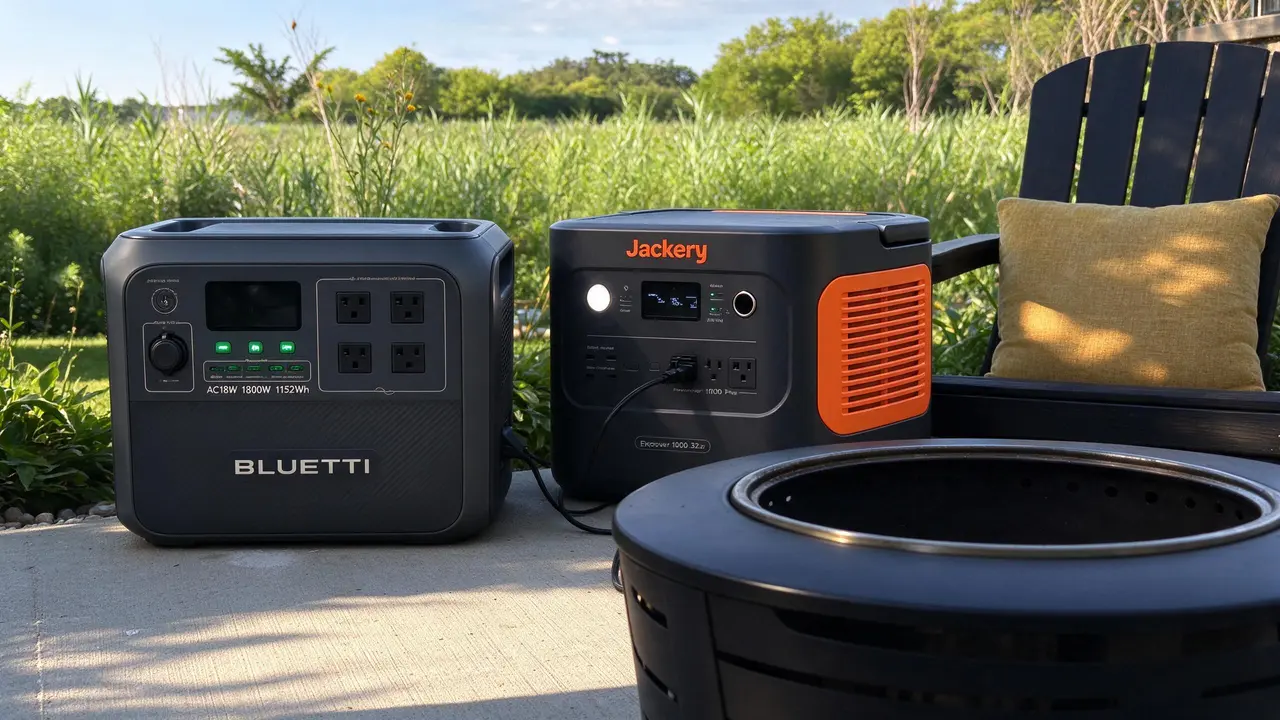
Two 1 kWh-class stations, one $499 and one $1,589. The AC180 wins on price and UPS speed; the Jackery wins on expandable capacity and cycle life. Here's how to pick.
Updated
At a glance
Two 1 kWh-class stations, one $499 and one $1,589. The AC180 wins on price and UPS speed; the Jackery wins on expandable capacity and cycle life. Here's how to pick.
- AC180: cheapest per nameplate Wh in this pair ($0.43/Wh vs $1.26/Wh), 20 ms UPS, 1,800 W continuous.
- Jackery 1000 Plus: expandable to ~5 kWh with add-on packs, 2,000 W continuous, 4,000 W peak, 0.02 s EPS switchover.
Same money? No — same class, different bets
As an Amazon Associate I earn from qualifying purchases. Recommendations here are based on fit and the evidence below — not commission size.
If you are shopping a 1 kWh-class station for outage backup, these two land in the same conversation but not the same budget. The BLUETTI AC180 lists at $499. The Jackery Explorer 1000 Plus Portable Power Station Kit - 2528Wh LiFePO4 lists at $1,589 — roughly three times the money for about 10% more nameplate capacity. (The '2528Wh' in the SKU name refers to the kit's total capacity when paired with the included expansion battery; the base unit itself is 1,264 Wh, as shown in the spec table.)
So the real question is not which is bigger. It is what you are paying the extra grand for. The AC180 bets on price, a fast UPS handoff, and 1,800 W of continuous AC. The Jackery bets on expandable capacity (up to three add-on packs), a longer LFP cycle story, and 2,000 W continuous. This page is for buyers deciding between those two bets — not for whole-home backup, and not for anyone who needs to run a 240 V well pump or central AC.
One disclosure: picks here are fit-led, not commission-led. I'm working from listing specs and owner themes on file, not lab-bench measurements.
- AC180: cheapest per nameplate Wh in this pair ($0.43/Wh vs $1.26/Wh), 20 ms UPS, 1,800 W continuous.
- Jackery 1000 Plus: expandable to ~5 kWh with add-on packs, 2,000 W continuous, 4,000 W peak, 0.02 s EPS switchover.
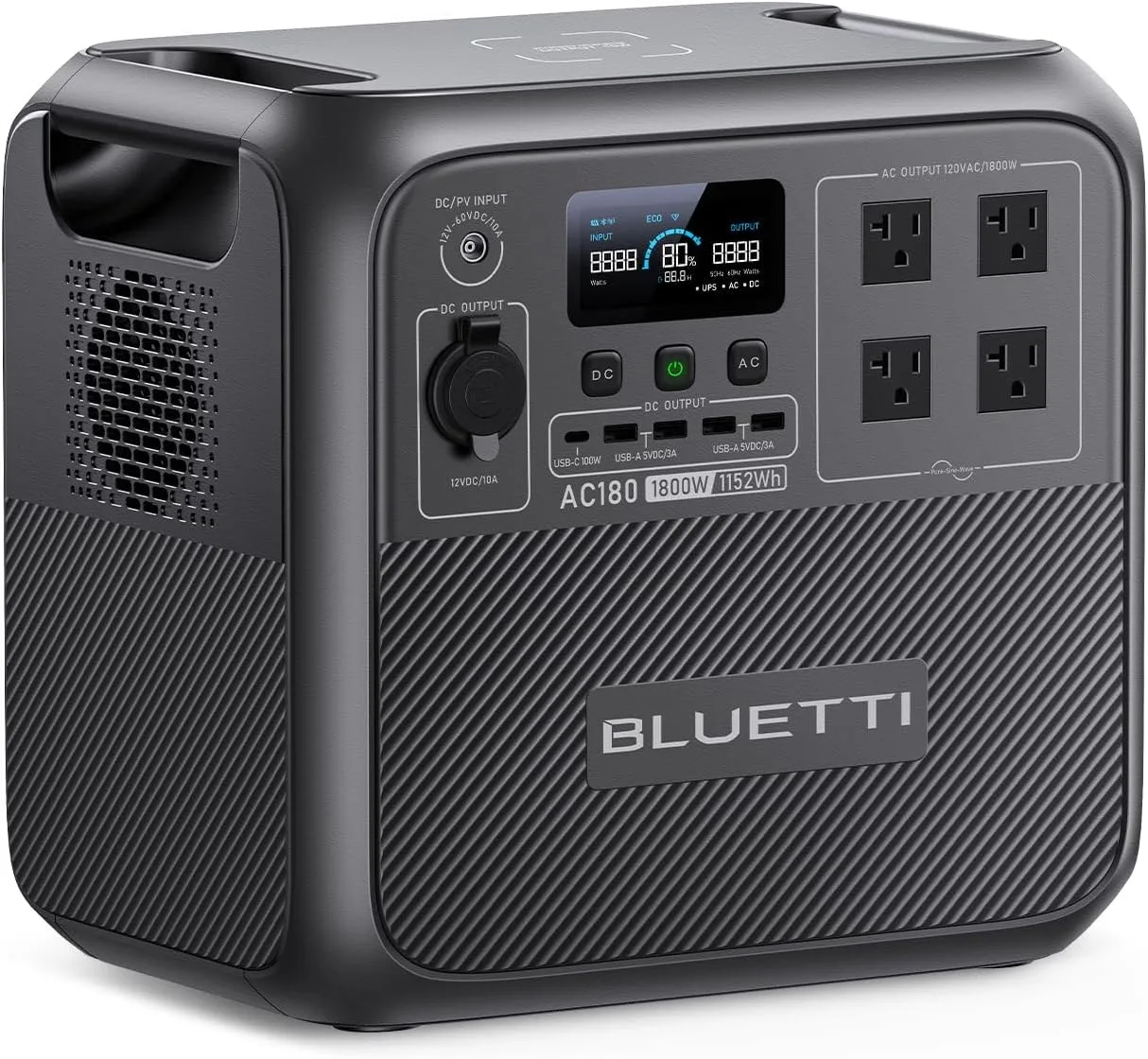
BLUETTI Portable Power Station AC180, 1152Wh LiFePO4 Battery Backup w/ 2 1800W
Highlights
- 1152Wh rated capacity
- 1800W continuous AC
- LiFePO4 chemistry
- Up to 500W solar input
- 35.3 lb (~16.0 kg)
- About $499 list
Best for
- AC180: most Wh per list dollar in mid-size LiFePO4 shortlists (~1152Wh)
- Home essentials when 1800W continuous matters more than a light carry
- Skip if 35.3 lb is too heavy for stairs or frequent car packing
Strengths
- AC180: 1800W continuous on a 1152Wh pack — more headroom for small appliances than 1kW-class peers
- 35.3 lb (~16.0 kg) is a park-and-use chassis — plan a short path, not a trail hike
- 1800W continuous headroom covers more small appliances than 1kW-class inverters
- About $499 list in the Hub catalog — confirm live retail before you buy
Watch-outs · not ideal when
- 35.3 lb (~16.0 kg) is a two-hand lift; skip it if you walk more than a short path to camp
- Usable energy on AC180 is below the 1152Wh label once the inverter is working
- Rated 500W solar on AC180 is optimistic; shade and cables cut real watts
- LiFePO4 helps longevity, but AC180 still hates freezing charge temps on winter trips
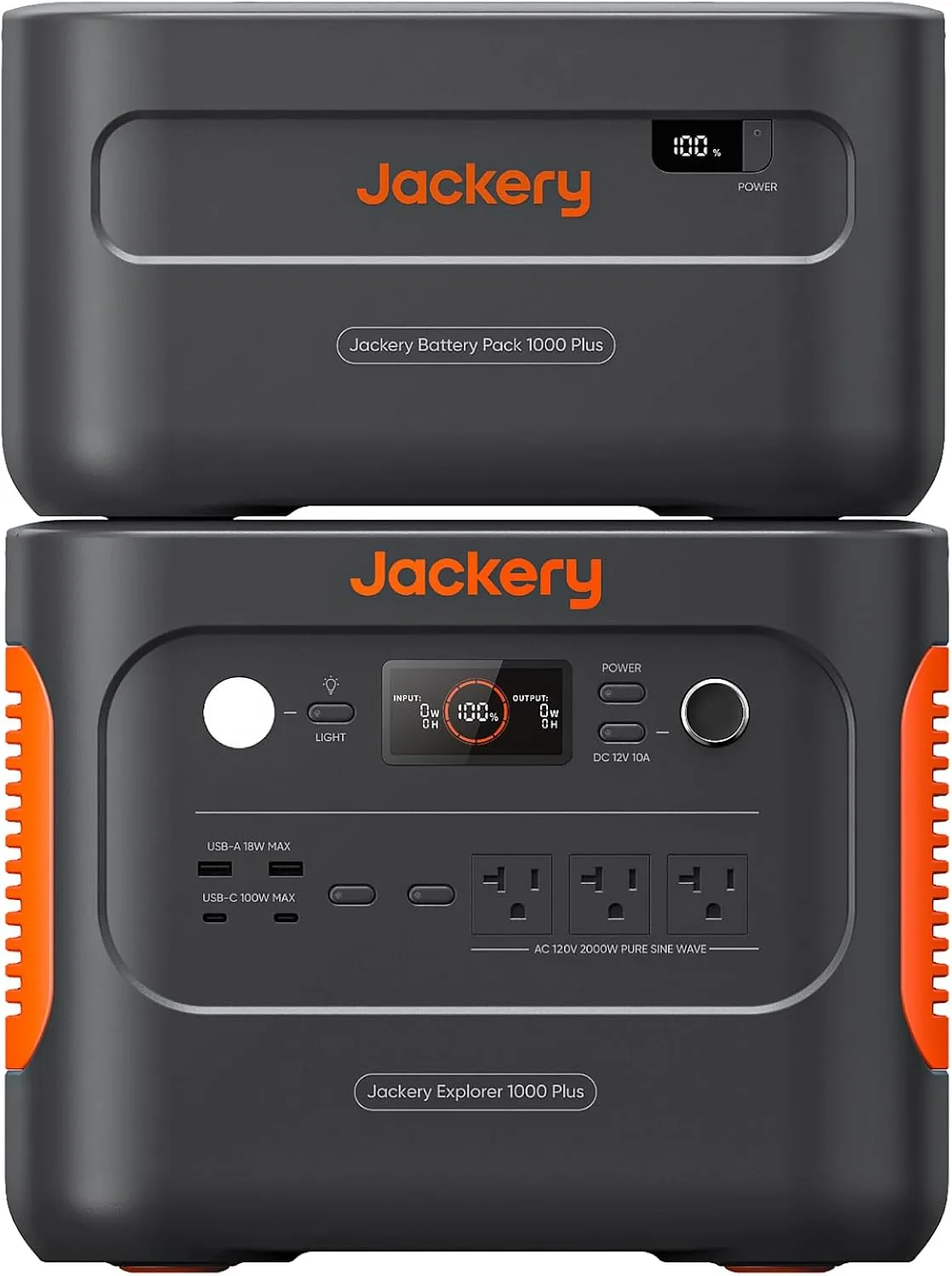
Jackery Explorer 1000 Plus Portable Power Station Kit - 2528Wh LiFePO4 Battery with
Highlights
- 1264Wh rated capacity
- 2000W continuous AC
- LiFePO4 chemistry
- 32 lb (~14.5 kg)
- About $1589 list
Best for
- Explorer 1000 Plus: small appliances and tools that need ~2000W continuous, not just phone charging
- Park-and-use backup — at 32 lb (~14.5 kg) this is a poor long hike companion
- Car or wall recharge between camps when solar input is accessory-dependent
Strengths
- Explorer 1000 Plus: 2000W continuous on a 1264Wh pack — more headroom for small appliances than 1kW-class peers
- 32 lb (~14.5 kg) is a park-and-use chassis — plan a short path, not a trail hike
- 2000W continuous headroom covers more small appliances than 1kW-class inverters
- Owners on file: 5/5 · 98 helpful — I was totally in love with the Jackery Explorer 2000 plus, I had to get the 1000 plus when…
Watch-outs · not ideal when
- 32 lb (~14.5 kg) is a two-hand lift; skip it if you walk more than a short path to camp
- Usable energy on Explorer 1000 Plus is below the 1264Wh label once the inverter is working
- Solar input unpublished for Explorer 1000 Plus — do not assume a same-day off-grid refill
- LiFePO4 helps longevity, but Explorer 1000 Plus still hates freezing charge temps on winter trips
Owner voices
Short takes from public retail reviews — paraphrased or translated when long or non-English; meaning kept close to the original.
“5/5 · 98 helpful — I was totally in love with the Jackery Explorer 2000 plus, I had to get the 1000 plus when I saw it released. Explorer 1000 plus is the little brother of the Explorer 2000 plus. It has a lot of simi…”
“5/5 · 1 helpful — Bought this to power fridge/freezers during outages caused by storms. Have not had to use it yet and it has sat in the garage after fully charging it 6 months ago. Power is holding steady at 100%. I…”
Spec snapshot
Prices are list prices from the catalogue, not current sale stickers. Ratings are listing aggregates, not owner proof. Weight in pounds. The Jackery's rating is based on only 3 ratings, and only two owner reviews are on file — treat it as a thin sample.
| Product | List price | Capacity (Wh) | Output (W) | Weight (lb) | Rating | Warranty / Returns | Noise (fan) |
|---|---|---|---|---|---|---|---|
| BLUETTI AC180 | $499 | 1152 Wh | 1800 W | 35.3 lb | 4.85 | Not stated on listing on file | Not stated on listing on file |
| Jackery Explorer 1000 Plus Portable Power Station Kit - 2528Wh LiFePO4 | $1,589 | 1264 Wh (base); 2528 Wh with included expansion battery | 2000 W | 32 lb | 4.91 | Not stated on listing on file | Not stated on listing on file |
Where the money went
Four configuration differences explain most of the $1,090 gap. Start with capacity architecture. The AC180 is a sealed 1,152 Wh box — what you buy is what you get. The Jackery's 1,264 Wh base is designed to stack up to three add-on battery packs, so the same head unit can grow toward 5 kWh later. You are paying for an upgrade path, not just today's watt-hours.
Second, output headroom. The AC180's 1,800 W continuous is enough for a fridge, router, lights, and a TV at once; the Jackery's 2,000 W continuous and 4,000 W peak (per the listing) give it more room for a coffee maker or a small microwave alongside other loads. Neither is a whole-home solution.
Third, switchover. BLUETTI lists a 20 ms UPS handoff on the AC180; Jackery lists a 0.02 s (20 ms) EPS handoff on the 1000 Plus. On paper these are the same number — the difference is that AC180 owners on file describe actually wiring a basement circuit through a rated extension cord and watching the internet stay up. That is a use case, not a spec advantage. Note that the 20 ms figure is manufacturer-stated, not independently verified.
Fourth, cycle life and chemistry. Both are LiFePO4. Jackery publishes 4,000 cycles to 70% capacity; BLUETTI's listing does not publish a cycle count on file, so I can't compare that number honestly. If cycle count is your deciding factor, the Jackery has the published figure and the AC180 does not.
- Capacity architecture: sealed 1,152 Wh (AC180) vs expandable 1,264 Wh base (Jackery).
- Continuous output: 1,800 W (AC180) vs 2,000 W (Jackery); peak 4,000 W on the Jackery listing.
- Switchover: 20 ms UPS (AC180) vs 0.02 s EPS (Jackery) — same number, different owner evidence.
- Cycle life: 4,000 cycles to 70% published for Jackery; n/a (not on file) for AC180.
- Price per nameplate Wh: $0.43/Wh (AC180) vs $1.26/Wh (Jackery).
The spec that decides it
For most outage buyers, the deciding number is price per usable watt-hour, and the AC180 wins that by a wide margin. At $499 for 1,152 Wh nameplate, it is $0.43/Wh. The Jackery is $1.26/Wh at list. Even after accounting for the ~90% usable capacity AC180 owners report (and the ~20 W inverter idle draw), the AC180 is still the cheaper way to keep a fridge and router alive through a short outage.
The second deciding number is expandability. If you expect to grow into 2–3 days of backup, the Jackery's add-on battery architecture is the reason to pay more. The AC180 cannot be expanded — you buy a second station or a bigger one. That is the trade-off: cheaper today, capped tomorrow.
Real owner trade-offs
AC180 owners on file consistently praise the instant switchover and the simple three-button setup, and several describe running a basement circuit through a rated extension cord so the router and TV stay on when the grid drops. The recurring caveat is idle consumption: the inverter draws power even with nothing plugged in, and only about 90% of rated capacity is usable, so small loads get noticeably less runtime than the raw math suggests. One owner also found solar input capped well below panel ratings, and another needed firmware updates plus a full discharge/recharge cycle before the unit met spec. The wireless charging pad on top is a known weak spot — phones connect, then quit.
Jackery 1000 Plus evidence is thinner. The listing aggregate is 4.6 from 3 ratings, and only two owner reviews are on file. The high-helpful one describes adding an expansion battery to reach ~2.5 kWh and running laptop, lights, portable fridge, coffee maker, and oven without strain, and credits the LFP cells for the longer cycle story. The second owner left it fully charged in the garage for six months and found it still at 100%. The caveat both note is weight — LFP makes it heavier than the older Pro model — and the small sample means long-term field evidence is limited. I would treat the Jackery's owner record as promising but not yet deep.
One Jackery owner scenario on file: a buyer who started with the base 1,264 Wh unit for short outages, then added a single expansion battery to reach ~2.5 kWh for multi-day coverage — the upgrade path in action.
- AC180: UPS handoff and easy setup are the most-cited strengths; idle draw and ~90% usable capacity are the most-cited caveats.
- Jackery 1000 Plus: expandability and LFP longevity are the themes; thin review base means less confidence in long-term claims.
Load vs runtime: what each can actually run
These are rough estimates based on nameplate capacity and typical load draws, not lab measurements. Real runtime varies with inverter efficiency, idle draw, and load cycling. For fridges, the draw shown is an average that already accounts for duty cycle (compressor cycling on and off); continuous draw while the compressor runs is higher but brief.
| Load | Typical draw | AC180 (1152 Wh, ~90% usable) | Jackery 1000 Plus (1264 Wh base) |
|---|---|---|---|
| Fridge (average) | 100–200 W | ~5–10 hours | ~6–11 hours |
| Router + modem | 15–30 W | ~35–70 hours | ~40–75 hours |
| CPAP (with humidifier) | 30–60 W | ~17–35 hours | ~19–38 hours |
| Coffee maker (brewing) | 800–1200 W | ~1–1.5 hours of brewing | ~1–1.5 hours of brewing |
Buy the one that…
Buy the BLUETTI AC180 if your outage plan is a short list of essentials — fridge, router, lights, a TV, a CPAP — and you want the lowest entry price with a fast UPS handoff. At $499 and $0.43/Wh, it is the budget-friendly pick in this pair, and the owner record on file supports the switchover story. Skip it if you need to grow past ~1 kWh later, if you expect to run a coffee maker and a microwave simultaneously, or if a published cycle count is a must-have for you.
Buy the Jackery Explorer 1000 Plus Portable Power Station Kit - 2528Wh LiFePO4 if you already know you will want 2–3 kWh or more down the road and you value the add-on battery architecture and the 4,000-cycle LFP claim. It is the expandable pick, and the 2,000 W continuous output gives you more headroom. Skip it if $1,589 is a stretch for a 1 kWh-class box, if you need deep field evidence before buying, or if you will never add a battery pack — in that case you are paying for an upgrade path you won't use.
Frequently asked
How long will the AC180 run a fridge?
A typical full-size fridge draws roughly 100–200 W average once running. At 1,152 Wh nameplate and ~90% usable, that is roughly 5–10 hours of continuous fridge runtime before idle draw and inverter losses — enough for a short outage, not a multi-day one. The Jackery's 1,264 Wh is only about 10% more, so it does not change the category.
Can either one run a CPAP overnight?
Yes, on paper. A CPAP with humidifier draws roughly 30–60 W; without humidifier, less. Both stations have enough capacity for one night, but the AC180's ~20 W inverter idle draw matters more at these small loads — turn off AC output when not in use.
Do I need to buy anything extra?
The AC180 listing includes AC, car, and solar charging cables; a solar panel is sold separately. The Jackery kit listing includes one Battery Pack 1000 Plus, AC and car charging cables, and DC adaptors; solar panels are sold separately. Neither includes a transfer switch — the AC180 owner on file used a properly rated extension cord, not a permanent install.
What about warranty and returns?
Neither listing on file states warranty terms or return windows, so check the current product page before buying — that is a gap worth verifying for a purchase at this price.
How noisy are they?
Fan noise specs are not stated on either listing on file. Owners do not flag noise as a major issue, but if you plan to run one in a bedroom, look for a noise rating on the current product page.
Method and sources
Model names and list prices come from the WattPicks catalog at build time. WattPicks does not run its own laboratory tests on power stations, and nothing on this page is presented as a measured result — it is catalog-backed buying guidance.
Read our methodology for how the catalog is normalized, and about WattPicks for who publishes it.