
BLUETTI AC240 vs Jackery Explorer 1500 Ultra: Outage Pick
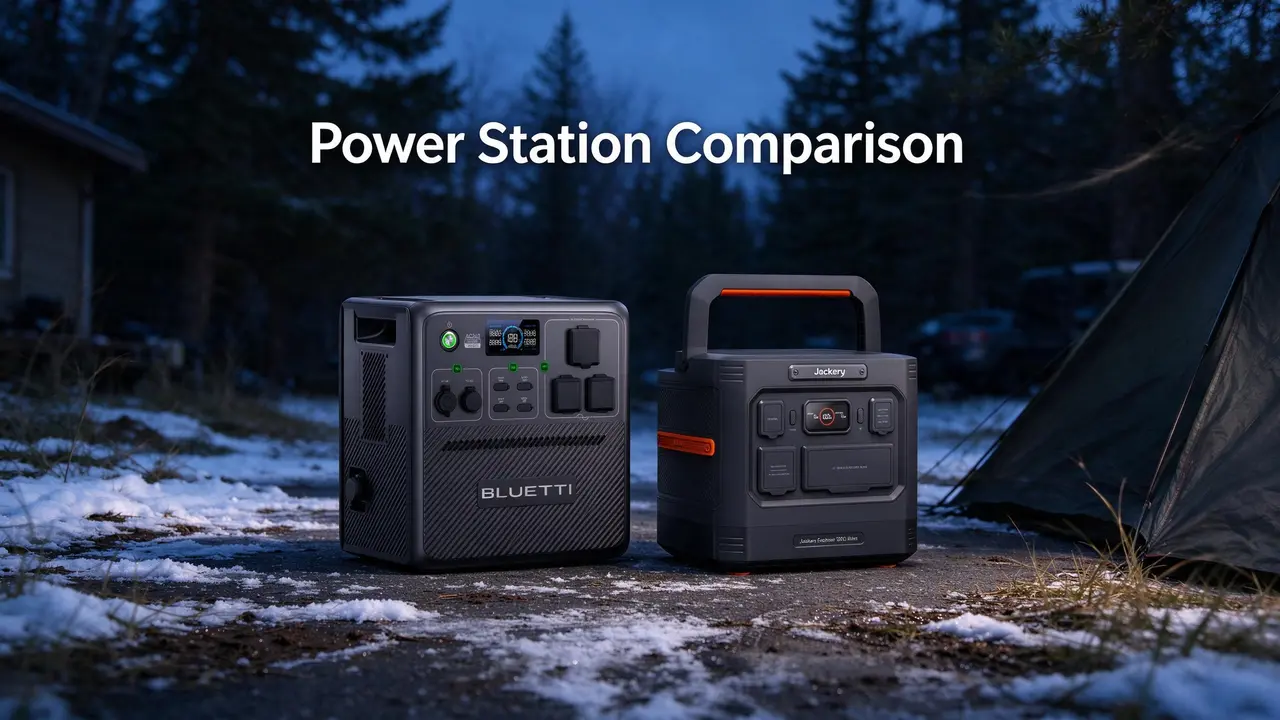
Two 1536 Wh stations at the same capacity, $200 apart, with very different bets: BLUETTI sells you watts and expandability, Jackery sells you a lighter box with a longer cycle rating. Here is which one fits your outage.
Updated
At a glance
Two 1536 Wh stations at the same capacity, $200 apart, with very different bets: BLUETTI sells you watts and expandability, Jackery sells you a lighter box with a longer cycle rating. Here is which one fits your outage.
Same money, different bets
Both of these are 1536 Wh LiFePO4 stations aimed at the same shopper: someone who wants a fridge, a CPAP, and the router to survive a multi-hour outage without hiring an electrician. The BLUETTI Pioneer 150 (AC240) lists at $999 and bets everything on headroom — 2400 W continuous, a 30A TT30 outlet, and the ability to stack external batteries up to 10,136 Wh.
The Jackery Explorer 1500 Ultra Portable Power Station,1536Wh,1800W AC lists at $1199 and bets on the box itself: 38.6 lb instead of 72 lb, an IP65 enclosure, a 4,000-cycle rating to 70%, and a 5-year warranty split as 3 standard plus 2 extended. Same capacity, $200 apart, and the money went to opposite places.
This is not a page for whole-home backup or for anyone sizing a transfer switch — neither unit is a panel-mounted system. It is also not a camping-first comparison; both are heavy enough that you move them once and leave them.
One disclosure: picks here are fit-led, and links may earn an Amazon Associates commission. Specs come from the listings; owner themes come from the review pack on file. Those are home-user checks, not lab-bench measurements.
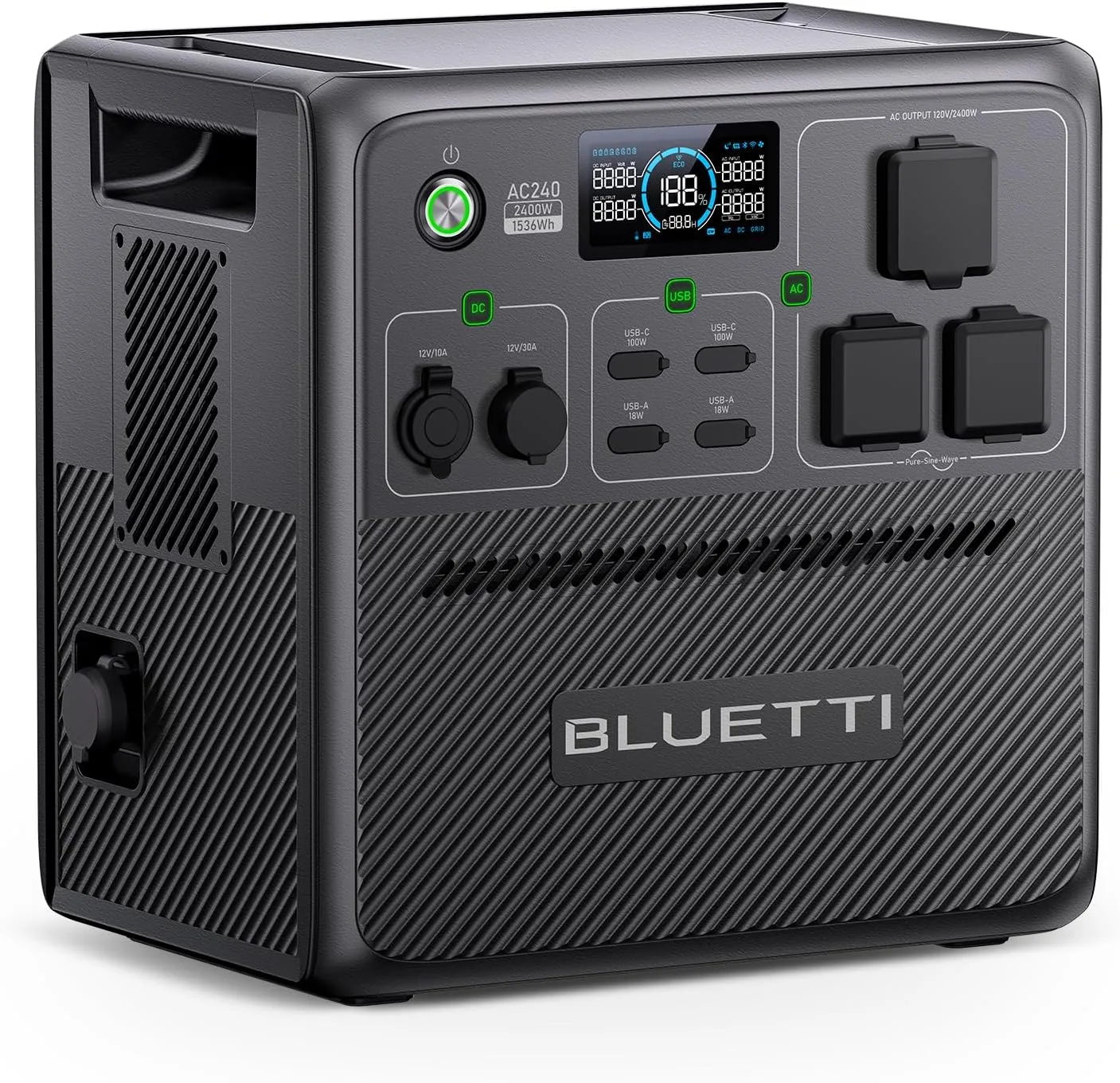
BLUETTI Pioneer 150 (AC240)
Highlights
- 1536Wh rated capacity
- 2400W continuous AC
- LiFePO4 chemistry
- Up to 1200W solar input
- 72 lb (~32.7 kg)
- About $1133.12 list
Best for
- AC240: longer outages or higher continuous loads (still not whole-home wiring)
- RV / off-grid days where recharge speed matters as much as Wh
- Best parked near the vehicle or cabin — not a long carry to a tent
Strengths
- AC240: 2400W continuous on a 1536Wh pack — more headroom for small appliances than 1kW-class peers
- 72 lb (~32.7 kg) is a park-and-use chassis — plan a short path, not a trail hike
- 15ms-class UPS switchover on the listing — useful when a router restart would hurt
- About $1133.12 list in the Hub catalog — confirm live retail before you buy
Watch-outs · not ideal when
- At 72 lb (~32.7 kg), AC240 is a poor tent-hike companion — plan a cart or leave it in the vehicle
- High continuous output on AC240 tempts big loads — Wh still runs out on kettles and A/C
- Rated 1200W solar on AC240 is optimistic; shade and cables cut real watts
- LiFePO4 helps longevity, but AC240 still hates freezing charge temps on winter trips
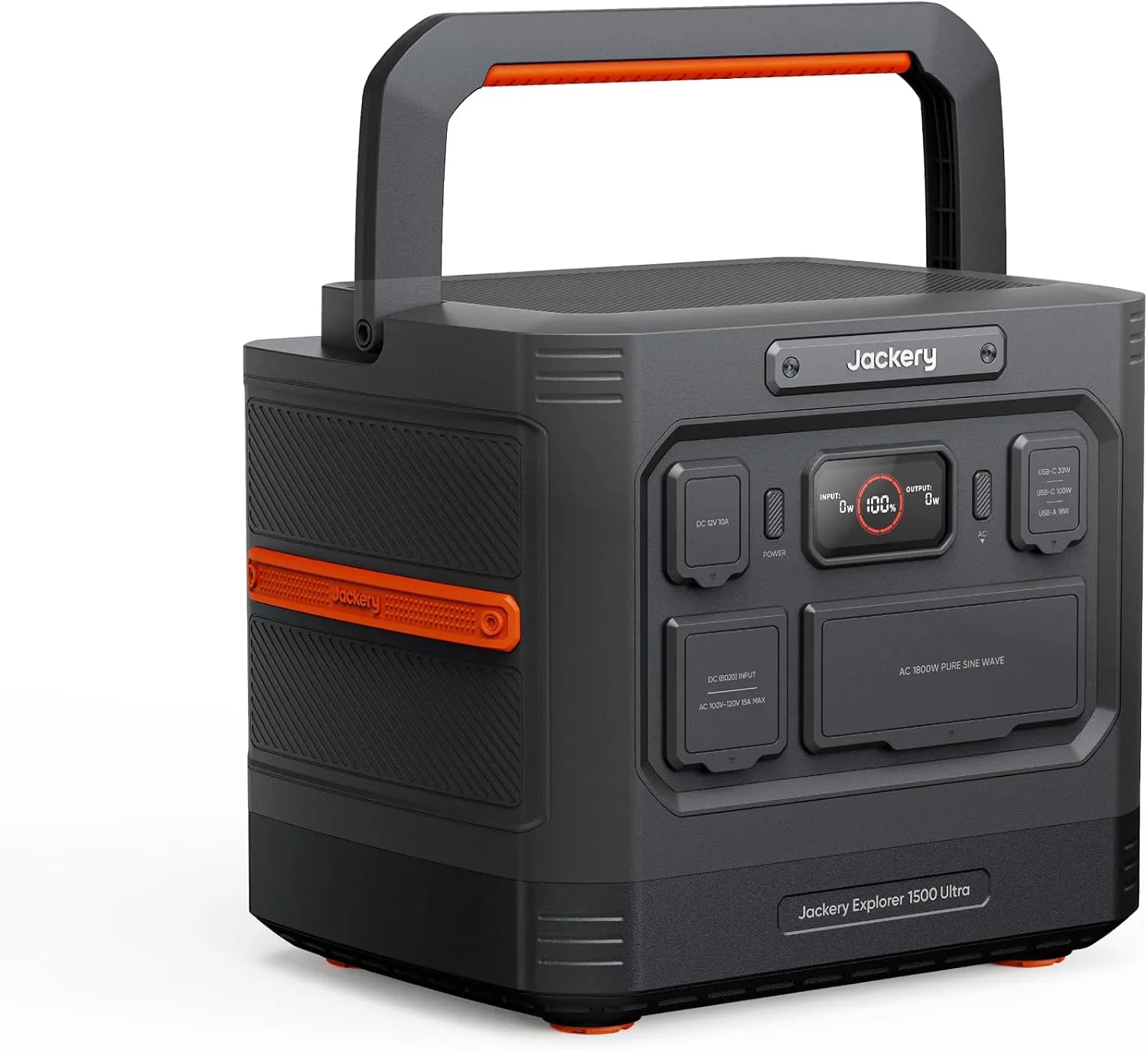
Jackery Explorer 1500 Ultra Portable Power Station,1536Wh,1800W AC
Highlights
- 1536Wh rated capacity
- 1800W continuous AC
- LiFePO4 chemistry
- Up to 800W solar input
- 38.6 lb (~17.5 kg)
- About $1199 list
Best for
- Explorer 1500 Ultra: longer outages or higher continuous loads (still not whole-home wiring)
- RV / off-grid days where recharge speed matters as much as Wh
- Users who will pair solar or expand rather than buy a second small pack
Strengths
- Explorer 1500 Ultra: 1800W continuous on a 1536Wh pack — more headroom for small appliances than 1kW-class peers
- 38.6 lb (~17.5 kg) is a park-and-use chassis — plan a short path, not a trail hike
- 1800W continuous headroom covers more small appliances than 1kW-class inverters
- Owners on file: 5/5 · 3 helpful — This worked amazing on our camping trip! While it was more expensive, it works VERY well in…
Watch-outs · not ideal when
- 38.6 lb (~17.5 kg) is a two-hand lift; skip it if you walk more than a short path to camp
- High continuous output on Explorer 1500 Ultra tempts big loads — Wh still runs out on kettles and A/C
- Rated 800W solar on Explorer 1500 Ultra is optimistic; shade and cables cut real watts
- LiFePO4 helps longevity, but Explorer 1500 Ultra still hates freezing charge temps on winter trips
Owner voices
Short takes from public retail reviews — paraphrased or translated when long or non-English; meaning kept close to the original.
“5/5 · 3 helpful — This worked amazing on our camping trip! While it was more expensive, it works VERY well in dusting wet conditions.”
“5/5 · 1 helpful — It works well. We train dogs on most weekends and I can run fans and other things all weekend.”
Owners and method
Avery Nolan is the WattPicks founding editor, covering portable power station capacity, output, and price-per-Wh guidance across the catalogue — no lab claims.
Method: I weighed these two on continuous output headroom (35%), weight and portability (25%), expandability and cycle/warranty terms (25%), and owner themes from the review pack (15%). Output headroom leads because outage loads are where these units fail first; weight is close behind because a station you cannot move does not help you mid-outage. On those weights the BLUETTI edges ahead for stationary backup and the Jackery wins for anyone who has to carry it — the $200 premium buys portability and published cycle terms, not watts.
Where a manufacturer has not published a figure — Jackery's expansion capacity, BLUETTI's cycle count and full warranty text — I have written n/a rather than guess.
Who wins on which axis: BLUETTI takes continuous output (2400 W vs 1800 W) and expandability (published path to 10,136 Wh vs n/a). Jackery takes weight (38.6 lb vs 72 lb) and published cycle/warranty terms (4,000 cycles, 5-year split vs n/a). Price per nameplate watt-hour favors BLUETTI ($0.65/Wh vs $0.78/Wh). Enclosure is a wash — both listings claim IP65. That is why the pick splits by job rather than one universal winner.
Spec snapshot
Prices are list prices, not deal stickers. Ratings are listing aggregates — the Jackery figure rests on three ratings, so treat it as a placeholder rather than a track record.
| Product | List price | Capacity (Wh) | Output (W) | Weight (lb) | Rating |
|---|---|---|---|---|---|
| BLUETTI Pioneer 150 (AC240) | $1,133.12 | 1536 Wh | 2400 W | 72 lb | 5.00 |
| Jackery Explorer 1500 Ultra Portable Power Station,1536Wh,1800W AC | $1,199 | 1536 Wh | 1800 W | 38.6 lb | 4.43 |
Where the money went
Four line items separate these two, and each one maps to a real household decision.
Output headroom. 2400 W continuous on the BLUETTI versus 1800 W on the Jackery. That gap is the difference between running a space heater or a 1,500 W-class appliance alongside a fridge and staying under the ceiling. On the Jackery, a 1,500 W heater plus a 150 W fridge cycle puts you at roughly 1,650 W — inside 1800 W, but with almost nothing left. The BLUETTI has room for that same pair plus lights and a router. Keep in mind a space heater is a worst-case load; most outage plans should size to fridge + medical + comms, not heater.
Expandability. BLUETTI publishes support for up to four B210 batteries for 10,136 Wh total. Jackery's listing for this unit does not publish an expansion figure, so treat expandability as n/a (not on file) rather than assume it. If you plan to grow capacity over years instead of replacing the box, that asymmetry matters more than the $200.
Weight and enclosure. 72 lb versus 38.6 lb is not a rounding error — it is the difference between one person carrying it up stairs and two people or a cart. Jackery counters with an IP65 rating and a drop-tested enclosure, which is genuinely useful on a wet porch or in a dusty garage. BLUETTI's listing also claims IP65, so this is closer to a wash than the marketing suggests.
Cycle life and warranty. Jackery publishes 4,000 cycles to 70% capacity and a 5-year warranty (3 + 2 extension). BLUETTI's listing does not publish a cycle count or a full warranty document in the data on file — so I would hedge there rather than assume parity. Ask BLUETTI support for the written warranty terms before you buy if that is your deciding factor.
Recharge speed is the one place both listings make big claims: BLUETTI says 0–80% in 45 minutes on 2400 W AC, Jackery says a full AC charge in 1.5 hours. Different starting points, so don't read them as a direct race.
The spec that decides it
For most outage households, continuous output is the deciding number, and 2400 W versus 1800 W is a wider gap than it looks. A refrigerator compressor surge, a space heater, a microwave, or a sump pump all push toward the ceiling fast. If your outage plan includes any single load above roughly 1,500 W, the Jackery leaves you almost no margin for the fridge running at the same time.
The second deciding number is weight, and it cuts the other way. At 72 lb, the BLUETTI is a two-person lift or a permanent garage fixture. At 38.6 lb, the Jackery is something one adult can move from the garage to the kitchen during a storm. If you live alone, have stairs, or expect to relocate the unit mid-outage, that 33 lb difference outweighs the wattage gap.
Everything else — capacity, chemistry, IP65 — is effectively tied on paper.
Real owner trade-offs
The BLUETTI has a deep owner record, and it is honest about the cracks. The UPS-style switchover is the most-repeated strength: owners describe wiring a basement circuit through a properly rated extension cord and having the router, TV, and lights stay on without a blink when utility power dropped. The display showing live incoming and outgoing watts came up repeatedly as the thing that made outage management teachable to family members.
The caveats are equally consistent. With the inverter on, owners report roughly 20 W of idle draw, and the manual caps usable capacity near 90% — so a 55 W fan that math says should run 16–17 hours delivered closer to 10–11 for one owner. Solar input is similarly optimistic: about 161 W from a 200 W panel on a clear April day, and roughly 57 W in rain. Several owners needed a full discharge to zero plus firmware updates before charging hit full speed. The wireless charging pad on top drew complaints. And the weight — owners describe it as a move-and-leave unit, not a carry-around.
The Jackery's owner record is thin: two reviews in the pack. One owner ran fans and gear all weekend at dog-training sessions without issue; another used it camping in dusty, wet conditions and said it worked very well, while noting it cost more. That is a promising signal, not a pattern. I would not treat the 5.0 listing aggregate as proof of anything at three ratings.
Read the BLUETTI reviews with the brand in mind: many of the detailed outage stories in the pack reference sibling models, so weight the themes — switchover, idle draw, solar reality — rather than any single narrative.
Buy the one that…
Buy the BLUETTI Pioneer 150 (AC240) if your outage plan includes a load approaching 2,400 W — a space heater, a microwave, a pump — or if you want to add capacity over time rather than replace the box. It is also the cheaper unit per nameplate watt-hour at $0.65/Wh versus $0.78/Wh, and the only one of the two with a published expansion path.
Buy the Jackery Explorer 1500 Ultra Portable Power Station,1536Wh,1800W AC if the unit has to move — up stairs, between rooms, into a truck — and your critical loads stay under about 1,500 W total. The 38.6 lb frame, published 4,000-cycle rating, and 5-year warranty terms are the reasons to pay $200 more for the same capacity.
Walk away from both if you need whole-home coverage or a transfer-switch install; neither is that product. Also skip both if you live in an apartment where you cannot safely vent a generator or run a heavy AC charge cord — these are stationary backup boxes, not balcony-friendly. And if you are buying the Jackery specifically for its warranty, confirm the full written warranty text with Jackery before purchase — the listing summarizes terms but the data on file does not include the full document.
Frequently asked
Can either of these run a refrigerator through a multi-hour outage?
Yes, both can, on paper — a typical fridge draws roughly 100–200 W running with a compressor surge on startup. The BLUETTI's 2400 W continuous gives more headroom if the fridge cycles while a heater or microwave is also on. The Jackery's 1800 W handles the fridge alone comfortably but leaves little margin for a second big load.
How long will each last on a fridge?
At roughly 150 W average draw, 1536 Wh works out to about 10 hours of raw math — but plan on less. Owners report ~20 W idle draw and roughly 90% usable capacity on the BLUETTI, which cuts real runtime meaningfully. Jackery does not publish a usable-capacity figure in the data on file, so I would not quote a runtime for it.
Which is cheaper per watt-hour?
The BLUETTI, at $0.65/Wh nameplate versus $0.78/Wh for the Jackery. That is nameplate math, not usable-capacity math — the usable gap depends on idle draw and inverter overhead, which owners report but the listings do not quantify.
Method and sources
Model names and list prices come from the WattPicks catalog at build time. WattPicks does not run its own laboratory tests on power stations, and nothing on this page is presented as a measured result — it is catalog-backed buying guidance.
Read our methodology for how the catalog is normalized, and about WattPicks for who publishes it.