
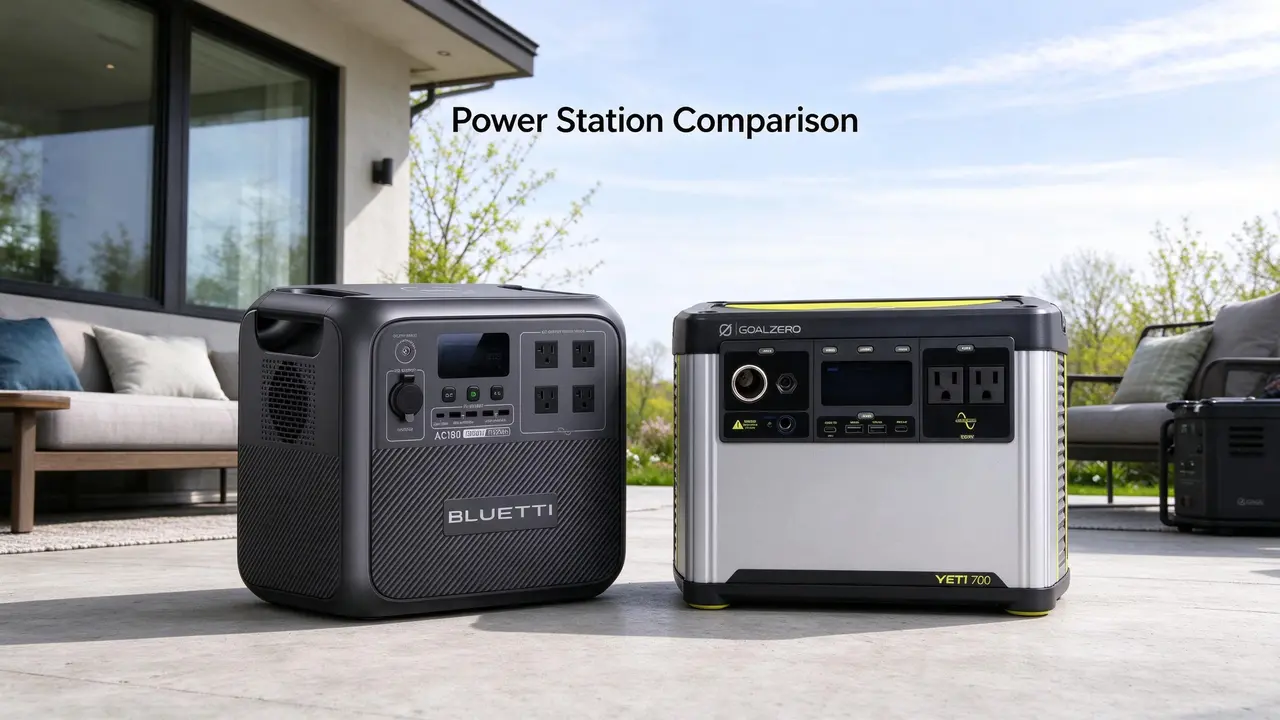
BLUETTI AC180 vs Goal Zero Yeti 700: Backup Face-Off
Two LiFePO4 stations, two very different bets: the AC180 buys watts and capacity, the Yeti 700 buys a lighter frame and onboard USB-C. Here is which one earns the money for your outage list.
Updated
At a glance
Two LiFePO4 stations, two very different bets: the AC180 buys watts and capacity, the Yeti 700 buys a lighter frame and onboard USB-C. Here is which one earns the money for your outage list.
Same money, different bets
These two are close enough in price to be a real choice, and far enough apart in build to make that choice matter. The BLUETTI AC180 at $499 puts its money into raw capacity and AC muscle: 1152 Wh and 1800 W continuous. The Goal Zero Yeti 700 at $699.95 puts its money into a smaller, lighter box — 677 Wh, 600 W — with onboard USB-C and a compact frame you can actually move.
So the question is not which station is better. It is which bet matches your outage list. If the list includes a fridge, a space heater's little sibling, or a sump pump, the AC180's wattage is the whole argument. If the list is a CPAP, a router, laptops, and phones — and you want to carry it — the Yeti 700's lighter frame and USB-C ports are the argument.
One boundary up front: neither of these is whole-home backup. They are circuit-level or room-level stopgaps, and both need you to do the runtime math with overhead included. This comparison is built from listing specs and owner themes on file — home-user checks, not lab-bench measurements. One Amazon Associates note: picks here are fit-led, not commission-led.
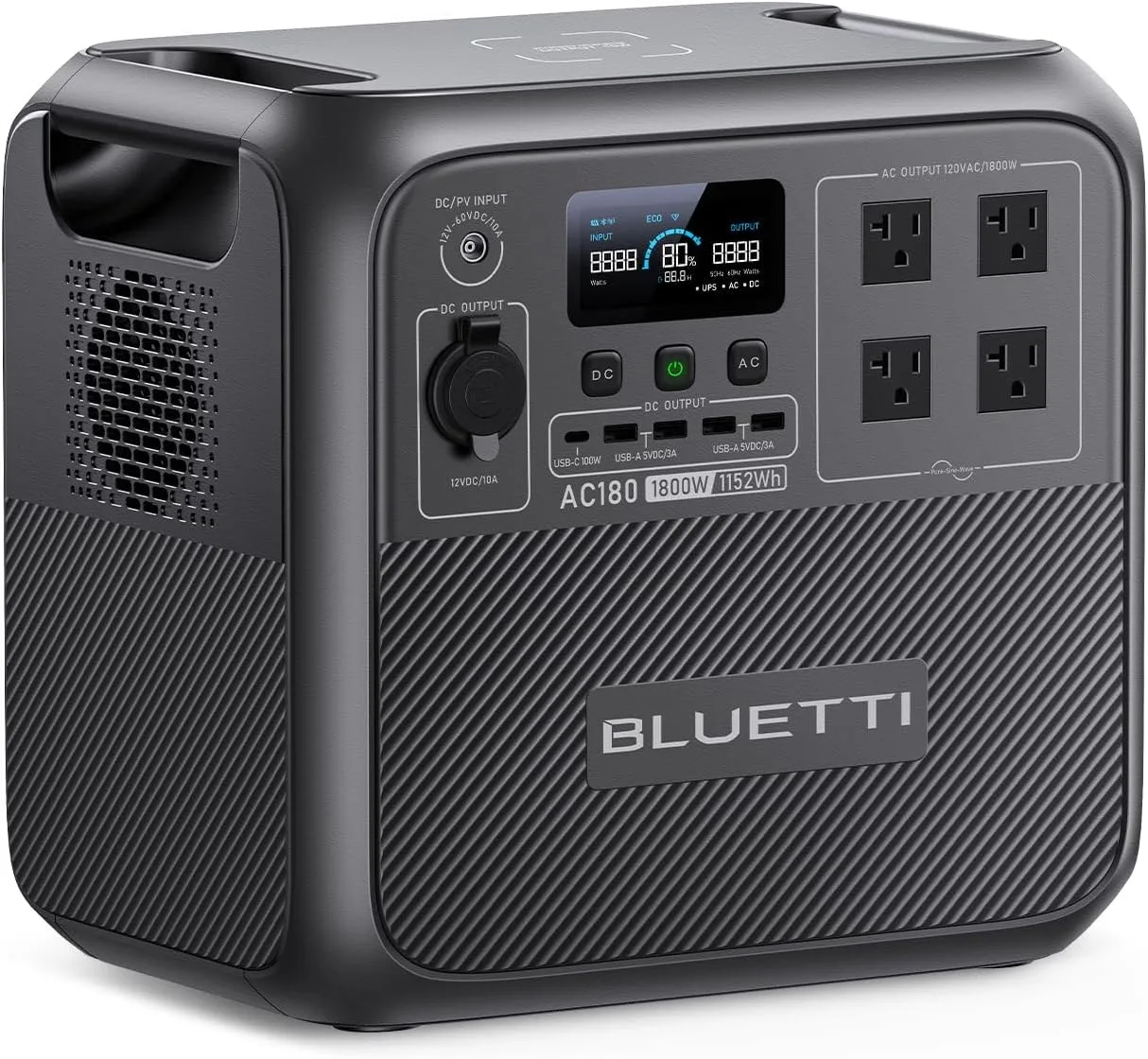
BLUETTI Portable Power Station AC180, 1152Wh LiFePO4 Battery Backup w/ 2 1800W
Highlights
- 1152Wh rated capacity
- 1800W continuous AC
- LiFePO4 chemistry
- Up to 500W solar input
- 35.3 lb (~16.0 kg)
- About $499 list
Best for
- AC180: most Wh per list dollar in mid-size LiFePO4 shortlists (~1152Wh)
- Home essentials when 1800W continuous matters more than a light carry
- Skip if 35.3 lb is too heavy for stairs or frequent car packing
Strengths
- AC180: 1800W continuous on a 1152Wh pack — more headroom for small appliances than 1kW-class peers
- 35.3 lb (~16.0 kg) is a park-and-use chassis — plan a short path, not a trail hike
- 1800W continuous headroom covers more small appliances than 1kW-class inverters
- Owners on file: Theme: Customers find this power station to be the best they've used, praising its fast charging capability (…
Watch-outs · not ideal when
- 35.3 lb (~16.0 kg) is a two-hand lift; skip it if you walk more than a short path to camp
- Usable energy on AC180 is below the 1152Wh label once the inverter is working
- Rated 500W solar on AC180 is optimistic; shade and cables cut real watts
- LiFePO4 helps longevity, but AC180 still hates freezing charge temps on winter trips
Owner voices
Short takes from public retail reviews — paraphrased or translated when long or non-English; meaning kept close to the original.
“Theme: Customers find this power station to be the best they've used, praising its fast charging capability (reaching 100% in about an hour) and value for money. They appreciate its power capacity, with one customer n…”
“Theme: Refrigerator (87)”
“Theme: Phone Charging (44)”
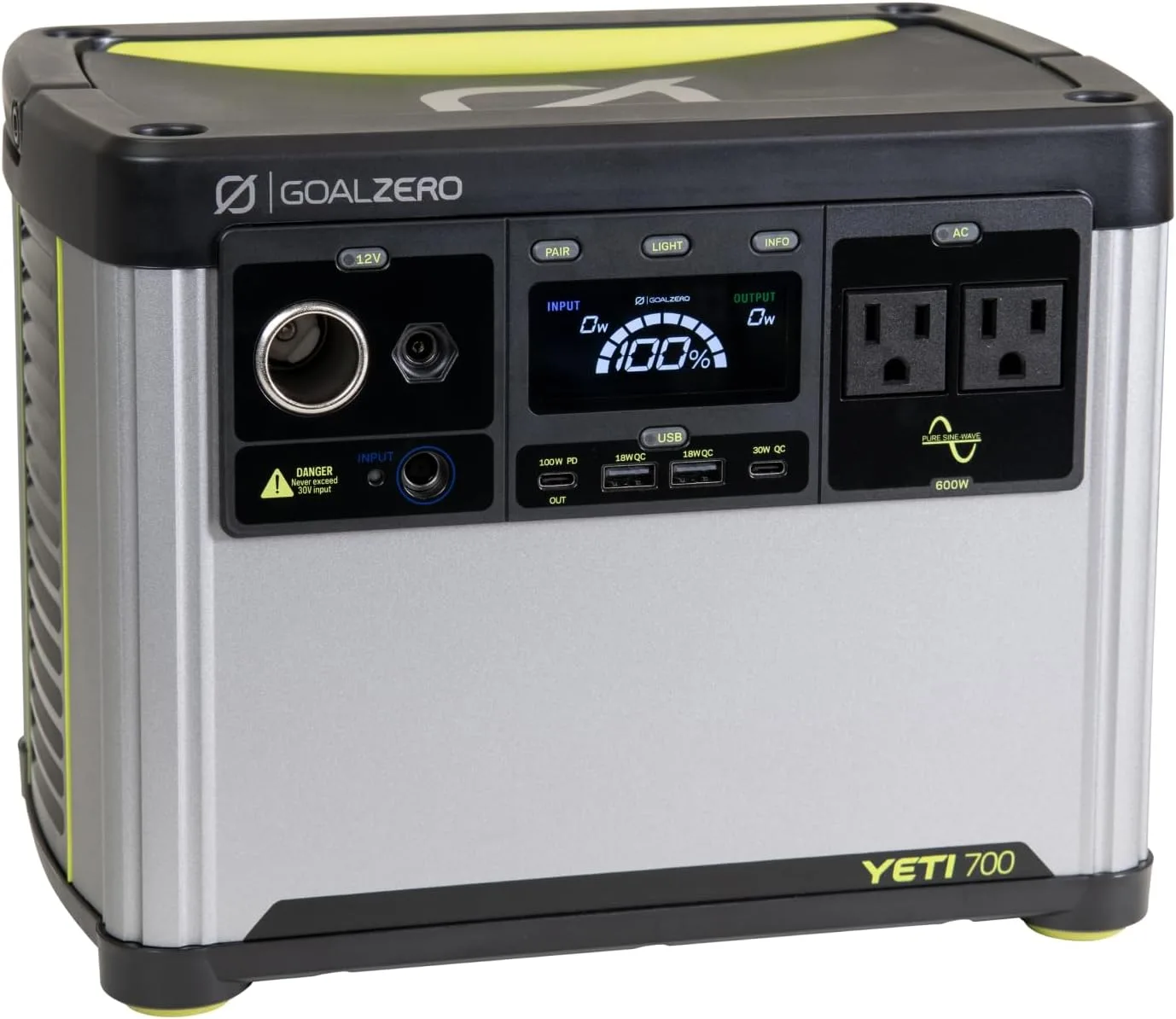
Goal Zero Yeti 700
Highlights
- 677Wh rated capacity
- 600W continuous AC
- 1000W surge
- LiFePO4 chemistry
- Up to 200W solar input
- 20.3 lb (~9.2 kg)
Best for
- Yeti 700: weekend camping when 20.3 lb carry weight matters as much as 677Wh
- Essentials bridge at home (fridge cycles, router) when sized to the Wh
- Solar top-ups up to ~200W when panels and weather cooperate
Strengths
- Yeti 700: 677Wh pack with 600W continuous / 1000W surge — size loads to both numbers
- 20.3 lb (~9.2 kg) is the lightest-class carry in this band — easier stairs and car packing
- Yeti 700 uses LiFePO4 — cycle-life claims usually beat older NMC marketing lines
- Owners on file: Theme: Customers find the power station reliable, with one mentioning it runs all their equipment through the…
Watch-outs · not ideal when
- Yeti 700 is still a bridge for essentials — not a transfer-switch whole-home system
- Usable energy on Yeti 700 is below the 677Wh label once the inverter is working
- Rated 200W solar on Yeti 700 is optimistic; shade and cables cut real watts
- LiFePO4 helps longevity, but Yeti 700 still hates freezing charge temps on winter trips
Owner voices
Short takes from public retail reviews — paraphrased or translated when long or non-English; meaning kept close to the original.
“Theme: Customers find the power station reliable, with one mentioning it runs all their equipment through the night. The battery life receives positive feedback, with multiple customers noting it charges quickly from…”
“Theme: Battery life (10)”
“5/5 · 19 helpful — I bought this 700 since I have a full size CPAP machine with the humidifier that I need when I go camping. Was able to charge multiple other devices over night (phone, hearing aid, watch) while I wa…”
Spec snapshot
Prices are list prices, not sale stickers. Ratings are the listing aggregate, which is not owner proof — especially on the Yeti, where 40 ratings is a thin sample.
| Product | Price | Capacity (Wh) | Output (W) | Weight (lb) | Rating |
|---|---|---|---|---|---|
| BLUETTI AC180 | $499 | 1152 Wh | 1800 W | 35.3 lb | 4.5 |
| Goal Zero Yeti 700 | $699.95 | 677 Wh | 600 W | 20.3 lb | 4.4 |
Where the money went
Four places the two stations spend differently, and each one changes what you can plug in.
Capacity: the AC180 carries 1152 Wh against the Yeti's 677 Wh — roughly 70% more nameplate energy for about $200 less. On paper that is a lopsided trade, and it is the single biggest reason the AC180 leads this comparison for backup duty.
AC output: 1800 W continuous versus 600 W. That gap decides appliance compatibility outright. A 600 W ceiling rules out most kitchen appliances and many power tools; 1800 W gets you into fridge-and-microwave territory, one at a time.
Ports: the Yeti 700 lists AC×2, USB-C×3, USB-A×2, and a car port — a phone-and-laptop-friendly spread with USB-C charging built in. The AC180 lists AC×4 and a car port; its USB-C and USB-A counts are not confirmed on file, so I will not claim either way. If USB-C charging without a wall brick is a priority, that is a point for the Yeti.
Weight: 20.3 lb versus 35.3 lb. The Yeti is the one you carry up stairs or into a tent without thinking about it. The AC180 is a park-it-and-leave-it unit.
- AC180: more Wh, more W, more AC outlets, less money — and 15 lb heavier.
- Yeti 700: lighter, USB-C onboard, faster to grab — and capped at 600 W AC.
The spec that decides it
If you buy one number, buy continuous AC output. The AC180's 1800 W means a typical fridge (a few hundred watts running, higher on compressor start) plus a router and a lamp is comfortably inside its ceiling. The Yeti 700's 600 W handles the router, the lamp, the laptops, and a CPAP — but a fridge is a stretch and a microwave is out.
The second deciding number is usable energy, and here the AC180's advantage narrows. Owners on file report the inverter itself draws roughly 15–20 W with AC on, and the unit reserves about 10% of capacity. Small loads therefore drain faster than 1152 Wh divided by load would suggest. The Yeti's 677 Wh is smaller to begin with, so the same overhead hurts proportionally more — one owner saw only about 18–24 hours running a portable fridge. Neither station escapes overhead; the AC180 just starts with more headroom.
Real owner trade-offs
The AC180's owner themes skew toward backup and camping. One high-helpful reviewer wired a basement circuit through it and described the UPS switchover as seamless — router and devices stayed up when grid power was cut — and praised the display for showing runtime at a given load. A five-day camping report had it running a portable car fridge and charging phones without issue. The caveats are consistent too: the wireless charging pad on top often connects and then quits, solar input lands well under panel rating on anything but clear sun, and some units needed a firmware update plus a full discharge/recharge cycle before charging at full speed. Weight comes up repeatedly as a carry-far limitation.
The Yeti 700's themes center on CPAP and device charging. One owner ran a full-size CPAP with humidifier overnight plus a phone, hearing aid, and watch, and finished under 50% — that is the use case this station was built for. Others praise fast wall charging, charge retention in storage, and the compact ammo-box footprint; the Bluetooth app gets credit when the unit sits somewhere awkward. The caveats are sharper: capacity tops out quickly on appliances, and reliability is the real question. One high-helpful reviewer is on a third unit after two let smoke out, and another dealt with long service hold times during a system transition before getting a replacement. Goal Zero ultimately made both right, but the pattern is worth knowing.
Read the star lines with care. The AC180's 4.5 across 2,825 ratings is a broad sample. The Yeti's 4.4 rests on 40 ratings — thin enough that the owner themes above tell you more than the average does.
Buy the one that…
Buy the BLUETTI AC180 if your outage list includes a fridge, power tools, or anything that needs more than 600 W to start, and you are willing to park 35.3 lb in one spot and leave it there. At $499 it is also the cheaper nameplate per watt-hour of the two — $0.43/Wh against $1.03/Wh — which matters if capacity is what you are shopping for. Skip it if you need to carry the station between rooms or campsites regularly, or if built-in USB-C charging is non-negotiable.
Buy the Goal Zero Yeti 700 if the job is CPAP overnight, router and laptop backup, and phone charging — and you want to move the thing without a plan. The 20.3 lb frame and three USB-C ports are the reasons to pay $699.95 for less capacity. Skip it if a fridge, microwave, or power tool is on your list, or if you want the widest possible warranty cushion: the failure reports on file, while resolved, are frequent enough to factor in.
Neither station replaces a transfer switch or a generator. If your outages routinely run past a day or you need to power a furnace blower or well pump, size up rather than stretch either of these past its continuous rating.
Frequently asked
Can the Yeti 700 run a full-size CPAP with humidifier overnight?
Yes — that is the strongest owner theme on file, with one reviewer finishing a night plus device charging under 50%. The AC180 has the capacity to do it too, with more headroom to spare.
Can the AC180 run a refrigerator?
Owners report fridge use within its 1800 W continuous ceiling, though compressor startup draw and the ~15–20 W inverter overhead shorten runtime versus raw math. The Yeti 700's 600 W ceiling makes a fridge a stretch.
Which is easier to carry?
The Yeti 700 at 20.3 lb, clearly. The AC180 at 35.3 lb is a two-hand, short-distance move.
Do both have USB-C?
The Yeti 700 lists USB-C×3. The AC180's USB-C count is not confirmed on file, so check the current listing before you buy if that port matters to you.
Method and sources
Model names and list prices come from the WattPicks catalog at build time. WattPicks does not run its own laboratory tests on power stations, and nothing on this page is presented as a measured result — it is catalog-backed buying guidance.
Read our methodology for how the catalog is normalized, and about WattPicks for who publishes it.