
BLUETTI AC240 vs Jackery Explorer 1500 v2: Outage Backup Duel
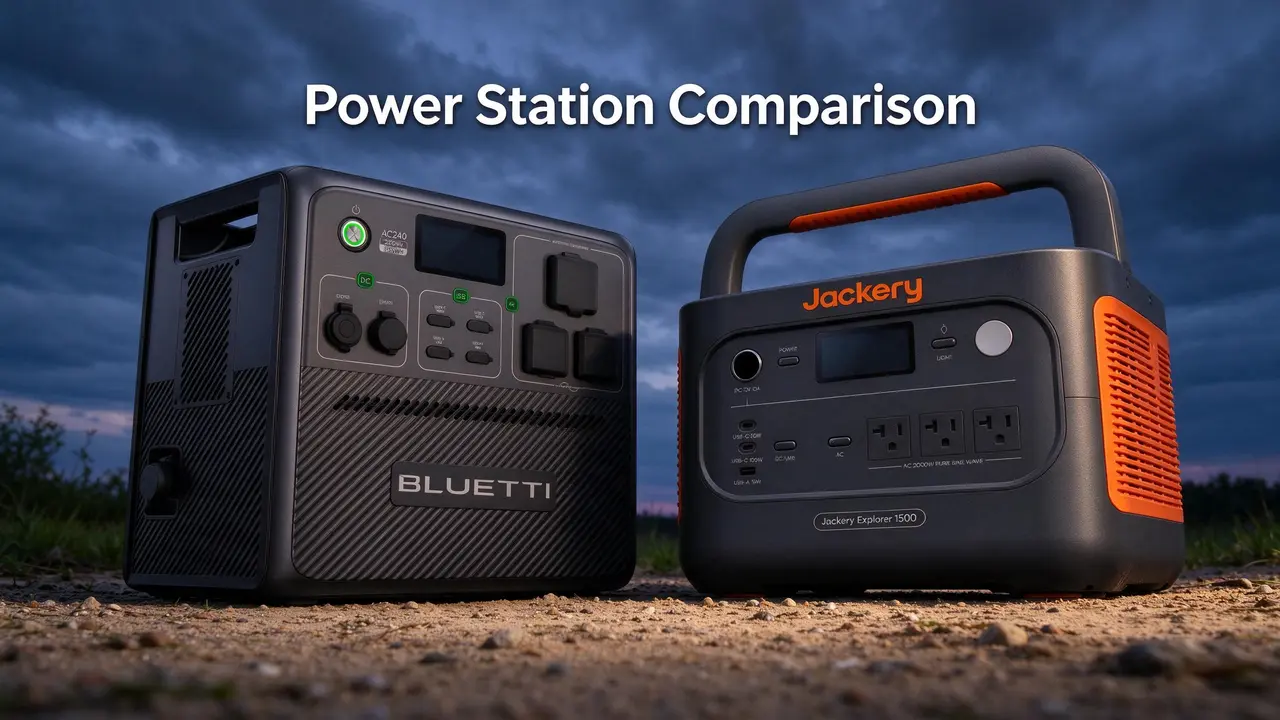
Two 1,536 Wh stations, two very different bets: the BLUETTI Pioneer 150 (AC240) is a 72 lb UPS-capable bruiser, while the Jackery Explorer 1500 v2 is a 32 lb featherweight with a thinner owner record. Here's which one fits your outage plan.
Updated
At a glance
Two 1,536 Wh stations, two very different bets: the BLUETTI Pioneer 150 (AC240) is a 72 lb UPS-capable bruiser, while the Jackery Explorer 1500 v2 is a 32 lb featherweight with a thinner owner record. Here's which one fits your outage plan.
- BLUETTI Pioneer 150 (AC240): $999, 2,400 W continuous, 72 lb, UPS switchover, app control.
- Jackery Explorer 1500 v2: $799.95, 2,000 W continuous, 32 lb, 10 ms UPS claim (listing claim, unverified), 6,000-cycle LiFePO4 claim (listing claim, unverified).
Same money, different bets
You're staring at two 1,536 Wh power stations that cost roughly the same and wondering which one keeps the fridge, router, and CPAP alive when the grid drops. The short answer: the BLUETTI Pioneer 150 (AC240) bets on raw output and UPS-style switchover, while the Jackery Explorer 1500 v2 bets on light weight and a lower nameplate price per Wh.
Cheaper wins if: your essentials stay under 2,000 W and you value a 32 lb package over a deeper owner track record. Pay more for the BLUETTI if you need 2,400 W and confirmed UPS behavior.
This is not a page for whole-home backup or running a 240V well pump. Both units are 120V portable stations with 1,536 Wh of capacity; they cover essentials for hours, not days of central air. If you need to run a furnace blower or a 3-ton AC, neither is the right tool.
One disclosure: as an Amazon Associate, WattPicks earns from qualifying purchases. Picks here are fit-led, not commission-led.
- BLUETTI Pioneer 150 (AC240): $999, 2,400 W continuous, 72 lb, UPS switchover, app control.
- Jackery Explorer 1500 v2: $799.95, 2,000 W continuous, 32 lb, 10 ms UPS claim (listing claim, unverified), 6,000-cycle LiFePO4 claim (listing claim, unverified).
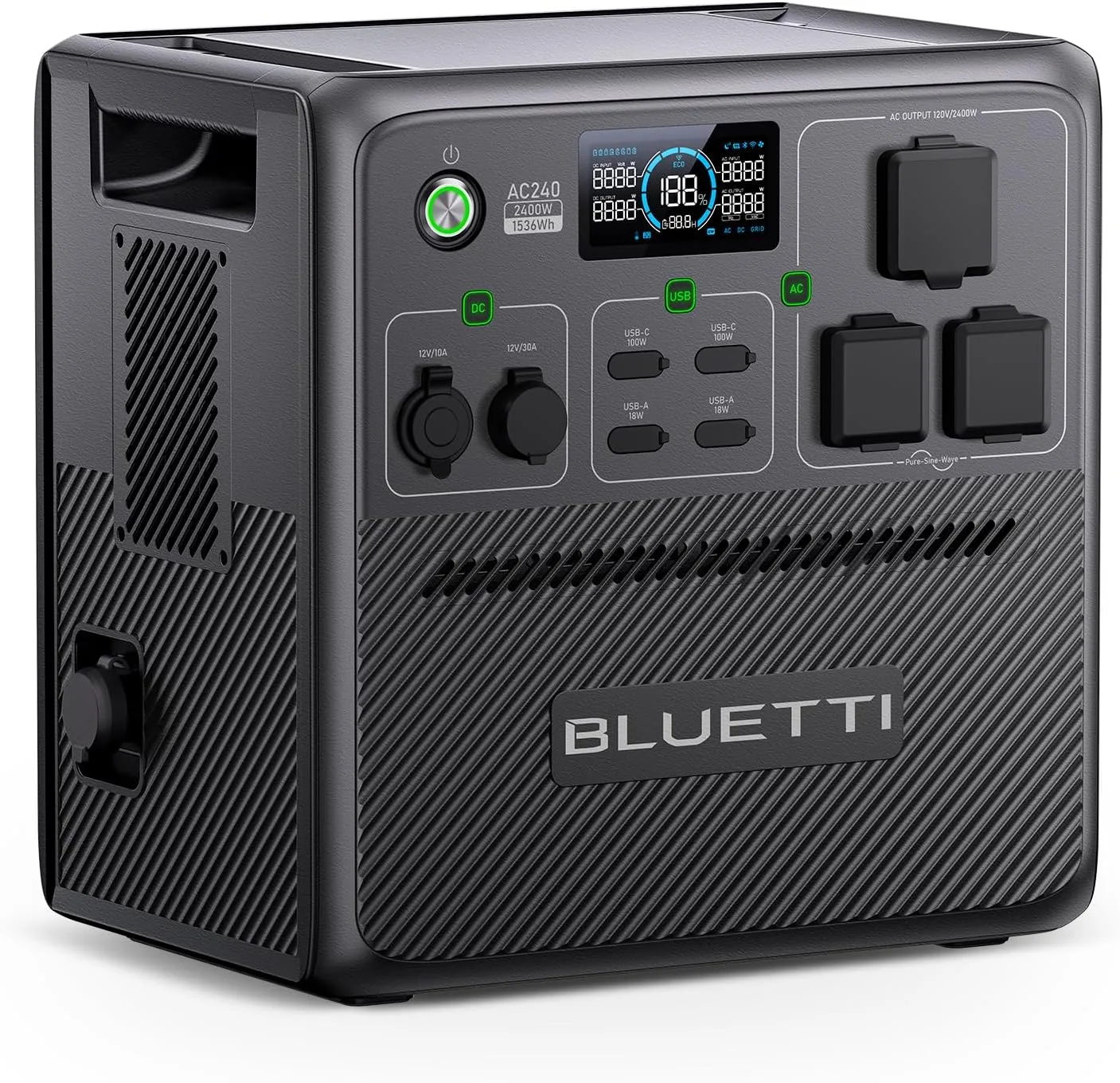
BLUETTI Pioneer 150 (AC240)
Highlights
- 1536Wh rated capacity
- 2400W continuous AC
- LiFePO4 chemistry
- Up to 1200W solar input
- 72 lb (~32.7 kg)
- About $1133.12 list
Best for
- AC240: longer outages or higher continuous loads (still not whole-home wiring)
- RV / off-grid days where recharge speed matters as much as Wh
- Best parked near the vehicle or cabin — not a long carry to a tent
Strengths
- AC240: 2400W continuous on a 1536Wh pack — more headroom for small appliances than 1kW-class peers
- 72 lb (~32.7 kg) is a park-and-use chassis — plan a short path, not a trail hike
- 15ms-class UPS switchover on the listing — useful when a router restart would hurt
- About $1133.12 list in the Hub catalog — confirm live retail before you buy
Watch-outs · not ideal when
- At 72 lb (~32.7 kg), AC240 is a poor tent-hike companion — plan a cart or leave it in the vehicle
- High continuous output on AC240 tempts big loads — Wh still runs out on kettles and A/C
- Rated 1200W solar on AC240 is optimistic; shade and cables cut real watts
- LiFePO4 helps longevity, but AC240 still hates freezing charge temps on winter trips
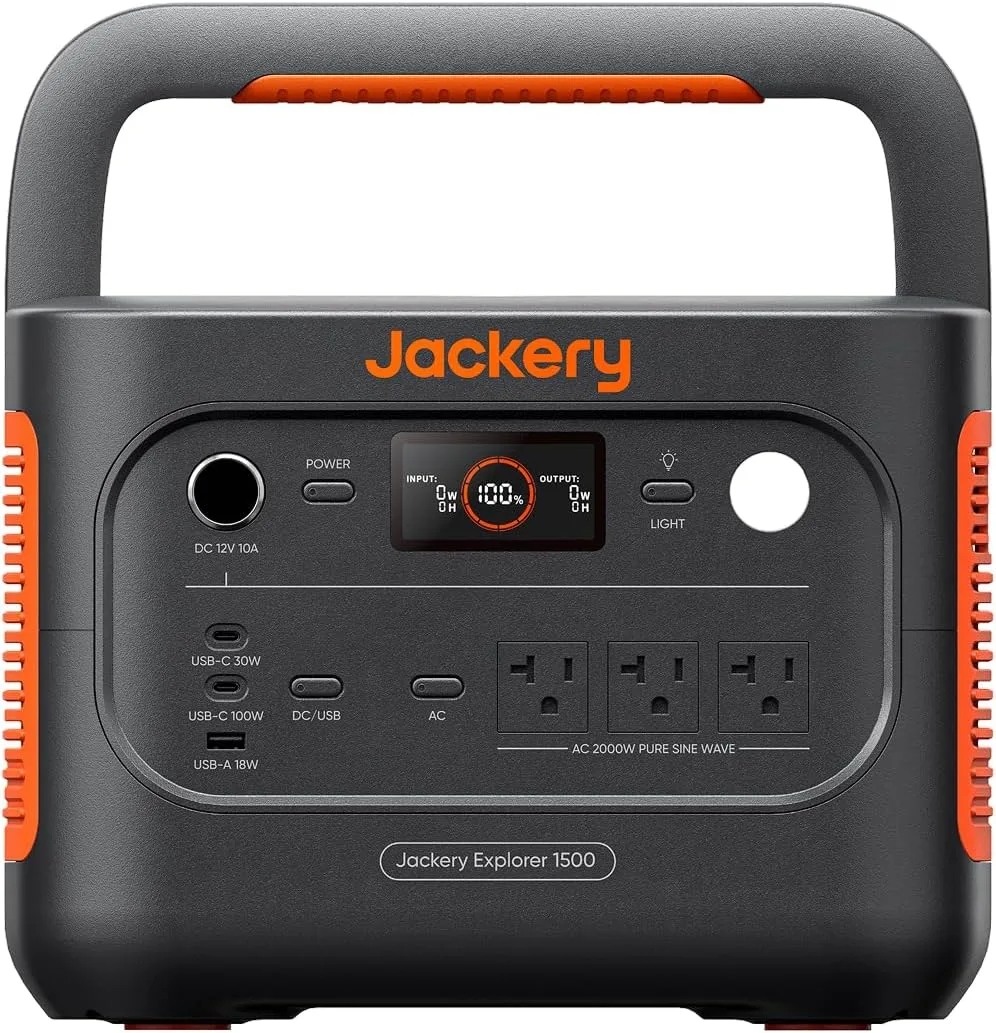
Jackery Explorer 1500 v2 Power Station,1536Wh,2000W Output
Highlights
- 1536Wh rated capacity
- 2000W continuous AC
- 4000W surge
- LiFePO4 chemistry
- 32 lb (~14.5 kg)
Best for
- Explorer 1500 v2: longer outages or higher continuous loads (still not whole-home wiring)
- RV / off-grid days where recharge speed matters as much as Wh
- Users who will pair solar or expand rather than buy a second small pack
Strengths
- Explorer 1500 v2: 1536Wh pack with 2000W continuous / 4000W surge — size loads to both numbers
- 32 lb (~14.5 kg) is a park-and-use chassis — plan a short path, not a trail hike
- 10ms-class UPS switchover on the listing — useful when a router restart would hurt
- Owners on file: Terrible product and company. Destructive service and defective products -- don't buy Jackery. Buy Ecoflow in…
Watch-outs · not ideal when
- 32 lb (~14.5 kg) is a two-hand lift; skip it if you walk more than a short path to camp
- High continuous output on Explorer 1500 v2 tempts big loads — Wh still runs out on kettles and A/C
- Solar input unpublished for Explorer 1500 v2 — do not assume a same-day off-grid refill
- LiFePO4 helps longevity, but Explorer 1500 v2 still hates freezing charge temps on winter trips
Owner voices
Short takes from public retail reviews — paraphrased or translated when long or non-English; meaning kept close to the original.
“1/5 — Terrible product and company. Destructive service and defective products -- don't buy Jackery. Buy Ecoflow instead -- their customer support arent insane and won't try to deny how shipping policies work in Canad…”
“4.6/5 — -5%$28.07 Typical price: $29.69 Get it as soon as Saturday, Oct 31 FREE Shipping on orders over $35 shipped by Amazon ZOUPW 200W Portable Solar Panel for Power Station,23.5% Efficiency | Mono Foldable Solar Pa…”
“4.4/5 — Amazon's Choice $189.99 Get it as soon as Saturday, Oct 31 FREE Shipping by Amazon Portable Carrying Bag Compatible with Jackery Explorer 1000 V2, Soft Power Station Storage Case with Padding, Generator Cover…”
Spec snapshot
Prices are list prices from the WattPicks catalogue as of January 2025. Ratings are listing aggregates, not owner proof—the Jackery's 3.6 comes from just 3 ratings, so treat it as a thin signal. The Jackery's 10 ms UPS transfer time is a listing claim, unverified by owner reports.
| Product | List price | Capacity (Wh) | Output (W) | Weight (lb) | Rating |
|---|---|---|---|---|---|
| BLUETTI Pioneer 150 (AC240) | $1,133.12 | 1536 Wh | 2400 W | 72 lb | 5.00 |
| Jackery Explorer 1500 v2 Power Station,1536Wh,2000W Output | $949 | 1536 Wh | 2000 W | 32 lb | 4.32 |
Where the money went
The BLUETTI's extra $199 buys you 400 more watts of continuous AC output, a heavier chassis that likely houses a larger inverter and cooling, and a documented UPS-style transfer that owners say kept routers and TVs alive without a blink. It also buys a 72 lb weight penalty—this is a garage or basement resident, not a trunk companion.
The Jackery spends its budget on portability and cycle-life claims. At 32 lb, it's less than half the BLUETTI's weight, and the listing claims 6,000 cycles to 70% capacity on LiFePO4. That's a compelling paper spec for someone who moves the station between rooms or vehicles. But the owner-review pack is essentially empty of usage reports, so I can't confirm how that 10 ms UPS claim behaves in a real outage.
Ports differ too: the BLUETTI lists AC×2 plus USB-C and USB-A; the Jackery lists AC×3 and USB-C×2, with USB-A unknown. If you need three AC plugs without a strip, the Jackery has the edge on paper.
The spec that decides it
For most outage plans, continuous output is the deciding number. A fridge compressor might pull 600–800 W running with a startup surge, a CPAP is 40–60 W, and a router is 10–20 W. Both stations handle that aggregate easily. But if you want to add a space heater (1,500 W) or a microwave (1,000–1,500 W) on top, the BLUETTI's 2,400 W ceiling gives you more headroom before you trip the inverter.
The second deciding factor is weight against your use case. If the station lives in a closet and only comes out for outages, 72 lb is manageable. If you plan to haul it to a campsite or between floors, the Jackery's 32 lb is the difference between using it and dreading it.
- Choose the BLUETTI if your essential load includes a fridge plus a 1,500 W appliance running at the same time.
- Choose the Jackery if you need to move the station regularly and your load stays under 2,000 W.
Real owner trade-offs
The BLUETTI has a deep owner record: 2,825 ratings at a 4.5 listing aggregate, with themes around UPS switchover, easy setup, and the runtime display. Owners repeatedly mention that the display shows incoming/outgoing watts and hours-left, which makes it easy to coach a family on what to unplug. The caveats are equally consistent: idle draw with the inverter on eats capacity, usable capacity is capped by battery protection, and solar input rarely hits the panel's rated watts. One owner's unit charged slowly until a firmware update and a full discharge/recharge cycle fixed it.
The Jackery's owner pack is thin. The only substantive review is a one-star complaint about shipping and customer service in Canada—not a usage report. I can't give you field notes on runtime, switchover, or app behavior from this pack without inventing them, and I won't. Treat the 3.6 listing aggregate as a thin signal, not a verdict.
What an outage night actually looks like
Here's a realistic runtime estimate for a core essentials load on either 1,536 Wh station. Assume a fridge that runs about 8 hours out of 24 (duty cycle ~33%) at 700 W, a router at 15 W continuous, and a CPAP at 50 W for 8 hours. The fridge uses roughly 5,600 Wh/day, but for an overnight (12-hour) window that's about 2,800 Wh—already more than one station can deliver. So the practical plan is to cycle the fridge: run it 2–3 hours on, 2–3 hours off. That cuts fridge draw to roughly 1,400–2,100 Wh over 12 hours, still near the station's limit. Add router (180 Wh) and CPAP (400 Wh) and you're at 2,000–2,700 Wh—beyond a single 1,536 Wh unit after inverter losses (~10–15%).
Bottom line: one 1,536 Wh station can carry router + CPAP + intermittent fridge for a night if you're disciplined about fridge cycling, but not a full 24 hours of normal fridge duty. The BLUETTI's display helps you watch the burn; the Jackery's lighter weight makes it easier to swap in a second unit if you have one. Neither replaces a generator for multi-day outages.
Warranty and support: both brands publish warranty terms on their listings, but coverage and response times vary by region—confirm the terms for your country before you buy.
Which one fits your outage plan
Match the station to your load ceiling and your lifting limit. If you need 2,400 W of continuous output and a proven UPS-style transfer for a basement circuit, the BLUETTI Pioneer 150 (AC240) is the safer bet—just budget for idle draw and do the firmware calibration on day one.
If 2,000 W covers your essentials and you value a 32 lb package with a lower nameplate $/Wh, the Jackery Explorer 1500 v2 is the logical pick—but go in knowing the owner record is thin and the cycle-life claim is listing-only until real reports accumulate.
- Skip the BLUETTI if you need to carry the station more than a few steps or run loads above 2,400 W.
- Skip the Jackery if you need confirmed UPS behavior or a deep owner track record before buying.
Verify before you buy the Jackery
Because the Jackery's owner evidence is thin, do these checks before ordering: confirm the return window and restocking fee with the seller; ask for the UPS spec sheet or a written confirmation of the 10 ms transfer time; and verify whether USB-A ports are included, since the listing doesn't specify. If you're in Canada, note that the one detailed review flagged shipping and customer service issues—check delivery terms and support channels for your region.
Frequently asked
Can the BLUETTI Pioneer 150 (AC240) run a fridge and a space heater at the same time?
On paper, yes—2,400 W continuous covers a 600–800 W fridge and a 1,500 W heater. Runtime will be short: 1,536 Wh divided by roughly 2,100 W is under an hour, so this is a bridge, not a day-long solution.
Which is cheaper per Wh?
The Jackery, at $0.52/Wh nameplate versus $0.65/Wh for the BLUETTI. That's a listing-math comparison, not a usable-capacity measurement—both units cap usable capacity below nameplate for battery protection.
Can either run a CPAP overnight?
Both can—a CPAP draws roughly 40–60 W, so 1,536 Wh gives you many hours even after inverter losses. The BLUETTI's display makes it easier to watch the draw.
Method and sources
Model names and list prices come from the WattPicks catalog at build time. WattPicks does not run its own laboratory tests on power stations, and nothing on this page is presented as a measured result — it is catalog-backed buying guidance.
Read our methodology for how the catalog is normalized, and about WattPicks for who publishes it.