
EcoFlow RIVER 2 Review: Fast-Charge Compact Power Station
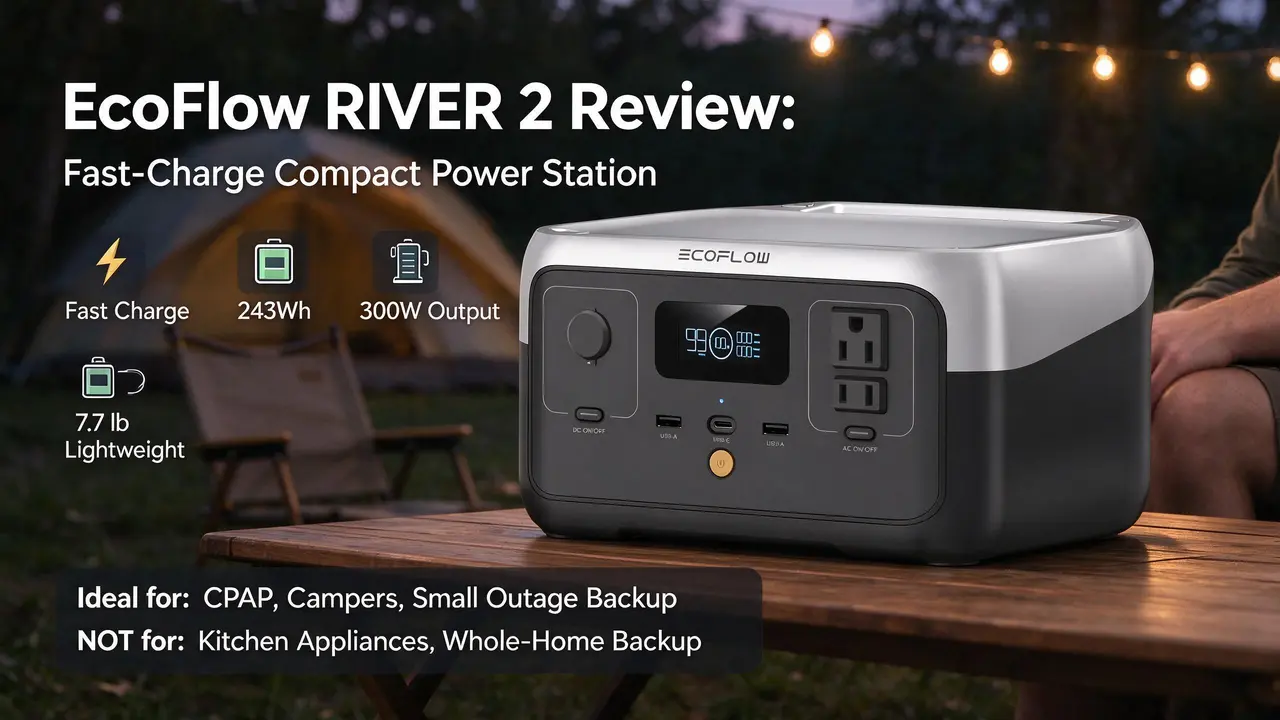
The EcoFlow RIVER 2 is a 243 Wh, 300 W power station that recharges from AC in about an hour and weighs just 7.7 lb. It suits CPAP users, campers, and small-outage backup — not kitchen appliances.
Updated
What the RIVER 2 is actually for
The EcoFlow RIVER 2 is a 243 Wh portable power station with 300 W continuous AC output and a 7.7 lb body. It is not a whole-home backup, and it will not run a coffee maker or microwave. What it does well is keep small essentials alive: a CPAP, a router, a fan, a laptop, and a few lights.
If you need to power a fridge, a space heater, or a sump pump, this is the wrong class of unit. Step up to a larger station with 1,000 W or more continuous output. The RIVER 2 is for the gap between a phone power bank and a serious backup system.
I base this on owner themes from the listing and the published specs — not lab-bench measurements. The numbers here come from EcoFlow's listing; the usage patterns come from what owners report. I did not run independent timed tests.
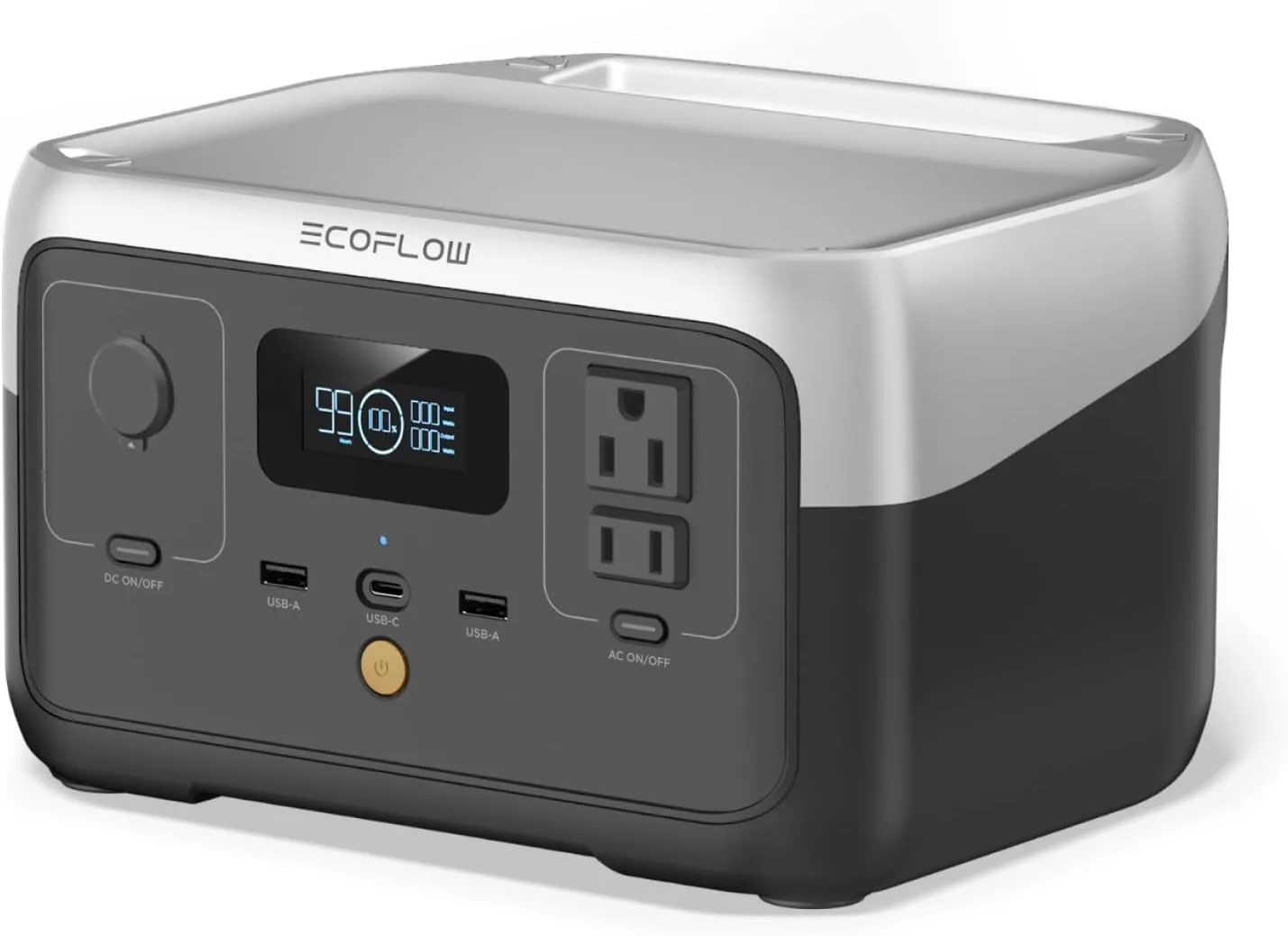
- 243 Wh capacity, 300 W continuous AC output (600 W with X-Boost for short bursts)
- 7.7 lb, built-in handle — easy to move room to room
- AC recharge in about 1 hour; solar input up to 110 W
- LiFePO4 battery rated for 3,000 cycles to 80%
EcoFlow RIVER 2
Highlights
- 243Wh rated capacity
- 300W continuous AC
- 600W surge
- LiFePO4 chemistry
- Up to 110W solar input
- 7.7 lb (~3.5 kg)
Best for
- RIVER 2: phones, cameras and a laptop on short trips
- Travel kits when you need quiet pack power, not appliance runtime
- Brief desk backup for router and lights — not a fridge for days
Strengths
- RIVER 2: 243Wh pack with 300W continuous / 600W surge — size loads to both numbers
- 7.7 lb (~3.5 kg) is the lightest-class carry in this band — easier stairs and car packing
- RIVER 2 uses LiFePO4 — cycle-life claims usually beat older NMC marketing lines
- Owners on file: Theme: Small Appliances (53)
Watch-outs · not ideal when
- RIVER 2's small Wh class empties fast with a kettle, hair dryer or space heater
- 300W continuous will not hold heating elements or many compressor surges for long
- Rated 110W solar on RIVER 2 is optimistic; shade and cables cut real watts
- Airline and pack limits may still block RIVER 2 even when the weight looks friendly
Owner voices
Short takes from public retail reviews — paraphrased or translated when long or non-English; meaning kept close to the original.
“Theme: Phone Charging (126)”
“Theme: Small Appliances (53)”
“Theme: Backup Power (43)”
Specs that matter for real use
The headline number is the 1-hour AC recharge. Owners consistently mention this as the feature that changes how they use the unit — top it up during breakfast, and it's ready for a day out. That speed is rare in this price and capacity class.
The LiFePO4 chemistry is the other long-term win. EcoFlow rates it for 3,000 cycles to 80%, which is roughly a decade of regular use. That matters if you're buying this as a backup that sits idle for months — you won't be replacing it every three years like a typical lithium-ion pack.
Port selection is decent: six AC outlets, USB-C (yes, one port), and USB-A (the listing doesn't specify how many, so I won't guess). The app shows power draw and remaining capacity, and solar charging works with a compatible panel — owners report needing at least 25 W input for consistent charging.
- Capacity: 243 Wh
- Continuous AC output: 300 W
- Weight: 7.7 lb
- List price: $299 (nameplate $/Wh: $1.23)
- Ports: AC×6, USB-C yes, USB-A unknown (not on file)
- Warranty: 5-year service (per listing)
Where it falls short
The 300 W continuous limit is the hard ceiling. Owners who tried coffee makers, microwaves, or hair dryers found the unit shut off or refused to start. X-Boost can push to 600 W for short bursts, but that's not a substitute for a higher-output station.
One owner reported a defective unit that wouldn't hold a charge and had a tedious warranty process. That's a single data point, not a pattern, but it's a reminder to test your unit thoroughly within the return window. Another owner had a firmware update temporarily disable AC charging display and USB-C input; a later update fixed it. If you rely on this for a medical device, time updates carefully.
The single USB-C port is a minor annoyance if you have multiple USB-C devices. And the fan is audible during fast charging or heavy load — not loud enough to distract in most settings, but noticeable in a quiet room.
- Not for high-wattage appliances (coffee makers, microwaves, hair dryers)
- One USB-C port only
- Fan noise during fast charge or heavy load
- Firmware updates can temporarily affect charging behavior — schedule them
Who should buy it — and who shouldn't
Buy the RIVER 2 if you need a lightweight, fast-recharging station for CPAP backup, camping, tailgating, or keeping routers and lights on during short outages. Owners report a full night of CPAP use and hours of runtime for a router, lamp, and laptop. The 1-hour recharge makes it easy to keep ready.
Skip it if you need to run kitchen appliances, power a fridge for hours, or back up a whole home. The 300 W continuous output and 243 Wh capacity won't get you there. Also skip if you need multiple USB-C ports or if fan noise in a quiet bedroom would bother you.
At $299 list, it's a fair price for the feature set. Owners who caught it on sale around $199–$249 felt it was a strong value. If you're patient, watch for discounts — but don't expect it to replace a larger backup system.
What you still need to buy: a compatible solar panel (up to 110 W input) and the right cable for it if you plan to recharge off-grid. The AC charging cable is included, but a solar panel is not.
- Buy if: CPAP backup, camping, small-outage essentials, fast recharge matters
- Skip if: you need to run appliances over 300 W, want whole-home backup, or need multiple USB-C ports
What owners say
The dominant theme in owner reviews is the fast AC recharge — many mention going from empty to full in about an hour. CPAP users report a full night's use, and campers appreciate the light weight and compact size. The app gets consistent praise for showing power draw and remaining capacity.
On the critical side, owners mention the 300 W limit as the main frustration, especially when trying to run small appliances. A few note fan noise during fast charging, and one reported a warranty hassle with a defective unit. Solar charging works well with a compatible panel, but owners recommend at least 25 W input for reliable charging.
The listing aggregate is 4.3 stars from 4,553 ratings — that's a listing figure, not a verified owner tally. The themes above come from high-helpful reviews and should be treated as directional, not statistical.
- Fast recharge is the most-praised feature
- CPAP and small-electronics runtime get positive mentions
- 300 W limit is the most common complaint
- One warranty complaint and one firmware glitch reported
RIVER 2 vs Jackery: how to choose
If you're cross-shopping the RIVER 2 against a Jackery unit, the decision usually comes down to recharge speed and chemistry versus capacity and port layout. The RIVER 2's 243 Wh and 300 W continuous output are the numbers to compare against whatever Jackery model you're considering — check that model's Wh, continuous W, and battery chemistry before deciding.
On value, the RIVER 2's $299 list price works out to about $1.23 per Wh. Run the same math on the Jackery model you're eyeing: divide its price by its Wh. The lower $/Wh is the better capacity value, though recharge speed and LiFePO4 cycle life can justify a higher $/Wh for some buyers.
For a solar example: a 110 W panel in good sun can realistically deliver a meaningful fraction of the RIVER 2's 243 Wh in a day, but expect less in clouds or shade. Size your panel to your daily Wh need, not the station's max input.
- Compare Wh, continuous W, and battery chemistry before choosing
- RIVER 2 nameplate: $299 ÷ 243 Wh ≈ $1.23/Wh
- Recharge speed and LiFePO4 cycle life can offset a higher $/Wh
Methodology
I’m Avery Nolan, WattPicks founding editor. For this review I combined the published listing specs with owner themes from high-helpful Amazon reviews — home-user checks, not lab-bench measurements. I did not run independent timed tests; runtime and charging figures are from the listing and owner reports. The listing star average is shown as a listing aggregate, not owner proof. One Amazon Associates disclosure: picks are fit-led, not commission-led, and product links may earn a commission.
Frequently asked
Can the RIVER 2 run a CPAP all night?
Owners report a full night's use (7–8 hours) on a CPAP, but runtime depends on your machine's wattage and settings. Do the math: a CPAP drawing 30 W for 8 hours needs about 240 Wh — right at the RIVER 2's 243 Wh usable capacity, so a humidifier or higher draw will cut that short. Check your CPAP's draw and compare to 243 Wh.
How long does it take to recharge?
About 1 hour from AC, per the listing and owner reports. Solar charging takes longer and depends on panel wattage and sun conditions — owners recommend at least 25 W input.
Will it run a coffee maker?
No. The continuous output is 300 W, and most coffee makers draw 600–1,500 W. X-Boost can handle short bursts up to 600 W, but not a full brew cycle.
What's the warranty?
The listing states a 5-year service. One owner reported a difficult warranty process, so keep your receipt and test early.
Method and sources
Model names and list prices come from the WattPicks catalog at build time. WattPicks does not run its own laboratory tests on power stations, and nothing on this page is presented as a measured result — it is catalog-backed buying guidance.
Read our methodology for how the catalog is normalized, and about WattPicks for who publishes it.