
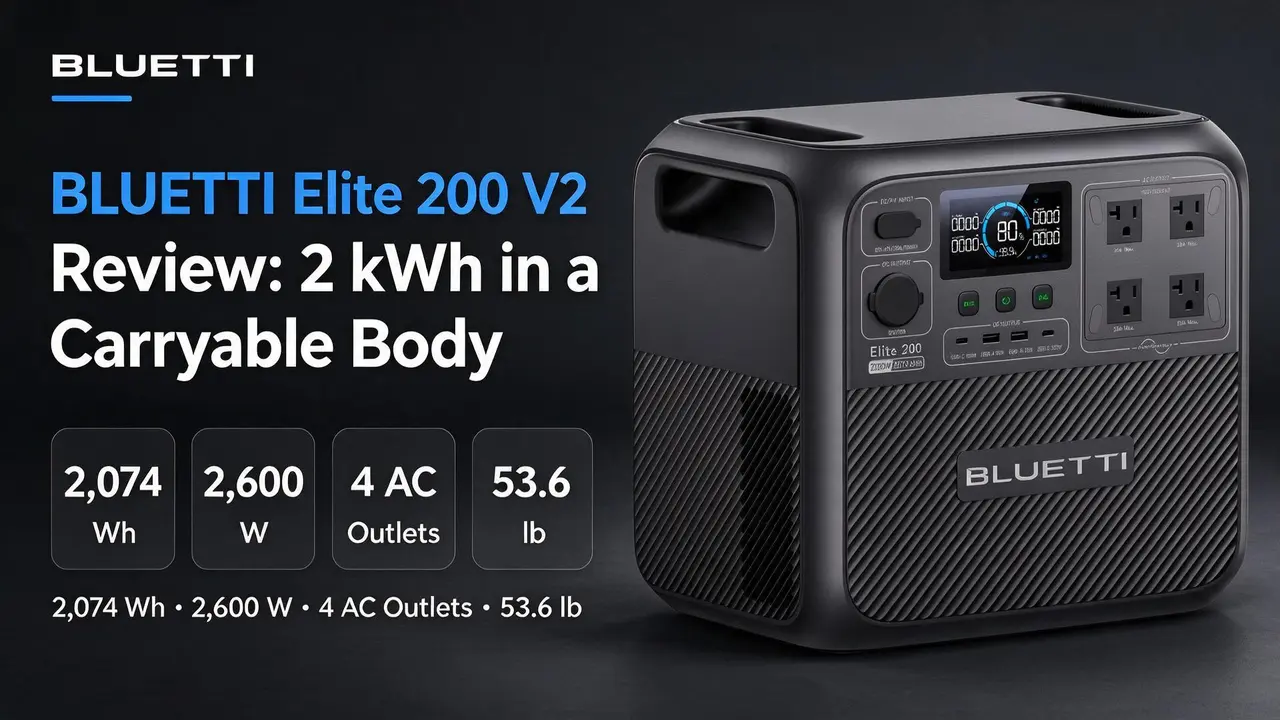
BLUETTI Elite 200 V2 Review: 2 kWh in a Carryable Body
The Elite 200 V2 packs 2,074 Wh and 2,600 W continuous into 53.6 lb — enough to run a fridge, CPAP, and a full kitchen burst. But the warranty term is not on file, and solar charging lacks user-set SoC limits.
Updated
What this price buys
The BLUETTI LFP Battery Backup w/ 4 2600W AC Outlets 3900W Power Lifting lists at $1,399. For that you get a 2,074 Wh LiFePO4 station rated 2,600 W continuous AC output, four AC outlets, and a 3,900 W power-lifting mode for motor starts. In the box: the station, an AC charging cable, a grounding screw, and the manual. Solar panels, a car charging cable, and the app are not included — the app is a free download, but the panels are extra.
This is not a whole-home battery. It has no transfer switch, no smart panel wiring, and no 240 V output. It is a large portable station you can carry to the breaker panel or plug a fridge into directly. If you need a permanent home backup circuit, this is the wrong class of product — look at a fixed battery with a transfer switch instead.
The nameplate cost is $0.67 per Wh. That is mid-pack for LFP stations in this capacity band; for comparison, many 2 kWh LFP stations land between $0.50 and $0.80 per Wh, so you are paying for the compact footprint and the 2,600 W inverter, not for the cheapest watt-hour.
- List price: $1,399 (ignore any deal sticker — the table uses list)
- Capacity: 2,074 Wh LiFePO4
- Continuous AC: 2,600 W; power lifting: 3,900 W
- In the box: station, AC cable, grounding screw, manual
- Not included: solar panels, car charging cable, transfer switch
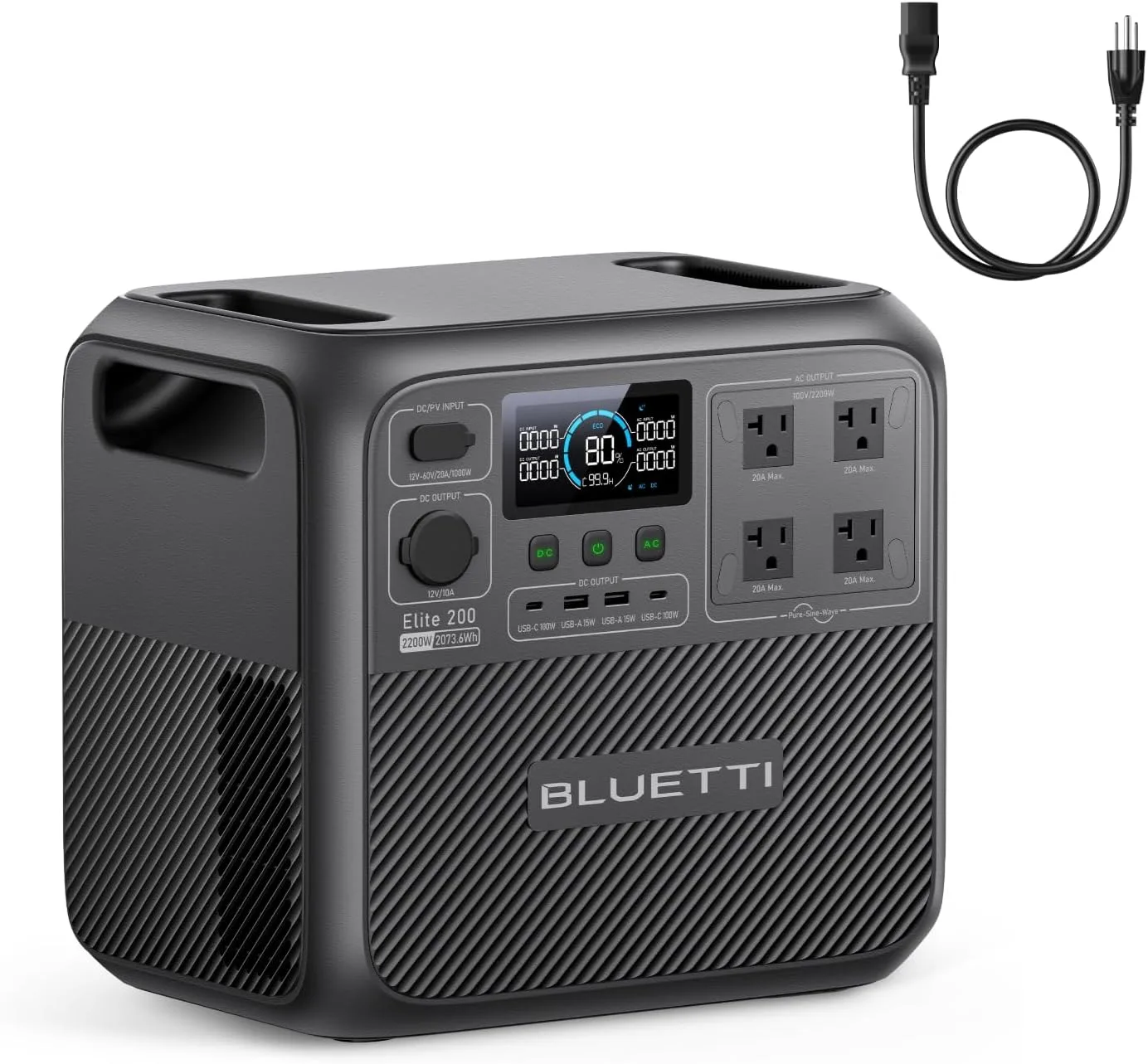
BLUETTI LFP Battery Backup w/ 4 2600W AC Outlets 3900W Power Lifting
Highlights
- 2074Wh rated capacity
- 2600W continuous AC
- LiFePO4 chemistry
- 53.6 lb (~24.3 kg)
- About $1399 list
Best for
- Elite 200 V2: longer outages or higher continuous loads (still not whole-home wiring)
- RV / off-grid days where recharge speed matters as much as Wh
- Best parked near the vehicle or cabin — not a long carry to a tent
Strengths
- Elite 200 V2: 2600W continuous on a 2074Wh pack — more headroom for small appliances than 1kW-class peers
- 53.6 lb (~24.3 kg) is a park-and-use chassis — plan a short path, not a trail hike
- 2600W continuous headroom covers more small appliances than 1kW-class inverters
- Owners on file: Theme: Customers find this power station performs exceptionally well, particularly in emergency situations wh…
Watch-outs · not ideal when
- At 53.6 lb (~24.3 kg), Elite 200 V2 is a poor tent-hike companion — plan a cart or leave it in the vehicle
- High continuous output on Elite 200 V2 tempts big loads — Wh still runs out on kettles and A/C
- Solar input unpublished for Elite 200 V2 — do not assume a same-day off-grid refill
- LiFePO4 helps longevity, but Elite 200 V2 still hates freezing charge temps on winter trips
Owner voices
Short takes from public retail reviews — paraphrased or translated when long or non-English; meaning kept close to the original.
“Theme: Customers find this power station performs exceptionally well, particularly in emergency situations when there's no power. The generator charges quickly from 120V input, runs fridges for 24 hours, and has a 260…”
“Theme: Refrigerators (26)”
“Theme: Heating & Cooling (19)”
How capacity scales
The Elite 200 V2 does not expand with add-on battery packs. Its 2,074 Wh is fixed. That is a real limitation if you were hoping to start small and grow — there is no stackable B300-style expansion here. What you buy is what you get.
The expansion path is external: more solar panels, a second station, or a generator feeding the AC input. The solar input ceiling is 1,000 W with a 60 V maximum PV input, which owners note is hard to hit with portable panels because of the voltage limit. A 200 W folding panel is a realistic camping pairing; 400 W is better if you want to recover a full day of cooking.
For home backup, the practical scaling move is a second unit or a generator. There is no per-inverter max unit count published, because there is no stacking feature. Cost per added battery pack is n/a — no packs are sold for this model.
- Base capacity: 2,074 Wh — fixed, not expandable
- Max solar input: 1,000 W, 60 V PV ceiling
- No add-on battery packs; cost per added pack n/a
- Realistic solar pairing: 200–400 W portable panels
What the warranty actually promises
Here is the honest answer: the warranty term is n/a (not on file). BLUETTI's listing does not publish a warranty document in the product data I have, and I will not invent a number. The listing claims over 6,000 cycles to 80% capacity and a 17-year lifespan of everyday use. Those are manufacturer claims, not a warranty term. A cycle-life claim and a warranty are different things — one is a lab projection, the other is what the company will actually fix or replace. The 17-year figure is marketing, not a durability guarantee.
Class standard for LFP stations in this size is typically 5 years, sometimes 3. Without a published term, I cannot tell you whether the Elite 200 V2 meets that bar. If warranty length is your deciding factor, ask BLUETTI directly before you buy, or wait for a published document. I would not treat the 17-year marketing line as a substitute for a warranty.
There is no performance guarantee published either — no stated capacity-retention threshold tied to a remedy. That is a gap worth flagging, especially at $1,399. This is the only section where warranty is discussed in depth; other sections cross-reference it rather than repeat it.
- Warranty term: n/a (not on file) — do not assume 5 years
- Cycle life claim: 6,000 cycles to 80% (manufacturer claim)
- Performance guarantee: not published
- Peer comparison: many LFP stations publish 3–5 year terms; this one is unconfirmed
Installation and connection reality
There is no installation. You plug it in. That is the appeal and the limit. No transfer switch option, no smart panel option, no electrician required — and no way to wire it into your home's circuits legally without a transfer switch or interlock, which this unit does not support as a permanent install.
For backup use, the realistic pattern is extension cords to a fridge, CPAP, or a few lights. Owners describe using it as a UPS for computers and networking gear, and one notes the auto shut-off makes it less than ideal for that role long-term. If you want circuit-level backup, this is not the product — a fixed battery with a transfer switch is.
DIY feasibility is high for portable use, zero for permanent wiring. Permits and electrician notes: none apply unless you are trying to backfeed a panel, which you should not do with a portable station.
For RVers: this unit can feed a 30A RV through a 30A-to-15A adapter, but only up to its 2,600 W continuous limit — that covers lights, fridge, and a single high-draw appliance, not air conditioning plus microwave simultaneously. It cannot supply a 50A RV service. Check your RV's combined load before relying on it.
- Transfer switch: not supported
- Smart panel: not supported
- DIY: plug-and-play for cords; not for panel wiring
- Permit/electrician: not applicable for portable use
- RV: can feed 30A via adapter up to 2,600 W; not 50A service
Where it beats the peers
The power-to-capacity ratio is the headline. 2,600 W continuous from a 2,074 Wh box is generous — many 2 kWh stations cap at 1,800–2,200 W. Owners report running a toaster and coffee maker at the same time, and cooking with an electric pressure cooker and air fryer together. That is a full meal from one battery, which is rare in this class.
The footprint is the other win. Owners repeatedly note it is roughly the size of a smaller 1 kWh unit while carrying nearly double the capacity. At 53.6 lb it is dense, but the bar handles make it manageable — one owner in their late 50s moved it without help.
Idle draw is about 10 W, which is low. Owners note the inverter barely drains the battery when nothing is plugged in, and AC charging gets it nearly full in about an hour. On a sunny camping day a 200 W panel kept it topped up through breakfast, lunch, and dinner.
Tax credit note: portable power stations are generally not eligible for the residential clean energy credit, which applies to installed home battery systems. Confirm with a tax professional; do not assume this purchase qualifies.
- 2,600 W continuous / 2,074 Wh — high power density
- Compact footprint for the capacity
- ~10 W idle draw
- Fast AC charging (~1 hour to near full, per owner notes)
- Tax credit: generally not eligible for portable stations — verify
Where it falls short
The warranty gap is the biggest one. n/a is not a pass. At $1,399, you deserve a published term, and this listing does not give one in the data I have. See the warranty section above for the full discussion.
Solar charging has no user-settable state-of-charge limits. It tops off to 100% and holds there, which is hard on lithium life. Competitors offer this. If you plan to leave it on a solar array permanently, that is a real trade-off — one owner measured it holding between 99% and 100% through the solar day.
Overload is possible with two high-wattage appliances. A 1,300 W microwave plus a 1,600 W air fryer sometimes shut it down; a power-cycle brought it back. Check your combined draw against 2,600 W.
The app takes getting used to, especially scheduling charge times. And at 53.6 lb, it is at the limit of what some users want to move regularly. Cost per kWh is $0.67 per Wh nameplate — not the cheapest in the band, but not the priciest either.
- Warranty term n/a — biggest open question (see warranty section)
- No user-set solar SoC limits
- Occasional overload with microwave + air fryer together
- App learning curve for scheduled charging
- 53.6 lb — dense, manageable but heavy
Who should pay it
Buy it if you need serious capacity in a small footprint for camping, RV, or corded home backup — fridge, CPAP, a few lights, and the occasional full-kitchen burst. It suits the owner who wants one box that can run a meal and still fit in the truck. The 2,600 W inverter and ~10 W idle draw are genuine advantages.
Skip it if you need a published warranty term before spending $1,399, if you plan to leave it on solar permanently and want charge-limit control, or if you need whole-home circuit backup. This is not a transfer-switch product and not a fixed home battery.
If you don't need 2,600 W, a 1,000–1,500 W station in the 1 kWh class typically costs less and weighs less — a cheaper alternative for lighter loads like CPAP, lights, and a laptop.
Financing: BLUETTI and Amazon sometimes offer installment options; check at checkout. Final verdict: a strong portable station with one unresolved question — the warranty — and one real limitation — solar charge control. If those two don't bother you, it earns its price. If they do, wait for a published warranty or look at a competitor with user-set SoC limits.
- Best fit: camper, RVer, corded backup user who needs 2 kWh in a small box
- Wrong fit: whole-home backup seeker, warranty-first buyer, permanent solar user
- Cheaper alternative: 1,000–1,500 W, 1 kWh class if you don't need 2,600 W
- Financing: check retailer options
- Verdict: buy for power density and footprint; skip if warranty term or solar SoC control is non-negotiable
Specs that matter
The table below uses list price and listing specs only. The listing aggregate is 4.7 from 950 ratings — that is a listing figure, not owner proof. Owner themes are summarized separately.
Method: home-user checks grounded in owner themes on file plus listing specs; these are not lab-bench measurements. One Amazon Associates disclosure: picks are fit-led, not commission-led. I am WattPicks' founding editor, covering portable power capacity, output, and price-per-Wh across the catalogue — no lab claims.
USB-C and USB-A port counts are marked unknown in the table; confirm them on BLUETTI's manufacturer page before buying if port count matters to you.
| Product | List price | Capacity (Wh) | Continuous AC (W) | Power lifting (W) | Weight (lb) | Nameplate $/Wh | Ports |
|---|---|---|---|---|---|---|---|
| BLUETTI LFP Battery Backup w/ 4 2600W AC Outlets 3900W Power Lifting | $1,399 | 2,074 | 2,600 | 3,900 | 53.6 | $0.67 | AC×4; USB-C unknown; USB-A unknown |
Owner themes from the field
Themes below are paraphrased from high-helpful owner reviews. They match this SKU's listed facts. Listing star average is not used as proof.
Compact 2 kWh footprint: owners repeatedly note it is about the size of a smaller 1 kWh unit while carrying nearly double the capacity.
Simultaneous kitchen appliances: toaster plus coffee maker, pressure cooker plus air fryer — one battery handled a full meal.
Low idle draw: ~10 W inverter standby, so it drains slowly when nothing is plugged in.
Fast AC charging: nearly full in about an hour, per owner notes.
No user-settable solar SoC limits: it tops off to 100% and holds there; competitors offer this.
Occasional overload: 1,300 W microwave plus 1,600 W air fryer sometimes shut it down; power-cycle recovered.
App learning curve: scheduling charge times takes getting used to, then it is set-and-forget.
Weight: 53.6 lb is dense; bar handles help, but it is at the limit for some users.
- Compact 2 kWh footprint — smaller than expected for the capacity
- Runs multiple kitchen appliances at once
- ~10 W idle draw — slow drain when idle
- Fast AC charging — near full in about an hour
- No user-set solar SoC limits — tops off to 100%
- Occasional overload with two high-wattage appliances
- App takes getting used to for scheduled charging
- 53.6 lb — dense but manageable with bar handles
Frequently asked
Can the Elite 200 V2 run a refrigerator overnight?
Yes, for a typical fridge. Owners report running a fridge for several days when that is the only load, and a CPAP plus fridge plus device charging lasted a full 48 hours minimum. Check your fridge's average draw — most run 100–200 W cycling, well under 2,600 W. Worked example: a 150 W fridge cycling at 50% duty draws about 75 W average, so 2,074 Wh × 0.9 usable ≈ 1,867 Wh ÷ 75 W ≈ 24 hours of fridge-only runtime.
Does it work as a UPS for a computer?
It can, but the auto shut-off makes it less than ideal for long-term UPS duty. One owner uses it that way with a separate UPS for shutdown signaling. If seamless UPS behavior is your main need, a dedicated UPS is the better tool.
What solar input does it accept?
Up to 1,000 W with a 60 V PV ceiling. Owners note the 60 V limit makes it hard to hit 1,000 W with series strings; 200–400 W of portable panels is the realistic pairing.
Is the warranty term published?
n/a (not on file). The listing claims 6,000 cycles and a 17-year lifespan, but that is a cycle-life claim, not a warranty term. Ask BLUETTI for the published warranty before buying if that matters to you.
How much capacity do I need?
For CPAP and lights, 1 kWh is often enough; for a fridge plus a few appliances, 2 kWh is a safer floor. Add up your critical loads' watt-hours and size up from there.
Method and sources
Model names and list prices come from the WattPicks catalog at build time. WattPicks does not run its own laboratory tests on power stations, and nothing on this page is presented as a measured result — it is catalog-backed buying guidance.
Read our methodology for how the catalog is normalized, and about WattPicks for who publishes it.