
Anker F3000 vs BLUETTI Elite 300: 3kWh Backup Pick
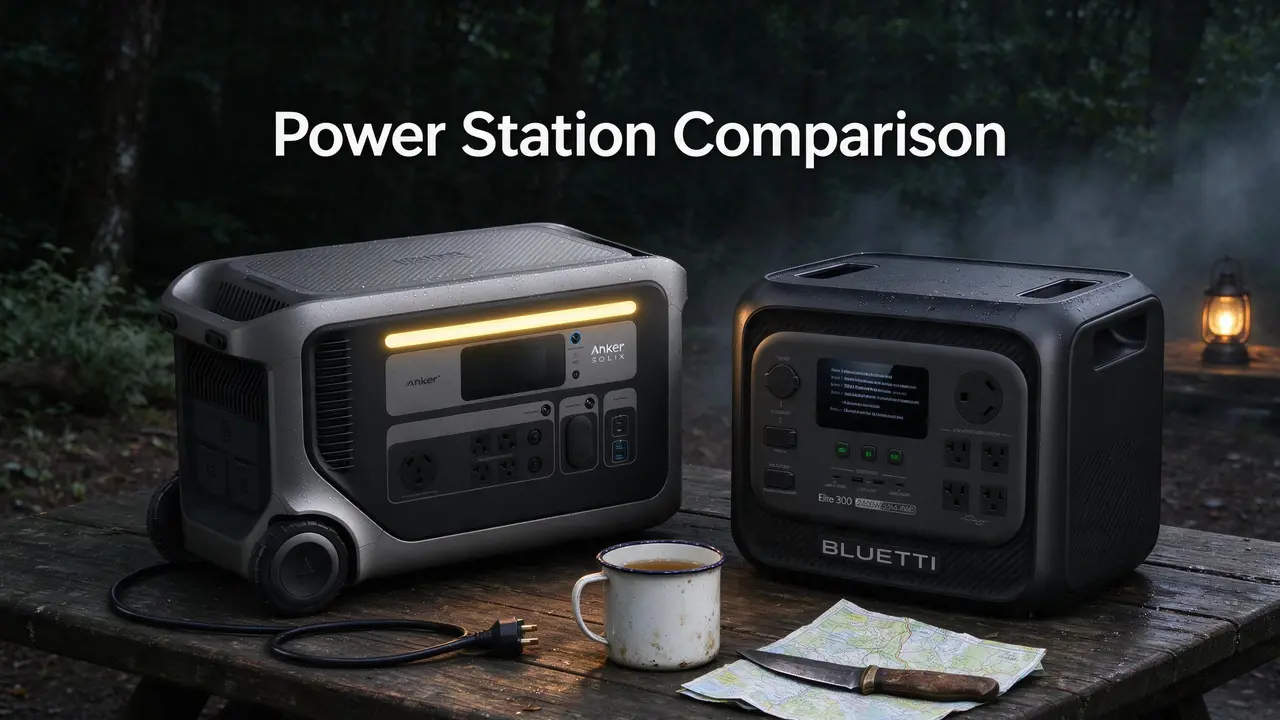
Two ~3kWh LiFePO4 stations, $150 apart, betting on opposite things: 3,600W and wheels versus 58 lb and a TT-30. Here's which one earns the money for your outage or your RV.
Updated
At a glance
Two ~3kWh LiFePO4 stations, $150 apart, betting on opposite things: 3,600W and wheels versus 58 lb and a TT-30. Here's which one earns the money for your outage or your RV.
- Anker's bet: 3,600W continuous and wheels for heavy loads you move around
- BLUETTI's bet: 58 lb, TT-30 RV outlet, 10ms UPS for grab-and-go backup
Same money, different bets
These two land within about $150 of each other at list, and they are not really the same product wearing different badges. The Anker F3000 Portable Power Station, 3,072Wh bets on raw output and rollability: 3,600W continuous, 91.5 lb, and built-in 6-inch wheels. The BLUETTI Elite 300 Portable Power Station for RV & Home Backup 3014.4Wh bets on density and RV plumbing: 58 lb, a TT-30 shore-power outlet, and a 10ms UPS claim.
So the question isn't which is better. It's which bet matches your outage. If you're hauling a roof air conditioner or want headroom for a well pump, the Anker's wattage is the whole argument. If you're plugging a camper's shore cord in and lifting the box by hand, the BLUETTI's weight and outlet are the argument.
One boundary up front: this is a two-way comparison for people choosing between these specific units. It is not a whole-home standby generator guide, and neither box replaces a transfer-switch install for a 240V panel. If that's your job, start with our home backup transfer switch sizing guide instead.
A note on method: I'm working from listing specs plus owner themes on file, not an invented third-party lab score. Where a number isn't published, I say so. Prices below are list prices, and this page contains an Amazon Associates disclosure — picks are fit-led, not commission-led.
- Anker's bet: 3,600W continuous and wheels for heavy loads you move around
- BLUETTI's bet: 58 lb, TT-30 RV outlet, 10ms UPS for grab-and-go backup
Spec snapshot
Listing figures only. Ratings are the listing aggregate, not owner proof of anything beyond a rough satisfaction signal. Weight in lb.
| Product | List price | Capacity (Wh) | Output (W) | Weight (lb) | Rating |
|---|---|---|---|---|---|
| Anker F3000 Portable Power Station, 3,072Wh | $1,548.99 | 3072 Wh | 3600 W | 91.5 lb | 4.92 |
| BLUETTI Elite 300 Portable Power Station for RV & Home Backup 3014.4Wh | $1,699 | 3014 Wh | 2400 W | 58 lb | 4.00 |
What each will actually run
Nameplate watts don't tell you runtime. This table pairs common loads with their typical continuous and surge draw, then estimates how long each station lasts assuming 90% usable capacity and a duty cycle where noted. Surge figures are typical for the appliance class, not measured on these units.
Duty cycle matters: an RV air conditioner cycles its compressor, so a 'night' of cooling isn't 8 hours of full draw. The estimates below assume 50% duty for the AC and continuous for the rest.
- Runtime estimates use 90% usable capacity; real-world varies with temperature and load profile.
- Surge watts are typical for the appliance class, not measured on these stations.
- The BLUETTI's 2,400W continuous may not handle the 13k AC's surge; the Anker's 3,600W has more headroom.
| Load | Continuous (W) | Surge (W) | Anker F3000 runtime | BLUETTI Elite 300 runtime |
|---|---|---|---|---|
| 13k RV air conditioner (low cool, 50% duty) | 1300 | 2800 | ~4.2 h | ~4.2 h (may trip on surge) |
| Well pump (1/2 hp) | 750 | 2200 | ~3.7 h | ~3.7 h (surge near limit) |
| Refrigerator (energy star) | 150 | 600 | ~18 h | ~18 h |
| CPAP (no humidifier) | 60 | 60 | ~46 h | ~46 h |
| Furnace blower + router | 500 | 800 | ~5.5 h | ~5.5 h |
Where the money went
Capacity is a near-tie — 3,072 Wh versus 3,014 Wh is noise. The dollars diverge on four things.
Output is the biggest split. The Anker's 3,600W continuous is 1,200W more than the BLUETTI's 2,400W. That headroom is what lets several owners on file report running a 13k roof AC on low cool through a night. The BLUETTI's 2,400W handles a fridge, fans, and a CPAP fine, but an RV air conditioner is a few-hours proposition at best on 3kWh.
Weight and mobility go the other way. The BLUETTI is 58 lb — heavy for its size, owners say, but liftable. The Anker is 91.5 lb and leans on its 6-inch wheels. If you're carrying it up stairs, that's a real difference; if you're rolling it across a campsite, the Anker's wheels mostly erase it.
Recharge and expansion round it out. The Anker lists 30A fast charging (several owners on file report roughly 90 minutes on a 30A input) and expansion up to 24kWh with add-on batteries. The BLUETTI lists 0–80% in as fast as 78 minutes but has no battery expansion — you're capped at the built-in capacity. On solar, the Anker takes high and low PV inputs (flexible but fiddly to max out); the BLUETTI's input window is tight around 60V, which narrows your rigid-panel choices.
- Output: 3,600W vs 2,400W — the Anker's 1,200W edge is the RV-AC difference
- Weight: 91.5 lb wheeled vs 58 lb liftable
- Expansion: Anker to 24kWh; BLUETTI capped at built-in
- Solar: Anker dual PV inputs (fiddly); BLUETTI ~60V ceiling (panel math required)
The spec that decides it
For most buyers, one number settles this: continuous output. If your outage plan includes a roof AC, a well pump, or anything with a hard startup surge, the Anker's 3,600W is the reason to pay. The BLUETTI's 2,400W is honest for fridge-and-fans duty but may trip on loads the Anker shrugs at.
The second deciding spec is weight, and it cuts the other way. At 58 lb the BLUETTI is a two-hand carry you can stash in a closet; at 91.5 lb the Anker is a roll-it-or-regret-it unit. Neither is wrong — they just answer different questions. If you can't roll it and can't lift 91.5 lb, the Anker is out regardless of wattage.
Real owner trade-offs
The owner notes on file line up with the spec split, and the caveats are where the money actually gets tested.
On the Anker, the wins are runtime and charging: several owners on file report a 13k roof AC carried through a night's sleep, adjustable AC charge levels that avoid tripping small circuits, and a 30A refill in about 90 minutes. The complaints are connectivity and solar ergonomics — Wi-Fi dropped more than one owner liked, and the included 400W panel is bulky enough that some left it home. The high/low PV input split also took homework to max out.
On the BLUETTI, owners praise the density and the UPS: several owners on file report a continuous 2,400W load held for about 30 minutes, a computer switched over without interruption, and a CPAP ran four nights with charge to spare. The recurring gripes are no expansion, a tight solar voltage window that can damage the MPPT charger if you overshoot, and some controls living only in the app — a weak point for a disaster device.
Neither listing aggregate is proof of much on its own. Treat 4.4 and 4.7 as a rough signal, not a verdict.
- Anker owners: strong RV-AC runtime and fast 30A charging; Wi-Fi and panel bulk are the friction
- BLUETTI owners: compact, quiet, solid UPS; no expansion and a narrow solar window are the limits
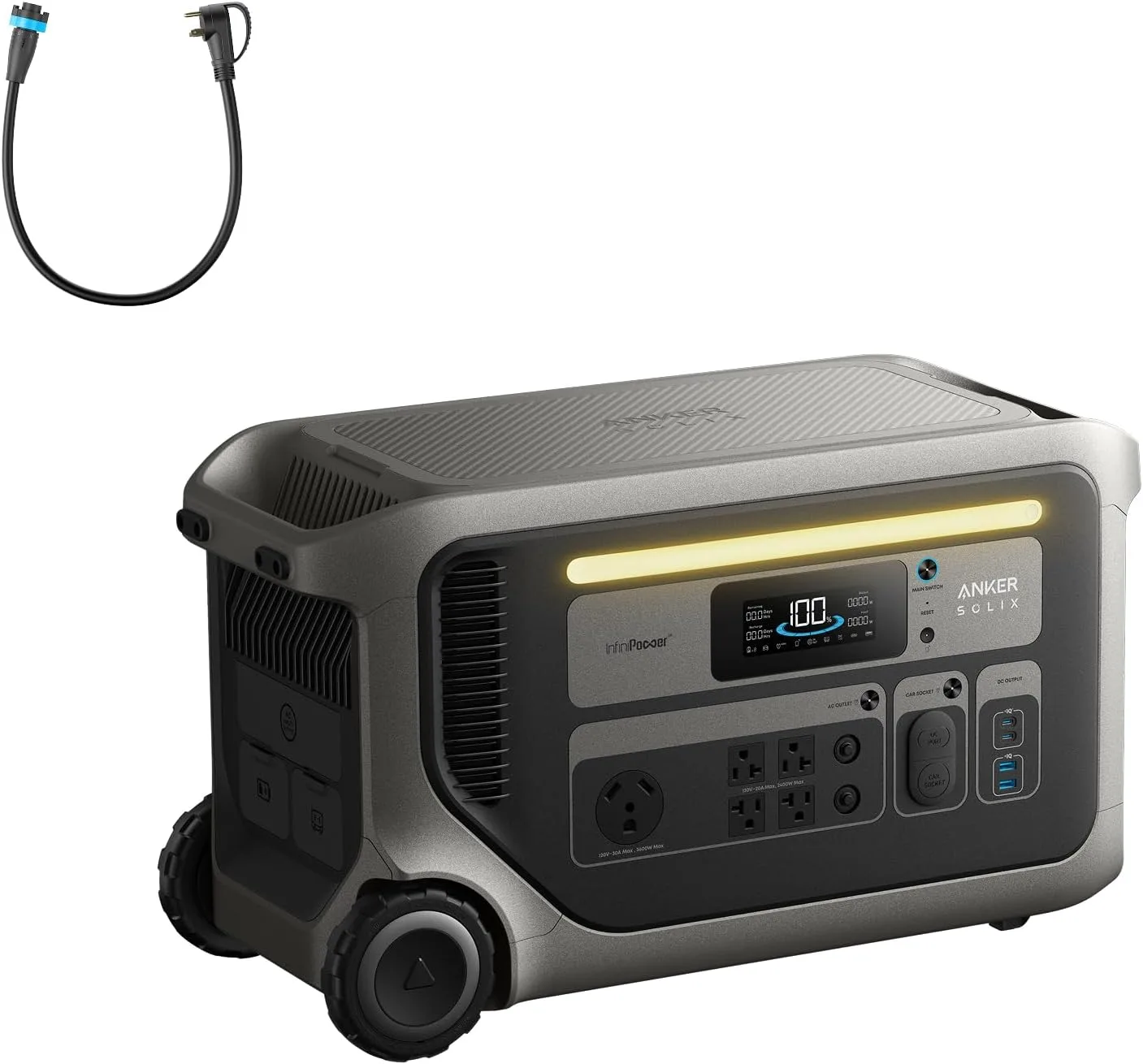
Anker F3000 Portable Power Station, 3,072Wh
Highlights
- 3072Wh rated capacity
- 3600W continuous AC
- 7200W surge
- LiFePO4 chemistry
- Up to 2400W solar input
- 91.5 lb (~41.5 kg)
Best for
- F3000: longer outages or higher continuous loads (still not whole-home wiring)
- RV / off-grid days where recharge speed matters as much as Wh
- Best parked near the vehicle or cabin — not a long carry to a tent
Strengths
- F3000: 3072Wh pack with 3600W continuous / 7200W surge — size loads to both numbers
- 91.5 lb (~41.5 kg) is a park-and-use chassis — plan a short path, not a trail hike
- 3600W continuous headroom covers more small appliances than 1kW-class inverters
- About $1548.99 list in the Hub catalog — confirm live retail before you buy
Watch-outs · not ideal when
- At 91.5 lb (~41.5 kg), F3000 is a poor tent-hike companion — plan a cart or leave it in the vehicle
- High continuous output on F3000 tempts big loads — Wh still runs out on kettles and A/C
- Rated 2400W solar on F3000 is optimistic; shade and cables cut real watts
- LiFePO4 helps longevity, but F3000 still hates freezing charge temps on winter trips
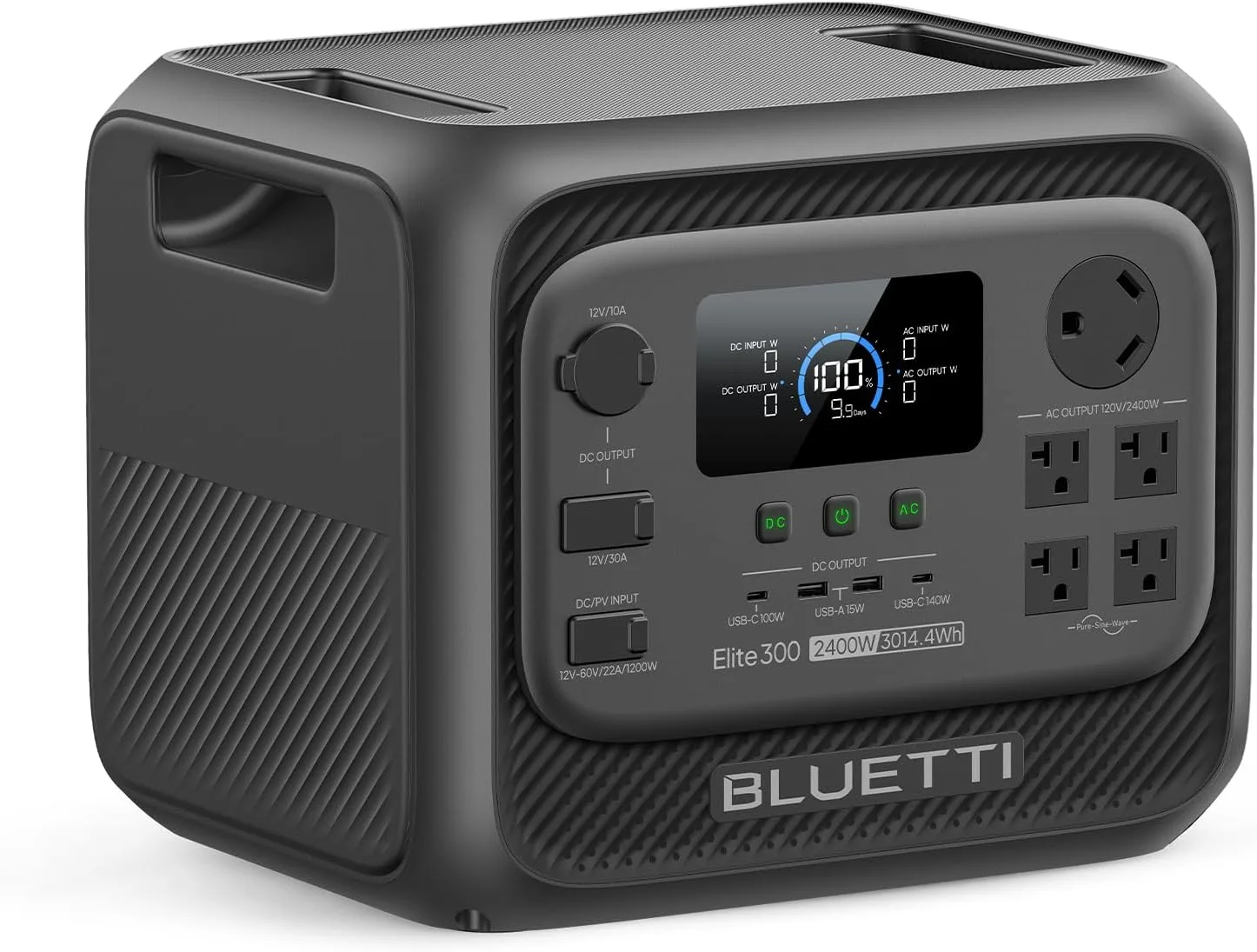
BLUETTI Elite 300 Portable Power Station for RV & Home Backup 3014.4Wh
Highlights
- 3014Wh rated capacity
- 2400W continuous AC
- LiFePO4 chemistry
- 58 lb (~26.3 kg)
- About $1699 list
Best for
- Elite 300: longer outages or higher continuous loads (still not whole-home wiring)
- RV / off-grid days where recharge speed matters as much as Wh
- Best parked near the vehicle or cabin — not a long carry to a tent
Strengths
- Elite 300: 2400W continuous on a 3014Wh pack — more headroom for small appliances than 1kW-class peers
- 58 lb (~26.3 kg) is a park-and-use chassis — plan a short path, not a trail hike
- 10ms-class UPS switchover on the listing — useful when a router restart would hurt
- About $1699 list in the Hub catalog — confirm live retail before you buy
Watch-outs · not ideal when
- At 58 lb (~26.3 kg), Elite 300 is a poor tent-hike companion — plan a cart or leave it in the vehicle
- High continuous output on Elite 300 tempts big loads — Wh still runs out on kettles and A/C
- Solar input unpublished for Elite 300 — do not assume a same-day off-grid refill
- LiFePO4 helps longevity, but Elite 300 still hates freezing charge temps on winter trips
Buy the one that…
Buy the Anker F3000 Portable Power Station, 3,072Wh if you need 3,600W for an RV air conditioner or a hard-starting load, want expansion headroom to 24kWh, and can roll 91.5 lb into place. Skip it if you need to carry the unit by hand or want a simple max-solar setup — the bulk and the PV input split will wear on you.
Buy the BLUETTI Elite 300 Portable Power Station for RV & Home Backup 3014.4Wh if 58 lb and a TT-30 shore outlet matter more than peak wattage, and your loads are fridges, fans, CPAP, and routers. Skip it if you plan to run an RV AC for hours or want to expand capacity later — the built-in 3,014 Wh is the ceiling, and the ~60V solar window demands careful panel matching.
Frequently asked
Can either run a 13k RV air conditioner?
The Anker has the wattage headroom (3,600W continuous) and several owners on file report a night's runtime on low cool. The BLUETTI's 2,400W is a few-hours proposition at best on 3kWh — plan around that.
Which is easier to move?
The BLUETTI at 58 lb is liftable; the Anker at 91.5 lb relies on its 6-inch wheels. If stairs are involved, that gap matters.
Can I expand capacity later?
The Anker lists expansion to 24kWh with add-on batteries. The BLUETTI has no battery expansion — you're capped at 3,014 Wh.
Which is cheaper per Wh?
On nameplate, the Anker at $0.50/Wh undercuts the BLUETTI at $0.56/Wh. That's list math, not a claim about real-world usable energy.
Method and sources
Model names and list prices come from the WattPicks catalog at build time. WattPicks does not run its own laboratory tests on power stations, and nothing on this page is presented as a measured result — it is catalog-backed buying guidance.
Read our methodology for how the catalog is normalized, and about WattPicks for who publishes it.