
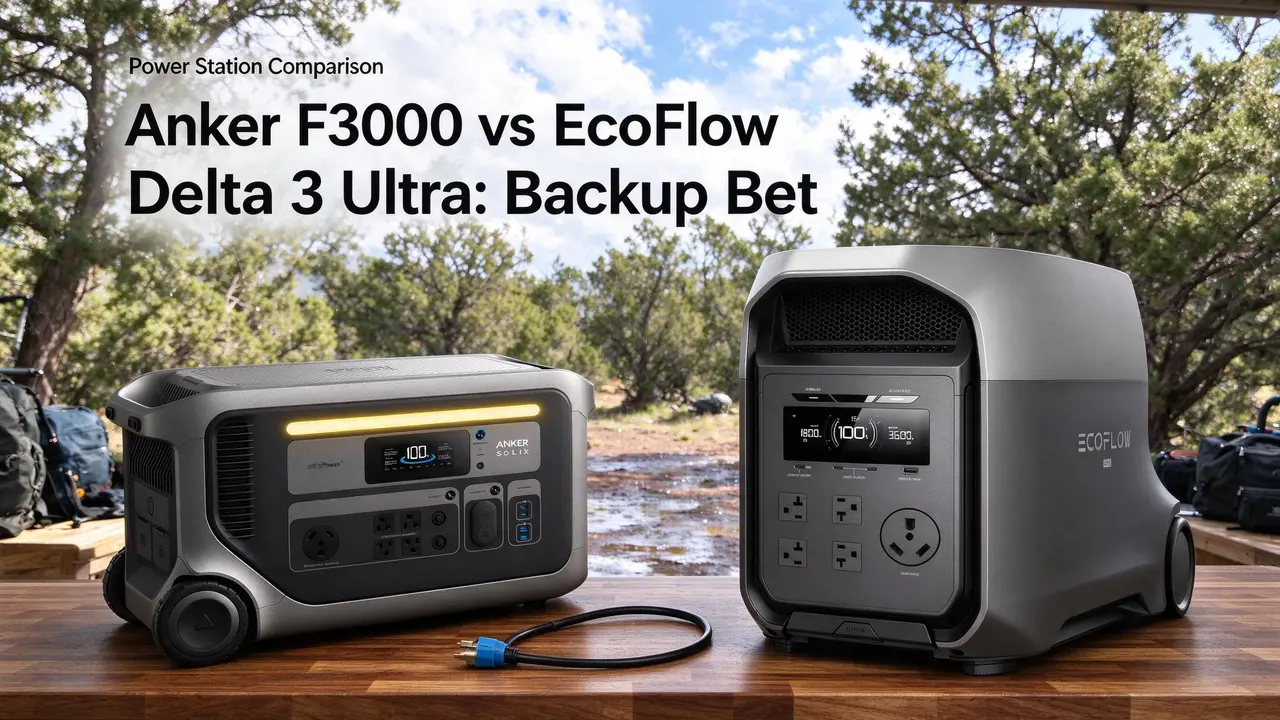
Anker F3000 vs EcoFlow Delta 3 Ultra: Backup Bet
Two 3,072Wh stations at nearly the same price, but they bet on different things: Anker on expandable capacity and 30A RV power, EcoFlow on lighter weight and a sub-10ms UPS. Here is how to pick one without regret.
Updated
At a glance
Two 3,072Wh stations at nearly the same price, but they bet on different things: Anker on expandable capacity and 30A RV power, EcoFlow on lighter weight and a sub-10ms UPS. Here is how to pick one without regret.
- Anker F3000: expandable capacity, 30A RV output, heavier at 91.5 lb
- EcoFlow Delta 3 Ultra: lighter at 72.1 lb, sub-10ms UPS (per listing), no expansion slots
Same money, two different bets
At $1,548.99 for the Anker F3000 Portable Power Station, 3,072Wh and $1,599 for the EcoFlow Delta 3 Ultra 3072Wh Portable Power Station, 3600W AC Output, you are paying almost the same for the same headline numbers: 3,072Wh and 3,600W continuous. The split is in what each brand spent the money on.
Anker's bet is expandability and RV-grade throughput — you can stack batteries toward a much larger bank and lean on a 30A output that stays live while charging. EcoFlow's bet is daily livability: 19.4 lb less to move, a sub-10ms UPS switchover (per EcoFlow listing), and a true AC pass-through that keeps the inverter idle on grid power.
This is a home-backup and RV comparison. It is not the page for a 1,000Wh camping kit or a solar-panel-only bundle — both of these are 3,072Wh wheeled units that want a cart path or a garage floor, not a backpack.
- Anker F3000: expandable capacity, 30A RV output, heavier at 91.5 lb
- EcoFlow Delta 3 Ultra: lighter at 72.1 lb, sub-10ms UPS (per listing), no expansion slots
Spec snapshot
Prices are list prices from the catalogue, not sale stickers. Ratings are the listing aggregate, shown for context — they are not a substitute for the owner themes further down. Weight is in pounds; capacity in Wh; output in continuous W.
| Product | List price | Capacity (Wh) | Output (W) | Weight (lb) | Rating |
|---|---|---|---|---|---|
| Anker F3000 Portable Power Station, 3,072Wh | $1,548.99 | 3072 Wh | 3600 W | 91.5 lb | 4.92 |
| EcoFlow Delta 3 Ultra 3072Wh Portable Power Station, 3600W AC Output | $1,599 | 3072 Wh | 3600 W | 72.1 lb | 5.00 |
What actually decides it
Four configuration differences move the decision, and they do not point the same way. The first is weight: 91.5 lb versus 72.1 lb is a 19.4 lb gap, and it is the difference between a unit one owner rolls like a suitcase and one that is genuinely a two-hand, plan-your-path object. If this lives in a garage and only moves during outages, that gap is tolerable. If it rides in an RV or gets repositioned weekly, EcoFlow's lighter frame earns its keep.
The second is expandability. Anker lets you add batteries toward a much larger bank (the listing pitches expansion up to 24kWh — that would take multiple add-on batteries, and the exact count is not on file). EcoFlow's Delta 3 Ultra has no battery expansion slots — owners are blunt about this, and the Plus model is the one to look at if you want to grow later. If a multi-day outage is your fear, that is a real fork.
The third is output and ports. Both run 3,600W continuous. Anker lists AC×3; EcoFlow lists AC×4 plus USB-C×1, USB-A×1, and a car port. Anker's USB-C and USB-A counts are not on file, so I will not claim either way. EcoFlow's extra AC outlet and documented USB set matter if you are plugging in a lot of small gear at once.
The fourth is recharge path. Anker's 30A input refilled in about 90 minutes in owner reports — that is an owner theme, not a lab measurement, and the test conditions (input source, starting state of charge) are not on file, so treat it as a bounded report. Adjustable charge levels let people avoid tripping small circuits. EcoFlow's X-Stream wall charging is also fast, and its true AC pass-through means it can run loads off grid power without cycling the inverter.
One more decision rule that cuts across all four: ask whether you are buying a battery or buying a system. If you want a single box that does its job and never grows, EcoFlow's lighter, quieter package wins. If you want a foundation you can add to as your needs change, Anker's expansion path is the reason to pay the same money for a heavier unit.
- Expansion: Anker yes (toward larger banks) / EcoFlow none on this model
- AC outlets: Anker AC×3 / EcoFlow AC×4
- Documented USB: EcoFlow USB-C×1, USB-A×1 / Anker n/a (not on file)
- Weight: Anker 91.5 lb / EcoFlow 72.1 lb
Real owner trade-offs
The owner notes on file are candid about both, and the caveats are where the honest decision lives. These are illustrative owner themes, not a statistically representative sample — treat them as leads to verify, not proof.
Anker F3000 owners praise the roof-AC runtime — one ran a 13k Coleman roof AC on low cool through a full night with tending — and the 30A output that stays live while charging. The recurring complaints are bulk, Wi-Fi dropouts that sting when you rely on the app, and an included 400W panel that is heavy enough people leave it behind. Solar input is split high-PV and low-PV, so maxing it out takes panel-matching homework.
EcoFlow Delta 3 Ultra owners like the simultaneous high-watt runs — an 1800W griddle and 1800W oven together for over half an hour still left 70% — and the quiet true pass-through that keeps an office silent at around 250W of load. The caveats are real: no expansion slots, a button layout that differs from other Delta 3 units, an intrusive app assistant, and firmware updates that cut AC output (reported on recent firmware; verify the current version before relying on it for medical gear or servers).
- Anker: 30A output stays live while charging; Wi-Fi dropouts reported
- EcoFlow: quiet AC pass-through at ~250W; firmware update cut AC output for some owners
Buy the one that…
Buy the Anker F3000 Portable Power Station, 3,072Wh if you want room to grow — expansion batteries, a 30A RV feed that stays live while charging, and you can live with 91.5 lb and occasional Wi-Fi fussiness. Skip it if you need to move the unit often or want a documented UPS switchover number, because that figure is n/a (not on file).
Buy the EcoFlow Delta 3 Ultra 3072Wh Portable Power Station, 3600W AC Output if lighter weight, a sub-10ms UPS (per listing), and quiet pass-through matter more than future expansion — and you accept that 3,072Wh is your ceiling on this model. Skip it if you already know you will want to add batteries; look at the Plus instead.
If you're an RVer: the Anker's 30A output that stays live while charging and its expansion path fit a rig that may grow; the EcoFlow's lighter 72.1 lb frame and quiet pass-through fit a rig where space and noise matter more than future batteries.
If you're a garage-backup owner: the EcoFlow's lighter weight matters less if the unit never leaves the garage, so the Anker's expansion and 30A throughput become the stronger long-term bet — unless you specifically need the documented sub-10ms UPS for sensitive gear.
Neither is a lab-verified winner here. This comparison is built from listing specs and owner themes on file, not independent bench measurements — so treat the trade-offs as the decision, not a scoreboard.
- Anker strength: 30A output live while charging; caveat: Wi-Fi dropouts
- EcoFlow strength: quiet AC pass-through; caveat: firmware update cuts AC output
Don't buy either if…
You don't need a cart path or a 30A/RV feed. If your backup plan is a few lights and a phone, a smaller, cheaper station will do the job without the 91.5 lb or 72.1 lb commitment.
Your budget is under $1.5k. Both of these sit at the top of the 3,072Wh class; a lower-capacity unit gets you most of the essentials coverage for less.
You want solar-only input. Both are wall-charge-first units with solar as a supplement, not a solar-only bundle.
You need to run a 4-ton central AC, or an electric range and dryer at the same time. 3,600W continuous won't carry those loads together — plan on essentials and one big appliance at a time, not whole-home simultaneous draw.
Price per Wh: the math the headline promises
At list price, the Anker F3000 works out to about $0.504 per Wh ($1,548.99 ÷ 3,072Wh), and the EcoFlow Delta 3 Ultra to about $0.520 per Wh ($1,599 ÷ 3,072Wh). That is a roughly $0.016/Wh gap — small in dollars, but it means the Anker is the cheaper way to buy the same headline capacity, and the EcoFlow's premium buys lighter weight and a documented UPS figure rather than more watt-hours.
What this comparison is built on
I am a deep-use experience reviewer working from listing specs and owner themes on file — home-user checks, not lab-bench measurements. Prices and specs come from the catalogue; ratings are the listing aggregate, not owner proof. Owner themes are illustrative, not a statistically representative sample.
As an Amazon Associate, WattPicks earns from qualifying purchases. Picks here are fit-led, not commission-led.
Avery Nolan is the WattPicks founding editor covering portable power capacity, output, and price-per-Wh guidance across the catalogue — no lab claims.
Frequently asked
Can either run a whole home?
Both are 3,600W continuous, which covers essentials and several appliances at once, but not a whole house with central AC and an electric range running together. Anker's expansion path is the better fit if "whole home" means growing over time.
Which is easier to move?
EcoFlow at 72.1 lb with wheels and a telescoping handle is the lighter, more suitcase-like unit. Anker at 91.5 lb with 6-inch wheels is manageable on flat ground but heavier to handle.
Do both have USB-C?
EcoFlow lists USB-C×1 and USB-A×1. Anker's USB-C and USB-A counts are n/a (not on file), so I will not claim either way.
Can I add batteries later?
On Anker, yes — expansion is a listed feature (the listing pitches up to 24kWh, which would take multiple add-on batteries; exact count not on file). On the EcoFlow Delta 3 Ultra, no; there are no expansion slots on this model.
Can either run a CPAP or fridge overnight?
Both have enough capacity on paper for a CPAP or a fridge overnight, but runtime depends on the appliance's draw and the station's starting charge. Neither has a lab-verified overnight runtime on file, so check your device's wattage against the 3,072Wh capacity before relying on it.
Method and sources
Model names and list prices come from the WattPicks catalog at build time. WattPicks does not run its own laboratory tests on power stations, and nothing on this page is presented as a measured result — it is catalog-backed buying guidance.
Read our methodology for how the catalog is normalized, and about WattPicks for who publishes it.