
Jackery Explorer 1500 v2 vs 1000 v2: Which Bet Fits?
Two Jackery stations at the same $0.52/Wh, but one buys capacity and one buys a track record. Here's how to pick between the 1536Wh Explorer 1500 v2 and the 1070Wh Explorer 1000 v2 — and when neither is the right call.
Updated
At a glance
Two Jackery stations at the same $0.52/Wh, but one buys capacity and one buys a track record. Here's how to pick between the 1536Wh Explorer 1500 v2 and the 1070Wh Explorer 1000 v2 — and when neither is the right call.
- Amazon Associates disclosure: purchases through links may earn a commission; picks are fit-led, not commission-led.
- The 1500 v2's owner pack is essentially empty of usage reports — treat its 3.6 listing aggregate as thin signal, not proof.
- The 1000 v2's 4.7 listing aggregate comes from 3,713 ratings, and its themes are specific and repeated.
Same money, different trade-offs
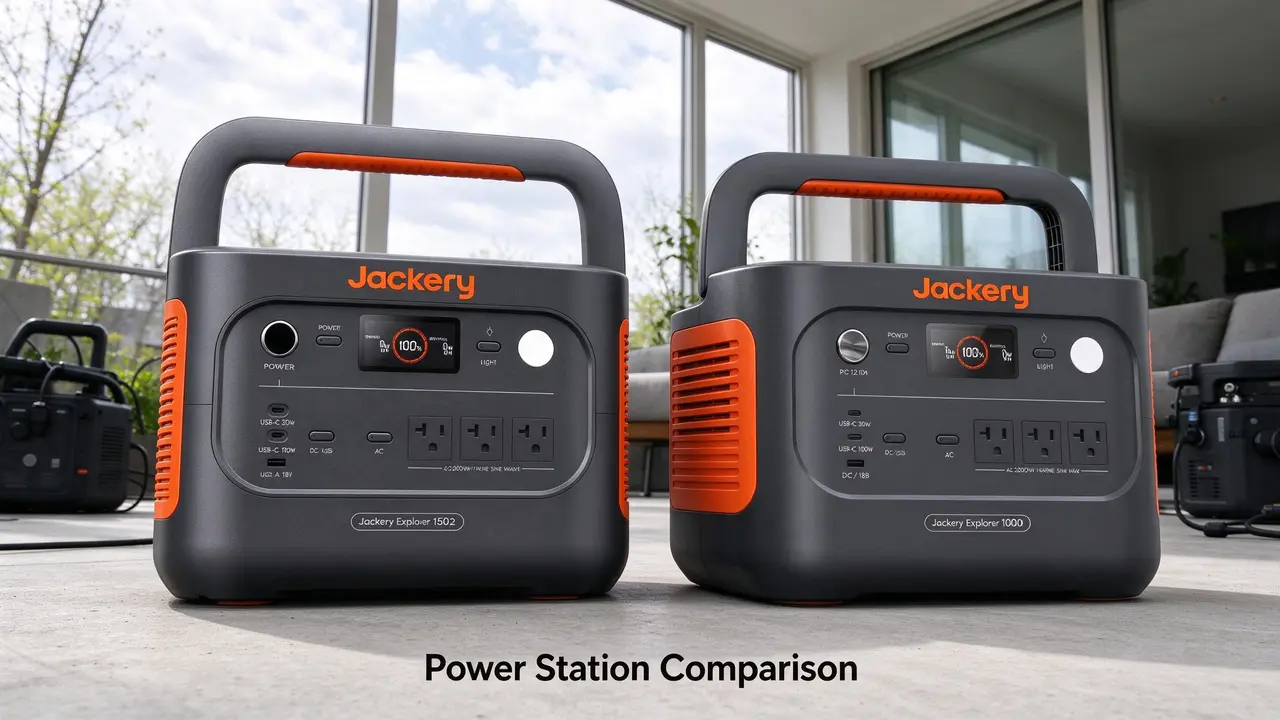
At $0.52 per nameplate Wh, the Jackery Explorer 1500 v2 and the Jackery Explorer 1000 v2 cost the same per watt-hour. That's the whole puzzle: the 1500 v2 sells you 466 more Wh and 500 more continuous watts; the 1000 v2 sells you a deep, well-documented owner base and a lighter box.
This comparison is not for whole-home backup — neither unit is a transfer-switch solution. It's for the shopper deciding whether to spend $799.95 on headroom or $559 on a proven 1,070Wh workhorse. I'm Avery Nolan, and I'm working from listing specs plus the owner themes on file, not lab-bench measurements.
- Amazon Associates disclosure: purchases through links may earn a commission; picks are fit-led, not commission-led.
- The 1500 v2's owner pack is essentially empty of usage reports — treat its 3.6 listing aggregate as thin signal, not proof.
- The 1000 v2's 4.7 listing aggregate comes from 3,713 ratings, and its themes are specific and repeated.
Spec snapshot
All figures below are from the listings. Prices are list prices; the 1000 v2's $559 deal price is not used here. Weight is in pounds. Ports and warranty are included where the listing states them; 'not listed' means the data I have doesn't specify.
| Product | List price | Capacity (Wh) | Output (W) | Weight (lb) | Ports (listing) | Warranty (listing) | Rating |
|---|---|---|---|---|---|---|---|
| Jackery Explorer 1500 v2 | $949 | 1536 Wh | 2000 W | 32 lb | AC×3, USB-C×2; USB-A and car port not listed | 5 years | 4.32 |
| Jackery Explorer 1000 v2 | $559 | 1070 Wh | 1500 W | 23.8 lb | AC×3, USB-C, USB-A, car×1 (listing shows inflated USB counts — see note) | Not listed in data | 4.75 |
Where the money went
The 1500 v2 puts its budget into raw capacity and surge headroom. The listing claims a 4,000W surge peak and a 10ms UPS switchover — useful if you're protecting a desktop or a medical device and want the station to take over without a reboot. Treat those as listing claims, not owner-verified performance. It also claims 6,000 cycles to 70% capacity on LiFePO4, which is a longer cycle spec than the 1000 v2's 4,000 cycles.
The 1000 v2 spends its money on portability and a proven control stack. At 23.8 lb it's 8.2 lb lighter, and the foldable handle is the kind of detail that matters when you're carrying it from kitchen to garage. The app gives you emergency charge, quiet mode, and efficiency mode — owners actually use these, which is more than I can say for the 1500 v2's feature list, where the app is mentioned but not corroborated by usage reports.
Ports are the other allocation. The 1000 v2 listing shows AC×3, USB-C, USB-A, and car×1; the raw listing also shows inflated USB-C and USB-A counts that are clearly a listing quirk, so I'm using the corrected port types rather than the nonsense numbers. Owners confirm the 100W PD ports fast-charge phones and tablets. The 1500 v2 listing shows AC×3 and USB-C×2; USB-A is unknown, so I won't claim it's absent. If you need a car port, the 1000 v2 has one and the 1500 v2's listing doesn't mention it.
Warranty is the quiet line item. The 1500 v2 listing says 5 years of coverage; the 1000 v2 listing doesn't publish a full warranty document in the data I have, so I'd hedge that one until you see the terms at checkout.
- Capacity: 1536 Wh vs 1070 Wh — 466 Wh more on the 1500 v2.
- Continuous output: 2000 W vs 1500 W — the 1500 v2 can run a 1,700W air fryer the 1000 v2 cannot.
- Weight: 32 lb vs 23.8 lb — the 1000 v2 is the one you'll actually move.
- Ports: 1500 v2 has AC×3 and USB-C×2; 1000 v2 has AC×3, USB-C, USB-A, and a car port.
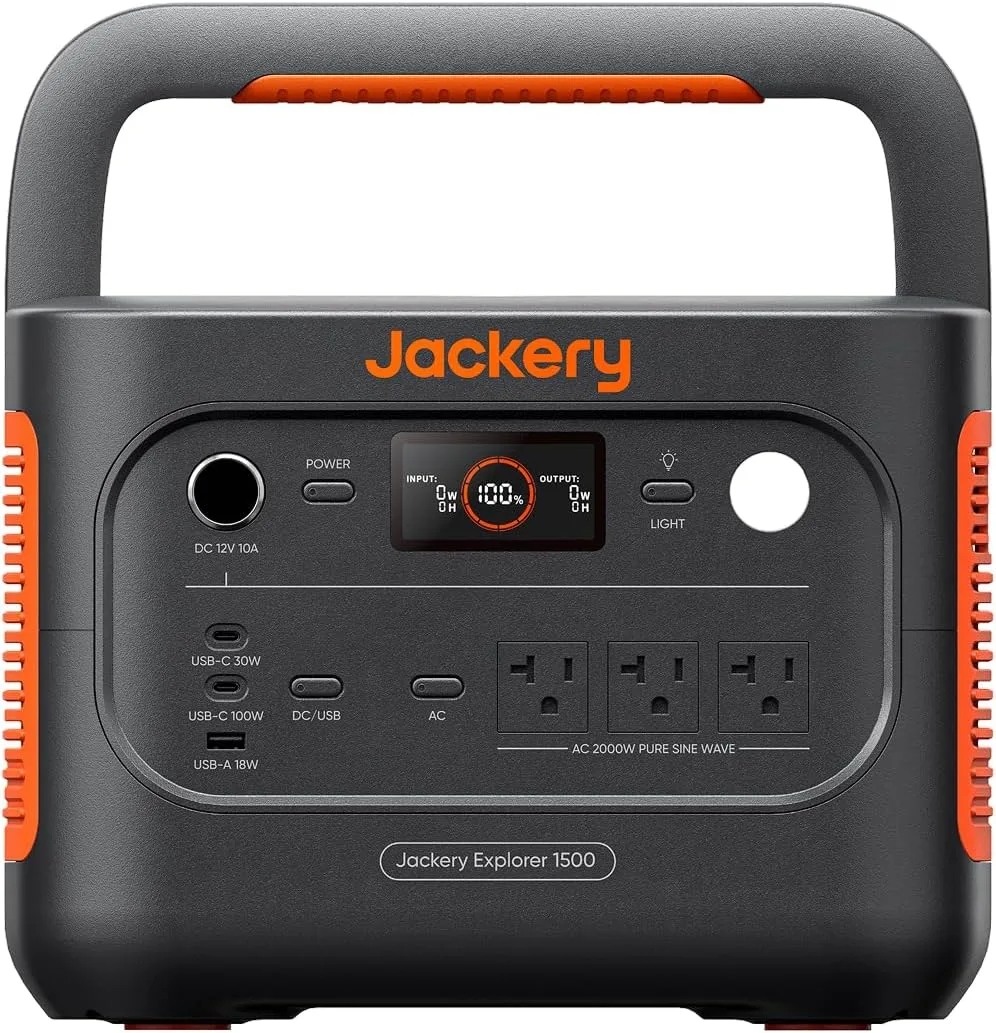
Jackery Explorer 1500 v2 Power Station,1536Wh,2000W Output
Highlights
- 1536Wh rated capacity
- 2000W continuous AC
- 4000W surge
- LiFePO4 chemistry
- 32 lb (~14.5 kg)
Best for
- Explorer 1500 v2: longer outages or higher continuous loads (still not whole-home wiring)
- RV / off-grid days where recharge speed matters as much as Wh
- Users who will pair solar or expand rather than buy a second small pack
Strengths
- Explorer 1500 v2: 1536Wh pack with 2000W continuous / 4000W surge — size loads to both numbers
- 32 lb (~14.5 kg) is a park-and-use chassis — plan a short path, not a trail hike
- 10ms-class UPS switchover on the listing — useful when a router restart would hurt
- Owners on file: Terrible product and company. Destructive service and defective products -- don't buy Jackery. Buy Ecoflow in…
Watch-outs · not ideal when
- 32 lb (~14.5 kg) is a two-hand lift; skip it if you walk more than a short path to camp
- High continuous output on Explorer 1500 v2 tempts big loads — Wh still runs out on kettles and A/C
- Solar input unpublished for Explorer 1500 v2 — do not assume a same-day off-grid refill
- LiFePO4 helps longevity, but Explorer 1500 v2 still hates freezing charge temps on winter trips
Owner voices
Short takes from public retail reviews — paraphrased or translated when long or non-English; meaning kept close to the original.
“1/5 — Terrible product and company. Destructive service and defective products -- don't buy Jackery. Buy Ecoflow instead -- their customer support arent insane and won't try to deny how shipping policies work in Canad…”
“4.6/5 — -5%$28.07 Typical price: $29.69 Get it as soon as Saturday, Oct 31 FREE Shipping on orders over $35 shipped by Amazon ZOUPW 200W Portable Solar Panel for Power Station,23.5% Efficiency | Mono Foldable Solar Pa…”
“4.4/5 — Amazon's Choice $189.99 Get it as soon as Saturday, Oct 31 FREE Shipping by Amazon Portable Carrying Bag Compatible with Jackery Explorer 1000 V2, Soft Power Station Storage Case with Padding, Generator Cover…”
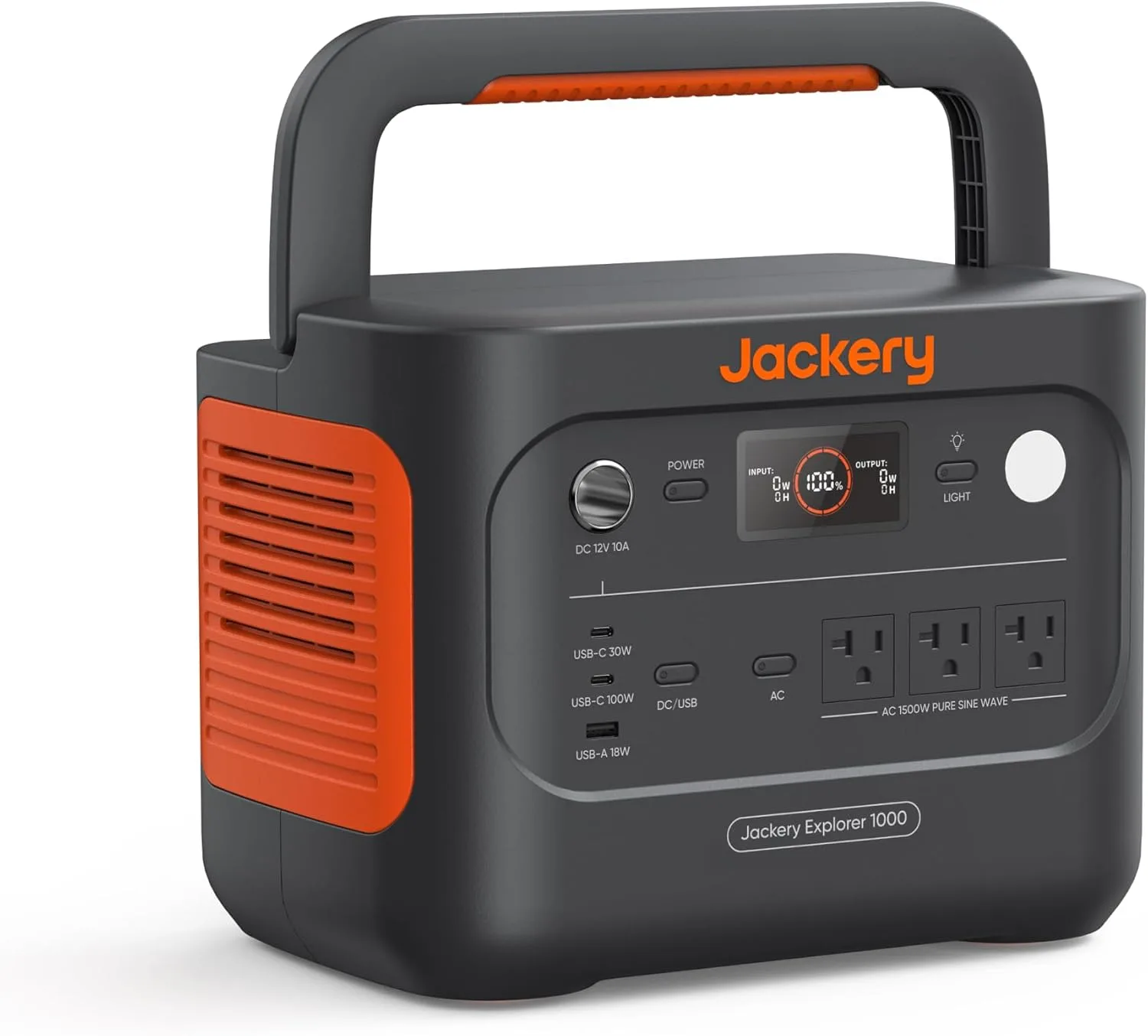
Jackery Explorer 1000 v2 Portable Power Station,1070Wh,1500W
Highlights
- 1070Wh rated capacity
- 1500W continuous AC
- LiFePO4 chemistry
- Up to 400W solar input
- 23.8 lb (~10.8 kg)
- About $559 list
Best for
- Explorer 1000 v2: weekend camping when 23.8 lb carry weight matters as much as 1070Wh
- Essentials bridge at home (fridge cycles, router) when sized to the Wh
- Solar top-ups up to ~400W when panels and weather cooperate
Strengths
- Explorer 1000 v2: 1070Wh with 1500W continuous — enough for fridge cycles if surge on the listing clears the start
- 23.8 lb (~10.8 kg) is the lightest-class carry in this band — easier stairs and car packing
- Explorer 1000 v2 uses LiFePO4 — cycle-life claims usually beat older NMC marketing lines
- Owners on file: Updated to add that customer service contacted me and offered a partial refund so i added 2 more stars. It do…
Watch-outs · not ideal when
- Explorer 1000 v2 is still a bridge for essentials — not a transfer-switch whole-home system
- Usable energy on Explorer 1000 v2 is below the 1070Wh label once the inverter is working
- Rated 400W solar on Explorer 1000 v2 is optimistic; shade and cables cut real watts
- LiFePO4 helps longevity, but Explorer 1000 v2 still hates freezing charge temps on winter trips
The spec that decides it
For most shoppers, continuous output is the deciding number. The 1000 v2's 1,500W ceiling is enough for a fridge plus a portable AC, which is exactly what the top verified owner ran during hurricane-season prep. It is not enough for a 1,700W air fryer — one owner found that out the hard way — and a 12-inch sliding miter saw stalled almost immediately in another owner's test.
The 1500 v2's 2,000W ceiling clears those loads on paper. That's the real upgrade: not more runtime on small loads, but access to appliances the 1000 v2 trips on. If your outage plan includes a space heater, a hot plate, or a full-size air fryer, the 1500 v2 is the only one of these two that stays inside its continuous rating for loads above 1,500W.
The second deciding spec is weight. At 32 lb, the 1500 v2 is a two-hand lift for most people; the 1000 v2 at 23.8 lb is a one-hand carry with the foldable handle. If the station lives in a closet and only comes out during outages, weight is a rounding error. If it moves between rooms or vehicles, it isn't.
Real owner trade-offs
The 1000 v2's owner themes are unusually consistent for a power station. Fridge backup is the headline: one verified owner ran a refrigerator and a portable AC simultaneously and reported no hiccups, and another stretched a 12-quart DC fridge about three days in eco mode with phone top-ups. Quiet mode is the sleeper feature — a family slept while the unit powered a fridge and fans, which is the whole argument against a gas generator.
The caveats are just as consistent. The one-hour emergency recharge is real but reverts to normal mode after each quick charge, so owners settle for roughly an hour and a half to two hours on default fast mode. There are no 12V barrel ports, so 12V gear needs an adapter off the cigarette socket, and the solar input connector isn't the common MC4 style — check your panel before you commit. One owner also wished Wi-Fi stayed on overnight for remote monitoring.
The 1500 v2's owner pack is thin enough that I can't give you a grounded usage picture. The one substantive signal is a verified one-star report about a delivery refusal and a frustrating customer-service exchange in Canada. That's a logistics and support complaint, not a performance measurement, and it stands alone — but if cross-border shipping and support responsiveness matter to you, it's the single data point worth weighing. Everything else about how the 1500 v2 behaves on a fridge, a heater, or a jobsite would be a guess, and I won't dress a guess up as a test.
- 1000 v2 owner theme: fridge plus portable AC ran together without complaint (top verified review).
- 1000 v2 owner theme: quiet mode allowed overnight sleep while powering a fridge and fans.
- 1000 v2 caveat: large sliding miter saw stalled almost immediately.
- 1500 v2 caveat: one verified delivery/service complaint; no usage reports on file.
Buy the one that…
Buy the Jackery Explorer 1500 v2 if you need to run a load above 2000W — a space heater, a hot plate, a 1,700W air fryer — and you're willing to accept a thin owner record and a 32 lb box in exchange for the headroom. The 2,000W continuous rating and the claimed 10ms UPS switchover are the reasons to pay $799.95 instead of $559.
Buy the Jackery Explorer 1000 v2 if your outage plan is fridge, fans, lights, phones, and a CPAP — and you want a station with a documented owner base, a car port, and a weight you can carry one-handed. The 1,500W ceiling is the limit; if you need more, this isn't the unit.
Walk away from both if you're sizing for whole-home backup or a transfer switch. Neither is a smart-panel solution, and neither will run a central AC or an electric water heater. For that job, you're shopping a different category — start with our home backup sizing guide before you spend here.
Frequently asked
Can the 1000 v2 run a 1,700W air fryer?
No — its continuous output is 1,500W, and one owner confirmed the air fryer wouldn't run. The 1500 v2's 2,000W continuous rating clears it on paper.
How long will the 1000 v2 run a fridge?
Owners report a 12-quart DC fridge lasting about three days in eco mode with phone top-ups, and a full-size fridge plus a portable AC running simultaneously during outage prep. Runtime depends on the fridge's duty cycle, so treat those as owner reports, not guarantees.
Does the 1500 v2 have a car port?
The listing doesn't mention one; the 1000 v2 listing shows car×1. If 12V charging matters, check the 1500 v2's port panel before you buy.
Which one has the better warranty?
The 1500 v2 listing states 5 years of coverage. The 1000 v2's full warranty document isn't in the data I have, so I'd confirm the terms at checkout rather than assume parity.
Method and sources
Model names and list prices come from the WattPicks catalog at build time. WattPicks does not run its own laboratory tests on power stations, and nothing on this page is presented as a measured result — it is catalog-backed buying guidance.
Read our methodology for how the catalog is normalized, and about WattPicks for who publishes it.