
Jackery Explorer 1500 Ultra vs BLUETTI AC180: Outage Bet
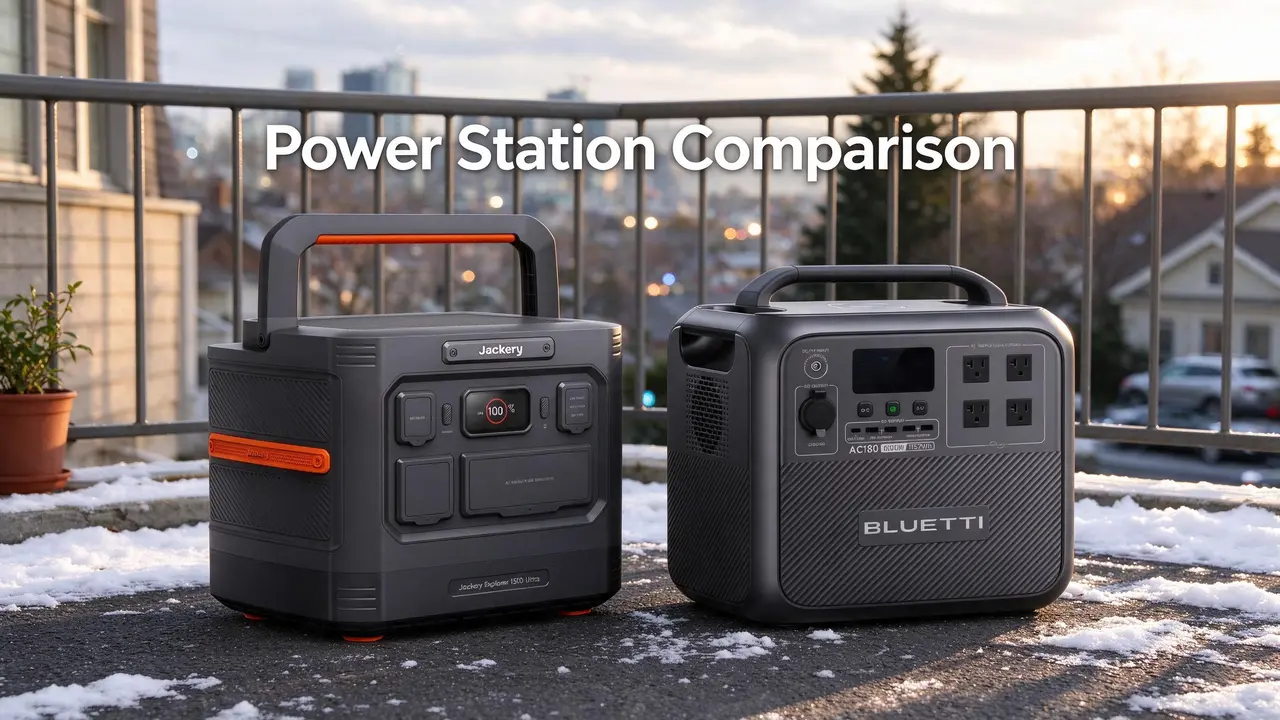
Two 1800 W stations, two very different bets: the Jackery Explorer 1500 Ultra buys you capacity and weather sealing, the BLUETTI AC180 buys you a lower entry price and UPS-style switchover. Here's which one fits your outage plan.
Updated
At a glance
Two 1800 W stations, two very different bets: the Jackery Explorer 1500 Ultra buys you capacity and weather sealing, the BLUETTI AC180 buys you a lower entry price and UPS-style switchover. Here's which one fits your outage plan.
- Jackery: pay more, get more stored energy and weather sealing.
- BLUETTI: pay less, get UPS-style switchover and a lighter footprint.
- Neither is a generator replacement; both are essentials-only backup.
Same money? No — same job, different bets
If you're shopping an outage backup and these two landed on your shortlist, the first thing to notice is that they are not the same price. The Jackery Explorer 1500 Ultra lists at $1199; the BLUETTI AC180 lists at $499. That's a $700 gap, and it changes what each unit is actually for.
The Jackery bets on capacity and environmental tolerance: 1,536 Wh, IP65 sealing, a 4,000-cycle LiFePO4 rating, and a 5-year warranty. The BLUETTI bets on affordability and UPS behavior: 1,152 Wh, a 20 ms switchover claim, and a much lower entry point. Both put 1,800 W continuous on the AC side, so neither is a whole-home solution — this page is about keeping a fridge, router, CPAP, and a few lights alive, not running a furnace or well pump.
- Jackery: pay more, get more stored energy and weather sealing.
- BLUETTI: pay less, get UPS-style switchover and a lighter footprint.
- Neither is a generator replacement; both are essentials-only backup.
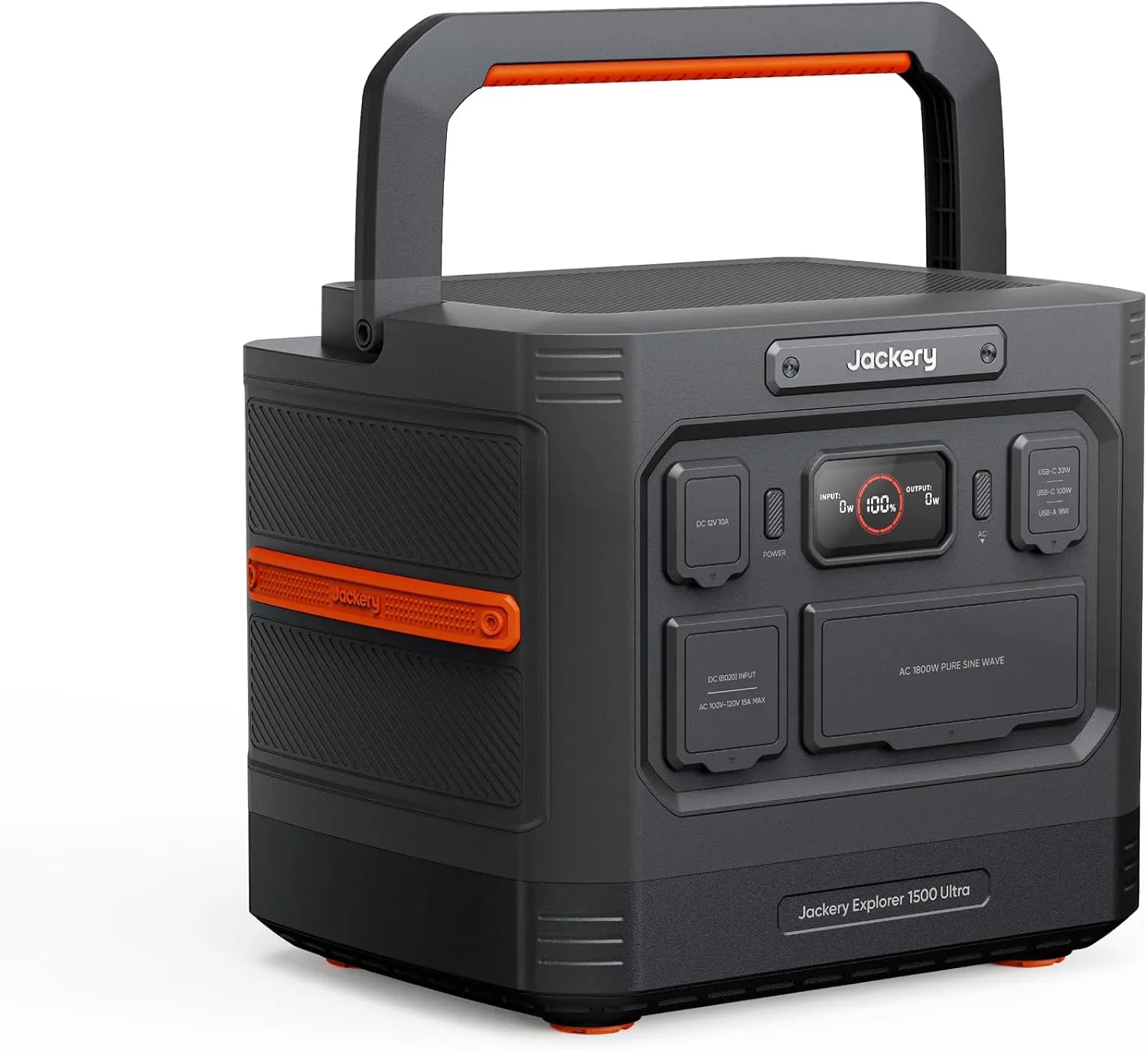
Jackery Explorer 1500 Ultra Portable Power Station,1536Wh,1800W AC
Highlights
- 1536Wh rated capacity
- 1800W continuous AC
- LiFePO4 chemistry
- Up to 800W solar input
- 38.6 lb (~17.5 kg)
- About $1199 list
Best for
- Explorer 1500 Ultra: longer outages or higher continuous loads (still not whole-home wiring)
- RV / off-grid days where recharge speed matters as much as Wh
- Users who will pair solar or expand rather than buy a second small pack
Strengths
- Explorer 1500 Ultra: 1800W continuous on a 1536Wh pack — more headroom for small appliances than 1kW-class peers
- 38.6 lb (~17.5 kg) is a park-and-use chassis — plan a short path, not a trail hike
- 1800W continuous headroom covers more small appliances than 1kW-class inverters
- Owners on file: 5/5 · 3 helpful — This worked amazing on our camping trip! While it was more expensive, it works VERY well in…
Watch-outs · not ideal when
- 38.6 lb (~17.5 kg) is a two-hand lift; skip it if you walk more than a short path to camp
- High continuous output on Explorer 1500 Ultra tempts big loads — Wh still runs out on kettles and A/C
- Rated 800W solar on Explorer 1500 Ultra is optimistic; shade and cables cut real watts
- LiFePO4 helps longevity, but Explorer 1500 Ultra still hates freezing charge temps on winter trips
Owner voices
Short takes from public retail reviews — paraphrased or translated when long or non-English; meaning kept close to the original.
“5/5 · 3 helpful — This worked amazing on our camping trip! While it was more expensive, it works VERY well in dusting wet conditions.”
“5/5 · 1 helpful — It works well. We train dogs on most weekends and I can run fans and other things all weekend.”
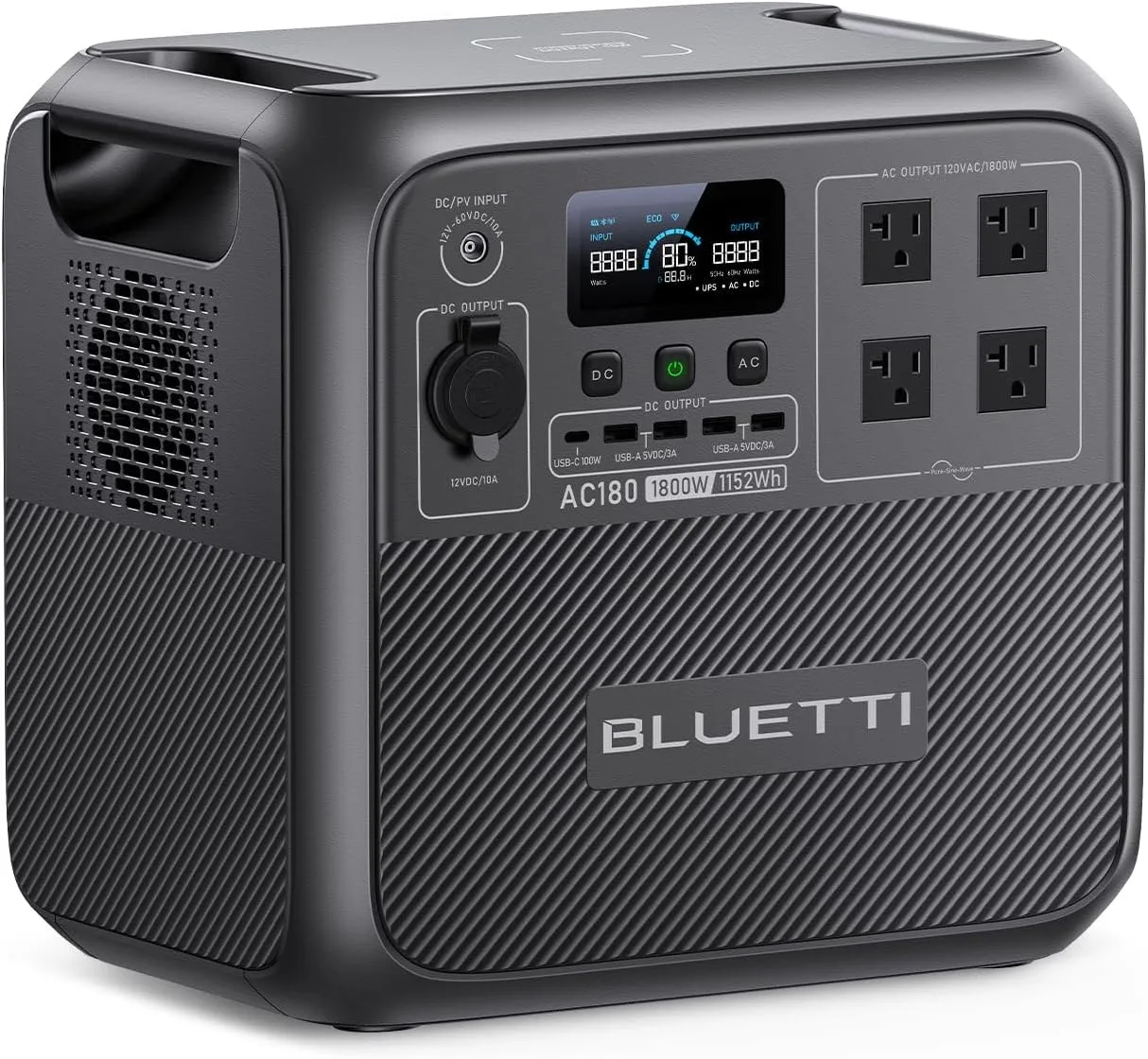
BLUETTI Portable Power Station AC180, 1152Wh LiFePO4 Battery Backup w/ 2 1800W
Highlights
- 1152Wh rated capacity
- 1800W continuous AC
- LiFePO4 chemistry
- Up to 500W solar input
- 35.3 lb (~16.0 kg)
- About $499 list
Best for
- AC180: most Wh per list dollar in mid-size LiFePO4 shortlists (~1152Wh)
- Home essentials when 1800W continuous matters more than a light carry
- Skip if 35.3 lb is too heavy for stairs or frequent car packing
Strengths
- AC180: 1800W continuous on a 1152Wh pack — more headroom for small appliances than 1kW-class peers
- 35.3 lb (~16.0 kg) is a park-and-use chassis — plan a short path, not a trail hike
- 1800W continuous headroom covers more small appliances than 1kW-class inverters
- Owners on file: Theme: Customers find this power station to be the best they've used, praising its fast charging capability (…
Watch-outs · not ideal when
- 35.3 lb (~16.0 kg) is a two-hand lift; skip it if you walk more than a short path to camp
- Usable energy on AC180 is below the 1152Wh label once the inverter is working
- Rated 500W solar on AC180 is optimistic; shade and cables cut real watts
- LiFePO4 helps longevity, but AC180 still hates freezing charge temps on winter trips
Owner voices
Short takes from public retail reviews — paraphrased or translated when long or non-English; meaning kept close to the original.
“Theme: Customers find this power station to be the best they've used, praising its fast charging capability (reaching 100% in about an hour) and value for money. They appreciate its power capacity, with one customer n…”
“Theme: Refrigerator (87)”
“Theme: Phone Charging (44)”
How I weighed these two
I'm Avery Nolan, WattPicks founding editor. My checks here are home-user comparisons grounded in the owner themes on file plus listing specs — not lab-bench measurements. I weighted usable capacity and runtime 35%, output and load fit 25%, recharge flexibility 15%, build and warranty 15%, and owner-reported reliability 10%. On that scale the BLUETTI wins on price-per-Wh and UPS behavior; the Jackery wins on stored energy and sealing. The ranking follows those weights, not brand preference.
As an Amazon Associate, WattPicks earns from qualifying purchases. Picks are fit-led, not commission-led.
- Capacity/runtime 35% — Jackery leads on Wh; BLUETTI leads on $/Wh.
- Output/load fit 25% — tie at 1,800 W continuous.
- Recharge 15% — BLUETTI's 1-hr AC claim edges it; Jackery's 800 W solar input is higher.
- Build/warranty 15% — Jackery's IP65 and 4,000-cycle rating lead; both list 5-year warranty.
- Owner reliability 10% — this weight reflects confidence in the evidence base, not a reliability verdict; BLUETTI has more data (including mixed service reports), Jackery's base is thin.
| Criterion (weight) | Jackery Explorer 1500 Ultra | BLUETTI AC180 | Winner |
|---|---|---|---|
| Capacity/runtime (35%) | 1,536 Wh; usable % not published | 1,152 Wh; ~90% usable per owners | Jackery on stored energy; BLUETTI on $/Wh |
| Output/load fit (25%) | 1,800 W continuous | 1,800 W continuous | Tie |
| Recharge (15%) | 1.5-hr AC claim; 800 W solar input | 1-hr AC claim at 1,440 W; 500 W solar | BLUETTI on AC speed; Jackery on solar ceiling |
| Build/warranty (15%) | IP65, 1-m drop, 5°F–113°F, 5-yr warranty | IP rating n/a; 5-yr warranty | Jackery |
| Owner reliability (10%) | Thin base (3 ratings) | Deep base; mixed service reports | BLUETTI on data volume; Jackery on fewer red flags |
Spec snapshot: the numbers that decide it
All figures below are from the listings on file. Ratings are listing aggregates, not owner proof. Where a spec isn't published, it's marked n/a (not on file).
Standing caveat: cycle-life and charge-time figures are vendor claims pending independent verification.
| Product | Price | Capacity (Wh) | Output (W) | Weight (lb) | Rating |
|---|---|---|---|---|---|
| Jackery Explorer 1500 Ultra | $1199 | 1536 Wh | 1800 W | 38.6 lb | 5 |
| BLUETTI AC180 | $499 | 1152 Wh | 1800 W | 35.3 lb | 4.5 |
Where the money went: four configuration calls
The price gap isn't arbitrary. It shows up in four places that matter for outage duty.
Battery and cycle life. The Jackery carries 1,536 Wh and rates its LiFePO4 cells at 4,000 cycles to 70% capacity. The BLUETTI carries 1,152 Wh; its listing doesn't publish a cycle count, so treat that as n/a (not on file). More watt-hours means longer runtime at the same load — roughly a third more stored energy on paper.
Recharge speed. Jackery claims a full AC charge in 1.5 hours and solar input up to 800 W. BLUETTI claims a 1-hour AC charge at 1,440 W input and 500 W solar. Both are fast; the BLUETTI's 1-hour claim is the more aggressive number, but owners note real solar harvest falls well short of panel ratings.
Weather and build. Jackery lists IP65 sealing, a 1-meter drop rating, and a 5°F–113°F operating range. BLUETTI's listing doesn't publish an IP rating, so n/a (not on file). If the unit lives in a garage or truck bed, that's a real difference.
Warranty and ports. Jackery lists a 5-year warranty (3-year standard + 2-year extension). BLUETTI lists a 5-year warranty as well. Jackery lists AC×3, USB-C×1, and car×1; BLUETTI lists AC×4 and car×1, with USB-C and USB-A not specified on file — don't assume either way.
- Capacity: 1,536 Wh vs 1,152 Wh — Jackery leads by 384 Wh.
- AC recharge: 1.5 hr (Jackery) vs 1 hr (BLUETTI) per listings — vendor claims, not independently verified.
- Sealing: IP65 (Jackery) vs n/a (BLUETTI).
- Warranty: 5 years both, per listings.
The spec that decides it: usable watt-hours, not headline Wh
Here's the number that actually runs your fridge: usable watt-hours after inverter overhead and depth-of-discharge limits. The BLUETTI's manual, per owners, caps usable capacity near 90%, and the inverter draws about 20 W with AC on. That means a 1,152 Wh pack behaves more like 1,000 Wh for small loads — and less if you leave AC idle.
The Jackery's listing doesn't publish a usable-capacity percentage. If it behaves like most LiFePO4 packs, assume roughly 85–90% usable — about 1,300–1,380 Wh — but that's an assumption, not a published spec. That makes this comparison one-sided on the usable-% metric: the BLUETTI figure is an owner-reported estimate, while the Jackery's is simply unknown. On paper, its 1,536 Wh gives you more headroom before overhead eats the difference.
Neither unit is enough for a 240 V well pump, electric heat, or a central AC. If that's your outage plan, you need a transfer switch and a different class of equipment.
- BLUETTI: ~90% usable capacity plus ~20 W inverter draw — plan for less than the label.
- Jackery: usable % not published; assuming ~85–90% usable, plan for ~1,300–1,380 Wh.
- Both: essentials only — fridge, router, lights, CPAP, phone charging.
- Cold weather: LiFePO4 capacity drops in freezing temps; the Jackery lists a 5°F–113°F operating range, while the BLUETTI's cold-weather range is n/a on file — plan for reduced runtime in an unheated garage.
| Load | Typical draw | BLUETTI AC180 (~1,000 Wh usable) | Jackery 1500 Ultra (~1,300–1,380 Wh usable, assumed) |
|---|---|---|---|
| Router/modem | 10–20 W | ~50–100 hr | ~65–138 hr (assumed usable) |
| CPAP (no humidifier) | 30–60 W | ~17–33 hr | ~22–46 hr (assumed usable) |
| LED lights (2–3 bulbs) | 15–30 W | ~33–67 hr | ~43–92 hr (assumed usable) |
| Fridge (duty-cycled) | 100–200 W avg | ~5–10 hr | ~6.5–13.8 hr (assumed usable) |
Real owner trade-offs: what the reviews actually say
The Jackery's review base is thin — 3 ratings on the listing — so treat these as early field impressions, not a consensus. Owners describe running fans and gear through a full weekend of dog training, and one notes it held up in dusty, wet camping conditions. The same owner flags the price as the main trade-off. That's the honest crack: you're paying a premium for sealing and capacity, and with so few reviews there's not much mileage to confirm long-term durability.
The BLUETTI has far more owner data, and the themes are consistent. The most helpful reviews describe UPS-style switchover that kept a router, TV, and lights running without a blink during an outage. Owners also praise the fast wall recharge and the clear display showing watts in and out. But the caveats are just as consistent: solar harvest falls well short of panel ratings (one owner saw roughly 57 W on a rainy day and about 161 W on a clear day from a 200 W panel), the top wireless charging pad drops connections, and some settings require the app. At least one owner needed firmware updates plus a full discharge/recharge cycle before the unit performed to spec — if you buy the AC180, plan to check for firmware on day one and run a calibration cycle before relying on it for an outage.
One more BLUETTI theme worth flagging: customer service is mixed. Some owners report excellent support and even an exchange offer; others describe frustrating back-and-forth. That's a real risk factor at the $499 price point — keep your receipt and register the unit.
- Jackery: weekend-long small loads and wet/dust tolerance praised; price flagged; thin review base.
- BLUETTI: UPS switchover and fast recharge praised.
- BLUETTI: solar harvest falls short of panel ratings; wireless pad drops connections.
- BLUETTI: firmware recalibration on day one is a recurring owner recommendation.
Buy the one that…
Buy the Jackery Explorer 1500 Ultra if your outage plan runs long — 48–72 hours of fridge, router, and CPAP — or if the unit will live somewhere dusty or damp. The extra 384 Wh and IP65 sealing are the reasons to pay the $700 premium. Skip it if budget is the binding constraint or if you need confirmed long-term owner data before committing.
Buy the BLUETTI AC180 if you want affordable essentials backup with UPS-style switchover and you're willing to manage loads. At $499 it's the lower-risk entry point, and the owner base is deep enough to know what you're getting. Skip it if you need to run multiple large appliances through an outage, if you're counting on the wireless charging pad, or if you need published cycle-life and IP ratings before you buy.
- Long outage (48–72 hr) + harsh location → Jackery.
- Short outage + tight budget → BLUETTI.
- Whole-home or 240 V loads → neither; look at a transfer switch setup.
Frequently asked
Can the BLUETTI AC180 run a fridge overnight?
On paper, 1,152 Wh with ~90% usable capacity gives you roughly 1,000 Wh. A typical fridge cycles at 100–200 W average, so you're looking at 5–10 hours depending on duty cycle and inverter overhead. The Jackery's 1,536 Wh, assuming ~85–90% usable, stretches that to roughly 6.5–13.8 hours on the same assumptions. Neither is a multi-day fridge solution without solar or a generator.
Does the Jackery Explorer 1500 Ultra have USB-C?
Yes — the listing shows USB-C×1. The BLUETTI's USB-C and USB-A ports are not specified on file, so don't assume either way.
Which one is cheaper per watt-hour?
On nameplate math, the BLUETTI AC180 is $0.43/Wh and the Jackery Explorer 1500 Ultra is $0.78/Wh. That's the BLUETTI's clearest advantage.
Do either of these need a transfer switch?
No — both are plug-in portable stations. A transfer switch or smart panel is for hardwired home backup, which is a different category.
Method and sources
Model names and list prices come from the WattPicks catalog at build time. WattPicks does not run its own laboratory tests on power stations, and nothing on this page is presented as a measured result — it is catalog-backed buying guidance.
Read our methodology for how the catalog is normalized, and about WattPicks for who publishes it.