
BLUETTI Elite 400 vs Goal Zero Yeti PRO 4000: Which Fits Your Backup Plan?
Two big-battery stations that spend your money very differently: one buys runtime and wheels, the other buys expandability and a transfer-switch ecosystem. Here is how to pick when the price gap is not the story.

Updated
At a glance
Two big-battery stations that spend your money very differently: one buys runtime and wheels, the other buys expandability and a transfer-switch ecosystem. Here is how to pick when the price gap is not the story.
- BLUETTI's bet: more Wh per dollar, less inverter headroom, no growth path.
- Goal Zero's bet: modular capacity and automatic circuit backup, with a heavier box and a thinner reliability record.
Two different buyers, two different bets
These two are not really fighting over the same buyer. The BLUETTI Elite 400 Portable Power Station with AC Cable 3840Wh 2600W LFP bets everything on battery: 3840 Wh behind a 2600 W inverter, on wheels, for $1499. The Goal Zero Yeti PRO 4000 Portable Power Station, 4000 Watt Hour LiFePO4 bets on the system around the box — expansion tanks, a Haven transfer switch, and a metal case built for permanent install.
One caveat before we go further: Goal Zero's list price is n/a (not on file) in our catalogue, so I can't put a dollar figure in the table. Treat the price comparison as incomplete and weigh the spec and ecosystem deltas instead. This is a versus for people deciding between a long-runtime wheeled battery and an expandable home-backup hub — not a ranking of every 2,400–3,840Wh station.
- BLUETTI's bet: more Wh per dollar, less inverter headroom, no growth path.
- Goal Zero's bet: modular capacity and automatic circuit backup, with a heavier box and a thinner reliability record.
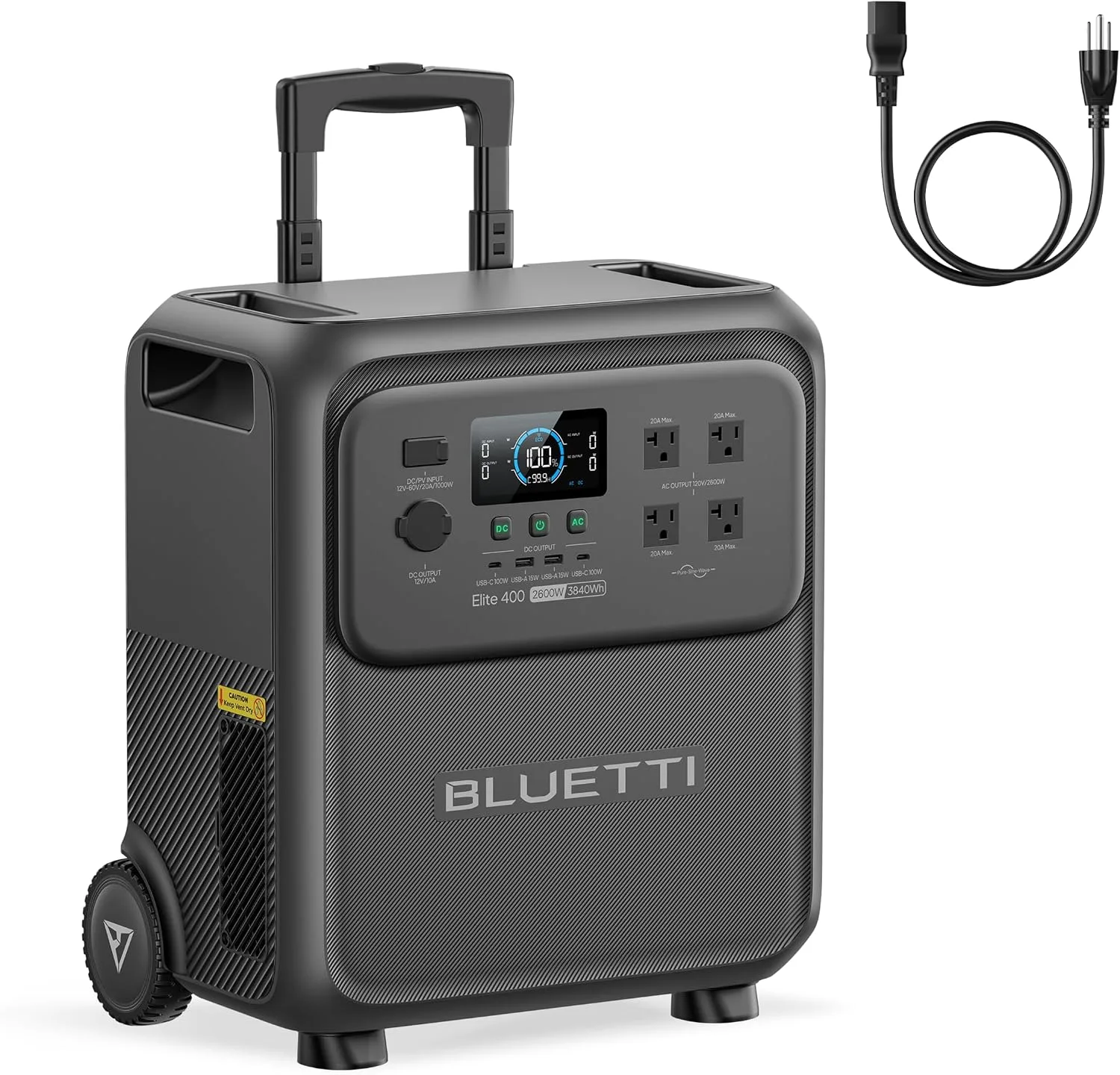
BLUETTI Elite 400 Portable Power Station with AC Cable 3840Wh 2600W LFP
Highlights
- 3840Wh rated capacity
- 2600W continuous AC
- LiFePO4 chemistry
- 86 lb (~39.0 kg)
- About $1499 list
Best for
- Elite 400: longer outages or higher continuous loads (still not whole-home wiring)
- RV / off-grid days where recharge speed matters as much as Wh
- Best parked near the vehicle or cabin — not a long carry to a tent
Strengths
- Elite 400: 2600W continuous on a 3840Wh pack — more headroom for small appliances than 1kW-class peers
- 86 lb (~39.0 kg) is a park-and-use chassis — plan a short path, not a trail hike
- 15ms-class UPS switchover on the listing — useful when a router restart would hurt
- About $1499 list in the Hub catalog — confirm live retail before you buy
Watch-outs · not ideal when
- At 86 lb (~39.0 kg), Elite 400 is a poor tent-hike companion — plan a cart or leave it in the vehicle
- High continuous output on Elite 400 tempts big loads — Wh still runs out on kettles and A/C
- Solar input unpublished for Elite 400 — do not assume a same-day off-grid refill
- LiFePO4 helps longevity, but Elite 400 still hates freezing charge temps on winter trips
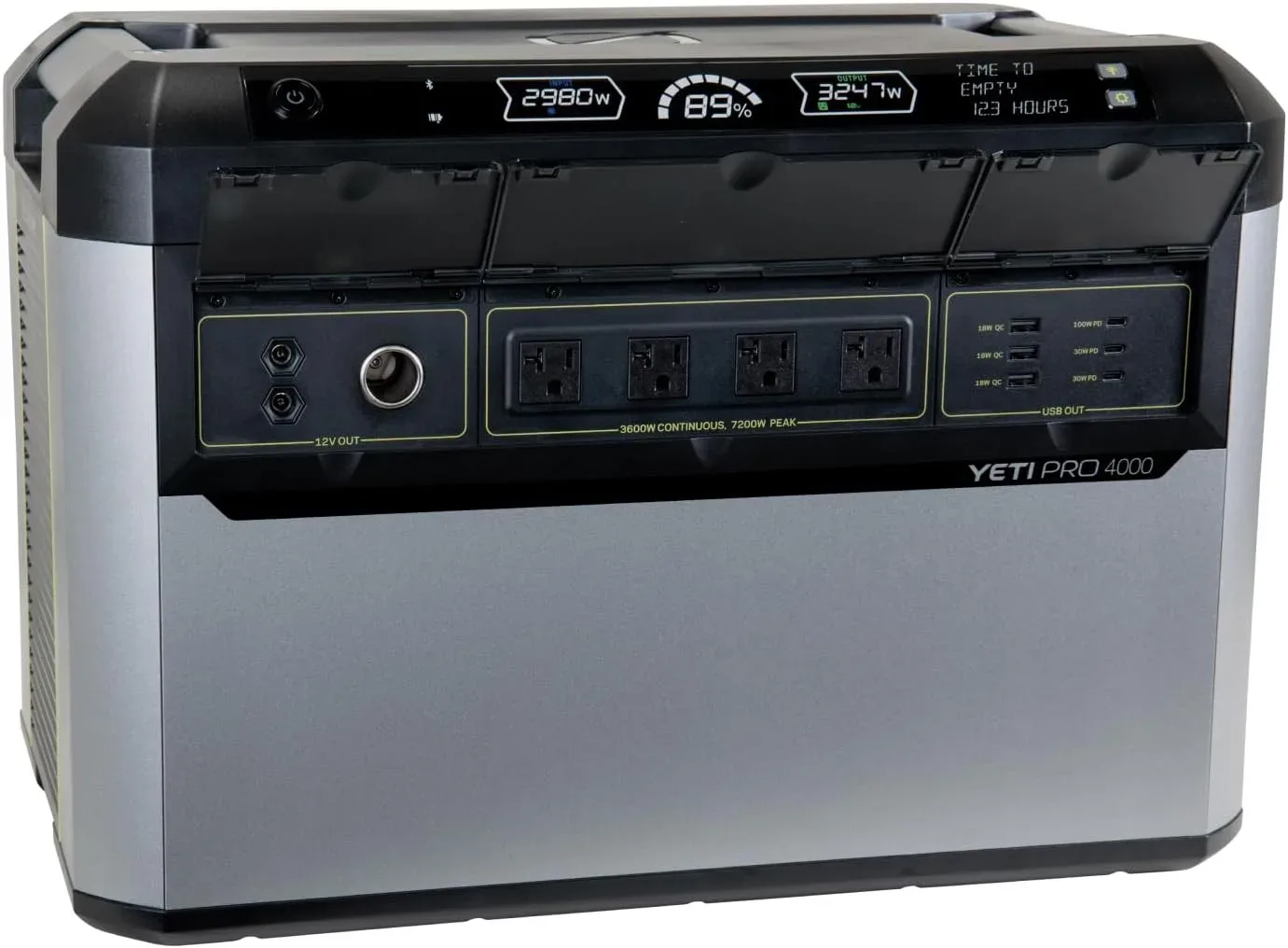
Goal Zero Yeti PRO 4000 Portable Power Station, 4000 Watt Hour LiFePO4 Battery, Expandable Solar Gen
Highlights
- LiFePO4 chemistry
- Goal Zero catalog listing
- Specs from manufacturer listings
Best for
- Goal Zero Yeti PRO 4000 Portable Power Station, 4000 Watt Hour LiFePO4 Battery, Expandable Solar Gen: longer outages or higher continuous loads (still not whole-home wiring)
- RV / off-grid days where recharge speed matters as much as Wh
- Users who will pair solar or expand rather than buy a second small pack
Strengths
- Goal Zero Yeti PRO 4000 Portable Power Station, 4000 Watt Hour LiFePO4 Battery, Expandable Solar Gen: capacity not published on file — compare only what the listing actually states
- Goal Zero Yeti PRO 4000 Portable Power Station, 4000 Watt Hour LiFePO4 Battery, Expandable Solar Gen: quiet battery output suits campsites with generator bans
- Goal Zero Yeti PRO 4000 Portable Power Station, 4000 Watt Hour LiFePO4 Battery, Expandable Solar Gen uses LiFePO4 — cycle-life claims usually beat older NMC marketing lines
- Owners on file: 5/5 · 19 helpful — I don't write many product reviews, but the GZ Yeti PRO 4000 has really impressed me. I wa…
Watch-outs · not ideal when
- Goal Zero Yeti PRO 4000 Portable Power Station, 4000 Watt Hour LiFePO4 Battery, Expandable Solar Gen is still a bridge for essentials — not a transfer-switch whole-home system
- No Wh on file for Goal Zero Yeti PRO 4000 Portable Power Station, 4000 Watt Hour LiFePO4 Battery, Expandable Solar Gen — do not invent runtime math from the product name
- Solar input unpublished for Goal Zero Yeti PRO 4000 Portable Power Station, 4000 Watt Hour LiFePO4 Battery, Expandable Solar Gen — do not assume a same-day off-grid refill
- Airline and pack limits may still block Goal Zero Yeti PRO 4000 Portable Power Station, 4000 Watt Hour LiFePO4 Battery, Expandable Solar Gen even when the weight looks friendly
Owner voices
Short takes from public retail reviews — paraphrased or translated when long or non-English; meaning kept close to the original.
“5/5 · 19 helpful — I don't write many product reviews, but the GZ Yeti PRO 4000 has really impressed me. I was looking for a power station to back my home, run my 30' travel trailer, and power the occasional backyard…”
“1/5 · 13 helpful — Why did you pick this product vs others?: DO NOT BUY!!! They do not have a customer service department anymore - Yeti Pro 4000 doesn't work. Won't hold charge no help - wasted money. Biolite purchas…”
“1/5 · 11 helpful — Well I have had this product for about 3 months now. When I first received it everything was fine and I was pleased. Have it in my Motorhome went out to check it was a storm was heading our way. I f…”
Methodology
This comparison is grounded in listing specs and owner themes on file — home-user checks, not lab-bench measurements. I weighted capacity and runtime fit at 30%, output headroom at 20%, expandability and ecosystem at 20%, portability at 15%, and owner-reported reliability at 15%. The BLUETTI wins on capacity-per-dollar and portability; the Goal Zero wins on expandability and installed-backup behavior. The reliability weight is why the Goal Zero's fault reports and support friction keep it from being the default pick despite its stronger ecosystem.
Avery Nolan is WattPicks' founding editor, covering portable power capacity, output, and price-per-Wh guidance across the catalogue — no lab claims. Prices and specs are from the listings; where data is missing, we say so. As an Amazon Associate, WattPicks earns from qualifying purchases; picks are fit-led, not commission-led.
The BLUETTI scores high where list price and published capacity match the job, medium on continuous watts. The Goal Zero scores high on continuous watts and ports, medium on price (list price not on file). That is why the pick splits by job rather than one universal winner.
Spec snapshot
Numbers below are from the listings, not from a bench. Where the listing is silent, the cell says so.
| Product | Price | Capacity (Wh) | Output (W) | Weight (lb) | Rating |
|---|---|---|---|---|---|
| BLUETTI Elite 400 Portable Power Station with AC Cable 3840Wh 2600W LFP | $1499 | 3840 Wh | 2600 W | 86 lb | 4.7 |
| Goal Zero Yeti PRO 4000 Portable Power Station, 4000 Watt Hour LiFePO4 | n/a (not on file) | 2400 Wh | 2400 W | 138 lb | 3.4 |
Where the differences are
Four configuration choices separate these units more than the headline wattage does.
Capacity vs. inverter balance. BLUETTI puts 3840 Wh behind a 2600 W inverter — a long-runtime, light-to-medium-draw profile. Goal Zero pairs 2400 Wh with a 2400 W inverter, so the battery-to-inverter ratio is closer to 1:1. In practice the BLUETTI runs low loads longer; the Goal Zero is less likely to be the bottleneck on a single big appliance.
Expansion. The Goal Zero listing supports up to four Tank PRO 4000 expansion batteries for up to 20 kWh, and it integrates with the Haven PRO transfer switch for up to 10 home circuits (Haven sold separately). The BLUETTI has no expansion battery port — owners on file flag this as a surprise. If you plan to grow capacity later, that difference is the whole decision.
Mobility. BLUETTI is 86 lb with a trolley handle and off-road wheels; Goal Zero is 138 lb and ships on a cart that locks in and detaches. Neither is a carry-up-the-stairs unit, but the BLUETTI is the one a single person can roll around a garage.
Recharge and I/O. BLUETTI lists 70 minutes to 80% on 2800 W AC+Solar, ~2.5 hr on a standard 1800 W outlet, and ~6 hr on 1000 W solar, with 9 AC outlets. Goal Zero lists 0–80% in 2 hours on 1800 W AC, under 90 minutes on 3000 W solar, and 2 AC outlets. Both list USB-C and USB-A as unknown — I'm not going to claim either way.
- BLUETTI: 3840 Wh / 2600 W / 86 lb / 9 AC / no expansion port.
- Goal Zero: 2400 Wh / 2400 W / 138 lb / 2 AC / up to 4 expansion tanks + Haven PRO (sold separately).
The spec that decides it
For most buyers, the deciding number is not wattage — it's whether the box can grow. The Goal Zero's four-tank expansion path and Haven PRO circuit integration make it a system you install once and add to. The BLUETTI's 3840 Wh is fixed the day it arrives.
The second deciding number is weight. At 86 lb with wheels, the BLUETTI is a one-person move on flat ground. At 138 lb, the Goal Zero is a two-person or cart job — plan where it lives before it lands, because you will not want to relocate it often.
Surge and startup watts matter too. The BLUETTI's 2600 W continuous output may handle a well pump or A/C startup only if the surge rating (not listed) is sufficient; the Goal Zero's 2400 W continuous is slightly lower but its 1:1 battery-to-inverter ratio may recover faster (untested). Check the locked-rotor amps (LRA) on your appliance before relying on either.
Real owner trade-offs
Owner notes on file tell a consistent story for each, and the caveats matter as much as the praise.
BLUETTI owners (owner reports on file, n≈several) describe a long-runtime workhorse: a camp trailer's 15k BTU A/C ran about three hours with the compressor cycling and never overloaded; a two-night tent trip with LED lights, heated blankets, phones, tablets, and a Starlink Mini ended near empty rather than dead; a fridge and Wi-Fi rode out a roughly four-hour outage. The repeated gripes are weight, app-dependent configuration (a problem in a grid-down emergency), and the missing expansion port. The 4.7 listing aggregate reflects that satisfaction — but it's a listing figure, not owner proof.
Goal Zero owners (owner reports on file, n≈several) describe a system that shines when wired in: with the Haven transfer switch, a simulated outage cut over so fast the TV and Wi-Fi didn't blink; a whole travel trailer ran off the 30A outlet with A/C and microwave together; a 30A house plug recharged in under 90 minutes. The caveats are louder than on the BLUETTI: repeated fault events during charging and on AC outputs, a unit charging to 100% despite an 85% cap, and support friction after the Biolite acquisition — though some owners report follow-up resolution. The 3.4 listing aggregate is thin (32 ratings) and should be read as a signal, not a verdict.
- BLUETTI: reliable long-runtime performance; heavy; app-reliant; no expansion.
- Goal Zero: excellent installed-backup behavior; fault reports and support friction are real watch-outs.
Runtime check: what these batteries actually run
Use this table to self-check runtime anxiety. Estimates assume continuous load and no inverter losses; real-world runtime will be shorter. For intermittent loads like a sump pump, size by locked-rotor amps (LRA) and surge watts, not average-watt math — the runtime shown is for the pump cycling on and off, not a continuous run.
| Load | Typical draw (W) | BLUETTI 3840Wh runtime (est.) | Goal Zero 2400Wh runtime (est.) |
|---|---|---|---|
| Fridge (average) | 100–200 | 19–38 hr | 12–24 hr |
| CPAP (no humidifier) | 30–60 | 64–128 hr | 40–80 hr |
| Sump pump (intermittent) | 800–1200 | 3–5 hr | 2–3 hr |
Buy the one that…
Buy the BLUETTI Elite 400 Portable Power Station with AC Cable 3840Wh 2600W LFP if you want the most watt-hours for the money, you'll roll it between garage, campsite, and outage duty, and you accept that capacity is fixed and many settings live in the app. Skip it if you need to add batteries later or run high-surge tools at full tilt.
Buy the Goal Zero Yeti PRO 4000 Portable Power Station, 4000 Watt Hour LiFePO4 if you're wiring a home circuit backup with the Haven PRO (sold separately), you want a growth path to 20 kWh, and you can live with 138 lb and a reliability record that includes real fault reports. Skip it if you need a one-person portable unit or you're not prepared to verify support responsiveness before you depend on it. Note: the 3.4 rating is based on only 32 ratings — treat it as a signal, not a verdict. Also note: Goal Zero's list price is not on file, so check the current listing before committing — if the price gap narrows, the ecosystem and expansion advantages may outweigh the BLUETTI's higher capacity.
Who should skip both
If your needs are under 1,000 Wh — charging phones, a laptop, and a few lights — these are overkill and you'll pay for capacity you won't use. A smaller, lighter station will serve you better.
Renters who can't wire a transfer switch should skip the Goal Zero's whole-home promise; without the Haven PRO, you're limited to its two AC outlets. And if you need to carry a unit up stairs regularly, both are too heavy — look for a sub-50 lb model.
Frequently asked
Can the BLUETTI Elite 400 run a fridge overnight?
Owners on file report a fridge and Wi-Fi through a roughly four-hour outage and a cooler/freezer setup stretching toward a week. At 3840 Wh and 2600 W continuous, a typical fridge (roughly 100–200 W average) is well within range; a whole-home load is not.
Does the Goal Zero Yeti PRO 4000 need the Haven PRO to back up home circuits?
Yes — the listing describes home circuit backup up to 10 circuits with Haven PRO, which is not included. Without it, you're using the AC outlets, not automatic transfer.
Which is easier to move?
The BLUETTI at 86 lb with a trolley handle and wheels is the one-person option. The Goal Zero at 138 lb ships on a cart but is effectively a two-person or leave-it-in-place unit.
Can I expand either one?
Goal Zero supports up to four Tank PRO 4000 expansion batteries (up to 20 kWh). The BLUETTI has no expansion battery port, per owner reports.
Method and sources
Model names and list prices come from the WattPicks catalog at build time. WattPicks does not run its own laboratory tests on power stations, and nothing on this page is presented as a measured result — it is catalog-backed buying guidance.
Read our methodology for how the catalog is normalized, and about WattPicks for who publishes it.