
BLUETTI Elite 300 vs Goal Zero Yeti 300: Backup Bet
Two very different bets on backup power: a 3,014 Wh RV-ready brick versus a 13.7 lb grab-and-go. Here's which one actually fits your outage plan — and where each one falls short.
Updated
At a glance
Two very different bets on backup power: a 3,014 Wh RV-ready brick versus a 13.7 lb grab-and-go. Here's which one actually fits your outage plan — and where each one falls short.
- BLUETTI bet: pay for capacity and output, accept 58 lb and no expansion.
- Goal Zero bet: pay for portability and fast recharge, accept 297 Wh and 350 W.
- Amazon Associates disclosure: picks here are fit-led, not commission-led.
Same money, different bets
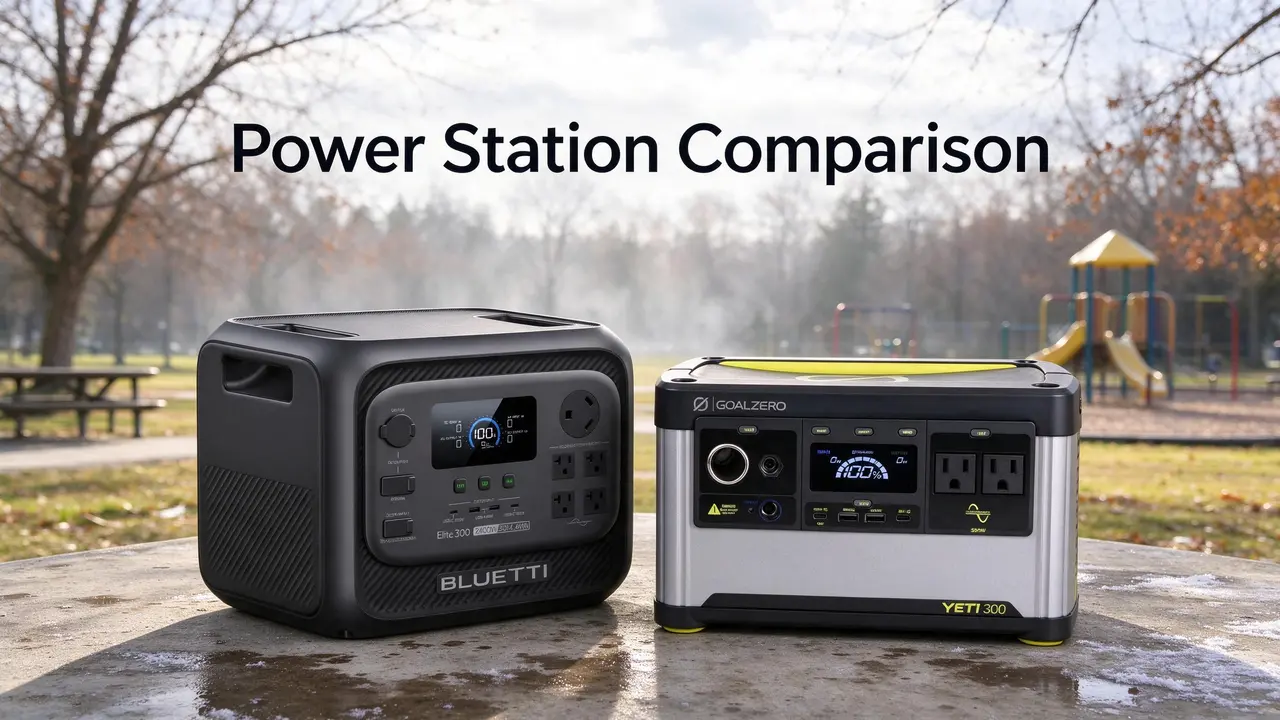
These two don't compete for the same outlet. The BLUETTI Elite 300 Portable Power Station for RV & Home Backup 3014.4Wh is a 3,014 Wh, 2,400 W brick at $1699 — a home-backup and RV shore-power play. The Goal Zero Yeti 300 Portable Power Station is a 297 Wh, 350 W grab-and-go at $349.95 — a device top-up and short-outage play.
If you're cross-shopping them, the real question isn't which is better. It's whether your outage plan needs to run a fridge and a router for a day, or keep phones and a laptop alive for a few hours. One of those bets costs five times as much and weighs four times as much. The other won't start a compressor.
This is a listing-and-owner-theme comparison, not a lab bench score. I'm working from published specs and the review themes on file — the numbers below are from the listings, and the owner notes are paraphrased, not pasted.
- BLUETTI bet: pay for capacity and output, accept 58 lb and no expansion.
- Goal Zero bet: pay for portability and fast recharge, accept 297 Wh and 350 W.
- Amazon Associates disclosure: picks here are fit-led, not commission-led.
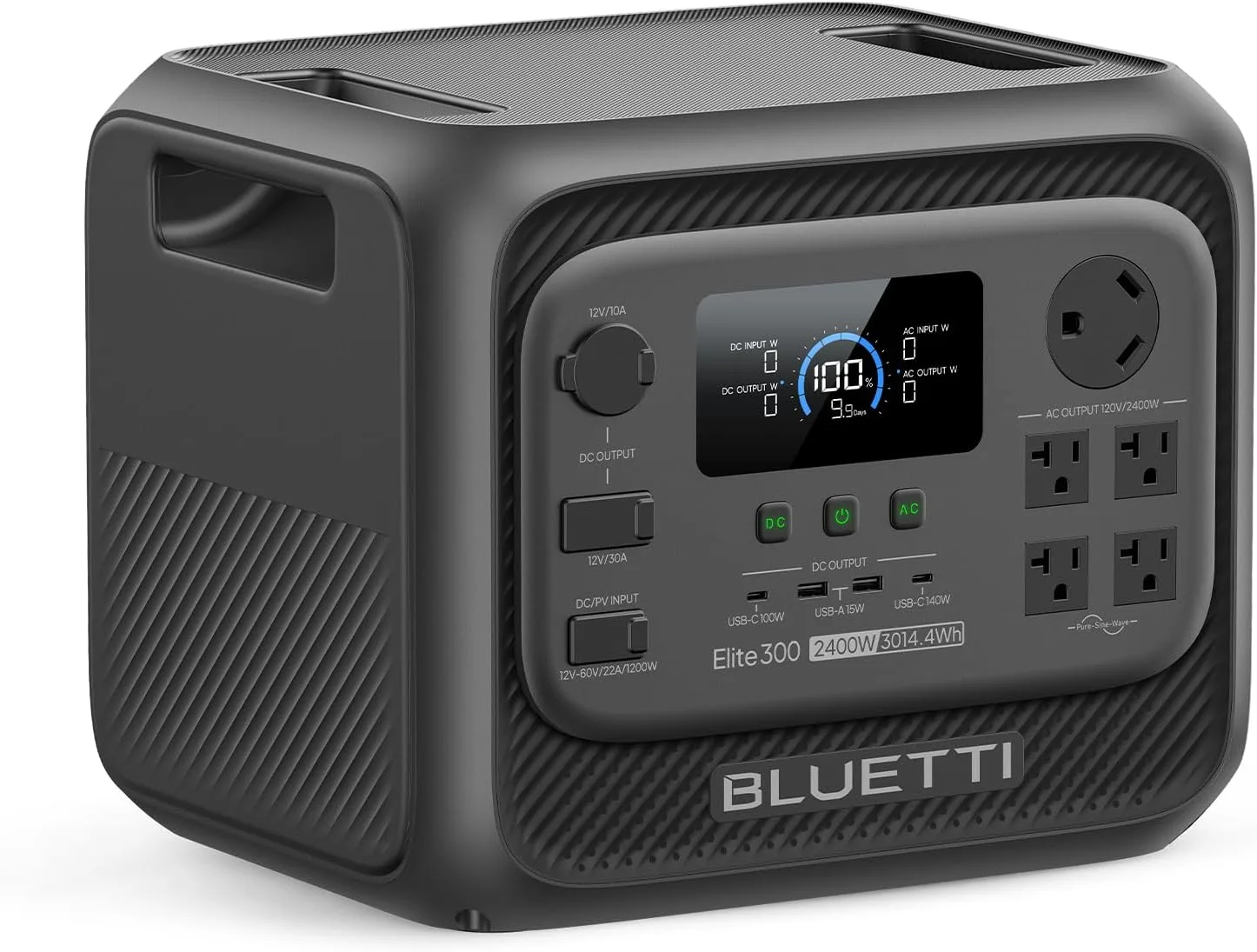
BLUETTI Elite 300 Portable Power Station for RV & Home Backup 3014.4Wh
Highlights
- 3014Wh rated capacity
- 2400W continuous AC
- LiFePO4 chemistry
- 58 lb (~26.3 kg)
- About $1699 list
Best for
- Elite 300: longer outages or higher continuous loads (still not whole-home wiring)
- RV / off-grid days where recharge speed matters as much as Wh
- Best parked near the vehicle or cabin — not a long carry to a tent
Strengths
- Elite 300: 2400W continuous on a 3014Wh pack — more headroom for small appliances than 1kW-class peers
- 58 lb (~26.3 kg) is a park-and-use chassis — plan a short path, not a trail hike
- 10ms-class UPS switchover on the listing — useful when a router restart would hurt
- About $1699 list in the Hub catalog — confirm live retail before you buy
Watch-outs · not ideal when
- At 58 lb (~26.3 kg), Elite 300 is a poor tent-hike companion — plan a cart or leave it in the vehicle
- High continuous output on Elite 300 tempts big loads — Wh still runs out on kettles and A/C
- Solar input unpublished for Elite 300 — do not assume a same-day off-grid refill
- LiFePO4 helps longevity, but Elite 300 still hates freezing charge temps on winter trips
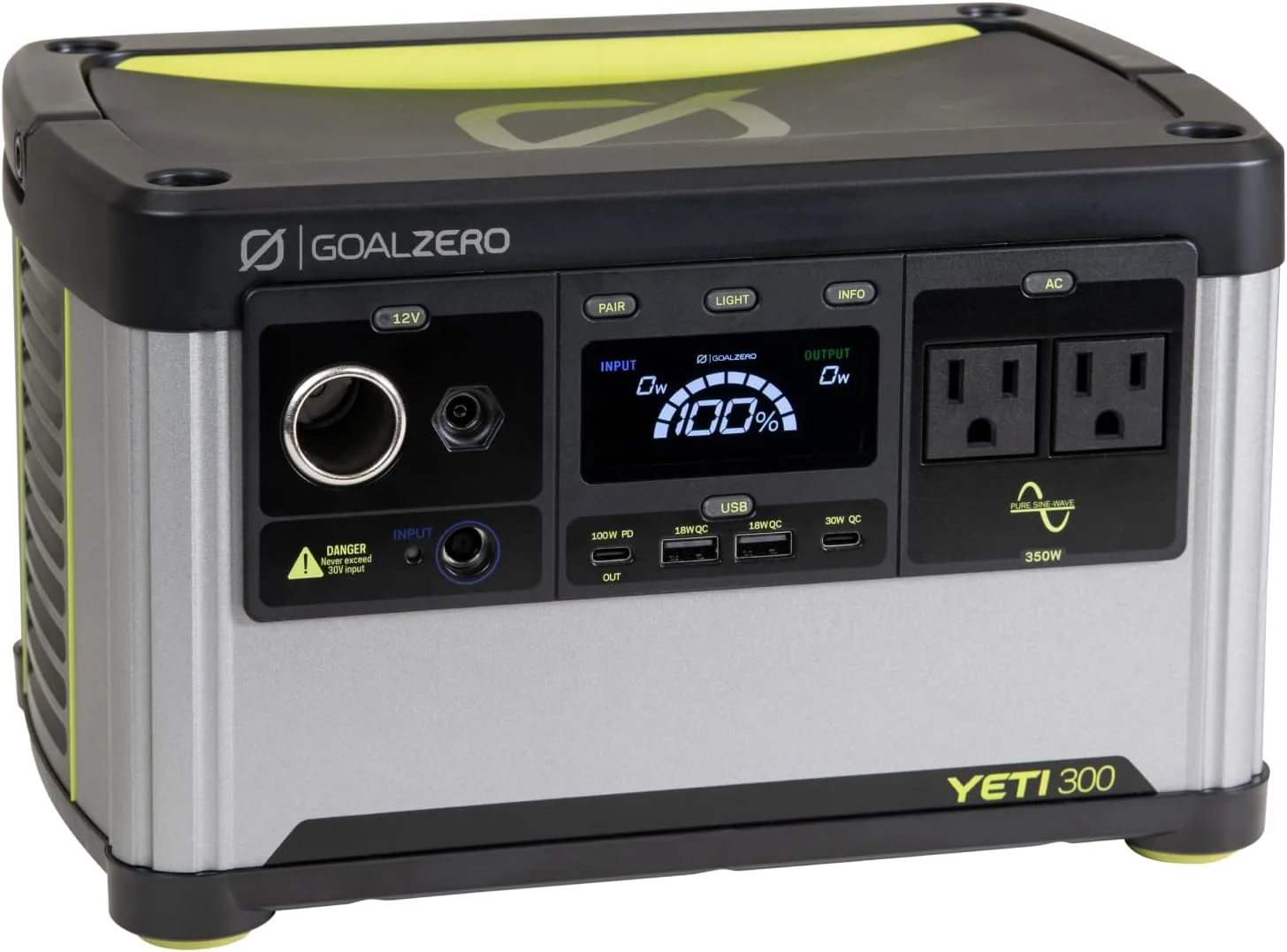
Goal Zero Yeti 300 Portable Power Station
Highlights
- 297Wh rated capacity
- 350W continuous AC
- 600W surge
- LiFePO4 chemistry
- Up to 200W solar input
- 13.7 lb (~6.2 kg)
Best for
- Yeti 300: phones, cameras and a laptop on short trips
- Travel kits when you need quiet pack power, not appliance runtime
- Brief desk backup for router and lights — not a fridge for days
Strengths
- Yeti 300: 297Wh pack with 350W continuous / 600W surge — size loads to both numbers
- 13.7 lb (~6.2 kg) is the lightest-class carry in this band — easier stairs and car packing
- Yeti 300 uses LiFePO4 — cycle-life claims usually beat older NMC marketing lines
- Owners on file: 1/5 · 36 helpful — I was stoked for this product given its light weight and functionality but I am incredibly…
Watch-outs · not ideal when
- Yeti 300's small Wh class empties fast with a kettle, hair dryer or space heater
- 350W continuous will not hold heating elements or many compressor surges for long
- Rated 200W solar on Yeti 300 is optimistic; shade and cables cut real watts
- Airline and pack limits may still block Yeti 300 even when the weight looks friendly
Owner voices
Short takes from public retail reviews — paraphrased or translated when long or non-English; meaning kept close to the original.
“1/5 · 36 helpful — I was stoked for this product given its light weight and functionality but I am incredibly disappointed. I took this out on 2 separate camping trips and it died both nights charging a single phone.…”
“3/5 · 9 helpful — I have a laptop and T Mobile whole house wifi connected. I use it to power my "mobile office". It powers the 2 devices for about 4 hours - then it is at 10% remaining. It works, it's quiet but I expe…”
“5/5 · 7 helpful — I have owned many goal zero products over the years and have found them to be among the best in the industry. While there are cheaper options out there, the quality doesn't match up to Goal Zero. The…”
Spec snapshot
Prices are list prices from the product data, not sale stickers. Ratings are listing aggregates, not owner proof. Where a spec isn't published, it's marked n/a (not on file).
| Product | Price | Capacity (Wh) | Output (W) | Weight (lb) | Rating |
|---|---|---|---|---|---|
| BLUETTI Elite 300 Portable Power Station for RV & Home Backup 3014.4Wh | $1699 | 3014 Wh | 2400 W | 58 lb | 4.7 |
| Goal Zero Yeti 300 Portable Power Station | $349.95 | 297 Wh | 350 W | 13.7 lb | 4 |
Where the money went
Four configuration differences explain most of the price gap. Start with capacity: 3,014 Wh versus 297 Wh is roughly a 10x spread. That's the difference between running a fridge overnight and running a fan for an evening.
Output follows the same curve. The Elite 300's 2,400 W continuous rating can carry a space heater or a full-size fridge compressor; the Yeti 300's 350 W is sized for laptops, routers, fans, and small appliances. Neither number is a surge figure — treat them as continuous ceilings.
Recharge speed is where Goal Zero claws back ground. The Yeti 300 listing claims 0–100% in about 50 minutes in high-speed mode, and owners back that up. The Elite 300 listing claims 0–80% in as fast as 78 minutes. Both are fast; the Yeti is faster per unit of capacity, but it's refilling a much smaller tank.
Chemistry and cycle life: the Yeti 300 is LiFePO4, rated 4,000+ cycles on the listing. The Elite 300's chemistry isn't spelled out in the product data on file — n/a (not on file) — so I won't claim a cycle count for it. That's a real gap if longevity is your deciding factor.
Ports and RV readiness: the Elite 300 has a TT-30 RV outlet and 12V/30A DC output, which is the whole point for camper van and motorhome owners. The Yeti 300 has USB-C×3, USB-A×2, and a car port — a device-charging layout. AC port counts for the Yeti aren't published (n/a), and USB-C/USB-A counts for the Elite 300 aren't published either, so I'm not going to claim absence on either side.
- Capacity: 3,014 Wh vs 297 Wh — a ~10x gap.
- Continuous output: 2,400 W vs 350 W.
- Recharge: ~78 min to 80% (Elite 300) vs ~50 min to 100% (Yeti 300, listing claim).
- Chemistry: LiFePO4 with 4,000+ cycles (Yeti 300); Elite 300 chemistry n/a (not on file).
- RV: TT-30 + 12V/30A DC (Elite 300) vs car port only (Yeti 300).
The spec that decides it
For most buyers, capacity and continuous output decide this, not port count. If your outage plan includes a refrigerator, a CPAP, or a router plus a few lights for a full day, the Elite 300's 3,014 Wh and 2,400 W are the only numbers on this page that can carry it. The Yeti 300's 297 Wh is a few hours of laptop-and-modem work — one owner measured about four hours before hitting 10% remaining.
The second deciding spec is weight. 58 lb versus 13.7 lb is the difference between a unit you wheel or two-hand to the garage and one you carry in a tote bag. If you're moving it between an apartment, a car, and a campsite, the Yeti wins on ergonomics by a wide margin.
One caveat on the Elite 300: owners report a soft-start voltage ramp that can balk at inductive loads. A 500W dehumidifier compressor wouldn't start on first switch-on in one owner's test, though it ran once the compressor kicked in. That's worth knowing before you plan to run a fridge compressor on it as your primary outage strategy.
Real owner trade-offs
The Elite 300's owner themes skew positive on capacity and UPS behavior. One owner ran a continuous 2,400 W load for about 30 minutes across multiple appliances without issue; another reported the UPS transferred to a computer with no interruption. A third powered a fridge, several fans, and a phone for a full day during an outage. The recurring complaints are the tight 12–60V solar input window (many rigid panels can't hit max charge rate, and exceeding open-circuit voltage can damage the MPPT charger), no battery expansion port, and app-dependent features that one owner flagged as a concern for a disaster device.
The Yeti 300's owner themes are more mixed. Fast recharge is the consistent praise — under an hour to full in one report. But runtime under load draws criticism: one owner got about four hours on a laptop plus whole-house wifi modem before dropping to 10%, and another reported the unit died both nights on two separate camping trips while charging a single phone. A third blew a fuse charging from a Jeep cigarette lighter at too high a rate. The listing aggregate is 4 stars across 107 ratings, which tracks with that split.
Neither set of reviews is a lab result. They're owner reports, and I'm treating them as themes rather than proof.
- Elite 300: strong on capacity, UPS, and RV shore power; weak on solar voltage range and expansion.
- Yeti 300: strong on weight and recharge speed; weak on runtime under load and overnight reliability reports.
- Ratings are listing aggregates (4.7/254 and 4/107), not owner-verified scores.
Buy the one that…
Buy the BLUETTI Elite 300 Portable Power Station for RV & Home Backup 3014.4Wh if you need to run a fridge, a CPAP, or a router-plus-lights for a full outage day, or if you want a TT-30 shore-power plug for a camper van. Skip it if you need expandable capacity, plan to use rigid solar panels above 60V open-circuit, or can't lift 58 lb.
Buy the Goal Zero Yeti 300 Portable Power Station if your backup need is phones, a laptop, a router, and a fan for a few hours, and you want something you can carry in one hand. Skip it if you need all-day runtime under load, dependable overnight camping power without a solar panel, or anything that draws more than 350 W continuous.
- Walk away from both if your plan requires running a 240V well pump or central AC — neither unit is sized for that.
- Walk away from the Yeti 300 if you've read the overnight-camping reliability reports and need certainty.
- Walk away from the Elite 300 if solar expansion is core to your setup and your panels exceed 60V open-circuit.
Frequently asked
Can the Yeti 300 run a full-size refrigerator?
No — 350 W continuous and 297 Wh won't carry a fridge compressor for meaningful runtime. It's sized for device charging and small appliances.
Can the Elite 300 run a CPAP overnight?
Yes, per owner reports — one owner ran a CPAP for four nights with charge left over. That's consistent with 3,014 Wh against a CPAP's typical draw.
Does the Elite 300 support battery expansion?
No expansion port is listed, and owners confirm the limitation. The workaround of feeding an external battery through the solar input loses roughly 20% in conversion.
Which recharges faster from AC?
The Yeti 300, per listing claims — about 50 minutes to 100% versus about 78 minutes to 80% for the Elite 300. But the Yeti is refilling a much smaller battery.
Method and sources
Model names and list prices come from the WattPicks catalog at build time. WattPicks does not run its own laboratory tests on power stations, and nothing on this page is presented as a measured result — it is catalog-backed buying guidance.
Read our methodology for how the catalog is normalized, and about WattPicks for who publishes it.