
DJI Power 1000 V2 vs EcoFlow DELTA 3: Which 1kWh Fits?
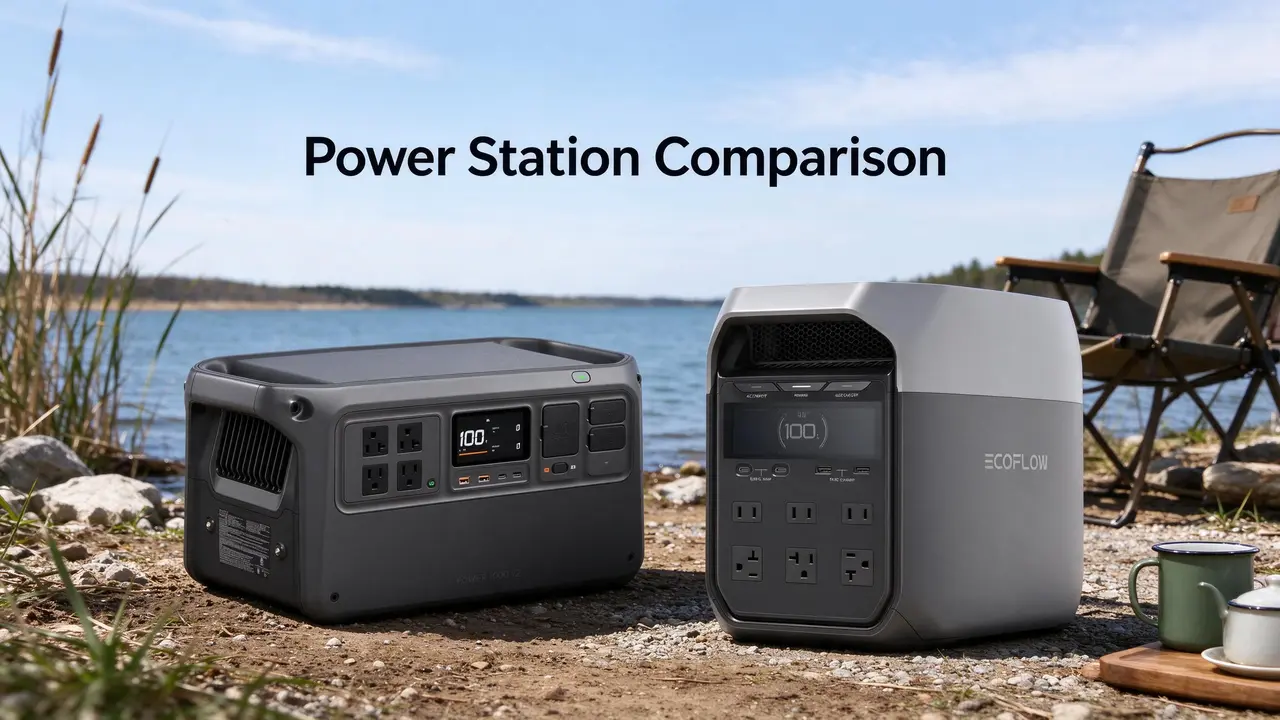
Same $699, same 1024 Wh, and two very different bets: DJI sells UPS speed and inrush headroom, EcoFlow sells 1800 W and six AC outlets. Here is how to pick without buying both.
Updated
At a glance
Same $699, same 1024 Wh, and two very different bets: DJI sells UPS speed and inrush headroom, EcoFlow sells 1800 W and six AC outlets. Here is how to pick without buying both.
Same money, different bets
Both of these land at $699 for 1024 Wh, which is $0.68/Wh on the nameplate for each — the cheapest per-Wh tier in this class on our card. So price stops being the tiebreaker, and the real question is what you are asking the box to do at 3 a.m.
DJI's bet is UPS behavior and inrush headroom: a 1000 W continuous rating, a claimed 10 ms switchover, and owners who report running tools and a rope winch that spike well above the continuous number. EcoFlow's bet is raw ceiling and outlet count: 1800 W continuous across six AC outlets, in a box that weighs 3.7 lb less.
This is not a page for whole-home backup. Neither unit carries a house through a multi-day outage on its own — owners on both sides say you add expansion batteries or buy bigger. If that is your job, skip both and size against your panel instead.
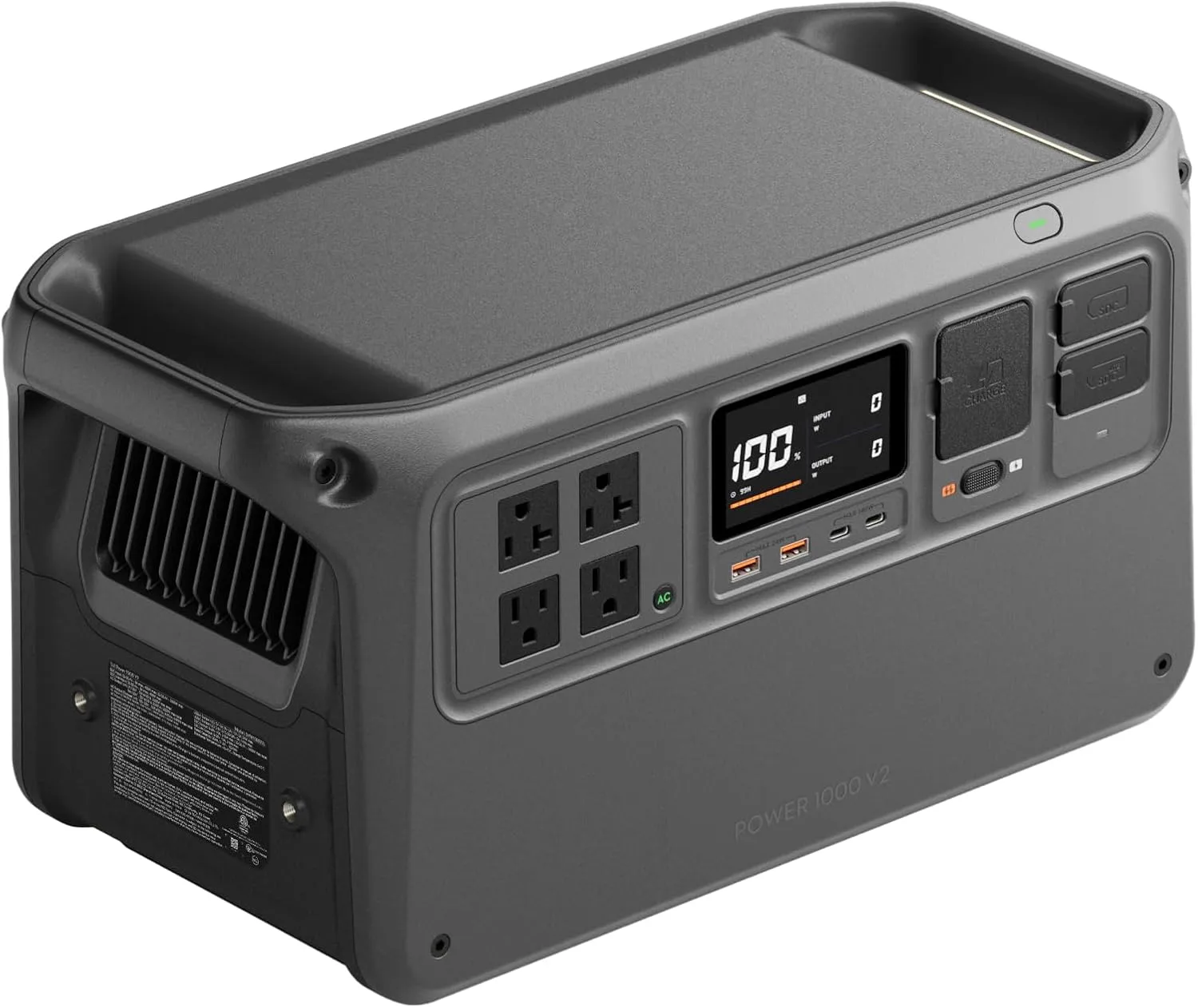
DJI DJI Power 1000 V2
Highlights
- 1024Wh rated capacity
- 1000W continuous AC
- LiFePO4 chemistry
- 31.3 lb (~14.2 kg)
- About $699 list
Best for
- DJI Power 1000 V2: UPS-style bridge for router/desktop through brief outages (10ms class on listing)
- Park-and-use indoor electronics backup at 31.3 lb — not a long hike companion
- Warranty-first buyers who accept accessory-dependent solar/car charging
Strengths
- DJI Power 1000 V2: 1024Wh / 1000W continuous — treat as electronics and light loads, not a tool inverter
- 31.3 lb (~14.2 kg) is a park-and-use chassis — plan a short path, not a trail hike
- DJI Power 1000 V2 uses LiFePO4 — cycle-life claims usually beat older NMC marketing lines
- About $699 list in the Hub catalog — confirm live retail before you buy
Watch-outs · not ideal when
- 31.3 lb (~14.2 kg) is a two-hand lift; skip it if you walk more than a short path to camp
- Usable energy on DJI Power 1000 V2 is below the 1024Wh label once the inverter is working
- DJI Power 1000 V2: solar/car charging is accessory-dependent on the listing — not a built-in published input ceiling
- LiFePO4 helps longevity, but DJI Power 1000 V2 still hates freezing charge temps on winter trips
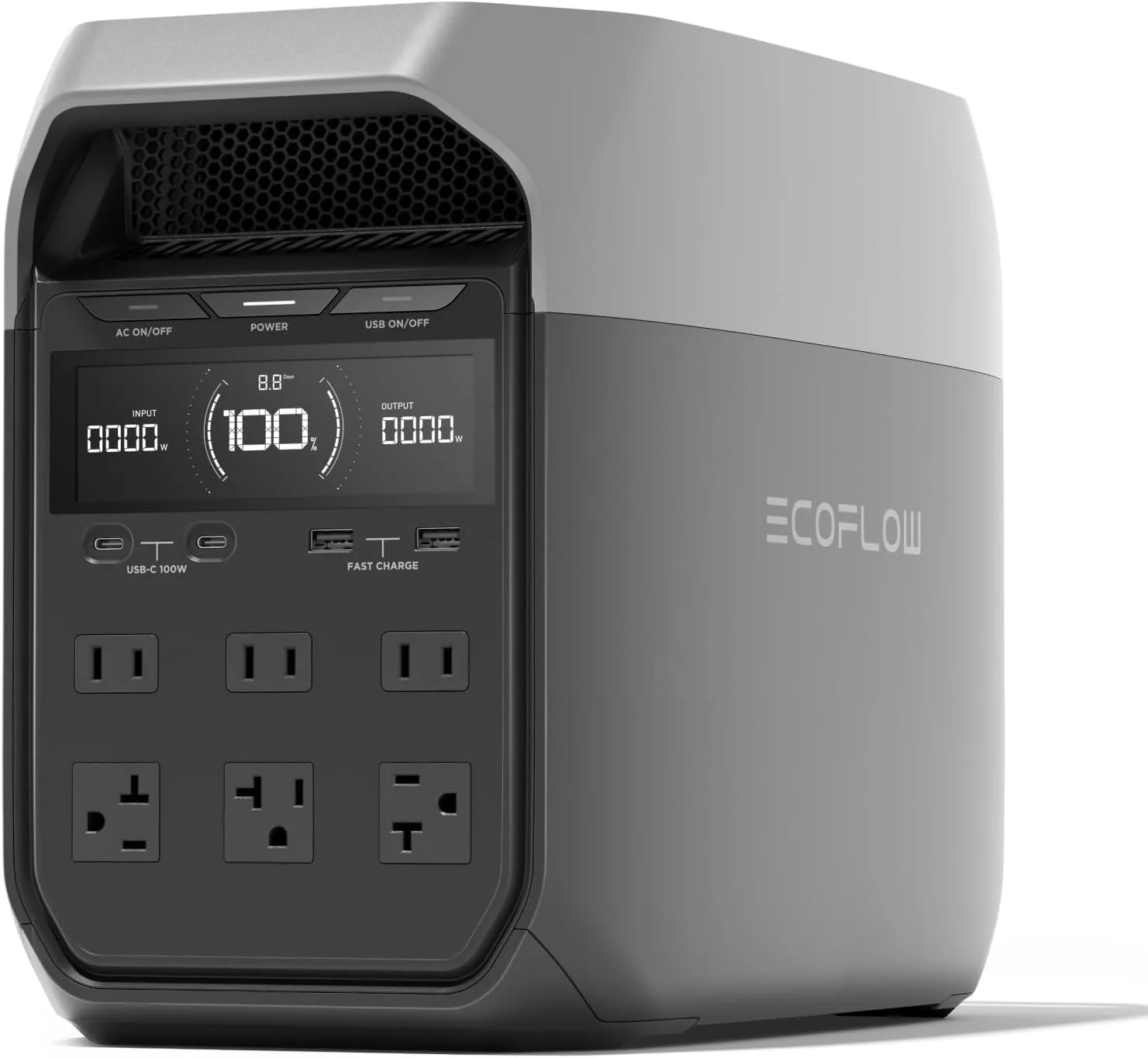
EcoFlow DELTA 3
Highlights
- 1024Wh rated capacity
- 1800W continuous AC
- 3600W surge
- LiFePO4 chemistry
- Up to 500W solar input
- 27.6 lb (~12.5 kg)
Best for
- DELTA 3: small appliances and tools that need ~1800W continuous, not just phone charging
- Essentials bridge at home (fridge cycles, router) when sized to the Wh
- Solar top-ups up to ~500W when panels and weather cooperate
Strengths
- DELTA 3: 1024Wh pack with 1800W continuous / 3600W surge — size loads to both numbers
- 27.6 lb (~12.5 kg) sits in the solo car-camp carry carry band for weekend moves
- 10ms-class UPS switchover on the listing — useful when a router restart would hurt
- About $699 list in the Hub catalog — confirm live retail before you buy
Watch-outs · not ideal when
- DELTA 3 is still a bridge for essentials — not a transfer-switch whole-home system
- Usable energy on DELTA 3 is below the 1024Wh label once the inverter is working
- Rated 500W solar on DELTA 3 is optimistic; shade and cables cut real watts
- LiFePO4 helps longevity, but DELTA 3 still hates freezing charge temps on winter trips
How I weighed these two
I am Avery Nolan, WattPicks founding editor — portable power capacity, output, and price-per-Wh guidance across the catalogue, no lab claims. My checks here are home-user reads grounded in the owner themes on file plus the listing specs; they are not lab-bench measurements, and the star figures are listing aggregates rather than owner proof.
Weights: continuous output fit 30%, port fit 20%, weight and handling 15%, recharge and UPS behavior 15%, owner themes 10%, and price-per-Wh 10%. Both units tie on the last one at $0.68/Wh, so the ranking turns on output and ports — which is why EcoFlow leads for general loads and DJI leads for UPS duty and inrush.
WattPicks earns from Amazon Associates links; picks here are fit-led, not commission-led. For the wider decision, see our guides on sizing a power station to your loads and on LFP versus NMC cycle life.
Scoreboard on those weights — see the table below. It shows why the pick splits by job rather than one universal winner.
| Criterion | Weight | DJI Power 1000 V2 | EcoFlow DELTA 3 |
|---|---|---|---|
| Continuous output fit | 30% | Med (1000 W) | High (1800 W) |
| Port fit | 20% | Med (AC×4, no car socket) | High (AC×6, car socket) |
| Weight & handling | 15% | Med (31.3 lb) | High (27.6 lb) |
| Recharge & UPS behavior | 15% | High (10 ms claim) | Med (no published transfer time) |
| Owner themes | 10% | High (UPS, inrush) | High (endurance) |
| Price-per-Wh | 10% | High ($0.68/Wh) | High ($0.68/Wh) |
Spec snapshot
Every number below is from the listing card. Rating is the listing aggregate, not a score I assigned. Where a figure is not published, it reads n/a (not on file).
| Product | List price | Capacity (Wh) | Output (W) | Weight (lb) | Rating |
|---|---|---|---|---|---|
| DJI DJI Power 1000 V2 | $699 | 1024 Wh | 1000 W | 31.3 lb | 4.40 |
| EcoFlow DELTA 3 | $699 | 1024 Wh | 1800 W | 27.6 lb | 5.00 |
Where the money went
Four places the two $699 checks get spent differently.
Outlets and ports. EcoFlow gives you AC×6, USB-C×2, USB-A×2, and a 12V car socket. DJI gives AC×4, USB-C (yes, onboard), and USB-A×2, with no car socket listed. If you are charging a phone, a laptop, and a camera while a fridge runs, the DELTA 3 has more places to put the plugs.
Weight and handling. 27.6 lb versus 31.3 lb. Neither is a backpack unit, but 3.7 lb is the difference between one-handing it out of a van and bracing it against your knee. DJI owners call it heavy but liftable; EcoFlow owners call theirs compact and easy to move.
Solar and accessories. DJI's listing says MPPT and car charging modules are not built in — a solar panel or car battery needs a separate compatible adapter, and an owner flagged the missing standard cable as an extra cost. EcoFlow's listing quotes 500 W solar input as part of its charge story. Check what is in each box before you budget the panel.
- Plan loads against continuous watts: 1000 W (DJI) vs 1800 W (EcoFlow).
- Outlet count favors EcoFlow 6-to-4 on AC, plus a car socket DJI does not list.
- DJI's edge is switchover speed and surge tolerance, not steady output.
- Budget the solar adapter on the DJI side; it is not in the box per the listing.
The spec that decides it
If you have to pick one number, pick continuous output. 1800 W means a 1500 W kettle or a 1200 W space heater sits inside the rating with margin; on a 1000 W unit those same loads are over the line and you are leaning on surge behavior you cannot plan a morning around.
The second number is switchover. DJI's listing claims a 10 ms UPS transfer, and the owner notes back that up in practice — people ran it as a UPS through winter-storm flicker with the DJI Home app open. EcoFlow's listing does not publish a transfer time on our card, so I will not invent one. If desktop gear or a CPAP must not blink, that published 10 ms is the concrete advantage DJI is selling.
Everything else — 1024 Wh on both, LFP cells on both, fast AC recharge on both — is a wash on paper. The recharge claims differ in wording (DJI 80% in 37 minutes; EcoFlow full in 56 minutes, 80% in 30), so treat both as fast and confirm against the current listing before you buy.
Runtime math closes the capacity question. At 1024 Wh, a 1500 W kettle draws about 0.68 hours (≈41 minutes) at full load, and a 1200 W space heater about 0.85 hours (≈51 minutes) — before inverter losses, so plan on less. On the DJI's 1000 W ceiling, that same kettle is over the continuous rating and the heater is over it too, so the EcoFlow's 1800 W is what makes those runtimes usable rather than theoretical. For lighter loads, a 500 W load runs about 2 hours and a 100 W load about 10 hours on either box, again before losses.
Real owner trade-offs
Themes from the reviews on file, paraphrased — not quoted, and not a substitute for the spec table.
On the DJI side:
On the EcoFlow side:
Read those as owner themes, not proof. The listing aggregates (4.4 across 807 ratings for DJI, 4.7 across 1,386 for EcoFlow) tell you the crowd is broadly satisfied; they do not tell you which unit survives your specific load.
- Positive: reliability as a UPS and on job sites — one owner replaced gas generators with these for tools and a winch, citing inrush well above the continuous rating.
- Positive: camp use — a 12V fridge running clean, and CPAP for several nights with the humidifier off.
- Negative: seller risk — a gray-market Hong Kong unit arrived set to 50 Hz and threw repeated charging errors, and resolution depended on the seller and a long support back-and-forth.
- Negative: a separate high-helpful review describes a unit dying near 85% with a slow repair path. Confirm the seller and the return route before checkout.
- EcoFlow positive: daily-driver endurance — a van owner running a coffee pot, an electric blanket all night, a fan all night, and a pile of devices together, every night, without a failure.
- EcoFlow positive: a diesel heater ran through the night where a smaller station could not, and a sump-pump backup ran the main pump about 8 hours.
Buy the one that…
Buy the DJI DJI Power 1000 V2 if you want a UPS first and a camp box second — published 10 ms switchover, app monitoring, and owner reports of tools and a winch starting on inrush headroom. Budget for the solar adapter, buy from a seller with a clean return path, and accept 1000 W as your continuous ceiling. Skip it if your regular load is a 1500 W heater or kettle, or if you want solar working out of the box.
Buy the EcoFlow DELTA 3 if 1800 W and six AC outlets are the point — heavier appliances, more things plugged in at once, and a car socket for the road. It is also the lighter of the two at 27.6 lb. Skip it if you need a published UPS transfer time for sensitive gear, or if you expect one 1024 Wh box to carry a house through a multi-day outage; owners on both sides treat that as a starting point, not a finish line.
Scenario callout: if you are a camper, the deciding metrics are weight, port fit, solar input, and panel-adapter cost — 27.6 lb and six AC outlets on the EcoFlow versus 31.3 lb and four on the DJI, with the DJI's 10 ms UPS less relevant in a tent. EcoFlow's listing quotes 500 W solar input; DJI's listing says MPPT and car charging modules are not built in, so a compatible adapter is required and sold separately. If you are a home-backup buyer, the deciding number is continuous output and switchover — 1800 W on the EcoFlow for heaters and kettles, or 1000 W plus a published 10 ms transfer on the DJI for sensitive electronics.
Don't buy either if: you need multi-day whole-home backup (add expansion batteries or size bigger); you plan to charge below freezing (check each listing's charging temperature limits); or your regular load is a high-draw continuous appliance above 1800 W (neither unit covers it).
As of February 2025, prices and ratings are from the listings; confirm the 10 ms switchover and the solar adapter requirement on the current listing before you buy.
Frequently asked
Can the DJI Power 1000 V2 run a 1500 W space heater?
Not within its 1000 W continuous rating. The EcoFlow DELTA 3's 1800 W continuous covers that load with margin.
Do both have USB-C?
Yes. DJI lists USB-C onboard alongside USB-A×2; EcoFlow lists USB-C×2 plus USB-A×2 and a car socket.
Which is better for a CPAP overnight?
Owners report multi-night CPAP use on the DJI with the humidifier off, and the published 10 ms UPS switchover suits bedside gear. EcoFlow's larger output ceiling matters more if you also run a heater or fridge on the same box.
Do I need extra parts for solar?
On the DJI, yes per the listing — MPPT and car charging modules are not built in, so a compatible adapter is required and sold separately. EcoFlow's listing quotes 500 W solar input as part of its charging spec.
Method and sources
Model names and list prices come from the WattPicks catalog at build time. WattPicks does not run its own laboratory tests on power stations, and nothing on this page is presented as a measured result — it is catalog-backed buying guidance.
Read our methodology for how the catalog is normalized, and about WattPicks for who publishes it.