
EcoFlow DELTA Pro 3 vs Jackery Explorer 5000 Plus
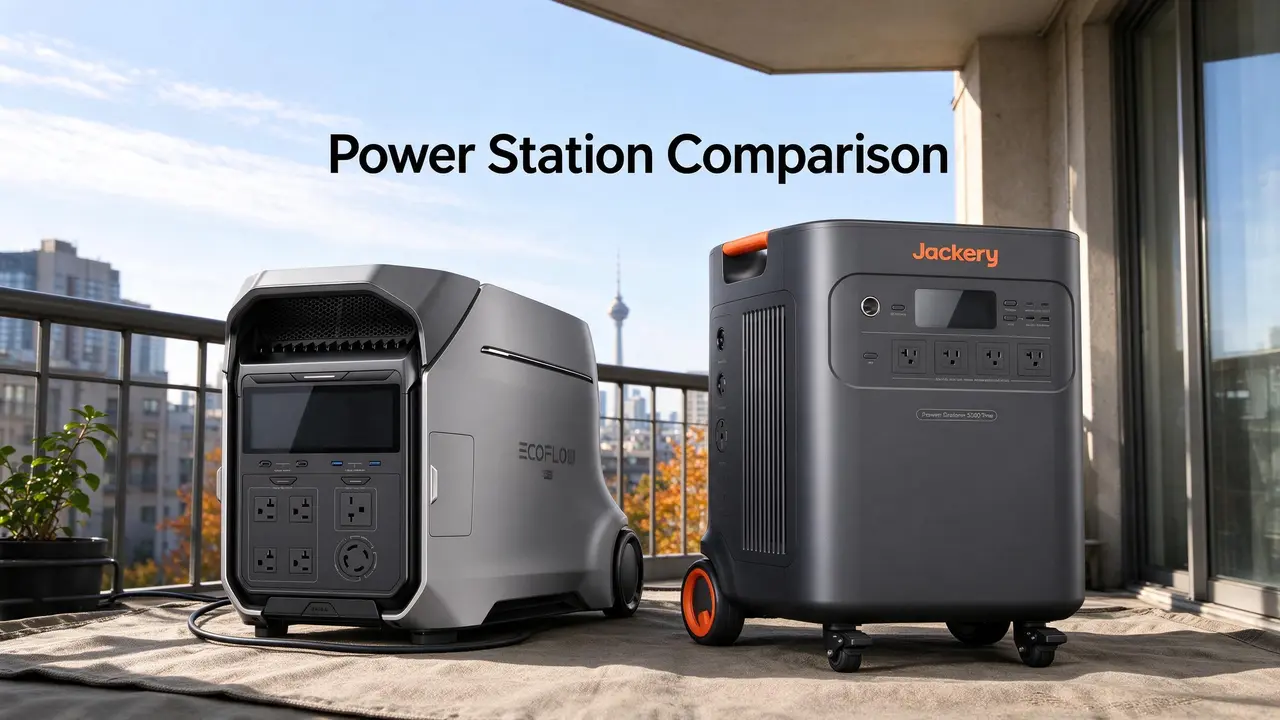
Two 4–5 kWh-class home backup bets at nearly the same list price, and they spend the money very differently. One buys you 4,000 W and a 240V outlet; the other buys you more stored watt-hours per dollar and a cheaper path to a smart transfer switch.
Updated
At a glance
Two 4–5 kWh-class home backup bets at nearly the same list price, and they spend the money very differently. One buys you 4,000 W and a 240V outlet; the other buys you more stored watt-hours per dollar and a cheaper path to a smart transfer switch.
- EcoFlow buys output headroom and 240V; Jackery buys watt-hours per dollar
- Both are LFP, both are heavy, both assume you have somewhere to park them
Same money, different bets
At list price these two land within about $200 of each other — $3,699 for the EcoFlow DELTA Pro 3 Portable Power Station, 4096Wh and $3,499 for the Jackery Explorer 5000 Plus Power Station, 5040Wh. That is close enough that the sticker stops being the deciding factor.
The EcoFlow is betting you care about watts and volts: 4,000 W continuous, a 240V path, and a 10 ms UPS switchover. The Jackery is betting you care about stored energy and cost per watt-hour: 5,040 Wh, 3,600 W, and the cheapest nameplate $/Wh of the pair at $0.69 versus $0.90.
This is a home-backup comparison, not a camping one. Neither unit is something you carry up a flight of stairs for a weekend — at 113.5 lb and 134.5 lb, both want a garage floor or a permanent spot near your panel. If you want a grab-and-go box for tailgates, this page is the wrong shortlist.
- EcoFlow buys output headroom and 240V; Jackery buys watt-hours per dollar
- Both are LFP, both are heavy, both assume you have somewhere to park them
How I weighed these two
My weighting for this comparison: continuous output and 240V capability 30%, stored capacity and nameplate $/Wh 25%, UPS/standby behavior 20%, expandability and ecosystem cost 15%, owner-reported reliability and handling 10%. Every one of those is scored above.
On that weighting the EcoFlow edges ahead for most home-backup buyers because output and clean switchover carry the most weight, and the Jackery's standby drain is a real operational cost. The Jackery wins the capacity and $/Wh category outright and is the better pick if your loads are modest and your priority is stored energy per dollar.
I am a deep-use experience reviewer working from listing specs and owner themes on file; these are home-user checks, not lab-bench measurements. One Amazon Associates disclosure: purchases through links on this page may earn a commission, and picks are fit-led, not commission-led. — Avery Nolan, WattPicks founding editor, portable power capacity and output guidance.
Scoreboard on those weights — EcoFlow DELTA Pro 3 Portable Power Station, 4096Wh (list $3699): High on continuous watts (4,000 W) and 240V output, Med on price; Jackery Explorer 5000 Plus Power Station, 5040Wh (list $3499): High on stored capacity and $/Wh, Med on continuous watts (3,600 W). That is why the pick splits by job rather than one universal winner.
Spec snapshot
Numbers below come from the listings, not from a bench run. Ratings are listing aggregates — useful context, not proof of owner experience.
| Product | List price | Capacity (Wh) | Output (W) | Weight (lb) | Rating |
|---|---|---|---|---|---|
| EcoFlow DELTA Pro 3 Portable Power Station, 4096Wh | $3,699 | 4096 Wh | 4000 W | 113.5 lb | 4.80 |
| Jackery Explorer 5000 Plus Power Station, 5040Wh | $3,499 | 5040 Wh | 3600 W | 134.5 lb | 4.55 |
Where the money went
Four places the budgets diverge, and each one changes how the unit behaves in an outage.
Inverter headroom. EcoFlow puts 4,000 W continuous in the box and pairs it with a 240V outlet — owners describe moving a generator cord into the 30A outlet and carrying the house, well pump included, for the rest of the day. Jackery rates 3,600 W continuous with 120V/240V support and a 14,400 W surge figure from the listing; that surge number is listing-only and not independently verified, so treat it as a marketing ceiling rather than a measured one. The 240V path is there, but you have less continuous headroom before you start shedding loads.
Stored energy. Jackery's 5,040 Wh is roughly 23% more nameplate capacity than EcoFlow's 4,096 Wh, and it costs $200 less. On paper that is the better watt-hour deal, and it is the one place Jackery clearly wins the arithmetic.
Expandability. Both scale, but the paths differ. EcoFlow stacks extra batteries and, per the listing, reaches 48 kWh when you include smart generators; owners note the stack immobilizes the main unit. Jackery's listing claims up to 60 kWh expansion, and owners consistently flag that Jackery-only expansion batteries are expensive — budget for it rather than assuming it.
Ecosystem and switching. EcoFlow's 10 ms UPS pass-through is the standout feature for electronics; one owner pulled the AC cord and the desktop never rebooted. Jackery's route is the 60A Smart Transfer Switch, which the listing says covers up to 12 circuits at 120V or 6 at 240V — but that switch is a separate purchase, so price it before you call the Jackery cheaper.
- EcoFlow: more continuous W, faster UPS handoff, 240V outlet standard
- Jackery: more Wh per dollar, cheaper nameplate $/Wh, transfer switch sold separately
- Both need paid accessories to become a real whole-home install
The spec that decides it
Two numbers matter more than the rest: continuous output and standby behavior.
Continuous output decides what you can run at once. If your outage plan includes a 240V well pump, a central AC, or several motor loads starting together, the EcoFlow's 4,000 W gives you more room before you trip something. The Jackery's 3,600 W is not weak — owners do run well pumps and freezers — but you are closer to the ceiling, and load sequencing matters more.
Standby behavior decides whether the battery is actually there when the grid drops. This is where the Jackery has a documented wrinkle: in UPS mode the unit draws a constant standby load, and one high-helpful owner measured over 30% of charge lost per day, enough to disconnect after a few days without recharging. That is a single-owner report, not a lab measurement, so treat it as a risk to plan around rather than a guaranteed number. Jackery's backup-only mode avoids the drain but adds a multi-second switchover and drops scheduled peak-shaving. The EcoFlow's 10 ms switchover is the cleaner UPS story, with the caveat that charge-rate control in pass-through is not always precise — one owner tripped a fused truck outlet when input ramped to the source's limit.
Match your loads
A quick check of which unit clears common outage loads on continuous output. These are typical load ranges, not measurements of these specific units — check your appliance nameplate before you buy.
- EcoFlow: strong outage results; heavy; app friction; warranty shipping risk
- Jackery: quiet and capable; standby drain; firmware quirks; cold-charge limit
| Load | Typical running draw | EcoFlow DELTA Pro 3 (4,000 W) | Jackery Explorer 5000 Plus (3,600 W) |
|---|---|---|---|
| Well pump (240V) | 1,000–2,000 W running, higher surge | Clears with headroom | Clears; watch surge and sequencing |
| Refrigerator / freezer | 100–800 W cycling | Clears easily | Clears easily |
| Furnace blower (gas heat) | 300–800 W | Clears | Clears |
| Central AC | 3,000–5,000 W running | Clears smaller units; larger units may exceed 4,000 W | Likely exceeds 3,600 W; plan to skip or add soft-start |
Real owner trade-offs
Themes from owner reviews, paraphrased — not lab measurements, and not a substitute for your own load math. Where a figure comes from a single owner, I say so.
EcoFlow owners praise the outage performance and the UPS handoff, then complain about the same two things: weight and software. At 113.5 lb it is a two-person lift into a truck, and the app is effectively mandatory for capping charge rate. A high-helpful failure report describes a locked BMS (Error 71) and a warranty return bogged down by hazardous-material shipping rules — a logistics risk worth knowing if this is your only backup.
Jackery owners describe solid build, quiet operation (one owner welds from it indoors), and whole-home runs during rural outages. The counterweight is software maturity: error codes even under light loads until firmware updates, a basic app that updates slowly, no recharging below freezing, and expensive expansion. Jackery's listing aggregate sits at 4.4 from 61 ratings — thin enough that I would treat it as a signal, not a verdict.
- EcoFlow: strong outage results; heavy; app friction; warranty shipping risk
- Jackery: quiet and capable; standby drain; firmware quirks; cold-charge limit
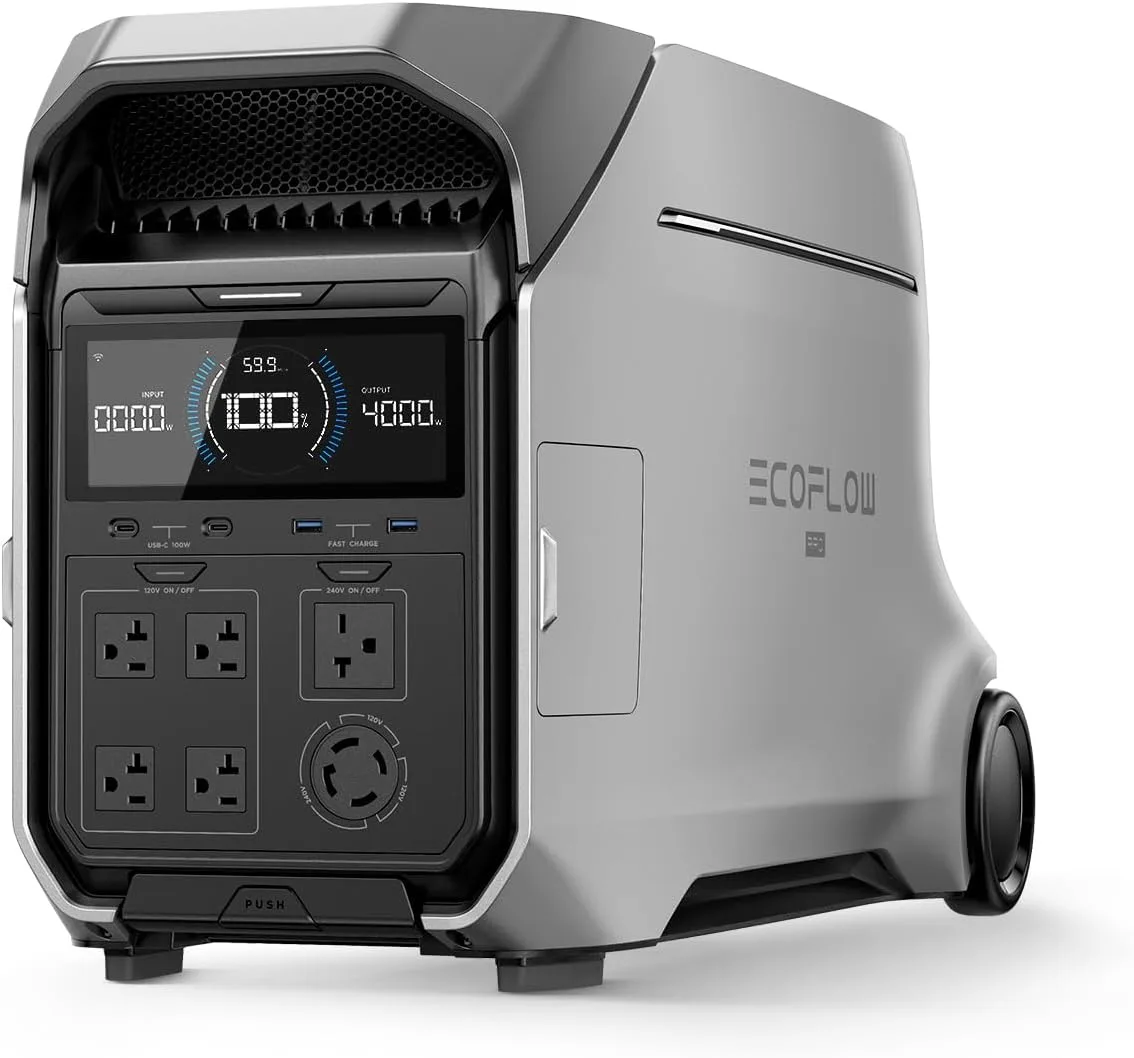
EcoFlow DELTA Pro 3 Portable Power Station, 4096Wh
Highlights
- 4096Wh rated capacity
- 4000W continuous AC
- 8000W surge
- LiFePO4 chemistry
- Up to 2600W solar input
- 113.5 lb (~51.5 kg)
Best for
- DELTA Pro 3: longer outages or higher continuous loads (still not whole-home wiring)
- RV / off-grid days where recharge speed matters as much as Wh
- Best parked near the vehicle or cabin — not a long carry to a tent
Strengths
- DELTA Pro 3: 4096Wh pack with 4000W continuous / 8000W surge — size loads to both numbers
- 113.5 lb (~51.5 kg) is a park-and-use chassis — plan a short path, not a trail hike
- 10ms-class UPS switchover on the listing — useful when a router restart would hurt
- About $3699 list in the Hub catalog — confirm live retail before you buy
Watch-outs · not ideal when
- At 113.5 lb (~51.5 kg), DELTA Pro 3 is a poor tent-hike companion — plan a cart or leave it in the vehicle
- High continuous output on DELTA Pro 3 tempts big loads — Wh still runs out on kettles and A/C
- Rated 2600W solar on DELTA Pro 3 is optimistic; shade and cables cut real watts
- LiFePO4 helps longevity, but DELTA Pro 3 still hates freezing charge temps on winter trips
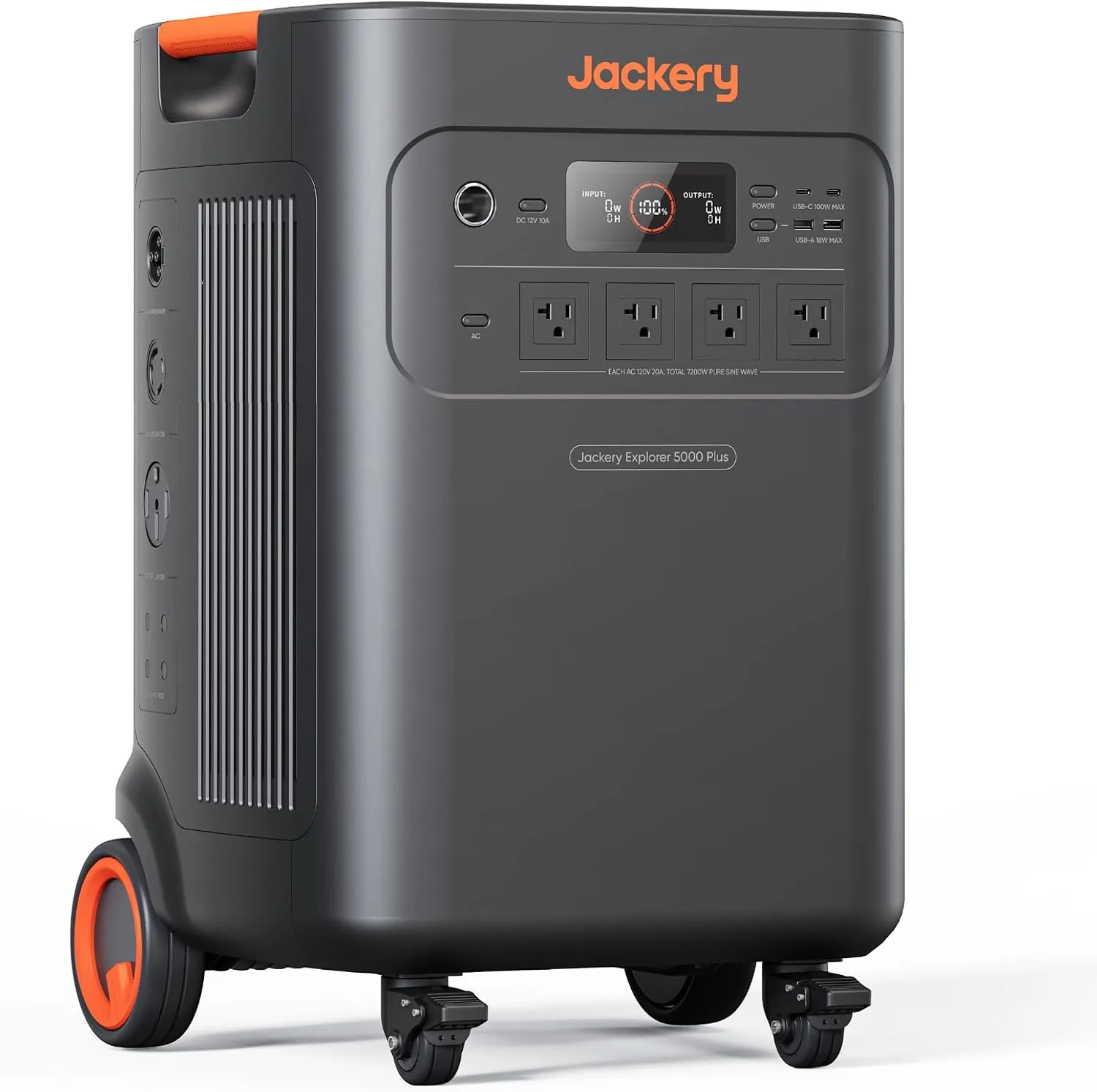
Jackery Explorer 5000 Plus Power Station, 5040Wh
Highlights
- 5040Wh rated capacity
- 3600W continuous AC
- LiFePO4 chemistry
- Up to 4000W solar input
- 134.5 lb (~61.0 kg)
- About $3499 list
Best for
- Explorer 5000 Plus: longer outages or higher continuous loads (still not whole-home wiring)
- RV / off-grid days where recharge speed matters as much as Wh
- Best parked near the vehicle or cabin — not a long carry to a tent
Strengths
- Explorer 5000 Plus: 3600W continuous on a 5040Wh pack — more headroom for small appliances than 1kW-class peers
- 134.5 lb (~61.0 kg) is a park-and-use chassis — plan a short path, not a trail hike
- 3600W continuous headroom covers more small appliances than 1kW-class inverters
- Owners on file: 3/5 · 129 helpful — I bought this battery and a smart transfer switch to backup my house. The battery, when n…
Watch-outs · not ideal when
- At 134.5 lb (~61.0 kg), Explorer 5000 Plus is a poor tent-hike companion — plan a cart or leave it in the vehicle
- High continuous output on Explorer 5000 Plus tempts big loads — Wh still runs out on kettles and A/C
- Rated 4000W solar on Explorer 5000 Plus is optimistic; shade and cables cut real watts
- LiFePO4 helps longevity, but Explorer 5000 Plus still hates freezing charge temps on winter trips
Owner voices
Short takes from public retail reviews — paraphrased or translated when long or non-English; meaning kept close to the original.
“3/5 · 129 helpful — I bought this battery and a smart transfer switch to backup my house. The battery, when not in use, loses over 30% of its charge per day. This means if I don’t constantly recharge it, it will die a…”
“5/5 · 95 helpful — I have owned 2 Jackery units for five years now. I own a Jackery 250, Jackery 1000. Both have been very reliable, I’ve had no issues with either unit in over 5 years! I recently purchased Solar Gene…”
“4/5 · 44 helpful — Firmware updated, so far issues haven’t returned. Still waiting to connect directly, I can’t afford to have my cortical systems go down. I travel & a shirt down will be extremely detrimental. I’ll u…”
Buy the one that…
Buy the EcoFlow DELTA Pro 3 Portable Power Station, 4096Wh if you need 4,000 W of continuous headroom, a 240V outlet for a well pump or AC, and a UPS handoff fast enough that your desktop and NAS ride through a blackout. It is the better bet when output and clean switching matter more than squeezing watt-hours per dollar.
Buy the Jackery Explorer 5000 Plus Power Station, 5040Wh if you want the most stored energy for the money, plan to pair it with the 60A Smart Transfer Switch for circuit-level backup, and can keep it on a charge schedule so UPS-mode drain never bites you. It is the cheaper watt-hour and the quieter neighbor.
Walk away from both if any of these describe you:
Renters or anyone who cannot modify the panel — both need an electrician-installed transfer switch or smart panel to back up circuits.
Apartment dwellers without a garage or dedicated floor space — 113.5 lb and 134.5 lb are not moving between rooms.
Budgets that cannot absorb the transfer switch, smart panel, or expansion batteries on top of the unit price.
Cold-climate users who need to charge below freezing — the Jackery listing notes no recharging below freezing, and neither is a cold-weather solution without a heated space.
Before you buy, ask EcoFlow and Jackery support two things in writing: the exact warranty return process for a 100-plus-pound lithium unit (who pays freight, and whether hazardous-material shipping applies), and the confirmed continuous and surge ratings for your specific load plan. Neither is a plug-in-and-forget appliance.
Frequently asked
Can either run a 240V well pump?
Yes — EcoFlow owners describe exactly that through the 30A outlet, and Jackery owners report running a 240V well pump alongside a fridge and freezer. EcoFlow gives you more continuous headroom (4,000 W vs 3,600 W) before you need to sequence loads.
How long will each last in an outage?
That depends entirely on your load. At a steady 500 W draw, the EcoFlow's 4,096 Wh is about 8 hours and the Jackery's 5,040 Wh is about 10 hours on nameplate math — real runtime is shorter once inverter losses and standby draw are counted.
Do I need extra hardware for whole-home backup?
Yes. EcoFlow's smart panel and Jackery's 60A Smart Transfer Switch are separate purchases, and both need an electrician.
Can either charge in cold weather?
The Jackery listing notes no recharging below freezing, so plan to keep it in a heated space or accept a charging gap in winter. Check EcoFlow's published charging temperature range for the DELTA Pro 3 before relying on it in an unheated garage.
Which is easier to live with day to day?
The Jackery is quieter and slightly cheaper per watt-hour; the EcoFlow is heavier but has the faster UPS switchover and more output. Neither app gets glowing reviews.
Method and sources
Model names and list prices come from the WattPicks catalog at build time. WattPicks does not run its own laboratory tests on power stations, and nothing on this page is presented as a measured result — it is catalog-backed buying guidance.
Read our methodology for how the catalog is normalized, and about WattPicks for who publishes it.