
DJI Power 1000 V2 vs EcoFlow DELTA 3 Plus: Backup Pick
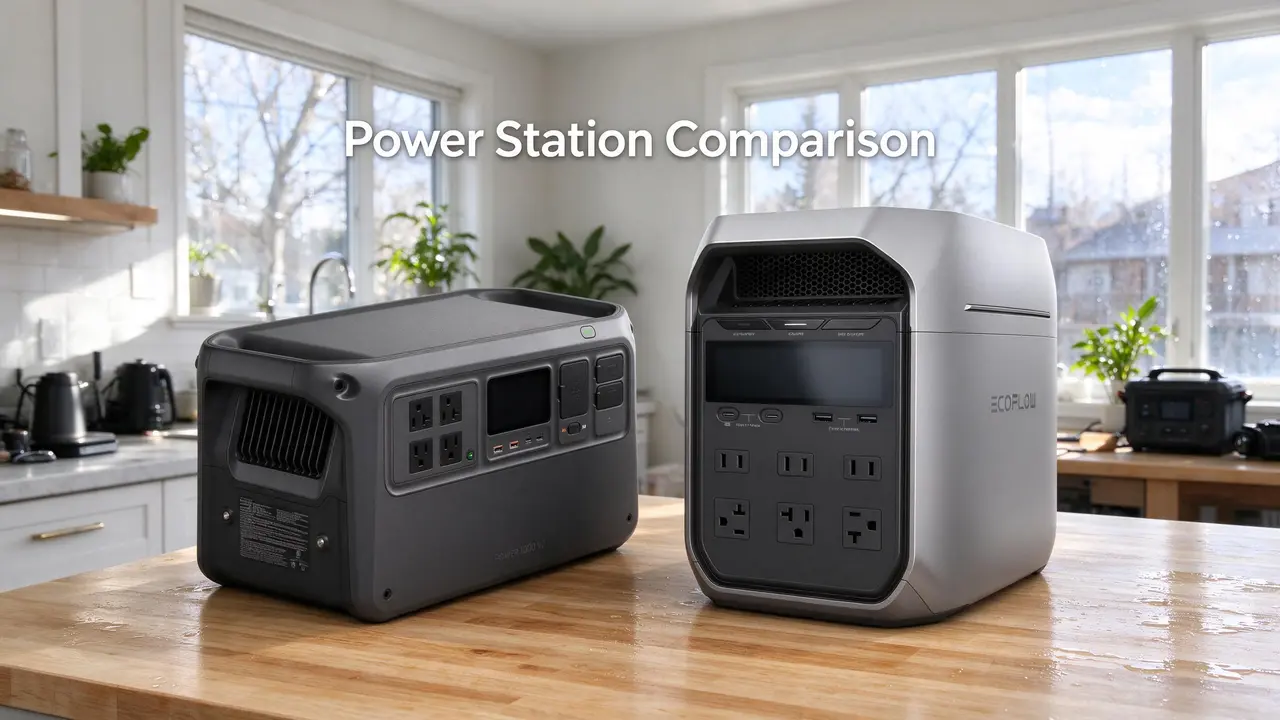
Two 1,024 Wh stations with different strengths: DJI on fast charging and drone-ecosystem ports, EcoFlow on 1,800 W output and expandable LFP capacity. The EcoFlow's current price isn't on file, so we compare on fit, not sticker.
Updated
At a glance
Two 1,024 Wh stations with different strengths: DJI on fast charging and drone-ecosystem ports, EcoFlow on 1,800 W output and expandable LFP capacity. The EcoFlow's current price isn't on file, so we compare on fit, not sticker.
Price uncertainty, different bets
Both of these are 1,024 Wh LiFePO4 stations, and that's where the similarity mostly ends. The DJI Power 1000 V2 is a $699 bet that you want fast AC charging, a quiet box, and a UPS that keeps a router and a CPAP alive through a winter storm. The EcoFlow DELTA 3 Plus is a bet that you'd rather have 1,800 W of continuous output, six AC outlets, and a path to expand past 1 kWh later.
The price comparison is awkward on paper: DJI lists at $699, while EcoFlow's list price is n/a (not on file) — its historical low sits at $899, so treat that as context, not a current sticker. If the two land within a couple hundred dollars of each other at checkout, the question stops being "which is cheaper" and becomes "which load do you actually need to run."
This is a home-backup and camping comparison, not a whole-home generator shootout. Neither unit carries a furnace, a well pump, and a fridge at once for days — if that's the job, you're shopping the wrong class.
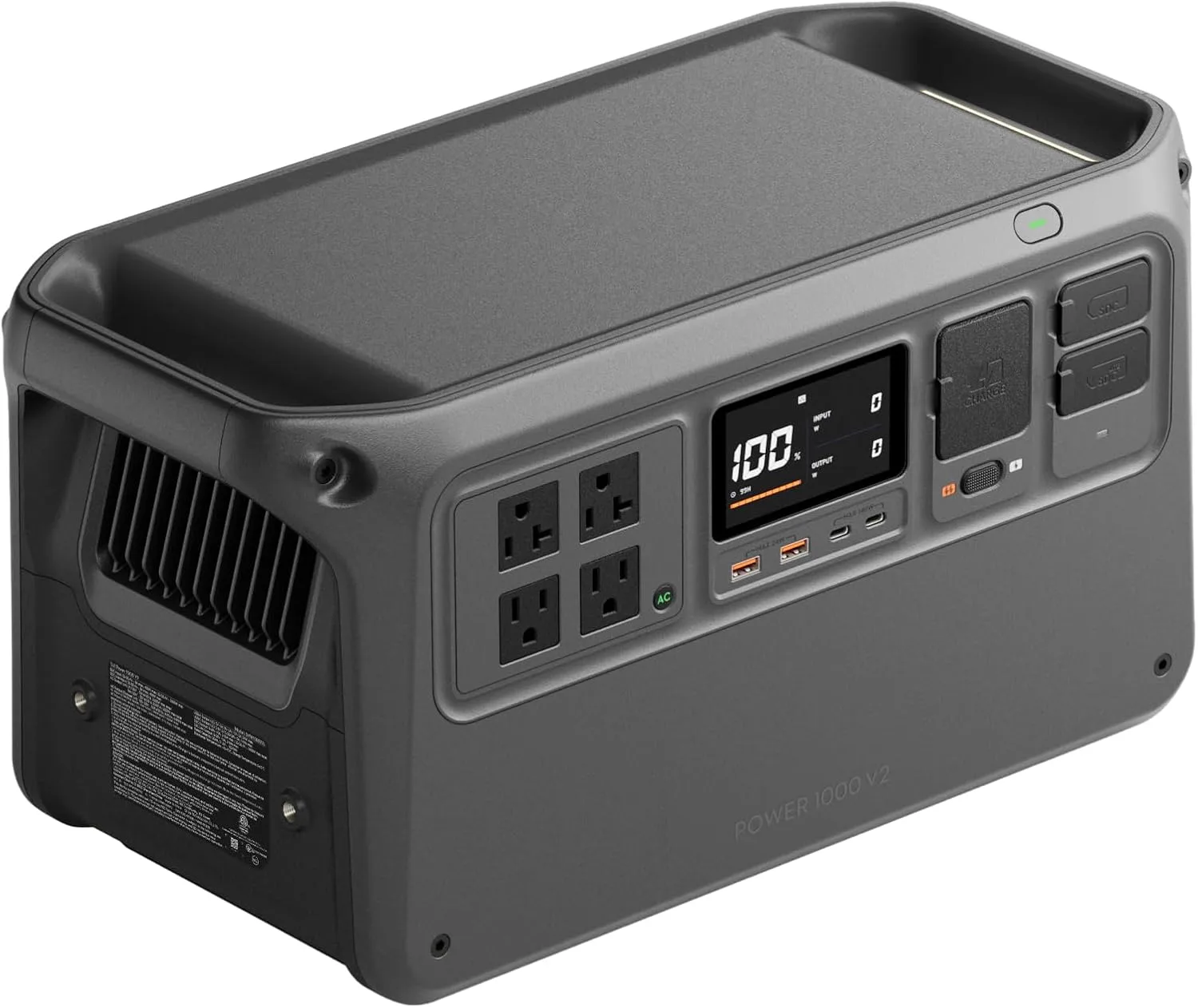
DJI DJI Power 1000 V2
Highlights
- 1024Wh rated capacity
- 1000W continuous AC
- LiFePO4 chemistry
- 31.3 lb (~14.2 kg)
- About $699 list
Best for
- DJI Power 1000 V2: UPS-style bridge for router/desktop through brief outages (10ms class on listing)
- Park-and-use indoor electronics backup at 31.3 lb — not a long hike companion
- Warranty-first buyers who accept accessory-dependent solar/car charging
Strengths
- DJI Power 1000 V2: 1024Wh / 1000W continuous — treat as electronics and light loads, not a tool inverter
- 31.3 lb (~14.2 kg) is a park-and-use chassis — plan a short path, not a trail hike
- DJI Power 1000 V2 uses LiFePO4 — cycle-life claims usually beat older NMC marketing lines
- About $699 list in the Hub catalog — confirm live retail before you buy
Watch-outs · not ideal when
- 31.3 lb (~14.2 kg) is a two-hand lift; skip it if you walk more than a short path to camp
- Usable energy on DJI Power 1000 V2 is below the 1024Wh label once the inverter is working
- DJI Power 1000 V2: solar/car charging is accessory-dependent on the listing — not a built-in published input ceiling
- LiFePO4 helps longevity, but DJI Power 1000 V2 still hates freezing charge temps on winter trips
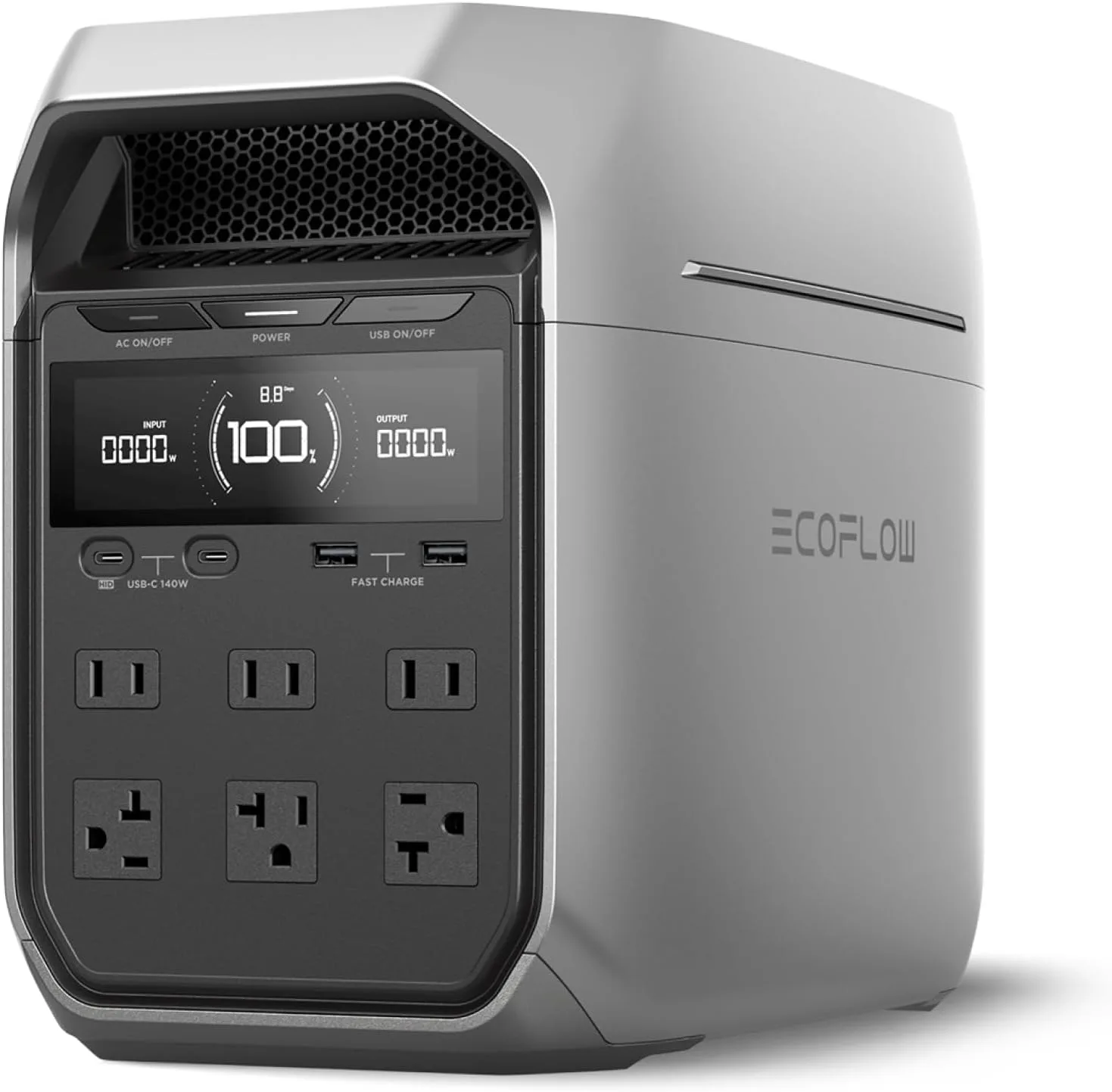
EcoFlow DELTA 3 Plus
Highlights
- 1024Wh rated capacity
- 1800W continuous AC
- 3600W surge
- LiFePO4 chemistry
- Up to 1000W solar input
- 27.6 lb (~12.5 kg)
Best for
- DELTA 3 Plus: small appliances and tools that need ~1800W continuous, not just phone charging
- Essentials bridge at home (fridge cycles, router) when sized to the Wh
- Solar top-ups up to ~1000W when panels and weather cooperate
Strengths
- DELTA 3 Plus: 1024Wh pack with 1800W continuous / 3600W surge — size loads to both numbers
- 27.6 lb (~12.5 kg) sits in the solo car-camp carry carry band for weekend moves
- 10ms-class UPS switchover on the listing — useful when a router restart would hurt
Watch-outs · not ideal when
- DELTA 3 Plus is still a bridge for essentials — not a transfer-switch whole-home system
- Usable energy on DELTA 3 Plus is below the 1024Wh label once the inverter is working
- Rated 1000W solar on DELTA 3 Plus is optimistic; shade and cables cut real watts
- LiFePO4 helps longevity, but DELTA 3 Plus still hates freezing charge temps on winter trips
Methodology
I'm Avery Nolan, WattPicks founding editor — portable power station capacity, output, and price-per-Wh guidance across the catalogue, no lab claims. This comparison is built from listing specs and owner themes on file, not lab-bench measurements.
Weights: continuous output 30% (it decides which loads are even possible), solar and expansion 25% (it decides multi-day viability), UPS and app behavior 20% (it decides outage usefulness), weight and portability 15% (it decides whether you actually move it), owner themes 10% (it decides whether the spec sheet holds up in the field).
Why the EcoFlow edges it: it wins on output (1,800 W vs 1,000 W) and solar (built-in dual MPPT vs adapter required), which together carry 55% of the weight. The DJI wins on app monitoring and a slightly clearer CPAP track record, but those don't outweigh the output and solar gaps for most outage buyers. The DJI's $699 list price is the counterweight — if the EcoFlow lands meaningfully higher at checkout, the DJI becomes the better value for lighter loads.
One Amazon Associates disclosure: picks here are fit-led, not commission-led. Because the EcoFlow's current price isn't on file, the pick could flip on checkout price — if the DELTA 3 Plus lists above $899, the DJI's $699 becomes the better value for lighter loads.
Scoreboard on those weights — DJI Power 1000 V2 (list $699): High where list price and published capacity match the job, Med on continuous watts; EcoFlow DELTA 3 Plus (list $n/a): High on continuous watts and ports, Med on price. That is why the pick splits by job rather than one universal winner.
Spec snapshot
Numbers below are from the listings; where a figure isn't published, it's marked n/a rather than guessed. Weight is in pounds, capacity in Wh, output in continuous watts.
| Product | List price | Capacity (Wh) | Output (W) | Weight (lb) | Rating |
|---|---|---|---|---|---|
| DJI Power 1000 V2 | $699 | 1024 Wh | 1000 W | 31.3 lb | 4.40 |
| EcoFlow DELTA 3 Plus | $649 | 1024 Wh | 1800 W | 27.6 lb | 4.80 |
Where the configuration differs
Four configuration differences do most of the separating here, and they map to different buyers.
Output headroom. The DELTA 3 Plus runs 1,800 W continuous against the DJI's 1,000 W. That's the difference between a space heater or a microwave on high and a hard no — one EcoFlow owner ran a space heater on high without complaint, and the listing notes X-Boost for resistive loads above 2,200 W. The DJI's 1,000 W is fine for a fridge, a router stack, a CPAP, or a 12V camping fridge, but it will trip on a full-size kettle or a shop vac.
Ports. EcoFlow gives you AC×6, USB-C×2, USB-A×2, and a 12V car socket. DJI gives AC×4, USB-C (yes, dual 140 W per the listing), and USB-A×2 — no car socket on the lock. If you're running a 12V fridge in a van, that car port on the EcoFlow is a real convenience; on the DJI you'd be reaching for an adapter.
Solar and expansion. EcoFlow's dual MPPT inputs accept up to 1,000 W of solar and the DELTA 3 line expands with EcoFlow battery packs up to roughly 5 kWh. DJI's listing is explicit that MPPT and car charging modules are not built in — you need a separate compatible adapter to use solar at all, and one owner spent about $80 on cables and a mod to make it work. If solar refill is part of your plan, EcoFlow is the plug-and-play path.
UPS behavior. Both claim a 10 ms switchover, and both owners describe using them as UPS units for networking gear. The DJI's edge is the DJI Home app for remote monitoring and on-the-fly settings; the EcoFlow's edge is that owners report it holding a small business rack for 8+ hours on a single charge.
The spec that decides it
If I had to pick one number, it's continuous output: 1,800 W vs 1,000 W. That single gap decides more buyers than capacity, weight, or app quality, because it's the line between "runs my fridge and router" and "runs my fridge, router, and a space heater during a cold-weather outage."
The second deciding spec is solar readiness. EcoFlow's built-in dual MPPT is a genuine differentiator for anyone planning to refill from panels; DJI's listing says the solar module isn't built in, so budget for the adapter and cables before you count on solar. If you're grid-only, this gap doesn't matter — if you're off-grid or prepping for multi-day outages, it's the whole ballgame.
For the van and camping buyer, weight and 12V behavior matter more than outage specs: the EcoFlow is lighter at 27.6 lb vs 31.3 lb, but its 12V output auto-shuts off after a couple hours unless you change the setting — a trap for a portable fridge. The DJI has no car socket, so you'd need an adapter, but it avoids that auto-off quirk.
Real owner trade-offs
The DJI's owner notes are a mix of genuine praise and one cautionary tale. On the good side, owners describe it holding networking gear as a UPS through winter storms, running high-inrush tools and an electric rope winch on job sites, and carrying a CPAP without the humidifier for several nights off-grid. On the cautionary side, one high-helpful owner received a unit configured for a 50 Hz region that threw an error code mid-charge and stopped charging — a gray-market issue that took a DJI return-and-replace cycle to resolve. Another high-helpful review describes a unit dying at ~85% with a weeks-long support loop and no repair case; that reads as isolated, but it's the kind of failure worth knowing about before you rely on one for a trip.
The EcoFlow's owner notes skew toward UPS and outage duty. One owner kept a small business rack online for 8+ hours through the 10 ms switchover and refilled from house panels via the dual MPPT inputs. Another ran a refrigerator for 2.5 hours during a real outage and dropped only from 100% to 82% — better than they expected. The recurring caveats are idle drain (one owner estimated ~15 W with AC off and ~45 W with AC on, enough to go dead after a few days sitting) and the 12V output auto-shutting off after a couple hours unless you change the setting — one owner nearly lost a portable fridge's contents. A separate owner notes that always charging at the full 1,500 W trades battery lifespan for speed and charges at 500 W instead, which takes about 3 hours.
Both listing aggregates are healthy — DJI at 4.4 across 807 ratings, EcoFlow at 4.7 across 721 — but treat those as listing aggregates, not proof. The owner themes above are the more useful signal.
Buy the one that…
Buy the DJI Power 1000 V2 if you want a quiet, fast-charging 1,024 Wh box for UPS duty on networking gear, CPAP off-grid, a 12V camping fridge, or job-site tools that need high inrush — and you're willing to check the seller carefully to avoid a gray-market unit and to buy the solar adapter separately if you ever add panels. Skip it if you need more than 1,000 W continuous, want solar without extra cables, or expect it to carry a house.
Buy the EcoFlow DELTA 3 Plus if your outage plan includes a space heater, a microwave, or a small rack, and you want built-in dual MPPT solar and a path to expand past 1 kWh. Skip it if you need it to sit for weeks without a top-up (the idle drain will bite), if you want zero-fuss 12V fridge power (the auto-off setting is a trap), or if you're not willing to match panels to the VOC spec.
Neither is a whole-home solution. If your outage plan needs a furnace, a well pump, and a fridge running for days, you're shopping transfer switches and a larger class of station — not these two.
Frequently asked
Can the DJI Power 1000 V2 run a space heater?
On paper, no — its 1,000 W continuous output is below what most space heaters draw on high. The DELTA 3 Plus at 1,800 W is the one that owners report running a space heater on high without complaint.
Do I need extra cables to use solar with the DJI?
Yes, per the listing — MPPT and car charging modules are not built in, and one owner spent about $80 on cables and a mod. The EcoFlow's dual MPPT inputs are built in, though you'll still need to match panels to the VOC spec per input.
How long will either run a refrigerator during an outage?
One EcoFlow owner reported 2.5 hours on a fridge for an 18% drop, which implies roughly 12+ hours to 10% at that load — better than the listing suggests. DJI owners describe running a 12V camping fridge without issue but don't give a comparable runtime figure, so treat that as n/a (not on file).
Which is better for a CPAP?
DJI owners specifically describe carrying a CPAP without the humidifier for several nights off-grid. EcoFlow owners describe UPS duty for networking gear more than CPAP use, so the DJI has the clearer owner track record for that specific load.
Method and sources
Model names and list prices come from the WattPicks catalog at build time. WattPicks does not run its own laboratory tests on power stations, and nothing on this page is presented as a measured result — it is catalog-backed buying guidance.
Read our methodology for how the catalog is normalized, and about WattPicks for who publishes it.