
Anker SOLIX C2000 Gen 2 vs EcoFlow DELTA 3 Max Plus
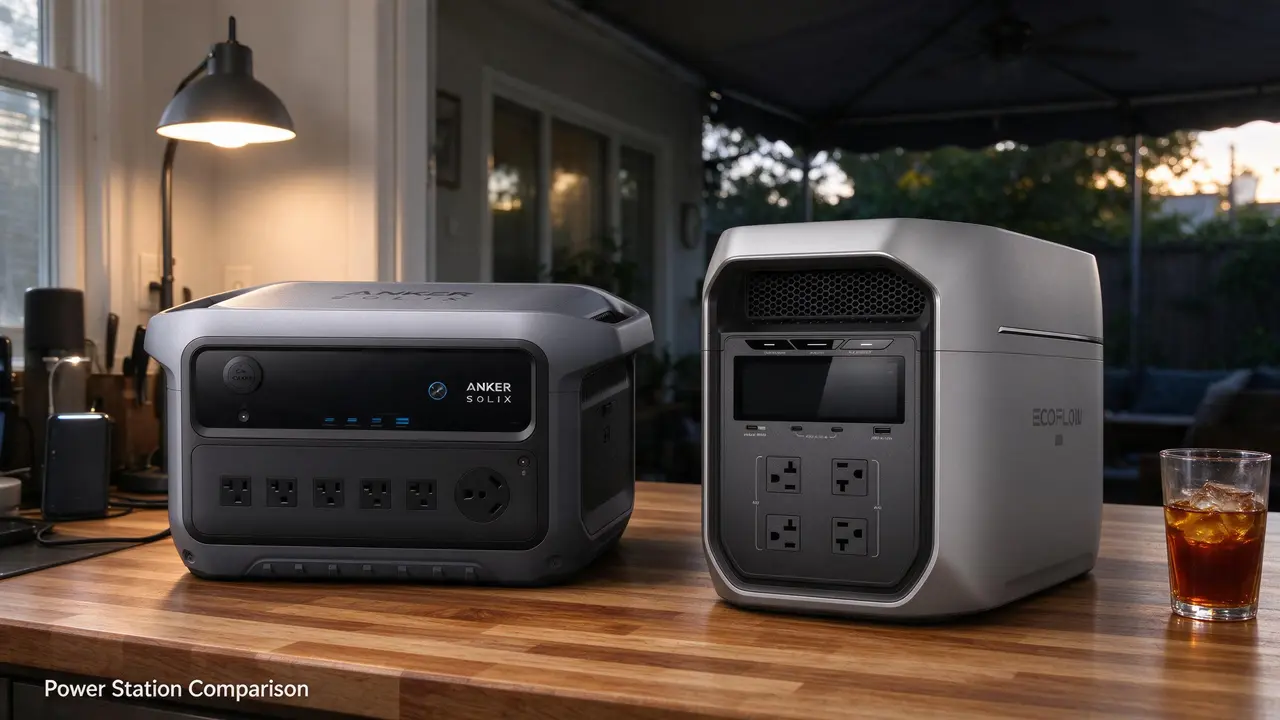
Two 2,048 Wh stations, $400 apart, betting on different things: the Anker on price-per-Wh and light weight, the EcoFlow on continuous output and expandability. Here's which backup bet fits your outage.
Updated
At a glance
Two 2,048 Wh stations, $400 apart, betting on different things: the Anker on price-per-Wh and light weight, the EcoFlow on continuous output and expandability. Here's which backup bet fits your outage.
Two 2,048 Wh bets, $400 apart
You are standing in a blackout with a fridge that needs to keep running and a budget that tops out around $1,500–$1,900. Both of these stations hold 2,048 Wh, so the raw energy is a wash. The bet each maker placed is not.
The Anker C2000 Gen 2 Portable Power Station, 2,048Wh puts its money into price-per-Wh and portability: $1,499 list, 41.7 lb, 2,400 W continuous. The EcoFlow DELTA 3 Max Plus spends on headroom and growth: $1,899 list, 48.7 lb, 3,000 W continuous, and a battery-expansion path. One is the cheaper, lighter workhorse; the other is the higher-output platform you can grow.
This is a home-backup and outage comparison, not a camping-first shootout and not a whole-home transfer-switch install guide. If you need to run a 240V well pump or a central AC, neither of these is the answer — look at a standby generator or a smart-panel setup instead.
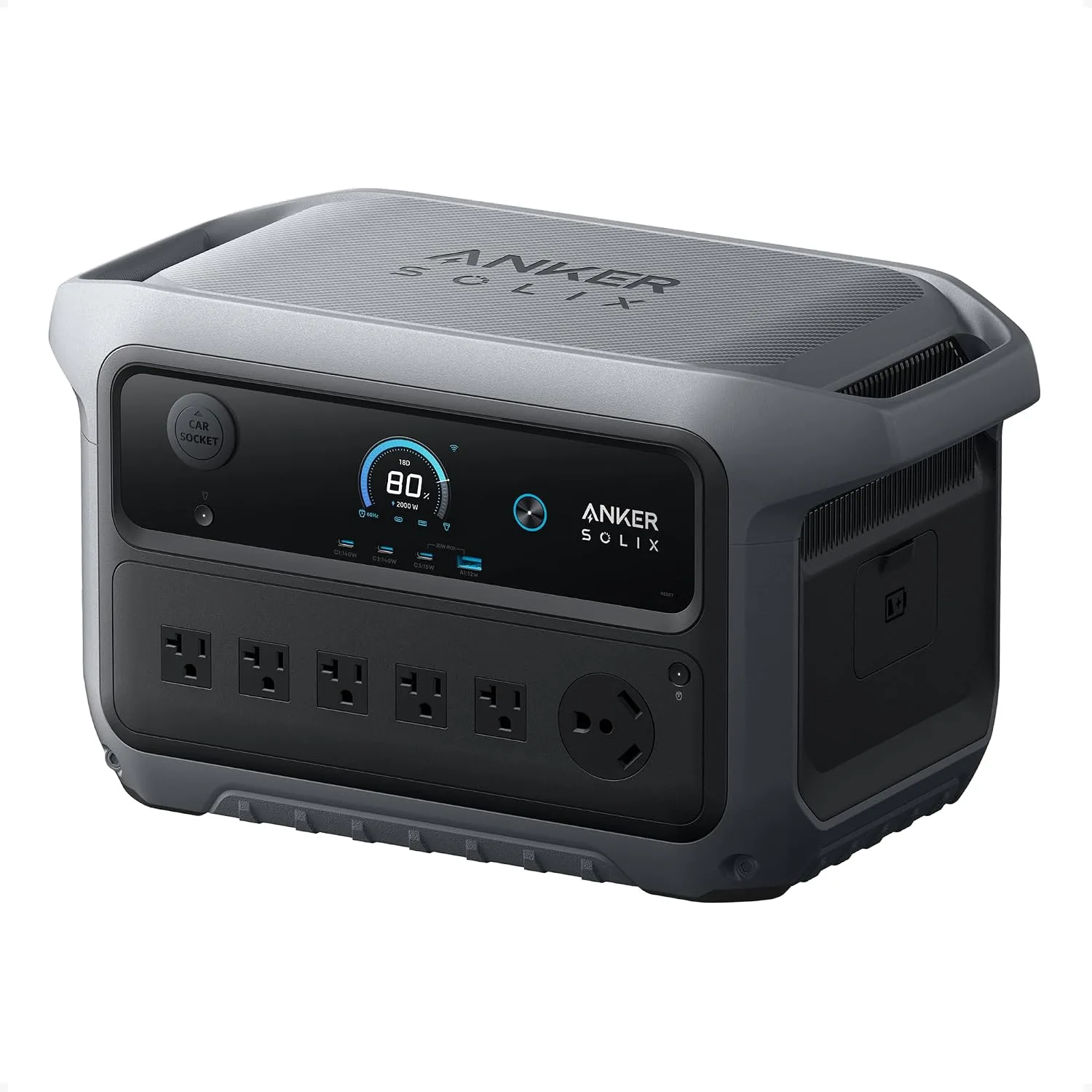
Anker C2000 Gen 2 Portable Power Station, 2,048Wh
Highlights
- 2048Wh rated capacity
- 2400W continuous AC
- 4000W surge
- LiFePO4 chemistry
- Up to 800W solar input
- 41.7 lb (~18.9 kg)
Best for
- C2000 Gen 2: longer outages or higher continuous loads (still not whole-home wiring)
- RV / off-grid days where recharge speed matters as much as Wh
- Best parked near the vehicle or cabin — not a long carry to a tent
Strengths
- C2000 Gen 2: 2048Wh pack with 2400W continuous / 4000W surge — size loads to both numbers
- 41.7 lb (~18.9 kg) is a park-and-use chassis — plan a short path, not a trail hike
- 2400W continuous headroom covers more small appliances than 1kW-class inverters
- About $999.99 list in the Hub catalog — confirm live retail before you buy
Watch-outs · not ideal when
- At 41.7 lb (~18.9 kg), C2000 Gen 2 is a poor tent-hike companion — plan a cart or leave it in the vehicle
- High continuous output on C2000 Gen 2 tempts big loads — Wh still runs out on kettles and A/C
- Rated 800W solar on C2000 Gen 2 is optimistic; shade and cables cut real watts
- LiFePO4 helps longevity, but C2000 Gen 2 still hates freezing charge temps on winter trips
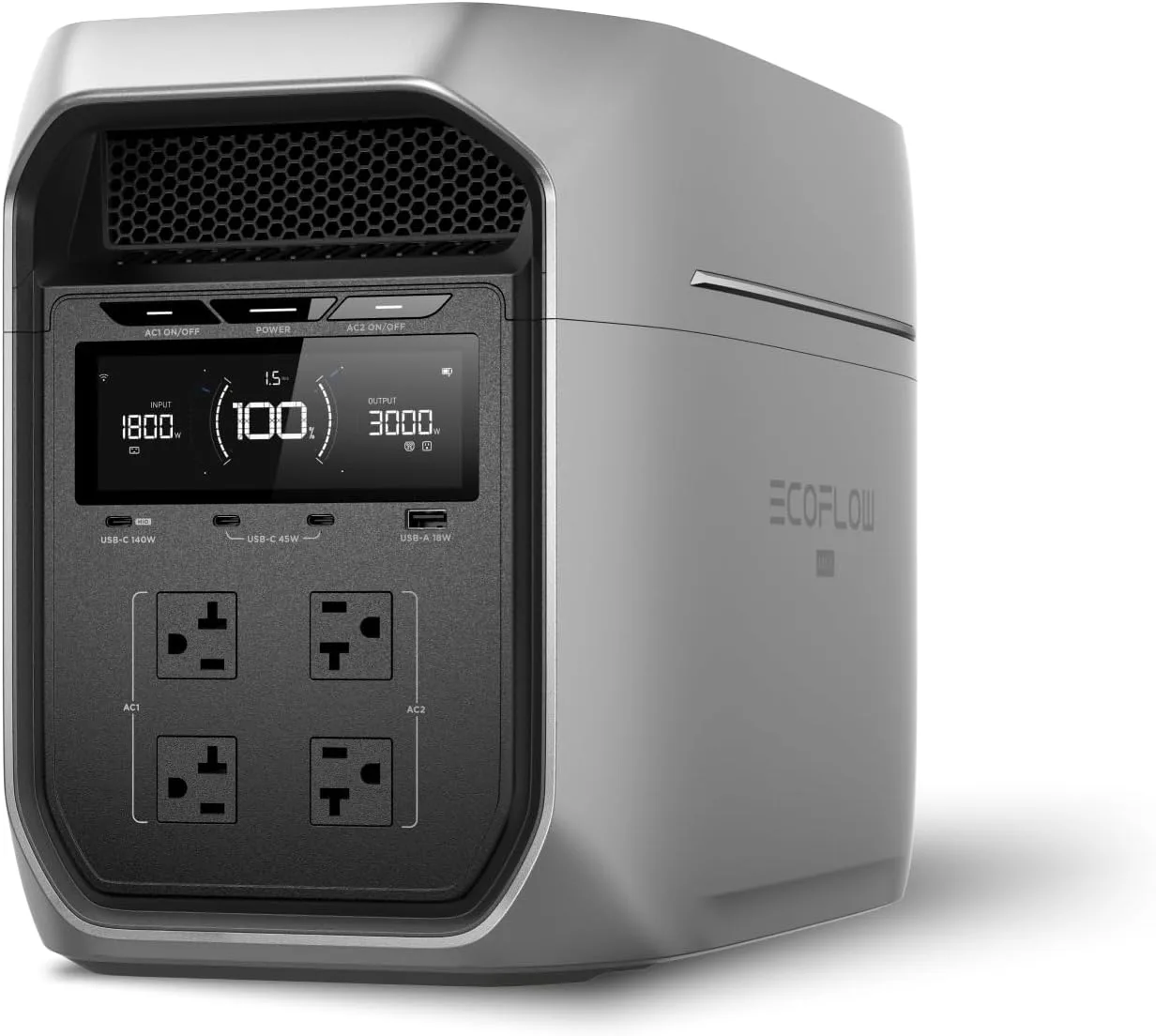
EcoFlow DELTA 3 Max Plus
Highlights
- 2048Wh rated capacity
- 3000W continuous AC
- 6000W surge
- LiFePO4 chemistry
- 48.7 lb (~22.1 kg)
- About $1899 list
Best for
- DELTA 3 Max Plus: longer outages or higher continuous loads (still not whole-home wiring)
- RV / off-grid days where recharge speed matters as much as Wh
- Best parked near the vehicle or cabin — not a long carry to a tent
Strengths
- DELTA 3 Max Plus: 2048Wh pack with 3000W continuous / 6000W surge — size loads to both numbers
- 48.7 lb (~22.1 kg) is a park-and-use chassis — plan a short path, not a trail hike
- 3000W continuous headroom covers more small appliances than 1kW-class inverters
- Owners on file: 5/5 · 6 helpful — I waited a while to leave this review. I bought this power station for one reason which was…
Watch-outs · not ideal when
- At 48.7 lb (~22.1 kg), DELTA 3 Max Plus is a poor tent-hike companion — plan a cart or leave it in the vehicle
- High continuous output on DELTA 3 Max Plus tempts big loads — Wh still runs out on kettles and A/C
- Solar input unpublished for DELTA 3 Max Plus — do not assume a same-day off-grid refill
- LiFePO4 helps longevity, but DELTA 3 Max Plus still hates freezing charge temps on winter trips
How I weighed these two
I'm Avery Nolan, founding editor at WattPicks, covering portable power capacity, output, and price-per-Wh across the catalogue. My checks here are home-user reads grounded in owner themes on file plus the listing specs — not lab-bench measurements, and I don't claim any.
The weighting for this head-to-head: continuous output 30%, price-per-Wh 25%, portability/weight 20%, expandability 15%, owner themes 10%. On that mix the Anker edges ahead for a typical fridge-and-devices outage because it wins price-per-Wh and weight while tying on capacity; the EcoFlow takes the lead the moment your load list includes a heater or a bigger AC start, where its 3,000 W and expansion path outweigh the $400 premium. That is why the pick splits by job rather than one universal winner.
As an Amazon Associate I earn from qualifying purchases. Picks here are fit-led, not commission-led — the cheaper unit wins on value, and I said so.
Spec snapshot
Everything below is from the listings. Prices are list prices, not sale stickers — both units have run cheaper, and I note that separately. Weight is in pounds; capacity in Wh; output is continuous AC watts.
| Product | List price | Capacity (Wh) | Output (W) | Weight (lb) | Rating |
|---|---|---|---|---|---|
| Anker C2000 Gen 2 Portable Power Station, 2,048Wh | $999.99 | 2048 Wh | 2400 W | 41.7 lb | 4.91 |
| EcoFlow DELTA 3 Max Plus | $1,899 | 2048 Wh | 3000 W | 48.7 lb | 5.00 |
Where the money went
Four configuration differences actually move the decision here, and they don't all point the same way.
Price-per-Wh. On nameplate math the Anker is $0.73/Wh against the EcoFlow's $0.93/Wh — the Anker is the cheaper energy of the two, and that's the one place I'll call a clear win. The EcoFlow's extra $400 buys output and expansion, not more watt-hours.
Continuous output. The EcoFlow's 3,000 W against the Anker's 2,400 W is the real gap. That 600 W is the difference between running a space heater plus a fridge and having to choose. If your outage plan includes a resistive heater or a big microwave alongside refrigeration, the EcoFlow's ceiling matters.
Expandability. The EcoFlow takes extra batteries to grow capacity well past the base 2,048 Wh; the Anker also lists an expansion battery to roughly double capacity, so both scale — but the EcoFlow's published path is the more aggressive one. Treat expansion as a paid add-on either way, not something in the box.
Recharge and ports. Both recharge fast on paper — the Anker advertises a full charge in 58 minutes, the EcoFlow 80% in 43 minutes. Ports differ: the EcoFlow lists AC×4 plus USB-C×1 and USB-A×1; the Anker's USB-C/USB-A count is not on file, so I won't claim it has or lacks them. The Anker's listing shows AC×1, which is the number to check against your plug count.
- Anker wins on nameplate $/Wh ($0.73 vs $0.93) and on weight (41.7 lb vs 48.7 lb).
- EcoFlow wins on continuous output (3,000 W vs 2,400 W) and on published expansion headroom.
- Both are LiFePO4, which for this pair mainly means the Anker's lighter 41.7 lb frame and the EcoFlow's heavier 48.7 lb build both carry the longer cycle-life chemistry rather than older lead-acid or NMC cells.
- Neither includes expansion batteries; those are separate purchases on both sides.
The spec that decides it
For most households, the deciding number is continuous output, not capacity — because both units hold the same 2,048 Wh and the runtime difference at a given load is basically nil.
Run a fridge that cycles around 150–250 W and both will carry it for many hours. A worked example: a fridge averaging 200 W draws roughly 4,800 Wh over 24 hours if it ran flat-out, but fridges cycle, so call it 1,500–2,400 Wh per day. At 80% depth of discharge that leaves about 1,638 Wh usable from either 2,048 Wh battery — enough for roughly 16–22 hours of fridge cycling, or about two-thirds of a day to a full day depending on how often yours kicks on. Owners on the Anker side report a fridge and standalone freezer together through an outage, and EcoFlow owners report fridges, freezers, and even a sump pump and boiler. Where they split is the top end. The Anker's 2,400 W continuous is enough for a fridge, lights, router, TV, and a fan at once — and owners note a small RV air conditioner for about an hour. The EcoFlow's 3,000 W continuous is the one to pick if a heater, a larger microwave, or a bigger AC start is in your outage script.
The second deciding number is weight. 41.7 lb versus 48.7 lb doesn't sound like much until you're carrying it up stairs in the dark. The Anker is the easier solo lift; the EcoFlow is the one owners put on a rolling platform.
Real owner trade-offs
The Anker's owner themes are consistent across multiple owner reports on file: fast recharge is the headline (one owner report on file went from 25% to full in about an hour during a hurricane outage), the app and display give useful detail, and it's compact for its capacity. The caveats are just as consistent — pass-through mode caps output at 15A when plugged into a household outlet, so you have to unplug to get full output; solar input tops out at 800W, which some find low for the size; and there's no printed manual, only the app version.
The EcoFlow's themes center on fast charging (90% in under two hours in owner reports), expandability, quiet operation, and running a spread of appliances. The caveats: it's heavy, especially once you add batteries; the front panel has only four AC outlets, so multi-device setups want a power strip; and the review base is thinner, so long-term durability is less corroborated than the Anker's.
One honest note on the ratings: the Anker's 4.7 (726 ratings) and the EcoFlow's 4.6 (107 ratings) are listing aggregates, not proof of anything. The EcoFlow simply has fewer owners reporting in, which is why I hedge harder on its long-term story.
- Anker owner theme: recharge speed changes outage planning — 25% to full in about an hour (one owner report on file).
- Anker caveat: 15A pass-through cap and an 800W solar ceiling.
- EcoFlow owner theme: expandable batteries turn it into a multi-day setup.
- EcoFlow caveat: heavy, four front outlets, thinner review history.
Buy the one that…
Buy the Anker C2000 Gen 2 Portable Power Station, 2,048Wh if your outage plan is refrigeration, lights, router, and devices — and you want the cheaper energy and the easier lift. It's the better value per Wh and the one you can actually move alone. Skip it if you need to run a heater or a larger AC alongside everything else, or if you plan to lean hard on solar and want more than 800W of input.
Buy the EcoFlow DELTA 3 Max Plus if your outage script includes a resistive heater, a bigger AC start, or a plan to add batteries and grow toward a multi-day setup — and you're fine paying $400 more for output and expansion rather than capacity. Skip it if portability is a priority, if four AC outlets won't cover your devices without a strip, or if you want a long, well-corroborated owner track record before committing.
Neither is a whole-home solution. If you're wiring a transfer switch or a smart panel, this comparison is the wrong tool — start with a sizing guide for home backup instead.
Frequently asked
Do these two have the same runtime?
On paper, yes at the same load — both are 2,048 Wh. A fridge cycling around 150–250 W gives many hours on either; the difference shows up at the top end of output, not in raw capacity.
Can the EcoFlow run a space heater?
Its 3,000 W continuous covers many space heaters, but check your heater's wattage — a 1,500 W unit leaves headroom, a 2,500 W one doesn't leave much. The Anker's 2,400 W continuous is tighter for heater-plus-fridge at once.
Do I need to buy expansion batteries?
No — both run on their base 2,048 Wh. Expansion is a separate purchase on both sides if you want multi-day runtime.
Which is cheaper per Wh?
The Anker, at $0.73/Wh nameplate versus the EcoFlow's $0.93/Wh. That's list-price math, not a claim about sale prices.
Method and sources
Model names and list prices come from the WattPicks catalog at build time. WattPicks does not run its own laboratory tests on power stations, and nothing on this page is presented as a measured result — it is catalog-backed buying guidance.
Read our methodology for how the catalog is normalized, and about WattPicks for who publishes it.