
Anker SOLIX C1000 vs EcoFlow DELTA 3 Classic: Which 1 kWh Station Fits Your Backup Plan?
Two 1 kWh-class stations, 32 Wh apart, $40 apart. The real split is outlet count and UPS behavior, not capacity. Here is who should take which.
Updated
At a glance
Two 1 kWh-class stations, 32 Wh apart, $40 apart. The real split is outlet count and UPS behavior, not capacity. Here is who should take which.
The short answer: pick by outlet count and UPS, not watt-hours
As an Amazon Associate I earn from qualifying purchases. Recommendations here are based on fit and the evidence below — not commission size.
Picture the moment the grid drops: the fridge hums to a stop, the sump alarm chirps, and you have minutes to decide what gets plugged in where. That is the scene these two stations are built for — and it is why the choice comes down to outlets and UPS behavior, not the 32 Wh gap between them.
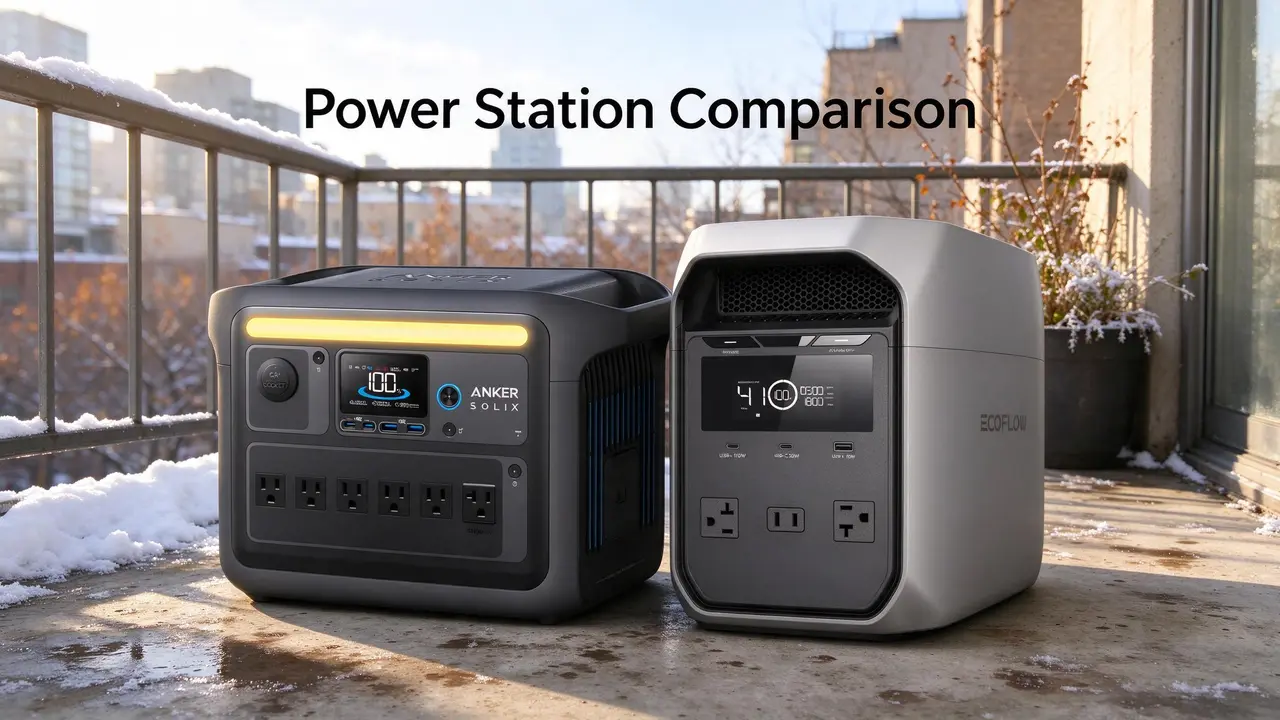
Both are 1,800 W continuous stations in the same 1 kWh class: 1,056 Wh on the Anker C1000 Portable Power Station against 1,024 Wh on the EcoFlow DELTA 3 Classic. That 32 Wh — about three percent — will not change what you can run.
The split that actually matters is elsewhere. The Anker lists AC×11 outlets at $599; the EcoFlow lists AC×6 at $559 and adds USB-C×2 plus a documented sub-10ms UPS switchover. If you are wiring a fridge or a sump pump to ride through outages unattended, the EcoFlow's UPS spec is the deciding line. If you are plugging in a lot of AC gear at once — a camper, a workbench, a tailgate — eleven outlets is the deciding line.
This page is not for whole-home backup. Neither unit is a transfer-switch appliance, and neither should be asked to carry a furnace blower, a well pump, or a 240 V load. It is for short-term, plug-in backup and off-grid use. Renters who cannot hard-wire a transfer switch are exactly the audience for these two — and the reason to skip them is if you need a hard-wired circuit.
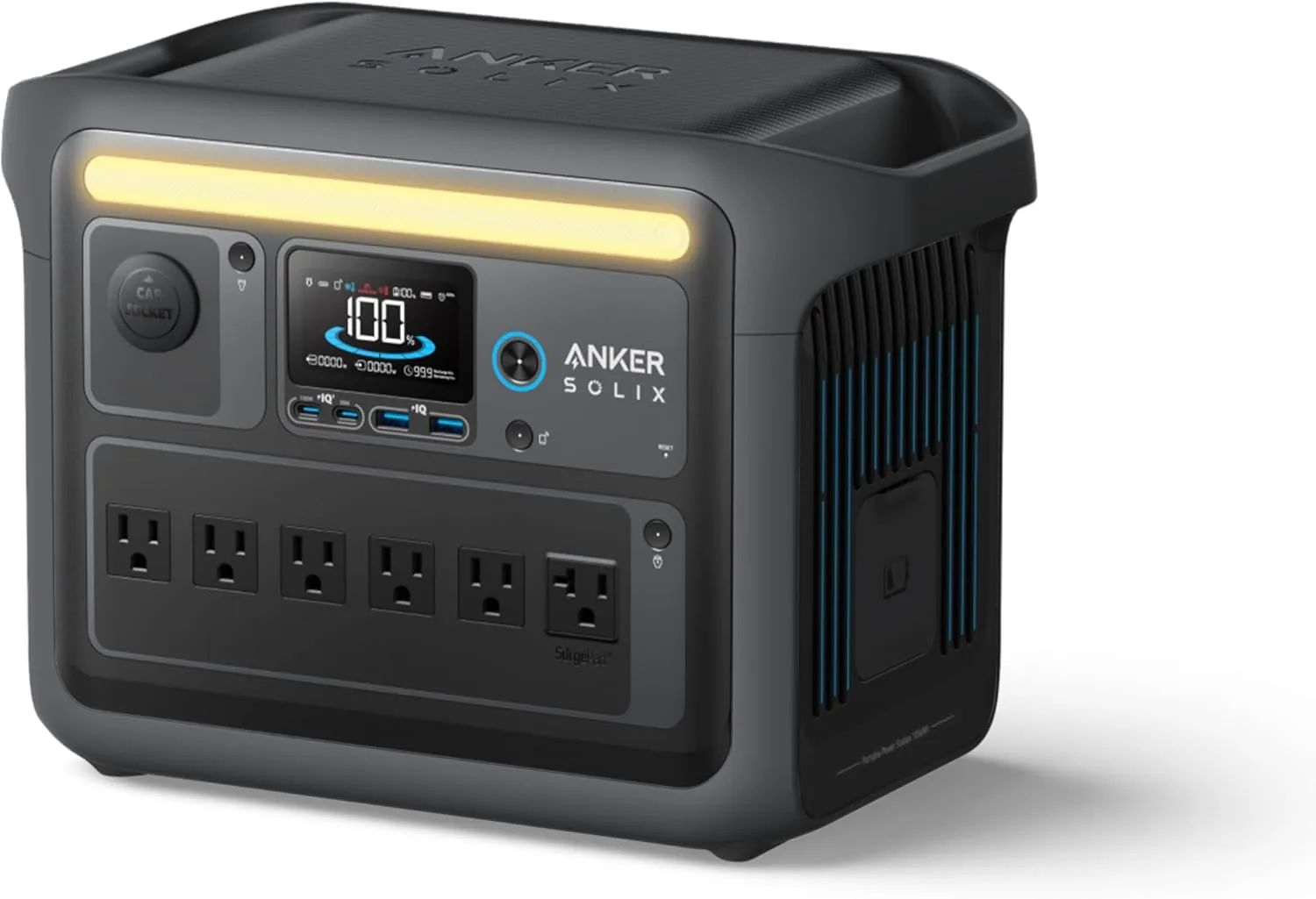
Anker C1000 Portable Power Station with Car Charging Cable, 1,056Wh
Highlights
- 1056Wh rated capacity
- 1800W continuous AC
- LiFePO4 chemistry
- Up to 600W solar input
- 28.4 lb (~12.9 kg)
- About $599.99 list
Best for
- SOLIX C1000: small appliances and tools that need ~1800W continuous, not just phone charging
- Essentials bridge at home (fridge cycles, router) when sized to the Wh
- Solar top-ups up to ~600W when panels and weather cooperate
Strengths
- SOLIX C1000: 1800W continuous on a 1056Wh pack — more headroom for small appliances than 1kW-class peers
- 28.4 lb (~12.9 kg) sits in the two-hand lift or wagon carry band for weekend moves
- 1800W continuous headroom covers more small appliances than 1kW-class inverters
- About $599.99 list in the Hub catalog — confirm live retail before you buy
Watch-outs · not ideal when
- 28.4 lb (~12.9 kg) is a two-hand lift; skip it if you walk more than a short path to camp
- Usable energy on SOLIX C1000 is below the 1056Wh label once the inverter is working
- Rated 600W solar on SOLIX C1000 is optimistic; shade and cables cut real watts
- LiFePO4 helps longevity, but SOLIX C1000 still hates freezing charge temps on winter trips
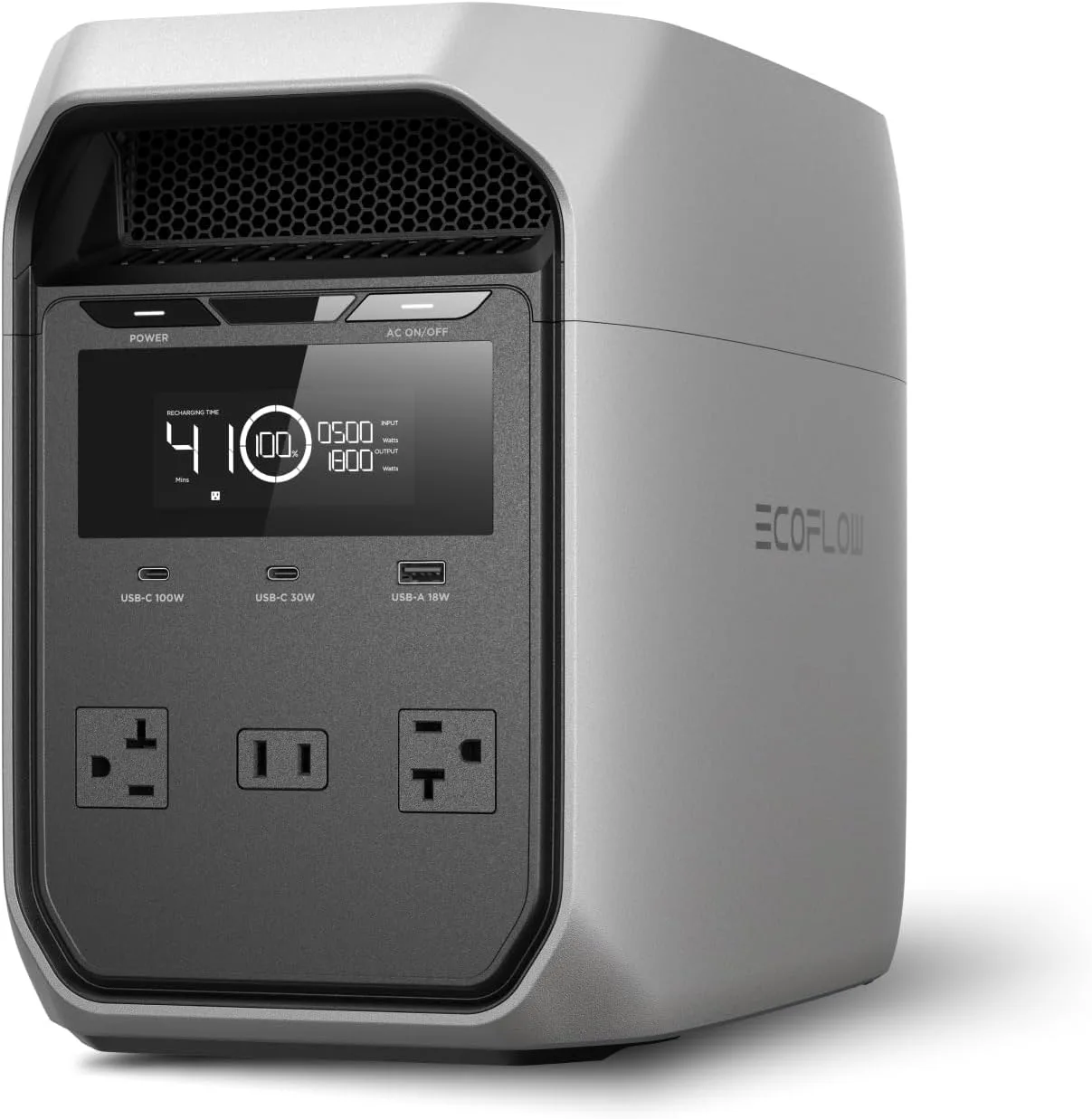
EcoFlow DELTA 3 Classic
Highlights
- 1024Wh rated capacity
- 1800W continuous AC
- 3600W surge
- LiFePO4 chemistry
- Up to 500W solar input
- 26.7 lb (~12.1 kg)
Best for
- DELTA 3 Classic: small appliances and tools that need ~1800W continuous, not just phone charging
- Essentials bridge at home (fridge cycles, router) when sized to the Wh
- Solar top-ups up to ~500W when panels and weather cooperate
Strengths
- DELTA 3 Classic: 1024Wh pack with 1800W continuous / 3600W surge — size loads to both numbers
- 26.7 lb (~12.1 kg) sits in the solo car-camp carry carry band for weekend moves
- 1800W continuous headroom covers more small appliances than 1kW-class inverters
- About $559 list in the Hub catalog — confirm live retail before you buy
Watch-outs · not ideal when
- DELTA 3 Classic is still a bridge for essentials — not a transfer-switch whole-home system
- Usable energy on DELTA 3 Classic is below the 1024Wh label once the inverter is working
- Rated 500W solar on DELTA 3 Classic is optimistic; shade and cables cut real watts
- LiFePO4 helps longevity, but DELTA 3 Classic still hates freezing charge temps on winter trips
Spec snapshot
Prices are list prices, not current sale stickers. Ratings are the listing aggregate, not owner proof.
| Product | List price | Capacity (Wh) | Output (W) | Weight (lb) | Rating |
|---|---|---|---|---|---|
| Anker C1000 Portable Power Station | $599.99 | 1056 Wh | 1800 W | 28.4 lb | 4.88 |
| EcoFlow DELTA 3 Classic | $559 | 1024 Wh | 1800 W | 26.7 lb | 5.00 |
Price per Wh: the EcoFlow wins, but narrowly
On nameplate math, the EcoFlow DELTA 3 Classic is the cheaper unit per watt-hour at $0.55/Wh against $0.57/Wh for the Anker C1000 Portable Power Station. That is the cheapest-per-Wh call on this page, and it holds because the EcoFlow has both the lower list price and the lower $/Wh.
What that $0.02/Wh gap buys you is small — roughly $21 across the full pack. Do not let it override the outlet count or the UPS question. If you need eleven AC receptacles, paying $40 more for the Anker is the correct trade.
One caveat on the Anker: its listing markets a 2,400 W SurgePad (Anker’s listed 2400 W surge branding) figure. That is a surge rating, not continuous output. Treat 1,800 W as the ceiling for anything you plan to run for more than a few seconds.
What each one is genuinely good at
The Anker C1000's owner file skews toward campers and home outages. Owners describe backpowering a truck camper through the shore-power hookup for about a day, running a garage fridge for 36 hours in cool weather, and recharging from a generator in roughly 1 to 1.5 hours. The recurring complaint is weight — several owners say 28.4 lb feels heavier in hand than the number suggests — and app connectivity that needed a firmware update to settle. Note that firmware and app behavior can vary by unit revision, so check the current app version before relying on remote monitoring.
The EcoFlow's owner file skews toward UPS duty and van life. Owners describe using the sub-10ms switchover to keep a fridge running when a van shuts off, running two sump pumps for two days on roughly half a charge, and charging to full in about 45 minutes on a standard wall outlet. The most common negative note is battery compatibility: the listing itself states the DELTA 3 Classic is not compatible with DELTA 2 or DELTA 3 Series Smart Extra Batteries, so expansion is a dead end here.
Neither of those is a lab measurement. They are owner themes on file plus listing specs, and that is the basis for every number on this page. The owner themes are drawn from a small sample of reviews and may not reflect the latest firmware or hardware revisions.
- Anker C1000: 11 AC outlets, 1,056 Wh, $599, 28.4 lb — outlet-rich, camper-friendly
- EcoFlow DELTA 3 Classic: 6 AC outlets, 1,024 Wh, $559, 26.7 lb — UPS-first, lighter, no extra-battery path
- Both: 1,800 W continuous, LiFePO4, fast AC recharge, app control
Load math: what 1,800 W actually covers
A typical home fridge draws somewhere in the 100–200 W range while running, with a compressor surge on startup. Both stations handle that comfortably. At 1,024–1,056 Wh, expect roughly 5 to 8 hours of fridge runtime per full charge depending on ambient temperature and how often the door opens — owners on both sides report numbers in that neighborhood, with the Anker file showing a 36-hour garage-fridge run in cool weather and a 12-hour run on a warmer kitchen unit. The 36-hour figure reflects a cool garage and a fridge that cycles less often; the 5–8 hour estimate assumes a warmer room and normal door openings. Inverter efficiency (typically around 85%) and cold-weather derating mean these are optimistic ceilings, not guarantees.
A CPAP at 30–60 W is a non-issue for either unit overnight — the Anker's 1,056 Wh covers roughly 17–35 hours of CPAP use, and the EcoFlow's 1,024 Wh covers about 17–34 hours, before inverter losses. A microwave is the interesting case: most draw 1,000–1,500 W, which fits under 1,800 W but eats capacity fast — a few minutes of runtime, not a meal plan. Space heaters, kettles, and hair dryers at 1,500 W will run, briefly.
For the sump-pump scenario, a typical 1/3 HP pump draws about 800–1,300 W surge at startup and less while running. Both stations' 1,800 W continuous rating covers that surge, but the EcoFlow's UPS switchover is what makes it practical for unattended pump duty. Check your pump's nameplate surge wattage against 1,800 W before relying on either unit.
What neither will do: a 240 V well pump, a central AC compressor, an electric dryer, or a furnace blower on a hard-wired circuit. Those need a transfer switch and a different class of equipment entirely.
- Fridge (100–200 W): both fine, 5–8 hr per charge typical (optimistic; assumes ~85% inverter efficiency and mild ambient)
- CPAP (30–60 W): both fine overnight — Anker ~17–35 hr, EcoFlow ~17–34 hr before losses
- Microwave (1,000–1,500 W): both fit, minutes not hours
- Sump pump (1/3 HP, ~800–1,300 W surge): both cover surge; EcoFlow's UPS makes it practical for unattended duty
- 240 V loads: neither — walk away
Charging speed and solar: close, with different ceilings
The Anker lists 600 W max solar input and a 1.8-hour full recharge on solar; the EcoFlow lists 500 W solar and a 2.5-hour recharge with a 500 W panel (sold separately). On AC, both are fast — Anker claims 80% in 43 minutes via its UltraFast mode, EcoFlow claims 0–80% in 45 minutes.
The practical difference is the Anker's higher solar ceiling, which matters if you are building an off-grid setup and want to recharge in a shorter sun window. For grid-tied backup, it is a wash.
Note the accessory flag: neither unit ships with solar panels. The EcoFlow's 500 W panel and the Anker's panel array are both separate purchases, and the EcoFlow's extra-battery path is closed by the listing's own compatibility note.
Which bet fits you
Take the Anker C1000 Portable Power Station if you are outfitting a camper, van, or job site where you will plug in several AC devices at once and want the higher solar ceiling. The eleven outlets and 1,056 Wh are the reason, and the $599 list price is the cost of that flexibility.
Take the EcoFlow DELTA 3 Classic if the job is unattended backup — a fridge, a sump pump, a CPAP — where the sub-10ms UPS switchover and the lower $0.55/Wh matter more than outlet count. The $559 list price and 26.7 lb make it the easier unit to move and the cheaper one to own per watt-hour.
Skip both if you need whole-home coverage, 240 V loads, or expandable capacity. The EcoFlow's listing rules out its own extra batteries, and the Anker's expansion path is a separate purchase not covered by this comparison. For those jobs, look at transfer-switch sizing and a larger class of station — this pair is a plug-in backup bet, not a panel bet.
The bottom line
If your outage plan is a fridge, a pump, and a CPAP running unattended, the EcoFlow DELTA 3 Classic at $559 is the better bet — cheaper per Wh, lighter, and built around that UPS switchover. If your plan is a camper or a workbench with a lot of AC plugs and a solar array, the Anker C1000 Portable Power Station at $599 earns its $40 premium on outlet count and solar headroom.
Neither is a whole-home answer. Buy one of these for plug-in, short-term backup; buy a transfer switch and a bigger system if the load is hard-wired.
WattPicks earns a commission from qualifying Amazon purchases made through links on this page. Picks are fit-led, not commission-led.
Frequently asked
Can either run a full-size refrigerator overnight?
Yes, with conditions. Both sit in the 1,024–1,056 Wh range and handle a 100–200 W fridge draw for roughly 5 to 8 hours per charge. The Anker file shows longer runs in cool ambient temperatures; warmer rooms and frequent door openings cut that down. Inverter efficiency and cold-weather derating mean these are optimistic ceilings.
Is the EcoFlow's sub-10ms UPS claim something I can verify?
Not from this page. It is a listing spec, and owners describe using it successfully for fridge and van setups. Treat it as a manufacturer claim backed by owner reports, not an independently measured figure.
Do I need to buy solar panels separately?
Yes, for both. Neither unit includes panels, and the EcoFlow's 500 W panel is an add-on. The Anker's 600 W solar ceiling is higher, but the panels are still a separate line item.
Which is cheaper per watt-hour?
The EcoFlow DELTA 3 Classic, at $0.55/Wh against $0.57/Wh for the Anker C1000, based on list prices. The gap is about $21 across the full pack, so let outlet count and UPS behavior drive the decision.
Method and sources
Model names and list prices come from the WattPicks catalog at build time. WattPicks does not run its own laboratory tests on power stations, and nothing on this page is presented as a measured result — it is catalog-backed buying guidance.
Read our methodology for how the catalog is normalized, and about WattPicks for who publishes it.