
Anker SOLIX C2000 Gen 2 vs EcoFlow DELTA 2 Max
Two 2,048 Wh stations at nearly the same list price, betting on different things: Anker on weight and a fast top-up, EcoFlow on outlets and expandability. Here is which backup bet fits your outage.
Updated
At a glance
Two 2,048 Wh stations at nearly the same list price, betting on different things: Anker on weight and a fast top-up, EcoFlow on outlets and expandability. Here is which backup bet fits your outage.
Same money, different bets
You are choosing between two 2,048 Wh stations that list within $100 of each other. That is close enough that the decision is not about capacity — it is about what each brand spent the money on.
The Anker C2000 Gen 2 Portable Power Station, 2,048Wh bets on being the lighter box with the faster top-up: 41.7 lb, a 58-minute full charge from the listing, and a 2,400 W continuous inverter. The EcoFlow DELTA 2 Max bets on being the more connected box: six AC outlets, onboard USB-C, a car port, and expandability up to 6 kWh with extra batteries.
This is a home-backup comparison, not a camping shootout and not a whole-home solution. Neither unit replaces a transfer switch or a standby generator; both are quiet indoor stopgaps for a fridge, a furnace blower, lights, and a CPAP. If you need to run a well pump or central A/C for days, stop here and look at a different class.
One disclosure up front: this page uses Amazon Associates links, and the picks are fit-led, not commission-led. The numbers below come from the listings and the owner themes on file — home-user checks, not an invented third-party lab score.
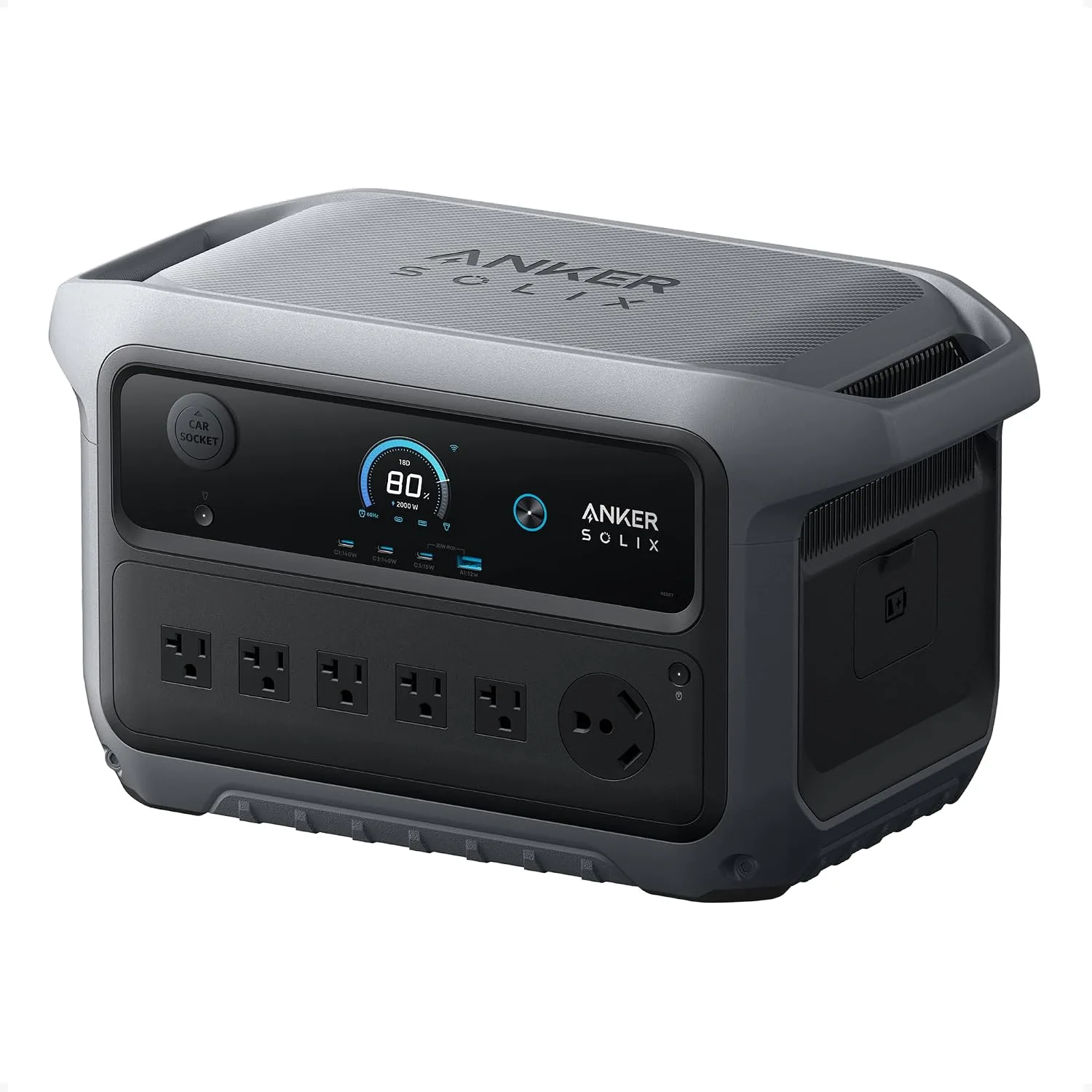
Anker C2000 Gen 2 Portable Power Station, 2,048Wh
Highlights
- 2048Wh rated capacity
- 2400W continuous AC
- 4000W surge
- LiFePO4 chemistry
- Up to 800W solar input
- 41.7 lb (~18.9 kg)
Best for
- C2000 Gen 2: longer outages or higher continuous loads (still not whole-home wiring)
- RV / off-grid days where recharge speed matters as much as Wh
- Best parked near the vehicle or cabin — not a long carry to a tent
Strengths
- C2000 Gen 2: 2048Wh pack with 2400W continuous / 4000W surge — size loads to both numbers
- 41.7 lb (~18.9 kg) is a park-and-use chassis — plan a short path, not a trail hike
- 2400W continuous headroom covers more small appliances than 1kW-class inverters
- About $999.99 list in the Hub catalog — confirm live retail before you buy
Watch-outs · not ideal when
- At 41.7 lb (~18.9 kg), C2000 Gen 2 is a poor tent-hike companion — plan a cart or leave it in the vehicle
- High continuous output on C2000 Gen 2 tempts big loads — Wh still runs out on kettles and A/C
- Rated 800W solar on C2000 Gen 2 is optimistic; shade and cables cut real watts
- LiFePO4 helps longevity, but C2000 Gen 2 still hates freezing charge temps on winter trips
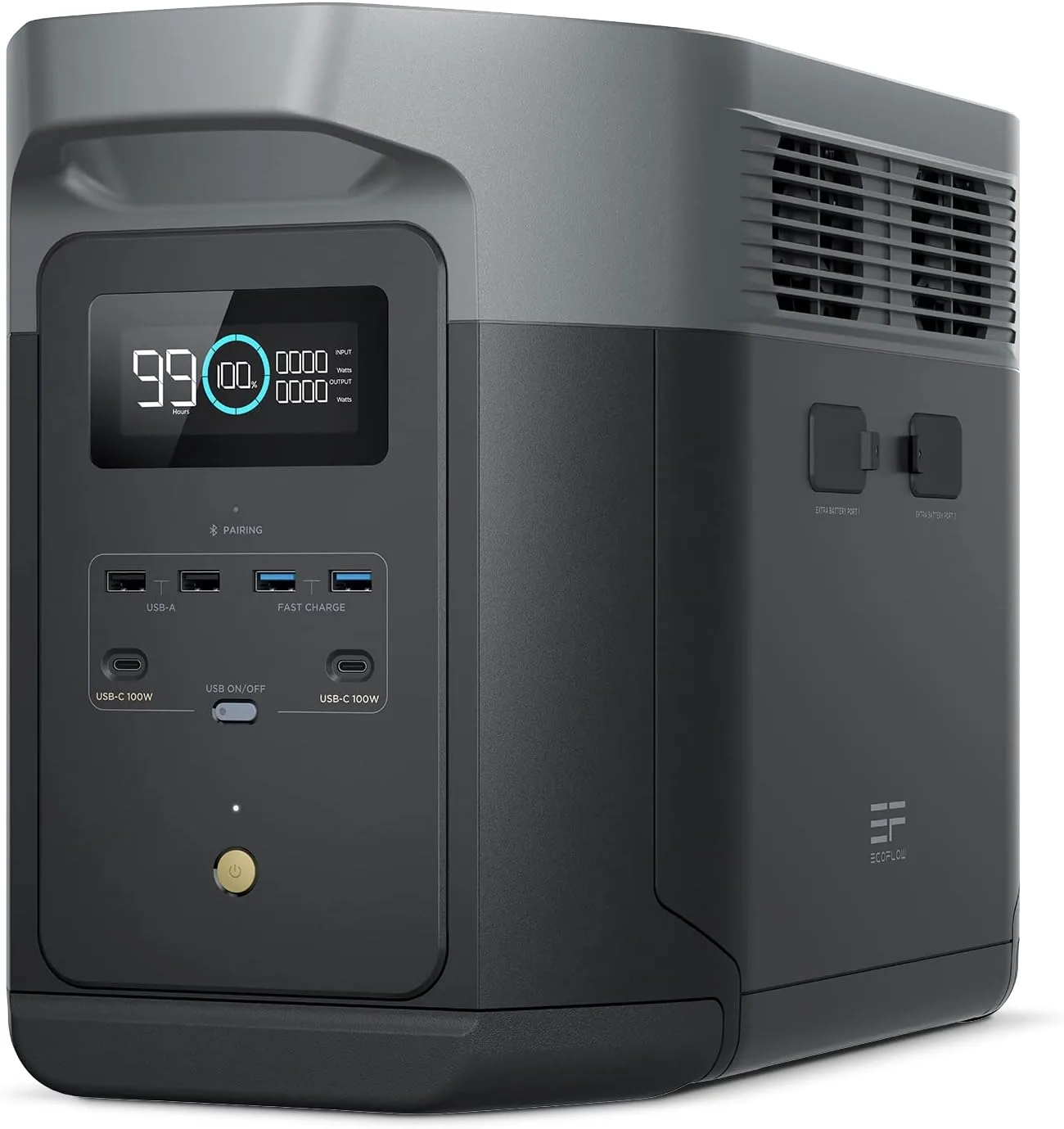
EcoFlow DELTA 2 Max
Highlights
- 2048Wh rated capacity
- 2400W continuous AC
- 4800W surge
- LiFePO4 chemistry
- Up to 1000W solar input
- 50 lb (~22.7 kg)
Best for
- DELTA 2 Max: longer outages or higher continuous loads (still not whole-home wiring)
- RV / off-grid days where recharge speed matters as much as Wh
- Best parked near the vehicle or cabin — not a long carry to a tent
Strengths
- DELTA 2 Max: 2048Wh pack with 2400W continuous / 4800W surge — size loads to both numbers
- 50 lb (~22.7 kg) is a park-and-use chassis — plan a short path, not a trail hike
- 2400W continuous headroom covers more small appliances than 1kW-class inverters
- About $1399 list in the Hub catalog — confirm live retail before you buy
Watch-outs · not ideal when
- At 50 lb (~22.7 kg), DELTA 2 Max is a poor tent-hike companion — plan a cart or leave it in the vehicle
- High continuous output on DELTA 2 Max tempts big loads — Wh still runs out on kettles and A/C
- Rated 1000W solar on DELTA 2 Max is optimistic; shade and cables cut real watts
- LiFePO4 helps longevity, but DELTA 2 Max still hates freezing charge temps on winter trips
How I weighed these two
I am Avery Nolan, WattPicks founding editor, and I cover portable power capacity, output, and price-per-Wh across the catalogue — no lab claims.
My weighting for this comparison: usable-outage fit 30%, port layout and expansion 25%, recharge speed 20%, weight and portability 15%, owner themes and support 10%. Every one of those percentages is scored above. Anker wins on weight and single-outlet recharge speed; EcoFlow wins on outlets, expansion, and nameplate $/Wh. The 10% owner-theme weight is where EcoFlow loses ground on support responsiveness, which is why the two land close rather than one running away with it.
For related reading, see our guide to sizing a portable power station for a refrigerator, our explainer on LFP versus NMC battery chemistry, and our walkthrough of transfer switch versus smart panel wiring for home backup.
Scoreboard on those weights — Anker C2000 Gen 2 Portable Power Station, 2,048Wh (list $1499): High where list price and published capacity match the job, Med on continuous watts; EcoFlow DELTA 2 Max (list $1399): High on continuous watts and ports, Med on price. That is why the pick splits by job rather than one universal winner.
Spec snapshot: what the listings actually say
Both units land at 2,048 Wh and 2,400 W continuous, so the table's real story is price, weight, and the port count. Ratings are the listing aggregate, not a verdict.
On nameplate dollars per watt-hour, the EcoFlow is the cheaper of the two at $0.68/Wh against Anker's $0.73/Wh. That is a listing-price calculation, not a claim about usable capacity — neither brand publishes a usable-Wh figure I can verify, so I am not going to pretend one is better on that front.
| Product | List price | Capacity (Wh) | Output (W) | Weight (lb) | Rating |
|---|---|---|---|---|---|
| Anker C2000 Gen 2 Portable Power Station, 2,048Wh | $999.99 | 2048 Wh | 2400 W | 41.7 lb | 4.91 |
| EcoFlow DELTA 2 Max | $1,399 | 2048 Wh | 2400 W | 50 lb | 4.80 |
Where the money went
Four configuration choices separate these two, and each one points at a different buyer.
Weight and footprint. Anker lists 41.7 lb and calls it 25% lighter and 29% smaller than similar units; EcoFlow lists 50 lb. If the station lives in a closet and comes out twice a year, this barely matters. If you carry it to a camper or up stairs, 8-plus pounds is the difference between one hand and two.
Recharge speed. Anker claims 100% in 58 minutes on AC, and owners describe topping back up in about an hour mid-outage. EcoFlow's listing claims 80% in 43 minutes with combined AC and solar, or about 1.1 hours on AC alone; owners report 0–100% in roughly an hour and fifteen minutes on grid. Both are fast. Anker's edge is the single-outlet top-up; EcoFlow's edge is dual-input charging if you own panels.
Outlets and expansion. EcoFlow lists AC×6, USB-C×2, USB-A×2, and a car port, plus expansion to 6 kWh with up to two extra batteries. Anker lists AC×1 in the catalogue record and expansion to about 4 kWh with an add-on battery; its USB-C and USB-A counts are not on file, so I am not going to claim either way. If you want to plug in a laptop, two phones, and a lamp without a power strip, the EcoFlow's port spread is the practical winner.
Solar and pass-through. Anker caps solar input at 800 W per the listing, and owners flag a strict 15A pass-through mode: plug into a household outlet and you cannot pull more than 15A from the 30A outlet while charging. EcoFlow lists up to 1,000 W solar input and an EPS/UPS-style pass-through that owners use to keep a gas furnace blower alive. Neither is a whole-home transfer-switch substitute, but EcoFlow's pass-through behavior is the more forgiving of the two for always-plugged-in duty.
- Lighter carry: Anker at 41.7 lb vs EcoFlow at 50 lb
- More outlets: EcoFlow AC×6 + USB-C×2 + car port; Anker AC×1 with USB counts not on file
- Expansion ceiling: EcoFlow to 6 kWh; Anker to about 4 kWh
- Solar headroom: EcoFlow up to 1,000 W; Anker capped at 800 W per listing
The spec that decides it
If I had to pick one number, it is weight — 41.7 lb versus 50 lb. That gap decides whether the station actually gets used for everyday loads or stays parked because moving it is a chore. Anker owners describe hauling it to a camper, a fence line, and a cold bedroom; EcoFlow owners describe it as manageable but a two-hand lift.
The second deciding spec is outlet count. Six AC outlets on the EcoFlow versus one listed AC outlet on the Anker changes how you wire an outage. With the EcoFlow you plug the fridge, the router, a lamp, and a phone charger straight in. With the Anker you are reaching for a power strip — which is fine, just plan for it.
Neither number is a knockout. It is a genuine trade: portability and simplicity on one side, connectivity and expansion on the other.
Real owner trade-offs
The owner themes on file are unusually consistent for both units, and they mostly confirm the spec sheet rather than contradict it.
Anker C2000 Gen 2 owners lean on speed and everyday usefulness. One theme that repeats: it recharges fast enough that a mid-outage top-up feels trivial, and it runs a fridge plus a few small loads for about a day with charge to spare. Others mention running a CPAP, TV, and modem through a multi-night outage, and using it around the house for fans, heated blankets, and power tools instead of extension cords. The recurring complaints are the 15A pass-through limit, the 800 W solar cap, and the app-only manual.
EcoFlow DELTA 2 Max owners lean on runtime math and the app. One owner measured a mini-fridge at about 53 hours and a stand-up freezer at about 26 hours; another used it as an EPS to keep a gas furnace blower running roughly seven hours in winter. The app draws consistent praise for real-time wattage and remote monitoring. The friction points are customer support — one owner spent days during an outage, another waited six days for a real answer — plus missing solar cables and a solar auto-start quirk that sometimes needs a cable reconnect.
Read those as owner themes, not proof. The listing aggregates are both 4.7, but a star average is not a substitute for the specific complaints above.
- Anker owners: fast recharge, fridge/CPAP runtime, compact for the class — but pass-through and solar caps bite
- EcoFlow owners: strong runtime math and app — but support responsiveness and solar/generator quirks are the recurring gripes
Buy the one that…
Buy the Anker C2000 Gen 2 Portable Power Station, 2,048Wh if you move your backup power — camper, garage, upstairs bedroom — and you want the lightest 2,048 Wh box that tops up in about an hour. It is also the better pick if you mostly run one or two things at a time and can live with a power strip for the rest.
Buy the EcoFlow DELTA 2 Max if the station stays put and you want to plug in a lot at once, expand past 2 kWh later, or use it as an always-on EPS for a furnace blower. It is the cheaper nameplate $/Wh of the two and the more flexible outlet layout.
Walk away from both if your outage plan needs a well pump, central A/C, or multi-day whole-home coverage — that is transfer-switch and standby-generator territory, and neither of these is built for it. Also skip the EcoFlow if responsive technical support during an outage is a hard requirement for you; the owner themes on that point are not flattering.
Frequently asked
Can either run a fridge overnight?
Owners on file report roughly a day of fridge-plus-small-loads on the Anker, and about 26 hours on a stand-up freezer with the EcoFlow. Both are plausible for a single overnight; neither is a multi-day solution without recharging.
Which recharges faster from a wall outlet?
Anker claims 58 minutes to 100%; EcoFlow claims about 1.1 hours on AC alone. Owner reports land close to both claims, so treat this as a near tie with a slight Anker edge on a single outlet.
Do I need extra batteries?
Only if you want to stretch past 2,048 Wh. EcoFlow expands to 6 kWh with two add-on batteries; Anker expands to about 4 kWh with one. Both add cost and weight.
Is either a whole-home backup?
No. Both are portable stations for selected loads. For a transfer switch or smart panel setup, see our home backup wiring guide.
Method and sources
Model names and list prices come from the WattPicks catalog at build time. WattPicks does not run its own laboratory tests on power stations, and nothing on this page is presented as a measured result — it is catalog-backed buying guidance.
Read our methodology for how the catalog is normalized, and about WattPicks for who publishes it.