
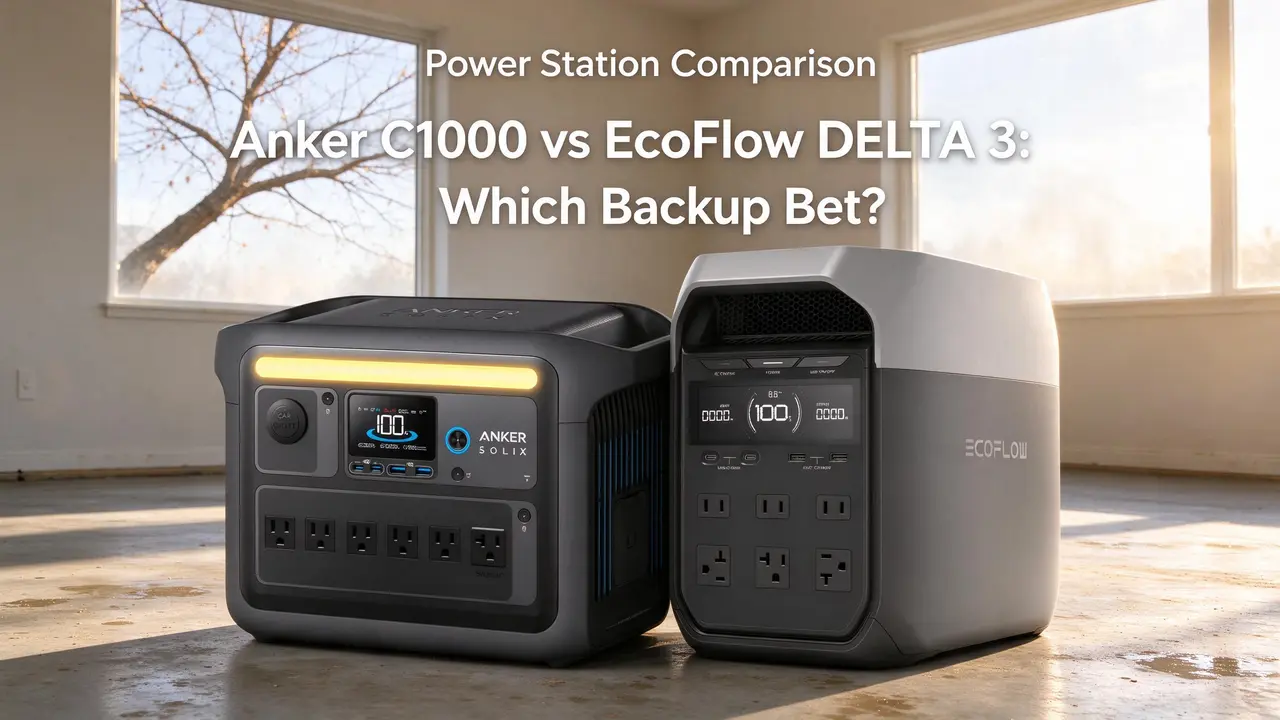
Anker C1000 vs EcoFlow DELTA 3: Which Backup Bet?
Two 1 kWh-class LiFePO4 stations, $100 apart, both rated 1,800 W continuous. One wins on price per watt-hour and raw AC outlet count; the other wins on published cycle life and expansion headroom. Here is how to pick without overpaying for a feature you will never use.
Updated
At a glance
Two 1 kWh-class LiFePO4 stations, $100 apart, both rated 1,800 W continuous. One wins on price per watt-hour and raw AC outlet count; the other wins on published cycle life and expansion headroom. Here is how to pick without overpaying for a feature you will never use.
Same money, different bets
You are standing in the same aisle with about $600–$700 and two boxes that both say 1,800 W. The honest answer is that neither is the wrong buy — but they are not betting on the same thing, and the $100 gap is not the interesting part.
The Anker C1000 Portable Power Station bets on watts per dollar and outlet count: 1,056 Wh and 11 AC receptacles for $599, which works out to $0.57/Wh on the nameplate. The EcoFlow DELTA 3 bets on published battery endurance and a bigger ecosystem: 1,024 Wh for $699, $0.68/Wh, with a 4,000-cycle LFP rating and expansion up to 5 kWh.
This is a comparison for people who already know they want roughly a kilowatt-hour and are deciding where the last hundred dollars should land. If you need 2 kWh+ of daily whole-home coverage, neither of these is your station — step up a class rather than stretch these.
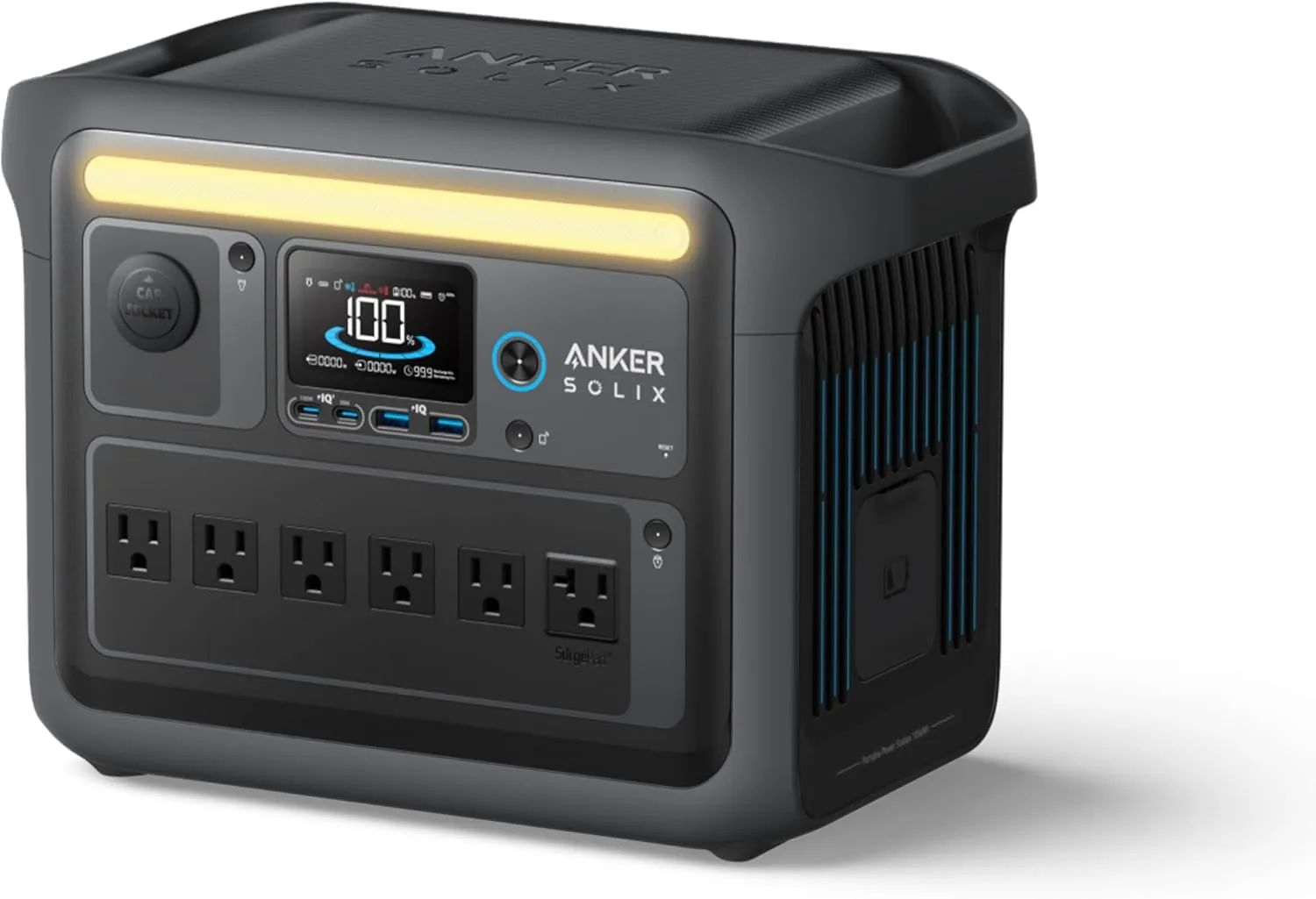
Anker C1000 Portable Power Station with Car Charging Cable, 1,056Wh
Highlights
- 1056Wh rated capacity
- 1800W continuous AC
- LiFePO4 chemistry
- Up to 600W solar input
- 28.4 lb (~12.9 kg)
- About $599.99 list
Best for
- SOLIX C1000: small appliances and tools that need ~1800W continuous, not just phone charging
- Essentials bridge at home (fridge cycles, router) when sized to the Wh
- Solar top-ups up to ~600W when panels and weather cooperate
Strengths
- SOLIX C1000: 1800W continuous on a 1056Wh pack — more headroom for small appliances than 1kW-class peers
- 28.4 lb (~12.9 kg) sits in the two-hand lift or wagon carry band for weekend moves
- 1800W continuous headroom covers more small appliances than 1kW-class inverters
- About $599.99 list in the Hub catalog — confirm live retail before you buy
Watch-outs · not ideal when
- 28.4 lb (~12.9 kg) is a two-hand lift; skip it if you walk more than a short path to camp
- Usable energy on SOLIX C1000 is below the 1056Wh label once the inverter is working
- Rated 600W solar on SOLIX C1000 is optimistic; shade and cables cut real watts
- LiFePO4 helps longevity, but SOLIX C1000 still hates freezing charge temps on winter trips
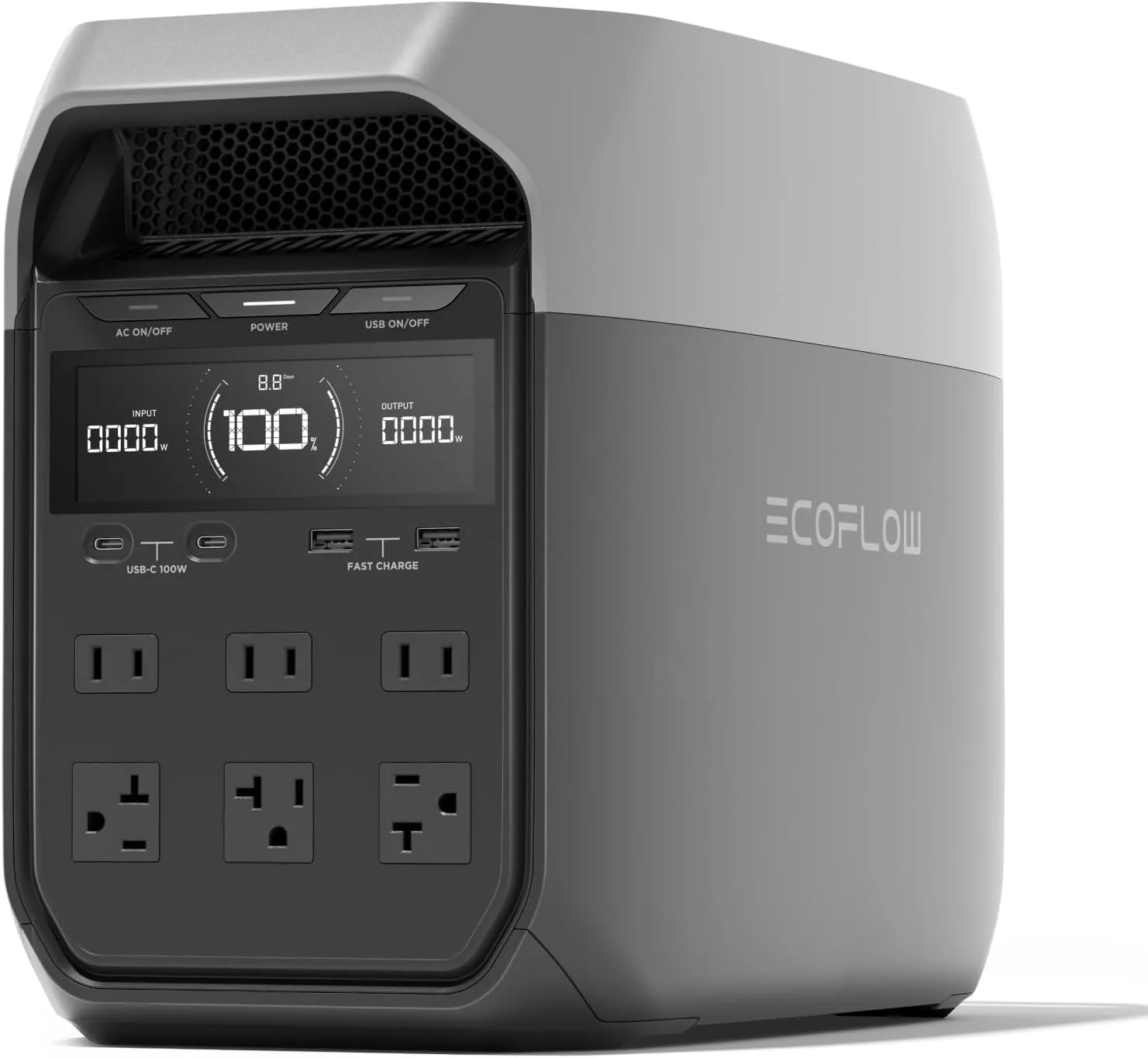
EcoFlow DELTA 3
Highlights
- 1024Wh rated capacity
- 1800W continuous AC
- 3600W surge
- LiFePO4 chemistry
- Up to 500W solar input
- 27.6 lb (~12.5 kg)
Best for
- DELTA 3: small appliances and tools that need ~1800W continuous, not just phone charging
- Essentials bridge at home (fridge cycles, router) when sized to the Wh
- Solar top-ups up to ~500W when panels and weather cooperate
Strengths
- DELTA 3: 1024Wh pack with 1800W continuous / 3600W surge — size loads to both numbers
- 27.6 lb (~12.5 kg) sits in the solo car-camp carry carry band for weekend moves
- 10ms-class UPS switchover on the listing — useful when a router restart would hurt
- About $699 list in the Hub catalog — confirm live retail before you buy
Watch-outs · not ideal when
- DELTA 3 is still a bridge for essentials — not a transfer-switch whole-home system
- Usable energy on DELTA 3 is below the 1024Wh label once the inverter is working
- Rated 500W solar on DELTA 3 is optimistic; shade and cables cut real watts
- LiFePO4 helps longevity, but DELTA 3 still hates freezing charge temps on winter trips
How this comparison was built
I am WattPicks' founding editor, and this piece compares two stations using the listing specifications in our catalogue plus owner review themes on file — home-user checks, not lab-bench measurements, and no invented third-party scores. Prices are list prices; the DELTA 3 has run at a $699 deal price, but the table uses the $699 list so the comparison stays honest. Ratings shown are listing aggregates, not owner proof.
As an Amazon Associate, WattPicks earns from qualifying purchases. Picks here are fit-led, not commission-led — the cheaper station wins on price per watt-hour because the math says so, not because of what it pays.
If you are still sizing, our guide to portable power station capacity and runtime walks through matching watt-hours to real appliance draws, and our LiFePO4 vs NMC explainer covers why chemistry matters for a station that sits idle between outages.
| Product | List price | Capacity (Wh) | Output (W) | Weight (lb) | Rating |
|---|---|---|---|---|---|
| Anker C1000 Portable Power Station | $599.99 | 1056 Wh | 1800 W | 28.4 lb | 4.88 |
| EcoFlow DELTA 3 | $699 | 1024 Wh | 1800 W | 27.6 lb | 5.00 |
Spec snapshot
Everything below comes from the listings and the WattPicks catalogue; the rating column is the listing aggregate, not a score I assigned. Where a number is not published, it says so.
- Cheaper per nameplate Wh: Anker C1000 Portable Power Station at $0.57/Wh vs $0.68/Wh
- More AC receptacles on the Anker (11 vs 6)
- Longer published cycle rating on the DELTA 3 (4,000 to 80% vs 3,000)
- Published expansion ceiling only on the DELTA 3 (up to 5 kWh)
| Product | List price | Capacity (Wh) | Output (W) | Weight (lb) | Rating |
|---|---|---|---|---|---|
| Anker C1000 Portable Power Station | $599.99 | 1056 Wh | 1800 W | 28.4 lb | 4.88 |
| EcoFlow DELTA 3 | $699 | 1024 Wh | 1800 W | 27.6 lb | 5.00 |
Where the money went
Four line items separate these two, and only one of them shows up on the spec sheet as a number you can compare directly.
Capacity and price per watt-hour. The Anker carries 32 more watt-hours and costs $100 less, so it is the cheaper station per nameplate Wh by a clear margin ($0.57 vs $0.68). That is a real advantage if your plan is "run the fridge and a few lights for one evening" — you are buying the same class of battery for less.
Cycle life and chemistry confidence. Both are LiFePO4, which is the chemistry you want for a station that sits at full charge waiting for an outage. The difference is what each brand publishes: Anker states 3,000 cycles over a 10-year lifespan; EcoFlow states 4,000 cycles to 80% and calls out an IP65 battery pack. On paper the DELTA 3 has the longer endurance claim. I would not treat a 1,000-cycle gap as decisive at this price — both are well past what a once-a-month outage user will ever consume — but if you plan to cycle daily in a van, the published number favors EcoFlow.
Recharge speed. EcoFlow publishes a 56-minute full charge (80% in 30 minutes) using 1,500 W max AC input. Anker publishes 80% in 43 minutes and a full charge in under an hour via UltraFast mode, which requires the app and a smartphone. Owner notes on the Anker side describe roughly 1.5 hours from near-empty in real use with input wattage dialed down. Both are fast enough that recharge speed should not decide this purchase; the practical difference is that Anker lets you cap input watts so a small generator stays on eco mode, which owners specifically called out as useful.
Ports and expansion. The Anker lists 11 AC outlets; the DELTA 3 lists 6 AC plus 2 USB-C, 2 USB-A, and 1 car port. Anker's USB-C and USB-A counts are not published in the data I have, so I will not claim either way — but owner notes describe a 100 W USB-C port fast-charging a phone, so USB-C is present in practice. On expansion, EcoFlow is explicit: up to 5 kWh with DELTA 3, DELTA Pro 3, and DELTA 2 Max battery packs. Anker sells an expansion battery (owners pair it with a BP1000 and report the add-on draining first), but the listing does not publish a total expansion ceiling. That is a genuine information gap, not a knock.
- Cheaper per nameplate Wh: Anker C1000 Portable Power Station at $0.57/Wh vs $0.68/Wh
- More AC receptacles on the Anker (11 vs 6)
- Longer published cycle rating on the DELTA 3 (4,000 to 80% vs 3,000)
- Published expansion ceiling only on the DELTA 3 (up to 5 kWh)
The spec that decides it
Two numbers actually move the decision, and neither is output — both are 1,800 W continuous, so any single appliance you would reasonably plug into a 1 kWh station behaves the same on either unit.
The first is price per watt-hour. At $0.57/Wh against $0.68/Wh, the Anker is the cheaper way to own this capacity class, full stop. If your use is intermittent — a few outages a year, a camping weekend, a fridge on a hot afternoon — that $100 buys you nothing the Anker cannot do.
The second is published cycle life plus expansion headroom. If you are buying this as the first block of a system you intend to grow, the DELTA 3's documented path to 5 kWh and its 4,000-cycle rating are the more useful long-term assets. You are paying $100 for a growth path, not for tonight's outage.
One caveat on the Anker side worth flagging plainly: owners repeatedly say it feels heavier in hand than the 28.4 lb listing suggests. The DELTA 3 is listed at 27.6 lb, so on paper they are within a pound — treat the weight column as a tie and plan on two hands for either.
- Anker: strong camper and fridge-backup reports; friction is cable length, light brightness, app setup
- EcoFlow: strong heater and sump-pump reports; thin critical feedback, one 99% charge quirk
Real owner trade-offs
The Anker review base is deeper and more specific, which cuts both ways: more corroborated strengths, more corroborated friction. One camper owner backfed a full truck camper through the shore hookup for about a day of boondocking — microwave, furnace, water pump, lights — and reported the expansion battery roughly doubling that with the add-on draining first. Outage-focused owners describe an 18 cu ft garage fridge/freezer holding safe temps for about 36 hours in cool ambient, and a larger kitchen side-by-side lasting about 12 hours with doors opening. The recurring complaints are physical and small: a short stock AC cable, a dim yellow top light, and an app that needed a firmware update before Wi-Fi and Bluetooth settled. One owner reported a unit that would not power on without being plugged in and got nowhere with seller support — enough reason to test on arrival and register the warranty.
The DELTA 3 pack is thinner, and I want to be blunt about that: most entries are short praise, so the absence of complaints is limited evidence rather than proof. What is there is concrete. A van-life owner ran a diesel heater through the night where a smaller station gave out, kept a fan plus phone, watch, speaker, tablet, and laptop topped up nightly, and recharged every several days. An outage owner ran a sump pump for roughly 8 hours and kept a TV and fridge going. A large portable fridge got about 24 hours on one charge.
Neither of these is a documented long-term durability study. The Anker has the larger, more critical owner base; the DELTA 3 has the better published endurance claim and less field feedback to check it against.
- Anker: strong camper and fridge-backup reports; friction is cable length, light brightness, app setup
- EcoFlow: strong heater and sump-pump reports; thin critical feedback, one 99% charge quirk
Buy the one that…
Buy the Anker C1000 Portable Power Station if you want the most capacity and AC outlets for the least money in this class, and your use is intermittent — fridge duty during outages, camper quiet hours, tailgates. It is the cheaper bet per watt-hour and the owner base gives you a realistic picture of what you are getting. Skip it if you need a published expansion ceiling before you buy, or if you want a long stock AC cord out of the box.
Buy the EcoFlow DELTA 3 if you are starting a system you plan to grow and want the documented path — 4,000 cycles to 80%, expansion to 5 kWh, 2 USB-C and 2 USB-A onboard — and you are willing to pay $100 more for that growth path. Skip it if you are a once-a-year outage user; you would be paying for cycle life and expansion you will never touch, and the Anker does the same job for less.
Walk away from both if your outage plan involves a well pump, central AC, or anything that needs more than 1,800 W continuous — this is the wrong class, and no amount of expansion batteries fixes a continuous-output ceiling.
Frequently asked
Can either run my refrigerator through a multi-hour outage?
Yes, with conditions. Owner reports on the Anker describe an 18 cu ft garage fridge/freezer holding safe temps for about 36 hours in cool ambient and a larger kitchen side-by-side for about 12 hours with door openings; a DELTA 3 owner reported a large portable fridge for about 24 hours. Keep the doors shut and expect shorter runtime in a hot kitchen.
Is the $100 gap worth it for the DELTA 3?
Only if you value the published 4,000-cycle rating and the 5 kWh expansion path. For occasional outage use, the Anker C1000 Portable Power Station delivers more nameplate capacity and more AC outlets for less.
Which one is easier to move around the house?
On paper they are within a pound — 28.4 lb for the Anker, 27.6 lb for the DELTA 3 — but Anker owners consistently say it feels heavier than the number suggests. Plan on two hands and the handles for either.
Do both have USB-C?
The DELTA 3 lists 2 USB-C and 2 USB-A ports. Anker's published port counts for USB-C and USB-A are not on file, so I will not claim either way; owner notes describe a 100 W USB-C port in use.
Method and sources
Model names and list prices come from the WattPicks catalog at build time. WattPicks does not run its own laboratory tests on power stations, and nothing on this page is presented as a measured result — it is catalog-backed buying guidance.
Read our methodology for how the catalog is normalized, and about WattPicks for who publishes it.