
BLUETTI AC180 vs Anker C1000: Which 1 kWh Station Fits?
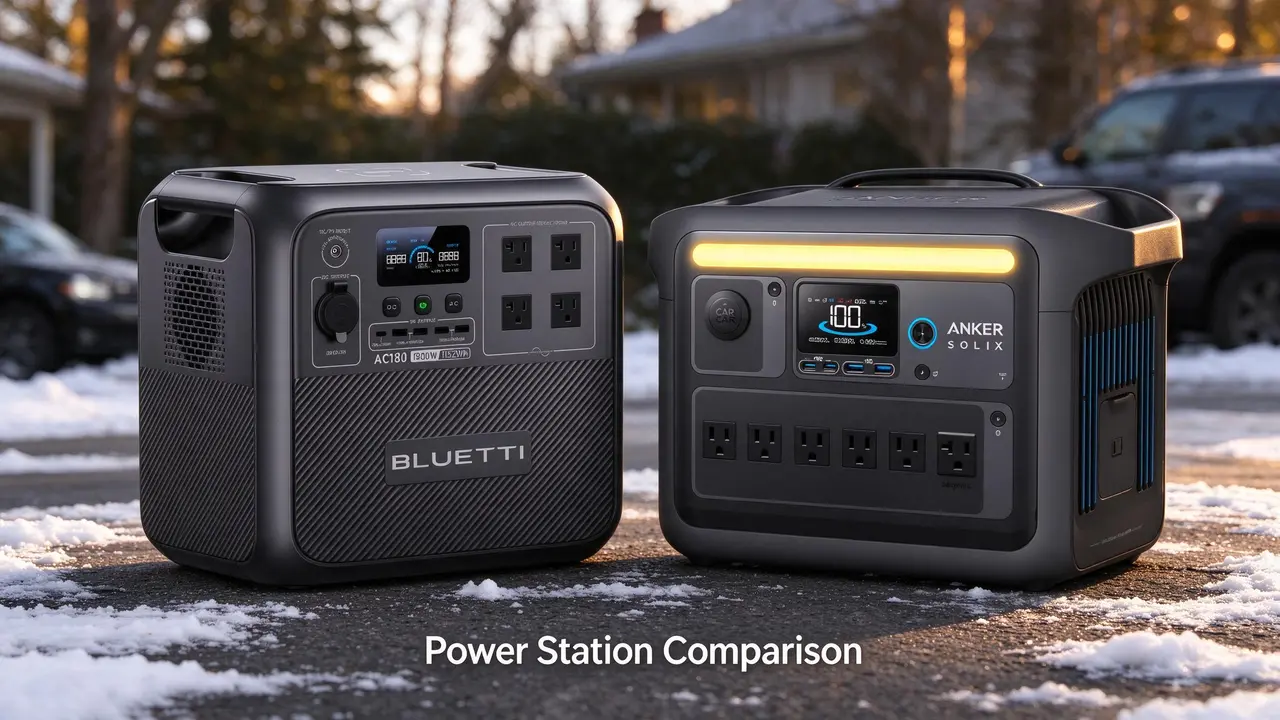
Two 1 kWh-class stations, $100 apart, built for different priorities: the AC180 on capacity per dollar, the C1000 on lighter weight and more outlets. Here's which one earns its spot in your outage kit.
Updated
At a glance
Two 1 kWh-class stations, $100 apart, built for different priorities: the AC180 on capacity per dollar, the C1000 on lighter weight and more outlets. Here's which one earns its spot in your outage kit.
Same money, different priorities
You're standing in the same aisle with roughly the same budget, and two stations are staring back at you. The BLUETTI AC180 lists at $499; the Anker C1000 Portable Power Station lists at $599.99. A hundred bucks apart is close enough that price alone shouldn't decide this — what you're actually buying is a different set of priorities.
The AC180 leans on capacity per dollar. It packs 1152 Wh and 1800 W into a 35.3 lb box for $499, which works out to about $0.43/Wh on nameplate — the cheaper of the two per watt-hour. The C1000 leans on portability and outlet count: 1056 Wh and the same 1800 W, but at 28.4 lb with AC×11, for $0.57/Wh.
That's the whole trade in one sentence: more stored energy and a lower $/Wh on one side, less weight and more places to plug in on the other. Everything below is about which of those you'll actually feel.
One boundary before we go further: this is a two-way comparison for people choosing between these specific 1 kWh-class units. If you need to run a well pump, a space heater, or a whole panel through a transfer switch, neither of these is the right conversation — you're shopping in a different class.
A note on sourcing: I'm working from the listing specs and the owner themes on file, not from lab-bench measurements. Where a number isn't published, I say so rather than guess. Some links here are Amazon Associates links; the picks are fit-led, not commission-led.
Spec snapshot
Both cells below come straight from the listings. Rating is the listing aggregate, not an owner-verified score.
| Product | List price | Capacity (Wh) | Output (W) | Weight (lb) | Rating |
|---|---|---|---|---|---|
| BLUETTI AC180 | $499 | 1152 Wh | 1800 W | 35.3 lb | 4.85 |
| Anker C1000 Portable Power Station | $599.99 | 1056 Wh | 1800 W | 28.4 lb | 4.88 |
Where the money went
Four configuration differences do most of the work here. Read them as a checklist of what each brand spent its budget on.
The first two are the headline trade: the AC180 gives you 96 Wh more capacity (about 9% more stored energy) for $100 less, while the C1000 gives you about 7 lb less weight to lift every time. The next two are the practical consequences: the C1000's AC×11 outlet count versus AC×4 on the AC180, and the resulting $/Wh gap — $0.43/Wh on the BLUETTI versus $0.57/Wh on the Anker on nameplate. In short, you're paying the Anker premium for portability and outlet count, not for stored energy.
- Capacity: AC180 1152 Wh vs C1000 1056 Wh — a 96 Wh gap, roughly 9% more stored energy on the BLUETTI.
- Weight: 35.3 lb vs 28.4 lb — the C1000 is about 7 lb lighter, which matters every time you lift it.
- Outlets: AC×4 on the AC180 vs AC×11 on the C1000. If you're plugging in a lot of small loads at once, the Anker has more room.
- Price per Wh: $0.43/Wh (AC180) vs $0.57/Wh (C1000) on nameplate. The BLUETTI is the cheaper buy per stored watt-hour.
- Charging inputs: the AC180 lists AC, car, and solar inputs (500 W solar, per the listing); the C1000 lists AC, car, and up to 600 W solar. Both are flexible; the Anker's solar ceiling is a touch higher on paper.
- USB-C/USB-A counts: n/a (not on file) for both in the catalogue. I'm not going to claim a port is missing when the listing doesn't say — check the current product page before you buy if a specific port matters.
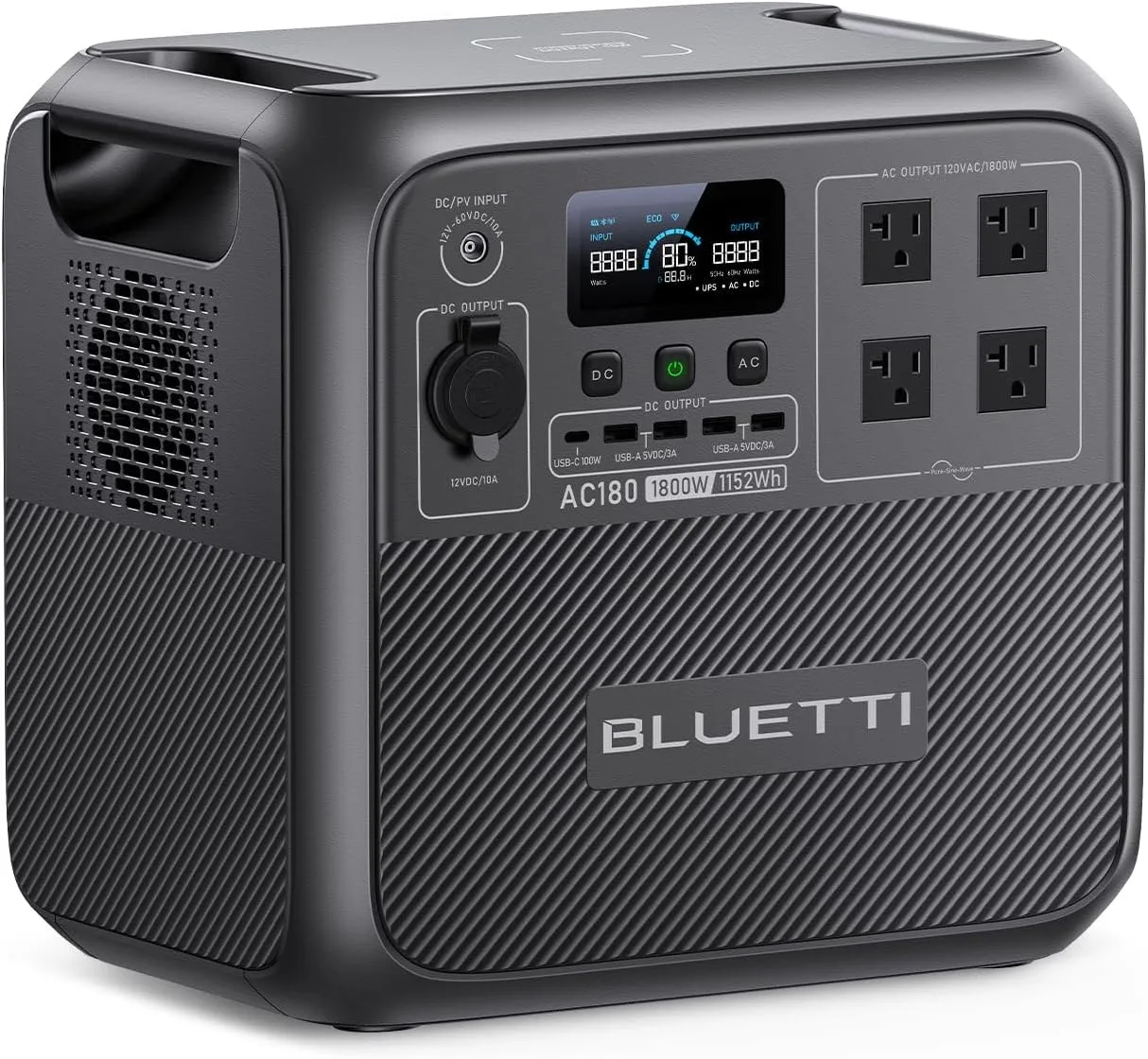
BLUETTI Portable Power Station AC180, 1152Wh LiFePO4 Battery Backup w/ 2 1800W
Highlights
- 1152Wh rated capacity
- 1800W continuous AC
- LiFePO4 chemistry
- Up to 500W solar input
- 35.3 lb (~16.0 kg)
- About $499 list
Best for
- AC180: most Wh per list dollar in mid-size LiFePO4 shortlists (~1152Wh)
- Home essentials when 1800W continuous matters more than a light carry
- Skip if 35.3 lb is too heavy for stairs or frequent car packing
Strengths
- AC180: 1800W continuous on a 1152Wh pack — more headroom for small appliances than 1kW-class peers
- 35.3 lb (~16.0 kg) is a park-and-use chassis — plan a short path, not a trail hike
- 1800W continuous headroom covers more small appliances than 1kW-class inverters
- About $499 list in the Hub catalog — confirm live retail before you buy
Watch-outs · not ideal when
- 35.3 lb (~16.0 kg) is a two-hand lift; skip it if you walk more than a short path to camp
- Usable energy on AC180 is below the 1152Wh label once the inverter is working
- Rated 500W solar on AC180 is optimistic; shade and cables cut real watts
- LiFePO4 helps longevity, but AC180 still hates freezing charge temps on winter trips
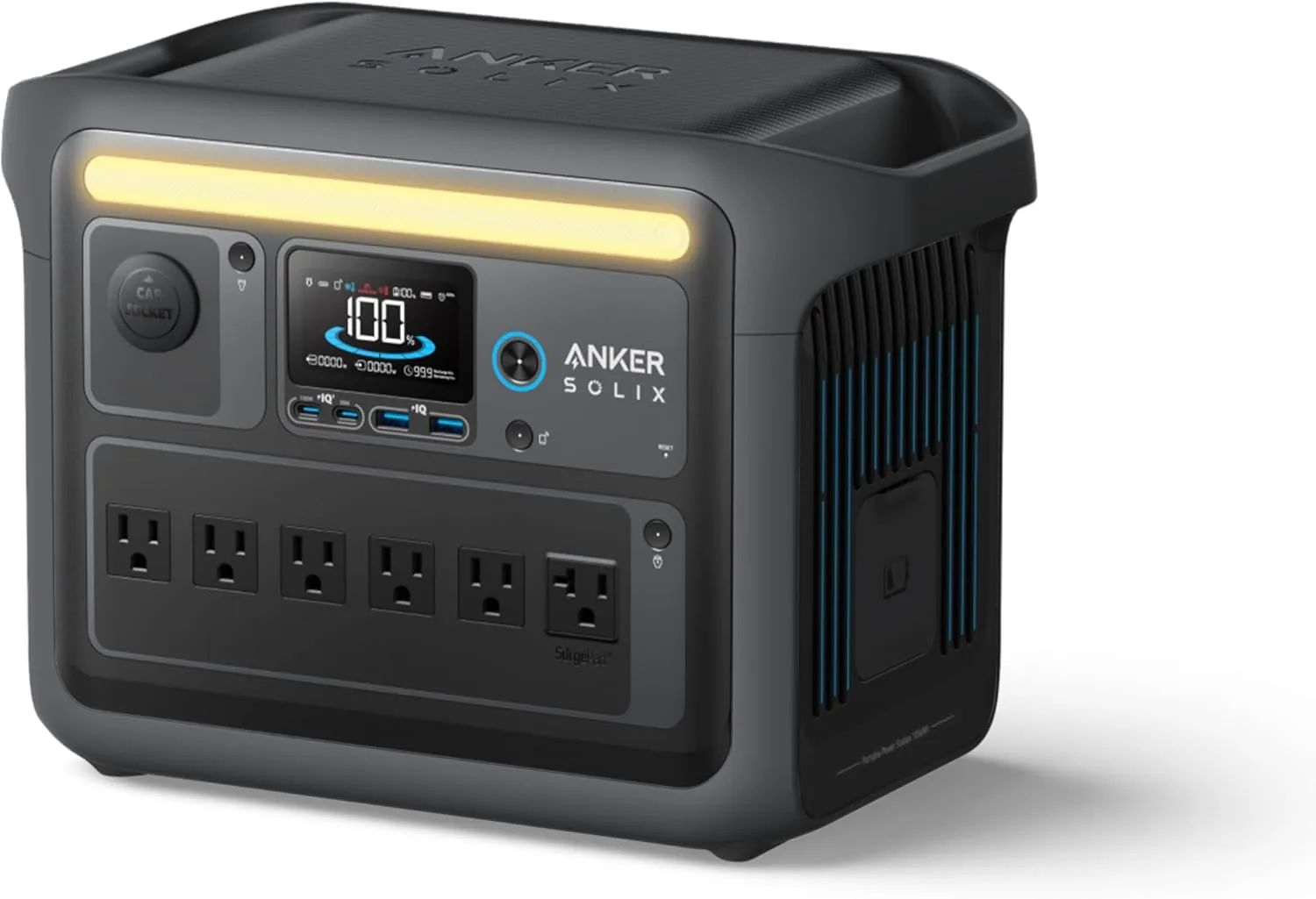
Anker C1000 Portable Power Station with Car Charging Cable, 1,056Wh
Highlights
- 1056Wh rated capacity
- 1800W continuous AC
- LiFePO4 chemistry
- Up to 600W solar input
- 28.4 lb (~12.9 kg)
- About $599.99 list
Best for
- SOLIX C1000: small appliances and tools that need ~1800W continuous, not just phone charging
- Essentials bridge at home (fridge cycles, router) when sized to the Wh
- Solar top-ups up to ~600W when panels and weather cooperate
Strengths
- SOLIX C1000: 1800W continuous on a 1056Wh pack — more headroom for small appliances than 1kW-class peers
- 28.4 lb (~12.9 kg) sits in the two-hand lift or wagon carry band for weekend moves
- 1800W continuous headroom covers more small appliances than 1kW-class inverters
- About $599.99 list in the Hub catalog — confirm live retail before you buy
Watch-outs · not ideal when
- 28.4 lb (~12.9 kg) is a two-hand lift; skip it if you walk more than a short path to camp
- Usable energy on SOLIX C1000 is below the 1056Wh label once the inverter is working
- Rated 600W solar on SOLIX C1000 is optimistic; shade and cables cut real watts
- LiFePO4 helps longevity, but SOLIX C1000 still hates freezing charge temps on winter trips
The spec that decides it
If I had to name the one number that splits these two for most buyers, it's weight. The C1000's 28.4 lb is the difference between carrying a station up a flight of stairs yourself and asking someone for help. For a camper, a truck-bed setup, or anyone who moves the unit between rooms, that 7 lb gap is the feature.
The second deciding number is capacity, and it cuts the other way. The AC180's 1152 Wh is about 9% more stored energy for $100 less. If the station is going to sit in a basement corner and only come out during an outage, that extra capacity and lower $/Wh are the better bet — you're paying for energy, not for a handle.
Output is a wash: both list 1800 W continuous. Neither is a whole-home solution, and neither should be asked to run a load above that continuous rating. For a fridge, router, lights, a CPAP, or a laptop, 1800 W is plenty of headroom on either unit.
One non-obvious decision rule: solar recharge time. The C1000's higher solar ceiling (600 W vs 500 W) only pays off if you have enough panel wattage and sun to use it. If you're recharging from a single 200 W panel, both units will be limited by the panel, not the station — so don't pay the Anker premium for solar headroom you won't use.
Real owner trade-offs
The owner themes on file tell a consistent story on both sides — and the caveats are as useful as the praise.
On the AC180, the standout theme is UPS-style switchover. Owners describe keeping a router and a few lights running through an outage with no reboot, and they lean on the runtime display to decide what to shut off. The recurring caveat is idle draw: with the inverter on, the unit pulls roughly 20 W continuously, and the manual reportedly caps usable capacity around 90%. One owner's math — about 800 Wh delivered from a 1152 Wh nameplate under a small load — is the kind of real-world gap to plan around; treat it as a single data point, not a measured average. The wireless charging pad also draws repeated complaints: it connects, then quits after a few seconds. Don't buy this one for the pad.
On the C1000, the refrigerator theme dominates. Owners report running a full-size garage fridge and a larger kitchen side-by-side through outages, with food staying safe. The exact hour counts vary with fridge efficiency, room temperature, and how often the door opens, so use them as directional rather than precise. Another owner describes camper use during generator quiet hours, running a microwave and coffee maker, and reports that switchover when backcharging felt seamless — that's an owner impression, not a spec. The caveats: the app can be slow to connect until a firmware update settles it, the AC charging cable is short (about 4–5 ft), and several owners say the unit feels heavier than its 28.4 lb spec when carried far.
Neither set of reviews is a lab score. They're owner experience, weighted toward the themes that show up most often and get the most agreement.
What neither will do
Before you pick either, know the shared limits. Neither unit is a whole-home backup: there's no transfer switch or smart-panel integration in the box, so you're running extension cords, not wiring into your panel. Both are LiFePO4, but cycle life isn't published in the listing — expect a finite number of charge cycles and plan for capacity to fade over years of use. Cold weather derates both: charging below freezing is restricted and capacity drops in the cold, so a garage or shed in winter isn't the same as a heated room. And neither will run a load above its 1800 W continuous rating, no matter how many outlets it has.
Buy the one that…
Buy the BLUETTI AC180 if you want the most stored energy and the lowest $/Wh in this pair, and the station will mostly live in one place — a basement, a garage shelf, a closet — waiting for an outage. The 1152 Wh, the UPS switchover owners keep praising, and the $499 list price all point the same way. Skip it if you'll be carrying it regularly or you need a lot of simultaneous outlets; 35.3 lb and AC×4 get old fast.
Buy the Anker C1000 Portable Power Station if portability and outlet count are what you'll feel day to day — camping, a truck camper, moving between rooms — and you value the lighter 28.4 lb and AC×11 enough to pay $100 more for slightly less capacity. Skip it if your priority is maximum watt-hours per dollar, or if you need a long AC charging cable out of the box; plan for an extension cord.
And walk away from both if your plan involves a transfer switch, a smart panel, or running anything above 1800 W continuous. That's a different class of equipment, and no amount of outlet count fixes it.
- How long will either run a fridge? Owner reports on the C1000 put a full-size garage fridge at about 36 hours and a larger kitchen unit at about 12 hours with door openings. The AC180's usable capacity is reportedly capped near 90%, so plan on less than the 1152 Wh nameplate suggests for small loads.
- Can either run a CPAP overnight? Yes — a CPAP draws well under 100 W, so both 1800 W units have ample headroom. The AC180's ~20 W idle draw is the thing to account for if you leave the inverter on all night.
- Do I need the app? The C1000's app controls charge rate and shows input/output; the AC180's app handles firmware and settings. Neither is strictly required to run the unit, but the C1000's charge-rate control is genuinely useful if you're recharging from a generator.
- Which is cheaper per Wh? The AC180 at $0.43/Wh on nameplate, versus $0.57/Wh for the C1000. That's list price, not a sale price.
Frequently asked
How long will either run a fridge?
Owner reports on the C1000 describe a full-size garage fridge and a larger kitchen side-by-side running through outages with food staying safe; exact hours depend on fridge efficiency, room temperature, and door openings, so treat them as directional. The AC180's usable capacity is reportedly capped near 90%, so plan on less than the 1152 Wh nameplate suggests for small loads.
Can either run a CPAP overnight?
Yes — a CPAP draws well under 100 W, so both 1800 W units have ample headroom. The AC180's ~20 W idle draw is the thing to account for if you leave the inverter on all night.
Do I need the app?
The C1000's app controls charge rate and shows input/output; the AC180's app handles firmware and settings. Neither is strictly required to run the unit, but the C1000's charge-rate control is genuinely useful if you're recharging from a generator.
Which is cheaper per Wh?
The AC180 at $0.43/Wh on nameplate, versus $0.57/Wh for the C1000. That's list price, not a sale price.
Method and sources
Model names and list prices come from the WattPicks catalog at build time. WattPicks does not run its own laboratory tests on power stations, and nothing on this page is presented as a measured result — it is catalog-backed buying guidance.
Read our methodology for how the catalog is normalized, and about WattPicks for who publishes it.