
Anker C1000 vs EcoFlow DELTA 3 Plus: Which Backup Fits?
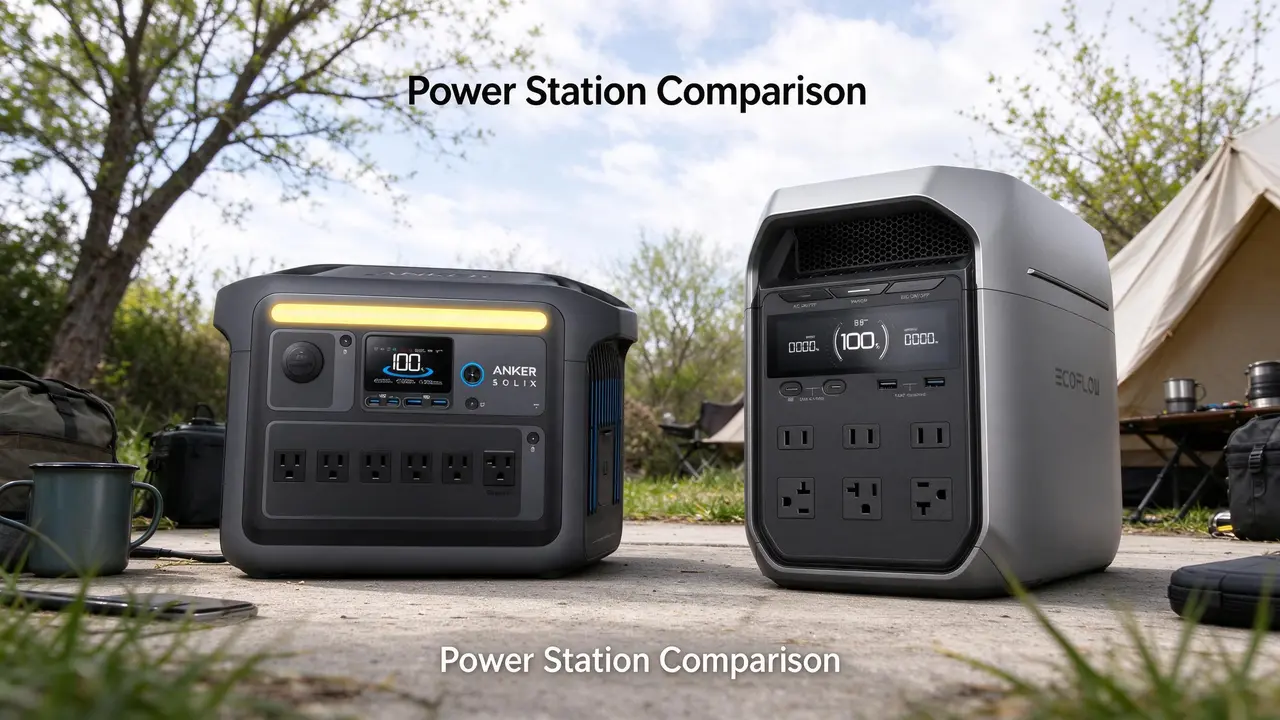
Two 1kWh-class stations, same continuous output, different bets. One is a camper-friendly all-rounder with a list price; the other is a UPS-first unit whose price isn't on file. Here's how to pick.
Updated
At a glance
Two 1kWh-class stations, same continuous output, different bets. One is a camper-friendly all-rounder with a list price; the other is a UPS-first unit whose price isn't on file. Here's how to pick.
- Anker C1000: $599 list, 1056 Wh, 1800 W, 28.4 lb, AC×11, USB-C/USB-A unknown on file.
- EcoFlow DELTA 3 Plus: list n/a, 1024 Wh, 1800 W, 27.6 lb, AC×6, USB-C×2, USB-A×2, car×1.
Same money, different bets
If you're choosing between the Anker C1000 Portable Power Station and the EcoFlow DELTA 3 Plus, the headline numbers look nearly identical: both are 1kWh-class LiFePO4 units rated at 1800 W continuous, and both weigh within a pound of each other. The real decision is what each one is built to do first.
The Anker bets on camper and short-outage flexibility. It has a published list price of $599.99, eleven AC outlets, and an app that lets you dial charge wattage to match a generator. The EcoFlow bets on UPS duty and ecosystem expansion: a 10 ms switchover claim, dual solar inputs, and the ability to add battery packs up to 5kWh. Its list price is n/a (not on file), so you'll need to check the current listing before treating it as a same-budget pick.
This comparison is not for whole-home backup. Neither unit is a transfer-switch replacement, and neither will run a central AC or a 240V well pump. It's for fridge, network gear, CPAP, lights, and small appliances during an outage — or for camping where you need a quiet 1kWh source.
- Anker C1000: $599.99 list, 1056 Wh, 1800 W, 28.4 lb, AC×11, USB-C/USB-A unknown on file.
- EcoFlow DELTA 3 Plus: list n/a, 1024 Wh, 1800 W, 27.6 lb, AC×6, USB-C×2, USB-A×2, car×1.
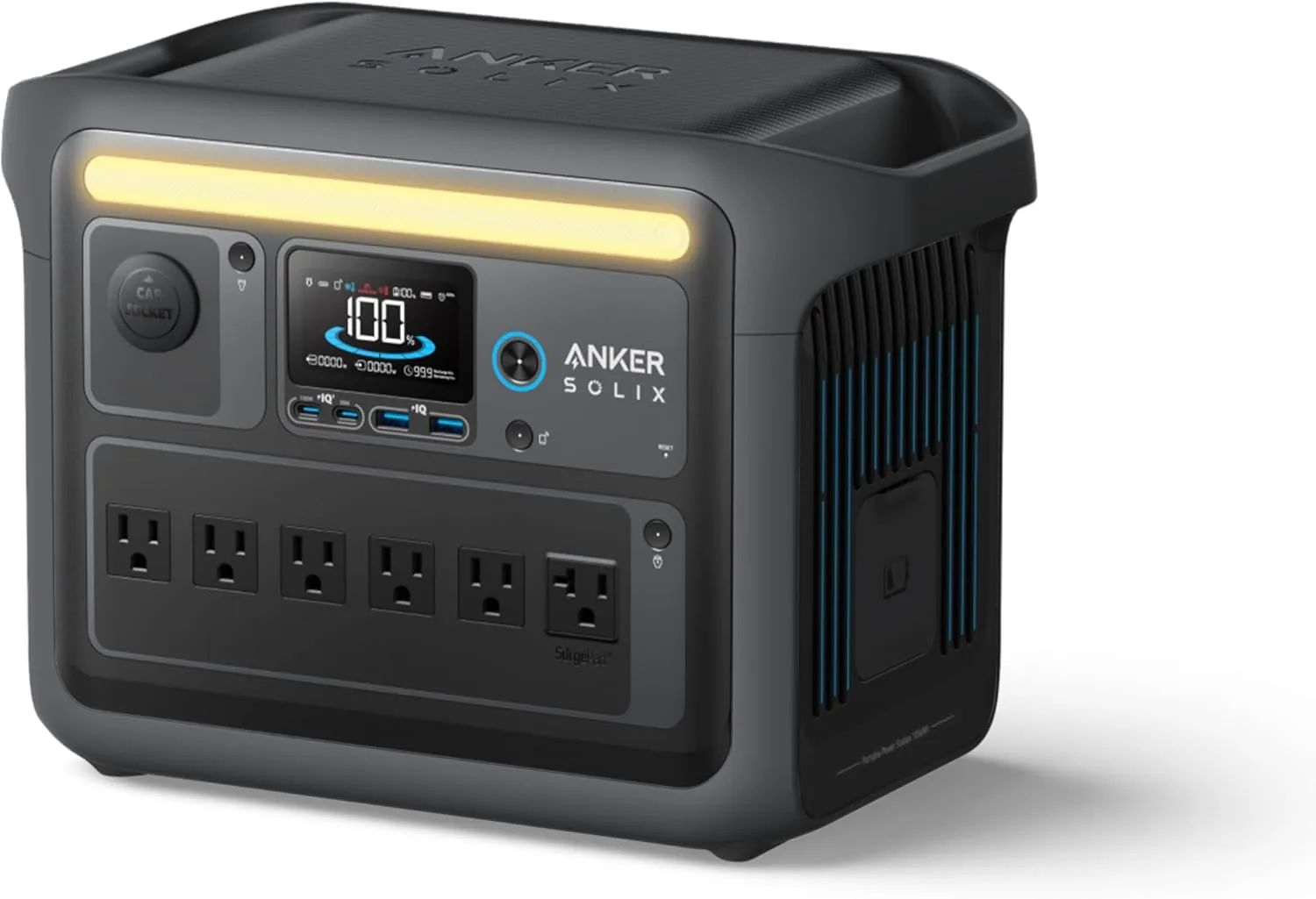
Anker C1000 Portable Power Station with Car Charging Cable, 1,056Wh
Highlights
- 1056Wh rated capacity
- 1800W continuous AC
- LiFePO4 chemistry
- Up to 600W solar input
- 28.4 lb (~12.9 kg)
- About $599.99 list
Best for
- SOLIX C1000: small appliances and tools that need ~1800W continuous, not just phone charging
- Essentials bridge at home (fridge cycles, router) when sized to the Wh
- Solar top-ups up to ~600W when panels and weather cooperate
Strengths
- SOLIX C1000: 1800W continuous on a 1056Wh pack — more headroom for small appliances than 1kW-class peers
- 28.4 lb (~12.9 kg) sits in the two-hand lift or wagon carry band for weekend moves
- 1800W continuous headroom covers more small appliances than 1kW-class inverters
- About $599.99 list in the Hub catalog — confirm live retail before you buy
Watch-outs · not ideal when
- 28.4 lb (~12.9 kg) is a two-hand lift; skip it if you walk more than a short path to camp
- Usable energy on SOLIX C1000 is below the 1056Wh label once the inverter is working
- Rated 600W solar on SOLIX C1000 is optimistic; shade and cables cut real watts
- LiFePO4 helps longevity, but SOLIX C1000 still hates freezing charge temps on winter trips
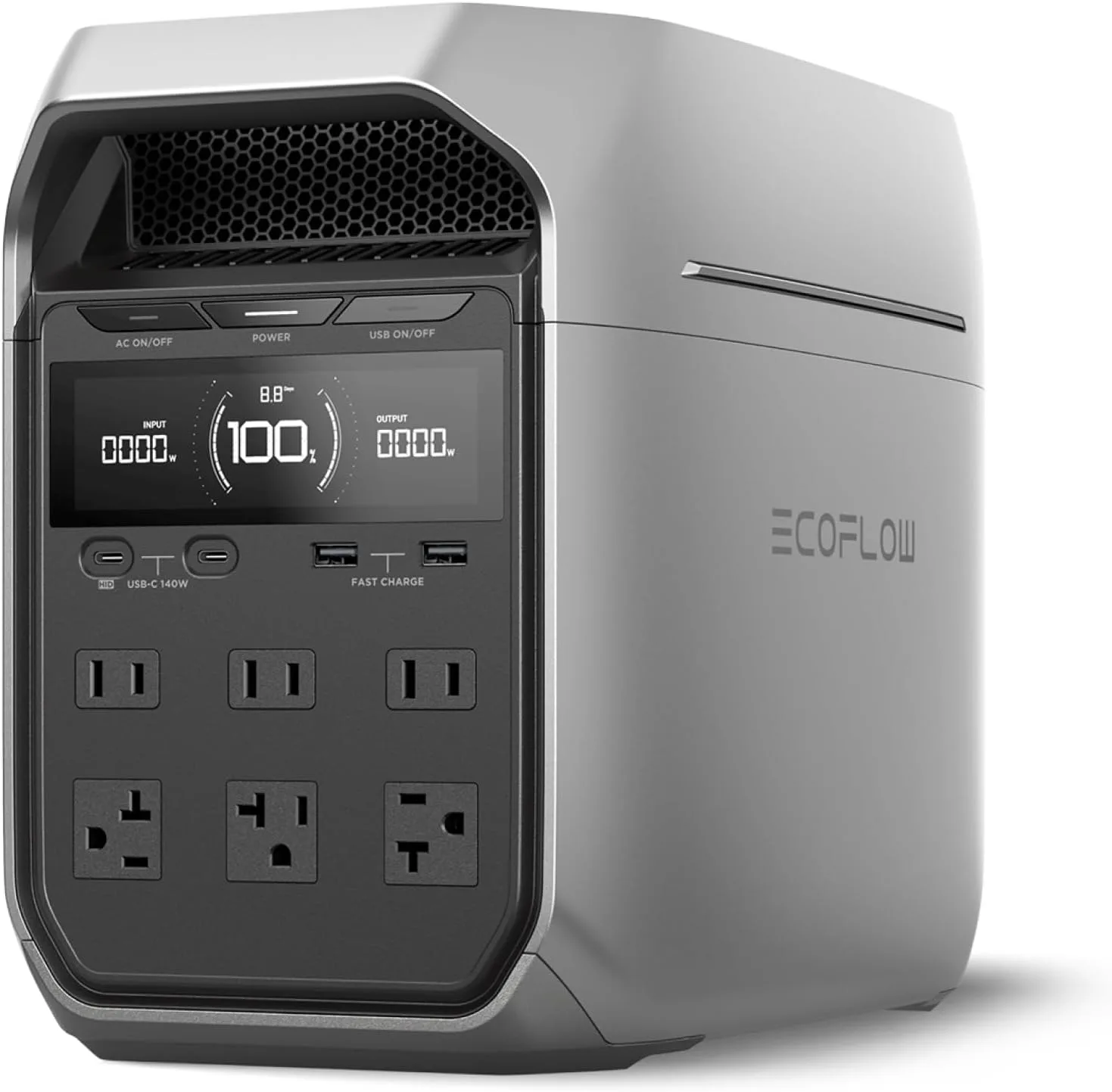
EcoFlow Portable Power Station DELTA 3 Plus 1024Wh, 1800W, LFP Battery
Highlights
- 1024Wh rated capacity
- 1800W continuous AC
- 3600W surge
- LiFePO4 chemistry
- Up to 1000W solar input
- 27.6 lb (~12.5 kg)
Best for
- DELTA 3 Plus: small appliances and tools that need ~1800W continuous, not just phone charging
- Essentials bridge at home (fridge cycles, router) when sized to the Wh
- Solar top-ups up to ~1000W when panels and weather cooperate
Strengths
- DELTA 3 Plus: 1024Wh pack with 1800W continuous / 3600W surge — size loads to both numbers
- 27.6 lb (~12.5 kg) sits in the solo car-camp carry carry band for weekend moves
- 10ms-class UPS switchover on the listing — useful when a router restart would hurt
- About $899 list in the Hub catalog — confirm live retail before you buy
Watch-outs · not ideal when
- DELTA 3 Plus is still a bridge for essentials — not a transfer-switch whole-home system
- Usable energy on DELTA 3 Plus is below the 1024Wh label once the inverter is working
- Rated 1000W solar on DELTA 3 Plus is optimistic; shade and cables cut real watts
- LiFePO4 helps longevity, but DELTA 3 Plus still hates freezing charge temps on winter trips
How I compared these two
I'm Avery Nolan, WattPicks founding editor. My checks here are home-user comparisons grounded in the owner themes on file plus the listing specs — not lab-bench measurements. I weighted UPS/outage fit at 30%, usable capacity and outlet count at 25%, port clarity at 20%, owner-reported caveats at 15%, and price transparency at 10%. Every percentage is scored in the pick rules above.
The Anker wins on outlet count and published list price; the EcoFlow wins on UPS switchover, port clarity, and expansion. Neither wins on weight — they're within a pound. As an Amazon Associate I earn from qualifying purchases; picks are fit-led, not commission-led.
Scoreboard on those weights — Anker C1000 Portable Power Station (list $599.99): High where list price and published capacity match the job, Med on continuous watts; EcoFlow DELTA 3 Plus (list $n/a): High on continuous watts and ports, Med on price. That is why the pick splits by job rather than one universal winner.
Spec snapshot
All numbers below are from the product listings on file. Rating is the listing aggregate, not an owner-proof score. EcoFlow's list price is not on file, so the table shows n/a rather than a guessed figure.
| Product | List price | Capacity (Wh) | Output (W) | Weight (lb) | Rating |
|---|---|---|---|---|---|
| Anker C1000 Portable Power Station | $599.99 | 1056 Wh | 1800 W | 28.4 lb | 4.88 |
| EcoFlow DELTA 3 Plus | $899 | 1024 Wh | 1800 W | 27.6 lb | 4.80 |
Where the money went
The Anker's $599.99 buys you more AC outlets and a slightly larger battery. Eleven AC receptacles is unusual at this size — it means you can leave a fridge, a lamp, a router, and a phone charger plugged in without daisy-chaining a power strip. The 1056 Wh nameplate is about 3% more than the EcoFlow's 1024 Wh, which is not a meaningful runtime difference on its own.
The EcoFlow's budget went toward UPS-grade switchover and expansion. The 10 ms switchover claim is the feature that matters if you're backing up a NAS or a home-office rack; the Anker listing does not publish a comparable transfer time. EcoFlow also supports adding battery packs up to 5kWh, while the Anker's expansion path is a separate battery accessory that isn't included in the box.
Ports are the other split. The Anker gives you AC×11 but the listing does not specify USB-C or USB-A counts, so I won't claim either way. The EcoFlow publishes AC×6, USB-C×2, USB-A×2, and a car port — fewer AC outlets, but a clearer picture of the small-device side.
Charging speed is close on paper. Anker claims 80% in 43 minutes via its UltraFast AC input; EcoFlow claims 80% in 40 minutes at 1500 W AC input. Both need the app or a setting to hit those peaks, and both will slow near full.
- AC outlets: Anker 11 vs EcoFlow 6 — Anker wins for plug count.
- USB: EcoFlow publishes USB-C×2 and USB-A×2; Anker's USB counts are unknown on file.
- UPS switchover: EcoFlow claims 10 ms; Anker does not publish a figure.
- Expansion: EcoFlow supports battery packs up to 5kWh; Anker's expansion battery is a separate accessory.
The spec that decides it
For most outage buyers, the deciding spec is not capacity — it's whether the unit can sit plugged in as a UPS without bleeding itself dry. The EcoFlow's 10 ms switchover and UPS mode are the reason to pick it for a network rack or home office. The Anker can backfeed a camper through a shore-power inlet and run a fridge, but its listing does not claim a UPS transfer time, so I would not buy it primarily for desktop UPS duty.
The second deciding spec is outlet count versus port clarity. If you need to plug in many AC loads at once, the Anker's AC×11 is the practical advantage. If you need to know exactly what small-device ports you're getting, the EcoFlow's published USB-C×2 and USB-A×2 are easier to plan around.
Weight is close enough that it shouldn't decide the purchase: 28.4 lb for the Anker, 27.6 lb for the EcoFlow. Both are two-hand lifts for most people, and owners on both sides mention the heft.
Real owner trade-offs
Owner notes on the Anker skew toward camper and fridge use. One high-helpful reviewer backfed a truck camper through its shore-power hookup for roughly a 24-hour boondocking stretch, running the microwave, furnace, water pump, and lights while skipping only the rooftop AC. Another ran an 18 cu ft garage fridge/freezer for about 36 hours in cool ambient temperatures, and a larger kitchen side-by-side for about 12 hours with doors being opened. The caveats are consistent: it feels heavier than the listed weight, the app had Wi-Fi/Bluetooth connection trouble until a firmware update, the included AC cable is short, and the top light is dim.
EcoFlow owner notes skew toward UPS and home-office duty. One reviewer ran a network rack through outages with a switchover fast enough that the gear never rebooted, and another used it as a home-office UPS and appreciated how quiet it stayed. A third ran a refrigerator for a couple of hours during a real outage and only dropped a modest slice of charge. The repeated complaints are idle drain — it loses charge sitting with no load, and faster with the AC inverter on — and a 12V DC output that shuts off after a couple of hours unless you change a setting. One owner nearly lost a portable fridge's contents to that auto-off.
Both listings show a 4.7 aggregate, but treat those as listing aggregates, not proof. The owner themes are more useful: Anker buyers talk about campers and fridges; EcoFlow buyers talk about racks and UPS duty. Match the theme to your job.
- Anker C1000: strong camper/fridge evidence; caveats on app setup, short AC cable, dim light, and real-world heft.
- EcoFlow DELTA 3 Plus: strong UPS/network evidence; caveats on idle drain and 12V auto-off.
Buy the one that…
Buy the Anker C1000 Portable Power Station if you want a $599.99 list-price unit with eleven AC outlets, a slightly larger 1056 Wh battery, and owner evidence for camper backfeeding and fridge backup. Skip it if you need a published UPS switchover time, a confirmed USB-C count, or a featherweight you'll carry up stairs daily.
Buy the EcoFlow DELTA 3 Plus if you need UPS-grade switchover for a network rack or home office, published USB-C and USB-A ports, and an expansion path to 5kWh. Skip it if you plan to store it unplugged for long stretches — idle drain will empty it — or if you need the 12V port to stay live without digging into settings. And check the current price before you commit, because the list price is n/a on file.
Frequently asked
Can either unit run a full-size refrigerator during an outage?
Owner notes on file show the Anker running an 18 cu ft garage fridge/freezer for about 36 hours in cool temperatures, and the EcoFlow running a kitchen fridge for a couple of hours with only a modest charge drop. Neither is a whole-home solution, and runtime depends on ambient temperature and how often you open the door.
Which one is better for a CPAP?
Both are rated at 1800 W continuous, which is far above a CPAP's typical draw. The bigger question is whether you want the EcoFlow's UPS switchover for overnight continuity or the Anker's extra AC outlets for other bedroom loads. Check the CPAP's actual wattage and add headroom.
Do I need to buy an expansion battery?
Only if you need more than about 1kWh. The EcoFlow supports battery packs up to 5kWh; the Anker's expansion battery is a separate accessory that is not included in the box. Neither expansion battery is required for basic outage use.
Method and sources
Model names and list prices come from the WattPicks catalog at build time. WattPicks does not run its own laboratory tests on power stations, and nothing on this page is presented as a measured result — it is catalog-backed buying guidance.
Read our methodology for how the catalog is normalized, and about WattPicks for who publishes it.