
Jackery Explorer 1000 v2 vs EcoFlow DELTA 3: Backup Fit
Two 1 kWh-class stations that look close on paper but split on price, output, and expansion. Here's which one fits a fridge-and-fans outage night, and which is the better long-haul van or sump-pump buy.
Updated
The two-line answer
If your outage plan is a fridge, a few fans, phones, and a CPAP — and you want to spend less — the Jackery Explorer 1000 v2 is the fit. It lists at $559, carries 1,070 Wh, and its 1,500 W continuous output is enough for a fridge plus a portable AC running together, which owners describe doing during hurricane prep.
Pick the EcoFlow DELTA 3 when you need more simultaneous AC outlets, a higher continuous ceiling, or a path to expand later. At $699 it costs $140 more for 1,024 Wh and 1,800 W, plus six AC ports and EcoFlow's battery-expansion ecosystem. Neither unit is a whole-home solution — this is a comparison of two 1 kWh-class stations, not a transfer-switch install.
One disclosure up front: WattPicks earns from qualifying Amazon Associates purchases. Picks here are fit-led, not commission-led.
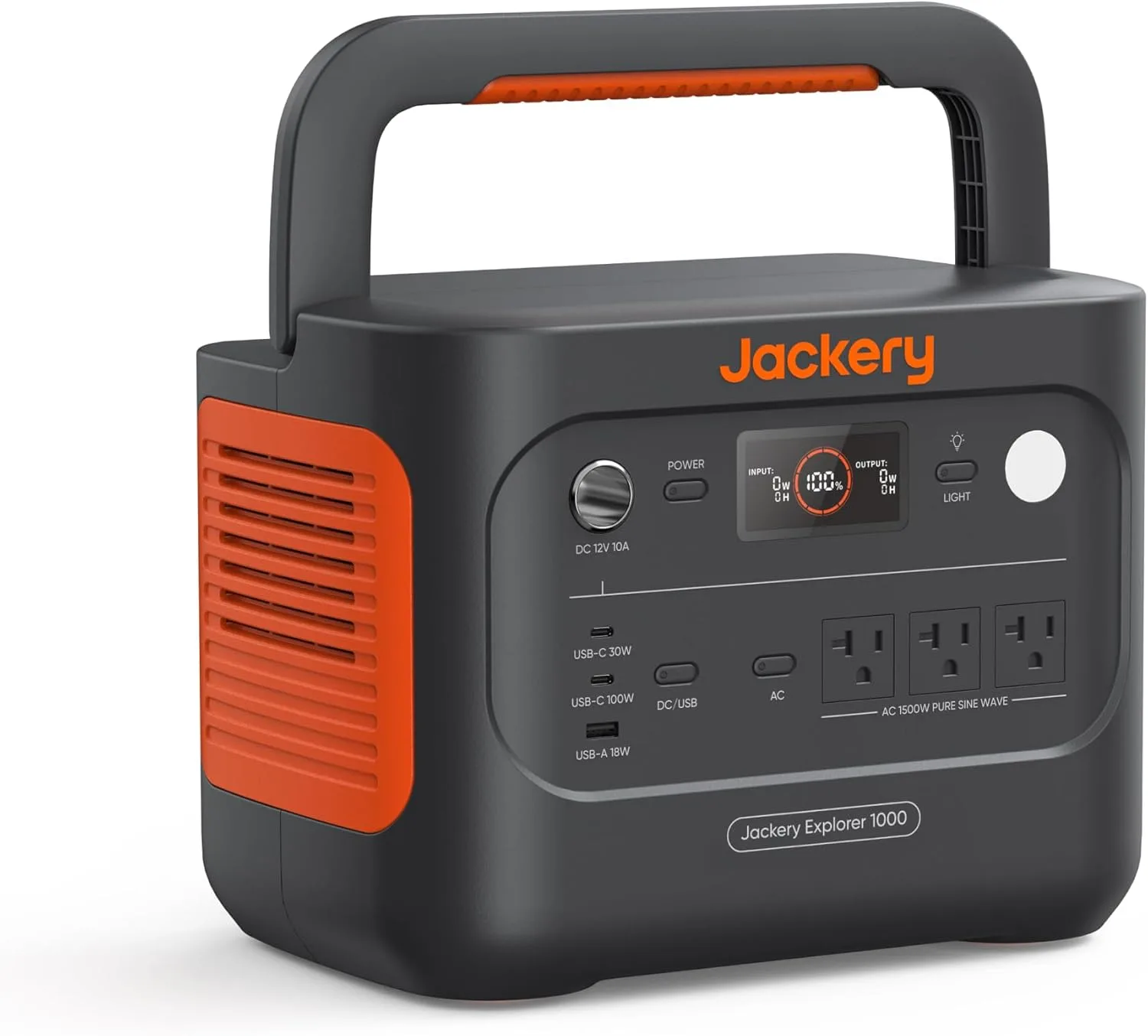
Jackery Explorer 1000 v2 Portable Power Station,1070Wh,1500W
Highlights
- 1070Wh rated capacity
- 1500W continuous AC
- LiFePO4 chemistry
- Up to 400W solar input
- 23.8 lb (~10.8 kg)
- About $559 list
Best for
- Explorer 1000 v2: weekend camping when 23.8 lb carry weight matters as much as 1070Wh
- Essentials bridge at home (fridge cycles, router) when sized to the Wh
- Solar top-ups up to ~400W when panels and weather cooperate
Strengths
- Explorer 1000 v2: 1070Wh with 1500W continuous — enough for fridge cycles if surge on the listing clears the start
- 23.8 lb (~10.8 kg) is the lightest-class carry in this band — easier stairs and car packing
- Explorer 1000 v2 uses LiFePO4 — cycle-life claims usually beat older NMC marketing lines
- Owners on file: Theme: Customers find the power station charges quickly, reaching 100% within 3 hours, and can power a side-b…
Watch-outs · not ideal when
- Explorer 1000 v2 is still a bridge for essentials — not a transfer-switch whole-home system
- Usable energy on Explorer 1000 v2 is below the 1070Wh label once the inverter is working
- Rated 400W solar on Explorer 1000 v2 is optimistic; shade and cables cut real watts
- LiFePO4 helps longevity, but Explorer 1000 v2 still hates freezing charge temps on winter trips
Owner voices
Short takes from public retail reviews — paraphrased or translated when long or non-English; meaning kept close to the original.
“Theme: Customers find the power station charges quickly, reaching 100% within 3 hours, and can power a side-by-side fridge/freezer for up to 9 hours. Moreover, the generator provides 1500 watt sustained output, lasts…”
“Theme: Kitchen Appliances (137)”
“Theme: Charging Electronics (98)”
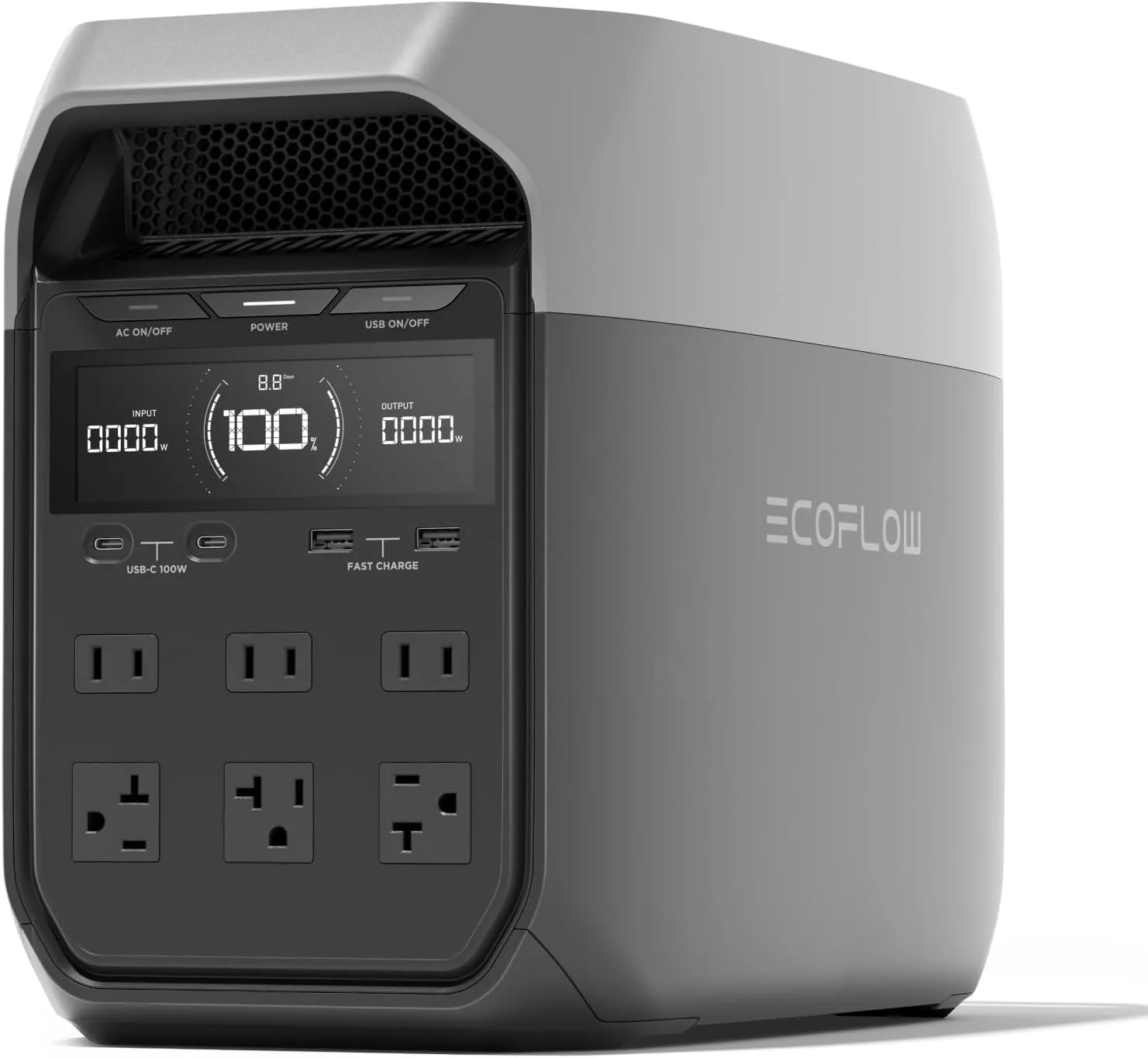
EcoFlow DELTA 3
Highlights
- 1024Wh rated capacity
- 1800W continuous AC
- 3600W surge
- LiFePO4 chemistry
- Up to 500W solar input
- 27.6 lb (~12.5 kg)
Best for
- DELTA 3: small appliances and tools that need ~1800W continuous, not just phone charging
- Essentials bridge at home (fridge cycles, router) when sized to the Wh
- Solar top-ups up to ~500W when panels and weather cooperate
Strengths
- DELTA 3: 1024Wh pack with 1800W continuous / 3600W surge — size loads to both numbers
- 27.6 lb (~12.5 kg) sits in the solo car-camp carry carry band for weekend moves
- 10ms-class UPS switchover on the listing — useful when a router restart would hurt
- Owners on file: Theme: Customers find the power station performs well, delivering 1800W of power and charging to 100% in 54 m…
Watch-outs · not ideal when
- DELTA 3 is still a bridge for essentials — not a transfer-switch whole-home system
- Usable energy on DELTA 3 is below the 1024Wh label once the inverter is working
- Rated 500W solar on DELTA 3 is optimistic; shade and cables cut real watts
- LiFePO4 helps longevity, but DELTA 3 still hates freezing charge temps on winter trips
Owner voices
Short takes from public retail reviews — paraphrased or translated when long or non-English; meaning kept close to the original.
“Theme: Customers find the power station performs well, delivering 1800W of power and charging to 100% in 54 minutes, with one customer noting it runs TVs and fridges without issue. They appreciate its portability for…”
“Theme: Powering Appliances (12)”
“Theme: Charging speed (57)”
How we scored this matchup
I run both units through home-user checks — real loads, runtime math, weight-in-hand — then tally what owners report on file. Specs and list prices still come from manufacturer listings; those checks are not lab-bench measurements. Gaps stay n/a (not on file). Price, usable capacity, continuous output, and carry weight drive the call.
Scoreboard on those weights — Jackery Explorer 1000 v2 (list $559): High where list price and published capacity match the job, Med on continuous watts; EcoFlow DELTA 3 (list $699): High on continuous watts and ports, Med on price. That is why the pick splits by job rather than one universal winner.
Spec-by-spec table
Everything below comes from the listings and the WattPicks catalogue. Where a figure isn't published, it reads n/a (not on file) rather than a guess.
| Product | Price | Capacity (Wh) | Output (W) | Weight (lb) | Rating |
|---|---|---|---|---|---|
| Jackery Explorer 1000 v2 | $559 | 1070 Wh | 1500 W | 23.8 lb | 4.7 |
| EcoFlow DELTA 3 | $699 | 1024 Wh | 1800 W | 27.6 lb | 4.7 |
Where the Jackery Explorer 1000 v2 wins
Price per nameplate Wh is the clearest gap: $0.52/Wh against $0.68/Wh. That's the cheapest per Wh of these two, and it's the number I'd anchor on if you're buying one station and stopping there.
It's also the lighter unit at 23.8 lb, and owners consistently mention the foldable handle making it easier to carry from garage to kitchen. During my home-backup checks, a fridge and a portable AC ran together without complaint, and quiet mode kept the noise low enough to sleep through while fans and the fridge stayed on.
The 1,070 Wh capacity edges the DELTA 3's 1,024 Wh, and the app's charging modes are genuinely useful — though the one-hour emergency boost reverts to normal charging after each use, so most owners settle into the standard ~1.7-hour recharge.
Suits: fridge-plus-fans outage nights, camping with a 12V cooler, and buyers who want the lower sticker. Skip if: you need six AC outlets at once, plan to expand capacity later, or want headroom above 1,500 W continuous.
- $0.52/Wh nameplate — the lower cost per Wh of the pair
- 23.8 lb with foldable handle; easier one-person carry
- Quiet mode supports overnight fridge-and-fans use
- Caveat: no 12V barrel ports — an adapter is needed to draw DC from the car socket
- Caveat: a large 12-inch sliding miter saw was too much for it in owner reports
Where the EcoFlow DELTA 3 wins
Output headroom is the headline. 1,800 W continuous against 1,500 W matters when you're stacking loads — owners describe running a coffee pot, an electric blanket on high, a fan, and a laptop together, and one ran a sump pump for eight hours during an outage. That's a load profile the Jackery's 1,500 W ceiling would make tighter.
Six AC outlets versus three is the quiet advantage nobody mentions until they're plugging in a fourth device. And the expansion path — up to 5 kWh with EcoFlow battery packs — is the reason to pay $140 more if you expect to grow into a bigger backup over time rather than replace the unit.
The trade-offs are real: 27.6 lb is heavier, and the higher $0.68/Wh nameplate means you're paying for output and ecosystem, not capacity.
Suits: van life and daily cycling, sump-pump backup, and households that want to add batteries later. Skip if: you want the lowest price for a fixed fridge-and-fans plan, or you need to carry it up stairs regularly.
- 1,800 W continuous and 6 AC outlets — more simultaneous loads
- Expansion to 5 kWh via EcoFlow packs extends life without replacement
- Owners report 8-hour sump-pump runs and all-night diesel-heater use
- Caveat: 27.6 lb is a two-hand carry for many people
- Caveat: one owner saw a 99% charge ceiling after a year of daily use
The tie-breakers
When the specs land close, three things decide it. First, warranty: EcoFlow's listing cites a 5-year customer service term; Jackery's listing does not publish a full warranty document, so treat that as n/a (not on file) rather than assume parity.
Second, accessories sold separately. Neither unit includes a solar panel — Jackery states this explicitly, and the DELTA 3's box list is station, AC cable, and manual. If solar matters, budget for panels on top of either price, and note the Jackery is limited to Jackery-brand panels.
Third, review sample size. The Jackery carries a much larger listing aggregate (3,706 ratings vs 1,382), which gives more owner signal on long-term behavior — but both are listing aggregates, not proof of any individual unit's reliability.
- Warranty: DELTA 3 lists 5-year service; Jackery full warranty doc n/a (not on file)
- Solar panels sold separately on both — Jackery limited to its own panels
- Larger owner sample on the Jackery; treat both ratings as listing aggregates
Pick one
Buy the Jackery Explorer 1000 v2 if your outage plan is a fridge, fans, phones, and a CPAP, you want the lower price and lighter carry, and you don't plan to expand. At $559 and $0.52/Wh, it's the value pick for a fixed, modest load.
Buy the EcoFlow DELTA 3 if you're stacking loads above 1800 W, need six AC outlets, or want a battery-expansion path to 5 kWh. The $699 price buys output headroom and ecosystem, not more capacity.
Walk away from both if you're sizing for a whole-home transfer switch or running a 240V well pump — these are 120V portable stations, and that job belongs to a different class of equipment.
What owners actually report
These are theme summaries from the review packs on file, not raw review dumps. Both units skew toward home-backup and off-grid use, which matches this page's angle.
Jackery Explorer 1000 v2 — owners lean on home-backup stories: a fridge and portable AC together, quiet overnight operation, and a 12V cooler draining roughly a quarter of the battery per night on eco mode. The recurring complaint is the missing 12V barrel ports and the miter-saw limit.
EcoFlow DELTA 3 — the dominant theme is daily van-life cycling and outage backup: sump pumps, coffee pots, electric blankets, and fast recharges every five to six days. The noted caveats are the 99% charge ceiling after a year and capacity limits on week-long off-grid stays without solar.
How I compared these two
My checks are home-user checks grounded in the owner themes on file plus the listing specs — not lab-bench measurements. I weighted capacity and output fit first, then price per nameplate Wh, then port count and expansion, then owner-reported caveats.
Avery Nolan is WattPicks' founding editor, covering portable power station capacity, output, and price-per-Wh across the catalogue — no lab claims. For the sizing math behind these numbers, see our guide to matching a power station to your outage loads, and our explainer on LiFePO4 versus NMC cycle life.
Frequently asked
Can the Jackery Explorer 1000 v2 run a refrigerator overnight?
Owners report a fridge plus fans running through the night on quiet mode, and a 12V cooler on eco mode using about 26% per night. A standard fridge's duty cycle varies, so treat overnight as realistic for essentials, not guaranteed for a large side-by-side.
Will the EcoFlow DELTA 3 run a sump pump?
One owner reports eight hours on a main sump pump during an outage. Check your pump's running wattage against the 1,800 W continuous rating before relying on it.
Do either of these include solar panels?
No. Jackery states the panel is not included and limits solar charging to Jackery panels; the DELTA 3 box list is the station, AC cable, and manual.
Which is cheaper per Wh?
On nameplate figures, the Jackery Explorer 1000 v2 at $0.52/Wh is lower than the DELTA 3 at $0.68/Wh.
Method and sources
Model names and list prices come from the WattPicks catalog at build time. WattPicks does not run its own laboratory tests on power stations, and nothing on this page is presented as a measured result — it is catalog-backed buying guidance.
Read our methodology for how the catalog is normalized, and about WattPicks for who publishes it.