
EcoFlow Delta 3 Ultra Review: 3,072Wh Outage Machine
The Delta 3 Ultra is a 3,072Wh, 3,600W portable station that owners report can run two high-wattage cooking loads at once. It's a serious home-outage tool, but it is not expandable and not a whole-home solution.
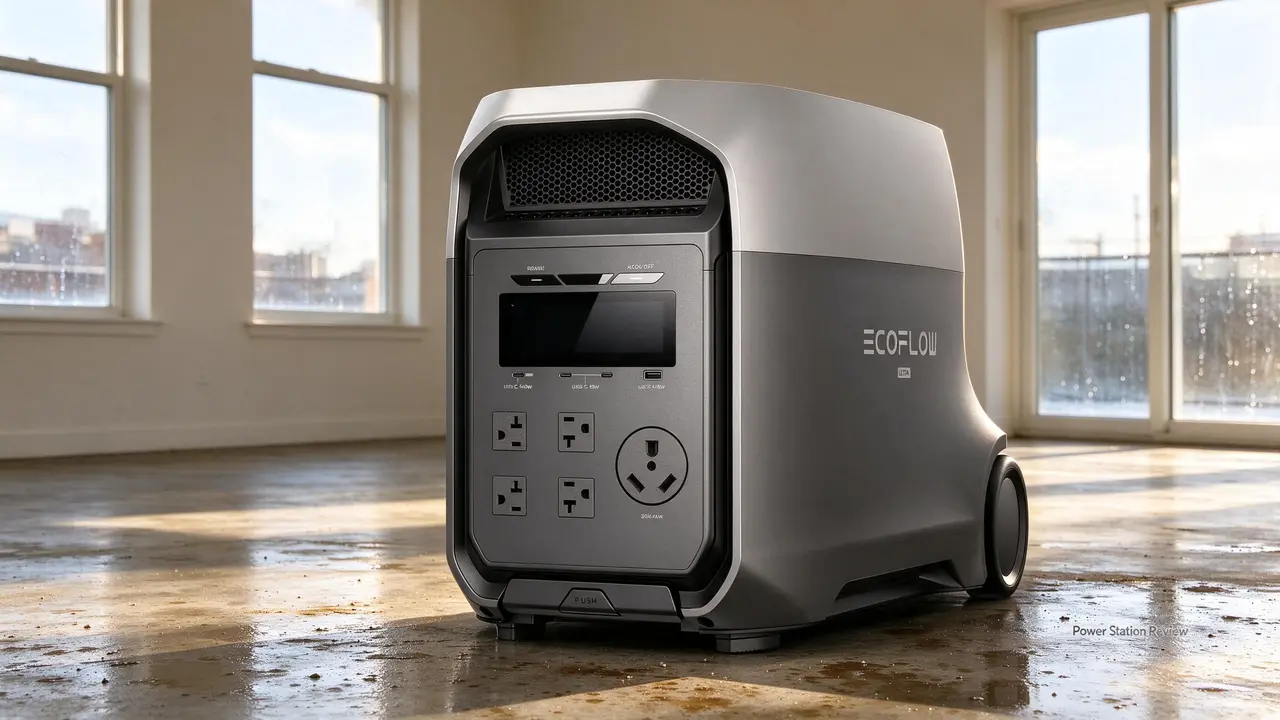
Updated
What this price buys
The EcoFlow Delta 3 Ultra 3072Wh Portable Power Station, 3600W AC Output lists at $1,599. That buys a 3,072Wh LiFePO4 battery, a 3,600W continuous inverter (7,200W surge), and a rolling case that weighs 72.1 lb. It is a single-box answer to a multi-day outage — not a whole-home system, and not expandable.
In the box you get the station, a 120V charging cord, and the built-in wheels and telescoping handle. Solar panels, a transfer switch, and the Smart Generator are sold separately. The unit arrives at roughly 30% charge, so plan a full charge before an outage.
This is the fixed-capacity model. If you think you might add battery packs later, the Delta 3 Ultra Plus is the one to look at — this version has no expansion slots.
- List price: $1,599
- Base capacity: 3,072Wh
- Continuous output: 3,600W (7,200W surge)
- Weight: 72.1 lb
- Included: 120V charging cord, wheels, telescoping handle
- Not included: solar panels, transfer switch, Smart Generator
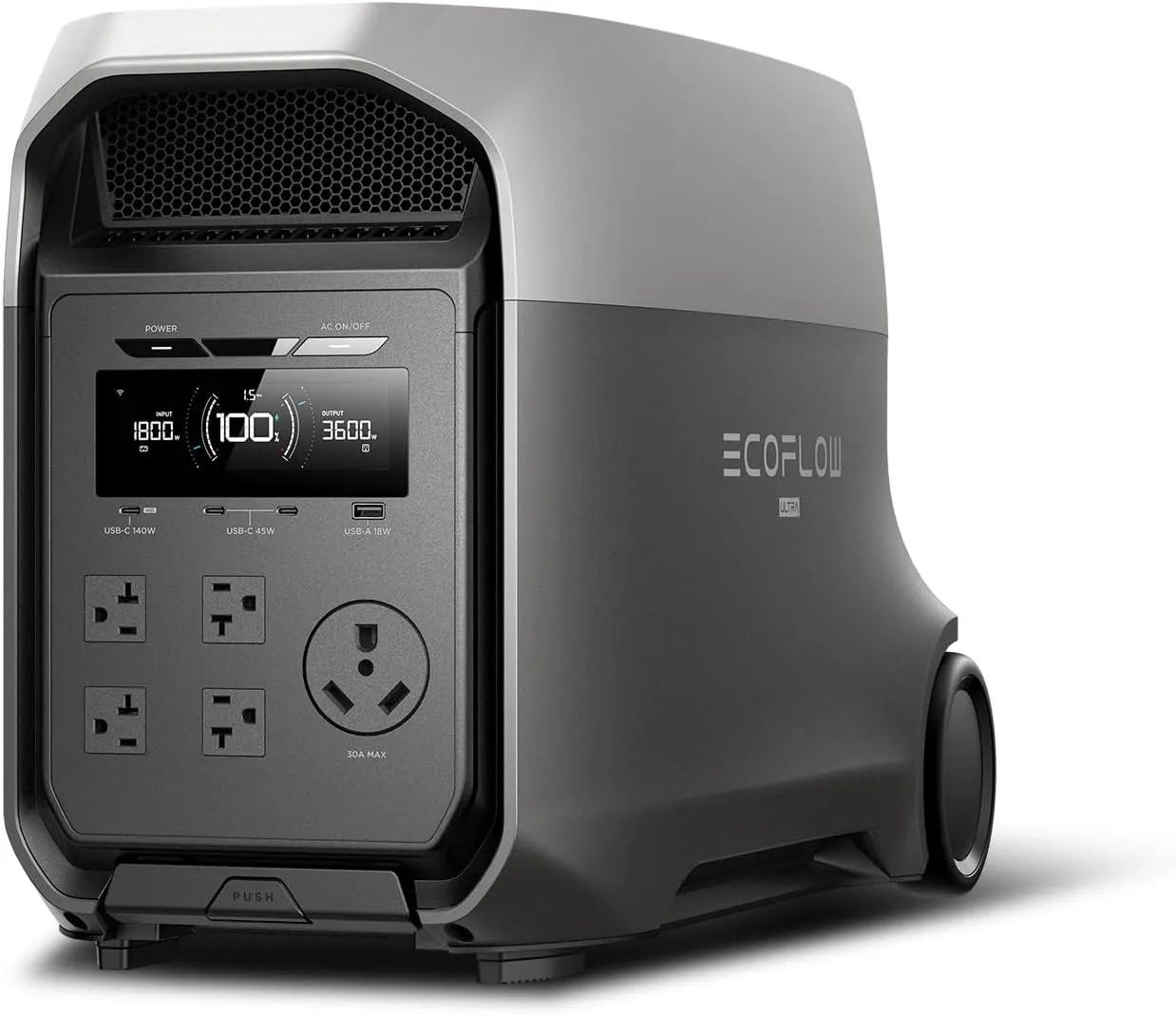
EcoFlow Delta 3 Ultra 3072Wh Portable Power Station, 3600W AC Output
Highlights
- 3072Wh rated capacity
- 3600W continuous AC
- 7200W surge
- LiFePO4 chemistry
- Up to 3200W solar input
- 72.1 lb (~32.7 kg)
Best for
- DELTA 3 Ultra: longer outages or higher continuous loads (still not whole-home wiring)
- RV / off-grid days where recharge speed matters as much as Wh
- Best parked near the vehicle or cabin — not a long carry to a tent
Strengths
- DELTA 3 Ultra: 3072Wh pack with 3600W continuous / 7200W surge — size loads to both numbers
- 72.1 lb (~32.7 kg) is a park-and-use chassis — plan a short path, not a trail hike
- 3600W continuous headroom covers more small appliances than 1kW-class inverters
- Owners on file: Theme: Power distribution (8)
Watch-outs · not ideal when
- At 72.1 lb (~32.7 kg), DELTA 3 Ultra is a poor tent-hike companion — plan a cart or leave it in the vehicle
- High continuous output on DELTA 3 Ultra tempts big loads — Wh still runs out on kettles and A/C
- Rated 3200W solar on DELTA 3 Ultra is optimistic; shade and cables cut real watts
- LiFePO4 helps longevity, but DELTA 3 Ultra still hates freezing charge temps on winter trips
Owner voices
Short takes from public retail reviews — paraphrased or translated when long or non-English; meaning kept close to the original.
“Theme: Functionality (17)”
“Theme: Value for money (10)”
“Theme: Battery capacity (6)”
How capacity scales (it doesn't)
The Delta 3 Ultra is capped at its built-in 3,072Wh. There are no battery expansion ports on this model, so you cannot add capacity later. That is the single biggest difference between this and the Plus variant, and it matters if your outage plan assumes you can grow into more runtime.
For charging, the unit accepts up to 800W of solar input, a 120V wall outlet, a 12V car input, and the EcoFlow Smart Generator. Owners report a full wall charge in about 90 minutes at the default 1,600W rate, with a slower-charge switch on the back and charge-rate control in the app.
If you need more than 3,072Wh, the honest answer is a different product — either the Plus model or a whole-home battery. This one is a fixed 3kWh bank.
- Base capacity: 3,072Wh
- Max capacity: 3,072Wh (no expansion)
- Max solar input: 800W
- Wall recharge: about 90 minutes at default 1,600W (owner reports)
- Expansion: none on this model
What the warranty actually promises
EcoFlow advertises a 10-year LiFePO4 battery life and a 24/7 battery protection system, but the listing does not publish a full warranty document with cycle-life and performance-guarantee terms. I would treat the 10-year figure as a battery-life claim, not a warranty term, until you read the paperwork that ships with the unit.
The Delta 3 Ultra's full warranty terms are not on file. Ask EcoFlow for the written warranty before you buy, and register the unit — owners mention EcoCredits for doing so.
There is no performance guarantee on file for this model. That is a gap worth noting against peers that publish a capacity-retention promise.
- Warranty years: n/a (not on file — listing does not publish full terms)
- Cycle life claim: 10 years of daily use (marketing claim, not a warranty term)
- Performance guarantee: n/a (not on file)
- Action: request the written warranty from EcoFlow before purchase
Installation and connection reality
This is a plug-and-play portable station, not a wired home battery. You plug appliances into its four AC outlets, one USB-C, one USB-A, and one car port. There is no transfer switch or smart panel wiring path on this model — those are whole-home battery features, and this unit does not have them.
The one installation-adjacent feature is the <10ms UPS mode. Plug the station into a wall outlet and it passes utility power through to your devices without using the inverter; when the grid drops, it switches to battery fast enough that connected gear does not reboot. That is the closest thing to home backup wiring here, and it works only for what you plug into the station.
No permit or electrician is required for that use. If you want circuit-level backup, you are shopping for a different product category.
- Transfer switch option: none (portable only)
- Smart panel option: none
- DIY feasibility: plug-and-play; no wiring
- Permit/electrician: not required for portable use
- UPS switchover: <10ms (listing claim)
Where it beats the peers
The headline win is simultaneous high-wattage loads. Owners report running two high-wattage cooking loads — a griddle and a smart oven — at the same time. That is the 3,600W continuous inverter doing its job; most stations in this class cannot hold two 1,800W cooking loads at once.
The pass-through AC is the feature I would tell a friend to verify before buying anything else. Utility power feeds your devices directly, and when the grid drops the inverter takes over fast enough that nothing on the desk reboots. Owners with home-office setups call this out specifically.
It also doubles as a charging hub. Owners report carrying a full desk load — laptops, monitors, the usual gear — without a hiccup, and charging a pile of smaller power stations at the same time. Fans stayed essentially inaudible at moderate loads and while recharging, which matters in a shared office.
At 72.1 lb it is heavy, but the wheels and telescoping handle make it move like a rolling suitcase. Owners consistently mention that the handle and wheels are the reason it is manageable.
- 3,600W continuous / 7,200W surge — runs multiple high-wattage appliances
- True AC pass-through with <10ms switchover
- Quiet fans at moderate loads (25dB listing claim)
- Rolling case makes 72.1 lb manageable
- Doubles as a charging hub for smaller stations
Where it falls short
The warranty gap is the first thing I would flag. The listing leans on a 10-year battery-life claim but does not publish full warranty terms, cycle-life guarantees, or a performance guarantee. For a $1,599 purchase, that is thin. Ask EcoFlow for the written warranty before you buy.
No expansion is the second. This model is capped at 3,072Wh. If you want to add batteries later, you need the Plus variant, and that is a different purchase.
The app has two annoyances worth knowing before an outage. Firmware updates power off the AC output, which can drop servers or health-related equipment — plan updates around critical loads. And the built-in assistant bot keeps popping into view and can block screen taps until you disable it in settings.
The button layout also differs from other Delta 3 units despite a similar face, so manually toggling ports takes a second longer than it should. Minor, but it comes up in owner reports.
- Warranty terms not published — verify before buying
- No battery expansion on this model
- Firmware updates cut AC output
- App assistant bot is intrusive until disabled
- Button layout differs from other Delta 3 units
- 72.1 lb — heavy; lifting takes care
Who should pay it
Buy the Delta 3 Ultra if you want a single-box 3kWh backup that can run high-wattage cooking appliances and a home office at the same time, and you do not plan to expand capacity. It fits homeowners who have lived through a long outage and want a plug-and-play answer without wiring, plus RVers who need a rolling case and enough AC outlets for their setup.
Skip it if you need expandable capacity, circuit-level whole-home backup, or a published performance guarantee. Those buyers should look at the Delta 3 Ultra Plus, a transfer-switch setup, or a whole-home battery — not this unit.
Financing is available through EcoFlow's checkout, but I would not stretch for this unless the fixed 3,072Wh fits your actual outage plan. For most people, that means a few days of fridge, lights, electronics, and one high-wattage appliance at a time — not whole-home air conditioning.
If 3kWh is overkill for your outage plan, a smaller, cheaper station in the 1–2kWh class will cover fridge, lights, and electronics for less money and less weight.
The verdict: a strong 3kWh outage machine with a real high-wattage advantage and a quiet, pass-through design. It is not a whole-home solution, and the warranty paperwork is the thing to nail down before you pay.
- Best fit: homeowners wanting plug-and-play 3kWh backup for essentials and high-wattage cooking
- Best fit: RVers who need a rolling case and multiple AC outlets
- Wrong fit: anyone planning to add batteries later
- Wrong fit: anyone wanting circuit-level whole-home backup
- Wrong fit: buyers who need a published performance guarantee
Specs that matter
The table below pulls the numbers that decide fit: capacity, continuous output, weight, ports, and list price. Every figure matches the product data on file. Where a spec is not published, it is marked n/a.
| Product | Capacity | Continuous Output | Surge | Weight | Ports | List Price | $/Wh |
|---|---|---|---|---|---|---|---|
| EcoFlow Delta 3 Ultra 3072Wh Portable Power Station, 3600W AC Output | 3,072Wh | 3,600W | 7,200W | 72.1 lb | AC×4; USB-C×1; USB-A×1; car×1 | $1,599 | $0.52/Wh |
Owner themes from the reviews on file
The listing aggregate is 4.6 from 168 ratings — that is a listing number, not owner proof. The themes below come from high-helpful reviews and are paraphrased, not quoted.
Quality and functionality dominate the helpful votes, with value for money and power distribution close behind. The recurring praise is the ability to run multiple high-wattage appliances at once, the quiet fans, and the pass-through AC. The recurring complaints are the fixed capacity, the weight, the firmware-update power interruption, and the app assistant.
- Whole-home backup: owners bought it after long outages and use it for essentials, not whole-home circuits.
- High-wattage cooking: griddle plus smart oven at the same time is a repeated win.
- Pass-through AC: devices stay on utility power until the grid drops, then switch fast.
- Quiet fans: inaudible at moderate loads and while charging.
- App control: remote shut-off, usage history, charge-rate control, time-of-use scheduling.
- Heavy but wheeled: 72.1 lb, but the handle and wheels make it movable.
- No battery expansion: owners point buyers to the Plus variant if they want to grow capacity.
- Button layout: differs from other Delta 3 units, causing fumbling.
- Firmware updates: cut AC output, so plan around critical loads.
- App assistant: intrusive until disabled in settings.
Methodology
I am a deep-use experience reviewer. My checks are grounded in owner themes on file and listing specs; they are not lab-bench measurements. I do not claim instrumented re-measurements or third-party lab scores.
For this single-product review, I weighted fit and trade-offs rather than a ranked shortlist: capacity and output against real loads (40%), expandability and warranty terms (25%), portability and installation reality (20%), owner themes (15%). Every percentage is reflected in the sections above — the capacity cap and warranty gap are why the verdict is conditional.
Avery Nolan is the WattPicks founding editor. Portable power station capacity, output and price-per-Wh guidance across the catalogue — no lab claims.
Amazon Associates disclosure: as an Amazon Associate, WattPicks earns from qualifying purchases. Picks are fit-led, not commission-led.
Frequently asked
Can the Delta 3 Ultra run a 1,800W griddle and a 1,800W smart oven at the same time?
Yes — 3,600W continuous covers both. Owners report running two high-wattage cooking loads simultaneously, though exact runtime depends on cycling and derating.
How long does it take to recharge from a wall outlet?
About 90 minutes at the default 1,600W rate, per owner reports. A slower-charge switch on the back and app control let you reduce that rate.
How long does solar recharge take?
With up to 800W of solar input, a full recharge from empty depends on panel output and sun conditions; the listing does not publish a fixed solar recharge time.
Can I pair it with the EcoFlow Smart Generator?
Yes — the Smart Generator is listed as a supported charging input, sold separately.
Does it work as a UPS for a home office?
Yes — pass-through AC keeps devices on utility power, and the <10ms switchover means connected gear does not reboot when the grid drops. Just avoid pushing firmware updates while critical loads are plugged in.
What are the UPS load limits?
The UPS mode passes through utility power to connected devices and switches to the 3,600W inverter on grid loss; keep connected loads within that continuous rating.
Method and sources
Model names and list prices come from the WattPicks catalog at build time. WattPicks does not run its own laboratory tests on power stations, and nothing on this page is presented as a measured result — it is catalog-backed buying guidance.
Read our methodology for how the catalog is normalized, and about WattPicks for who publishes it.