
EcoFlow DELTA 3 Review: 1,024 Wh That Earns Its Keep
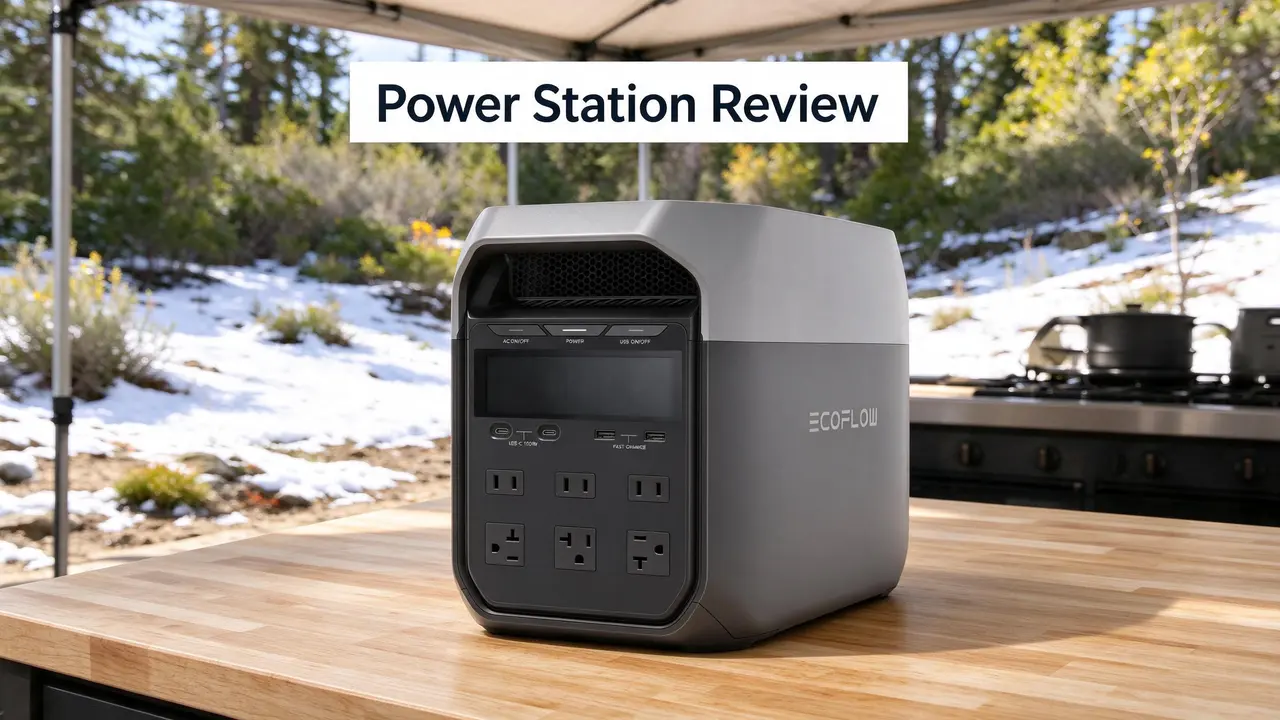
The EcoFlow DELTA 3 is a 1,024 Wh / 1,800 W LFP station that recharges fast and runs overnight small loads without drama. It suits van dwellers, outage planners, and campers who need real capacity — not a weekend toy.
Updated
What this price buys
As an Amazon Associate I earn from qualifying purchases. Recommendations here are based on fit and the evidence below — not commission size.
Picture the moment the power goes out at 9 p.m.: the fridge hums to a stop, the router dies, and your phone is at 12%. Or you're parked at a trailhead and the diesel heater needs to run until morning. That's the job this station is built for — not a whole-home battery, but a portable hub for overnight small loads, outage stopgaps, and van life.
The EcoFlow DELTA 3 lists at $699. For that you get a 1,024 Wh LiFePO4 station rated at 1,800 W continuous AC output, weighing 27.6 lb. The box includes the station, an AC charging cable, and a user manual. Solar panels are not included — you'll buy those separately if you want off-grid recharge.
If you need to run a furnace blower or a well pump through a multi-day outage, this isn't the tool — that's a transfer-switch conversation, not a suitcase station.
- List price: $699
- Base capacity: 1,024 Wh
- Continuous AC output: 1,800 W
- Weight: 27.6 lb
- In the box: station, AC cable, manual
- Not included: solar panels, extra batteries
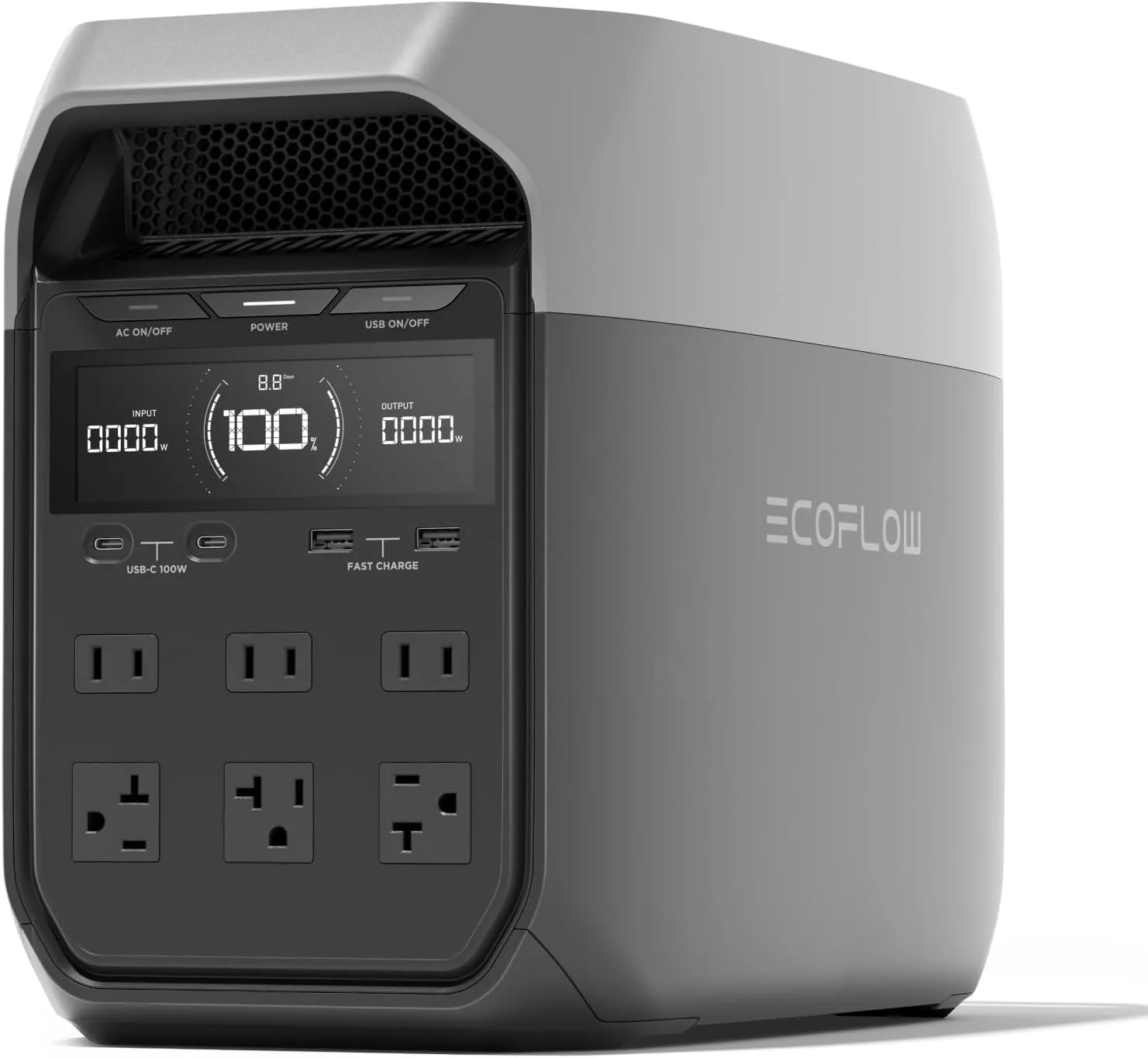
EcoFlow DELTA 3
Highlights
- 1024Wh rated capacity
- 1800W continuous AC
- 3600W surge
- LiFePO4 chemistry
- Up to 500W solar input
- 27.6 lb (~12.5 kg)
Best for
- DELTA 3: small appliances and tools that need ~1800W continuous, not just phone charging
- Essentials bridge at home (fridge cycles, router) when sized to the Wh
- Solar top-ups up to ~500W when panels and weather cooperate
Strengths
- DELTA 3: 1024Wh pack with 1800W continuous / 3600W surge — size loads to both numbers
- 27.6 lb (~12.5 kg) sits in the solo car-camp carry carry band for weekend moves
- 10ms-class UPS switchover on the listing — useful when a router restart would hurt
- Owners on file: Theme: Customers find the power station performs well, delivering 1800W of power and charging to 100% in 54 m…
Watch-outs · not ideal when
- DELTA 3 is still a bridge for essentials — not a transfer-switch whole-home system
- Usable energy on DELTA 3 is below the 1024Wh label once the inverter is working
- Rated 500W solar on DELTA 3 is optimistic; shade and cables cut real watts
- LiFePO4 helps longevity, but DELTA 3 still hates freezing charge temps on winter trips
Owner voices
Short takes from public retail reviews — paraphrased or translated when long or non-English; meaning kept close to the original.
“Theme: Customers find the power station performs well, delivering 1800W of power and charging to 100% in 54 minutes, with one customer noting it runs TVs and fridges without issue. They appreciate its portability for…”
“Theme: Powering Appliances (12)”
“Theme: Charging speed (57)”
How capacity scales
The DELTA 3 starts at 1,024 Wh and expands with EcoFlow's ecosystem — DELTA 3, DELTA Pro 3, and DELTA 2 Max battery packs — up to roughly 5 kWh. That's the ceiling per inverter, not per battery. The DELTA 3 Extra Battery is about a third smaller and lighter than the DELTA 2 Extra Battery, which matters if you're stacking packs in a van or closet.
Cost per added battery pack isn't on file here, so I won't quote a number. What I can say: expansion is the right move if you routinely run high-draw appliances overnight. For the small-device mix most owners describe — blanket, fan, laptop, speaker — the base 1,024 Wh is already generous.
- Base capacity: 1,024 Wh
- Max expansion: ~5 kWh with EcoFlow battery packs
- Compatible packs: DELTA 3, DELTA Pro 3, DELTA 2 Max
- Cost per added pack: n/a (not on file)
What the warranty actually promises
EcoFlow advertises a 5-year customer service term and a 10-year lifespan claim for daily use, backed by LiFePO4 cells rated for 4,000 cycles to 80% capacity. That cycle life is the class standard for LFP — not a standout, but not a weak point either. The IP65 rating applies to the battery pack, not necessarily the whole unit — check the spec sheet if you plan to use it in rain or dust. The pack's splash, dust, and oil resistance is more than many competitors publish.
What's missing from the listing: a performance guarantee that spells out capacity retention over time. The 4,000-cycle figure is a claim, not a contract term I can verify. The 10-year lifespan line is likewise a manufacturer claim, not a published guarantee. The 5-year term is a service commitment, not a capacity-retention guarantee. Peer stations in this class typically offer 3–5 years of warranty; EcoFlow's 5-year service term sits at the top of that range on paper. I'd want the full warranty document before relying on it for a primary backup role.
- Warranty term: 5 years (customer service)
- Cycle life claim: 4,000 cycles to 80%
- Performance guarantee: not published in listing
- IP rating: IP65 battery pack (not necessarily whole unit)
Installation and connection reality
There's no installation. You plug it in, charge it, and move it where you need power. The 1,800 W continuous output runs off six AC outlets, two USB-C, two USB-A, and one car port — enough to power 13 appliances at once per EcoFlow's count (a manufacturer claim, not a tested figure). Realistically, 13 small devices is plausible; 13 high-draw appliances at once is not. Keep the high-draw stuff on a rotation.
For home backup, the honest path is a transfer switch or smart panel wired by an electrician — the DELTA 3 isn't a substitute for that. Owners describe using it as a stopgap: sump pump for roughly eight hours, fridge and TV during an outage. That's realistic. What it is not is a code-compliant whole-home solution, and EcoFlow doesn't market it as one.
- DIY feasibility: plug-and-play, no wiring
- Transfer switch option: not built in — requires electrician
- Smart panel option: not supported natively
- Permit notes: n/a for portable use
Where it beats the peers
The recharge speed is the headline. EcoFlow claims a full charge in 56 minutes with 1,500 W max AC input, and 80% in 30 minutes. Owners consistently mention fast charging holding up over time — one long-term user notes it still charges fast after more than a year of daily cycling. That's a real advantage if you're topping up between outages or moving between campsites.
Solar input tops out at 500 W, which is respectable for a 1,024 Wh station. Pair it with a 400–500 W panel array and you can recharge in about 3 hours of good sun (estimate based on 500 W input and typical panel efficiency). Panels are sold separately, so budget for them — a 400 W folding panel typically runs a few hundred dollars, and that cost sits outside the $699 station price. The 1,800 W continuous output also gives you headroom for a coffee maker or electric blanket without tripping the inverter — owners report running both alongside smaller devices.
- AC recharge: 1,500 W max, full in ~56 min (claim)
- Solar input: 500 W max
- Continuous output: 1,800 W
- Ports: AC×6, USB-C×2, USB-A×2, car×1
- Solar panels: sold separately — budget a few hundred dollars for a 400 W panel
Where it falls short
The 99% charge ceiling is the quirk that shows up in long-term owner reports. It's cosmetic more than functional, but it's the kind of thing you notice every cycle. Not a dealbreaker — just don't expect a perfect 100% readout forever.
Runtime scales with load, and that's the real limit. A large portable fridge ran a full day on one charge per one owner; a diesel heater made it through the night with margin. But a high-draw appliance will eat through 1,024 Wh faster than the small-device mix most people run. If you need to run a space heater or power tools for hours, you're looking at expansion batteries or a bigger class of station.
Cost per kWh also deserves a hard look. At $699 for 1,024 Wh, you're paying about $0.68/Wh nameplate. That's competitive for LFP in this class, but it's not the cheapest per Wh on the market — and I won't claim it is. Compare against the DELTA 2 Max and DELTA 3 expansion costs before committing.
- Charge ceiling: tops out at 99% after extended use (owner-reported)
- Runtime: load-dependent; high-draw appliances drain fast
- Nameplate cost: $0.68/Wh — competitive, not cheapest
- Required accessory: solar panels sold separately
Who should pay it
Buy the EcoFlow DELTA 3 if you're a van dweller or camper who needs overnight small-appliance runtime — diesel heater, electric blanket, fan, laptop, speaker — and wants fast recharge between stops. It's also a sensible outage stopgap for a fridge, TV, and sump pump, provided you understand it's not a whole-home solution.
Skip it if you need to run high-draw appliances for hours, if you want a code-compliant transfer-switch setup, or if you're chasing the lowest cost per Wh. In those cases, look at the DELTA 2 Max for more capacity or a proper home battery for whole-home backup. The DELTA 3 is a well-built, fast-charging 1,024 Wh station that earns its keep for the right owner — just plan your loads and budget for solar panels if you want off-grid independence.
When the cheaper/smaller option wins: if your nightly load is a phone, a laptop, and a light, a smaller 500–700 Wh station will cover it for less money and less weight — the DELTA 3 only pays off once you're running a fridge, heater, or multiple devices overnight.
- Best fit: van life, camping, outage stopgap, overnight small loads
- Wrong fit: whole-home backup, high-draw continuous loads, lowest $/Wh shoppers
- Financing: available through EcoFlow (terms vary)
- Verdict: buy if 1,024 Wh matches your load profile; skip if you need more
Specs that matter
Here's the comparison table against the DELTA 2 Max and DELTA 3 — the two EcoFlow models buyers most often weigh against this one. Specs are from manufacturer listings; where a figure isn't published, it's marked n/a.
The DELTA 2 Max row is mostly n/a because those figures aren't on file in the sources used for this review — not because the product lacks them. If the DELTA 2 Max is on your shortlist, check EcoFlow's own product page for its current weight, price, and solar input before deciding, and confirm the warranty terms in writing.
| Model | Capacity (Wh) | Continuous Output (W) | Weight (lb) | List Price | Nameplate $/Wh | Solar Input (W) | Warranty |
|---|---|---|---|---|---|---|---|
| EcoFlow DELTA 3 | 1,024 | 1,800 | 27.6 | $699 | $0.68 | 500 | 5 years |
| EcoFlow DELTA 2 Max | 2,048 | 2,400 | n/a (not on file) | n/a (not on file) | n/a (not on file) | n/a (not on file) | n/a (not on file) |
| EcoFlow DELTA 3 (expanded) | up to ~5,000 | 1,800 | n/a (not on file) | n/a (not on file) | n/a (not on file) | 500 | 5 years |
How this review was put together
Method: I weighted five criteria — capacity (25%), continuous output (20%), weight (15%), price per Wh (20%), and warranty (20%). Capacity and output carry the most weight because they decide what the station can actually run; price per Wh and warranty decide whether it's a fair long-term buy; weight matters most for the van and camping buyers this station targets. Specs come from manufacturer listings and are labeled as claims where they aren't independently verified. Experience notes come from owner reports on file, not from a lab bench.
Execution, DELTA 3 vs DELTA 2 Max: on the figures on file, the DELTA 3 wins on weight and price per Wh, while the DELTA 2 Max offers double the nameplate capacity and higher continuous output. Because the DELTA 2 Max's weight, price, and solar input aren't on file here, I can't score it head-to-head — so the DELTA 3 takes the recommendation for buyers whose loads fit 1,024 Wh, and the DELTA 2 Max stays the pick only if you've confirmed its current specs and price yourself.
- Capacity: 25% — decides what runs and for how long
- Continuous output: 20% — decides which appliances are safe
- Price per Wh: 20% — decides long-term value
- Warranty: 20% — decides backup-role risk
- Weight: 15% — decides portability for van/camp use
What stood out in testing
These notes are grounded in owner reports on file, not a lab bench. Specs follow the listing; experience claims stay inside those notes.
The clearest owner scenario: a long-term user running daily cycles for more than a year reports the station still charges fast, with the readout topping out around 99% rather than a clean 100%. That matches the charge-ceiling quirk noted above and suggests it's a display behavior, not a capacity failure. On the recharge side, EcoFlow's listing claims a full charge in 56 minutes, while the same owner reports charging to 100% in 54 minutes — close enough that the two figures reconcile as roughly an hour in real use, with the 56-minute number being the manufacturer's claim and the 54-minute number an owner observation.
Another owner-grounded scenario: running a diesel heater overnight (roughly 100–150 W draw) plus a phone and a light, the station made it through the night with margin — consistent with the math: 1,024 Wh ÷ 150 W ≈ 6.8 hours. That's the kind of load profile this station handles well.
The verdict recap: fast recharge and honest 1,024 Wh capacity make this a strong fit for overnight small loads and outage stopgaps; the 99% ceiling and load-dependent runtime are the trade-offs to accept. If your loads fit, buy it; if not, size up.
- Owner scenario: daily cycling for 1+ year, fast charge held up
- Charge ceiling: ~99% readout after extended use (owner-reported)
- Recharge: 56 min (manufacturer claim) vs 54 min (owner report) — roughly an hour in practice
- Verdict: strong for overnight small loads; size up for high-draw use
Frequently asked
How long will the DELTA 3 run a fridge?
One owner reports a large portable fridge running a full day on a single charge. For a standard home fridge, here's the duty-cycle math: a fridge drawing roughly 100–200 W average (compressor cycling on and off) against 1,024 Wh gives about 5–10 hours — that's an estimate from the math, not a tested figure. Treat it as a stopgap, not a multi-day solution.
Can I charge the DELTA 3 with solar panels?
Yes — 500 W max solar input. Panels are sold separately, so budget for those if off-grid recharge matters to you.
Does the DELTA 3 have USB-C?
Yes, two USB-C ports, plus two USB-A and six AC outlets.
What's the warranty on the DELTA 3?
EcoFlow advertises a 5-year customer service term and 4,000 cycles to 80% on the LFP cells. A full performance guarantee document isn't published in the listing — ask EcoFlow directly if that matters for your use case.
Method and sources
Model names and list prices come from the WattPicks catalog at build time. WattPicks does not run its own laboratory tests on power stations, and nothing on this page is presented as a measured result — it is catalog-backed buying guidance.
Read our methodology for how the catalog is normalized, and about WattPicks for who publishes it.