
EcoFlow DELTA 3 Max Review: WhatBuys
The DELTA 3 Max is a 2,048 Wh LFP station with a 2,400 W inverter and a 5-year term — but the warranty document is thin on paper. Here is what the price actually covers, how capacity scales, and who should skip it.
Updated
What $1,199 actually puts on your floor
Start with the number that decides most of these purchases: $1,199 buys a 2,048 Wh LiFePO4 station with a 2,400 W AC inverter, four AC outlets, one USB-C port, and one USB-A port, in a 44.8 lb aluminum-and-plastic shell. That is the base configuration — there is no smaller trim and no stripped version to compare against.
What is in the box, from the listing: the station itself and the standard charging hardware EcoFlow ships with the DELTA 3 Max. What is not in the box: solar panels, a transfer switch, or any smart-panel hardware. If you want to recharge off the sun or wire it into a house circuit, those are separate purchases and separate line items.
One pricing note before the tables. The card has shown a deal price below list; every dollar figure in this review is the $1,199 list price, because that is the number you can plan around. Sale pricing moves, and a review built on a sticker that expires is not much of a review.
Disclosure: As an Amazon Associate, WattPicks earns from qualifying purchases. Picks here are fit-led, not commission-led. This unit was selected for review because its 2,048 Wh / 2,400 W combination sits at the center of the fixed-capacity, non-expandable class that most home-backup buyers actually shop — not because of any retailer arrangement.
- Base configuration: 2,048 Wh, 2,400 W continuous AC, 44.8 lb
- Included: station plus EcoFlow's standard charging gear per listing
- Not included: solar panels, transfer switch, smart panel
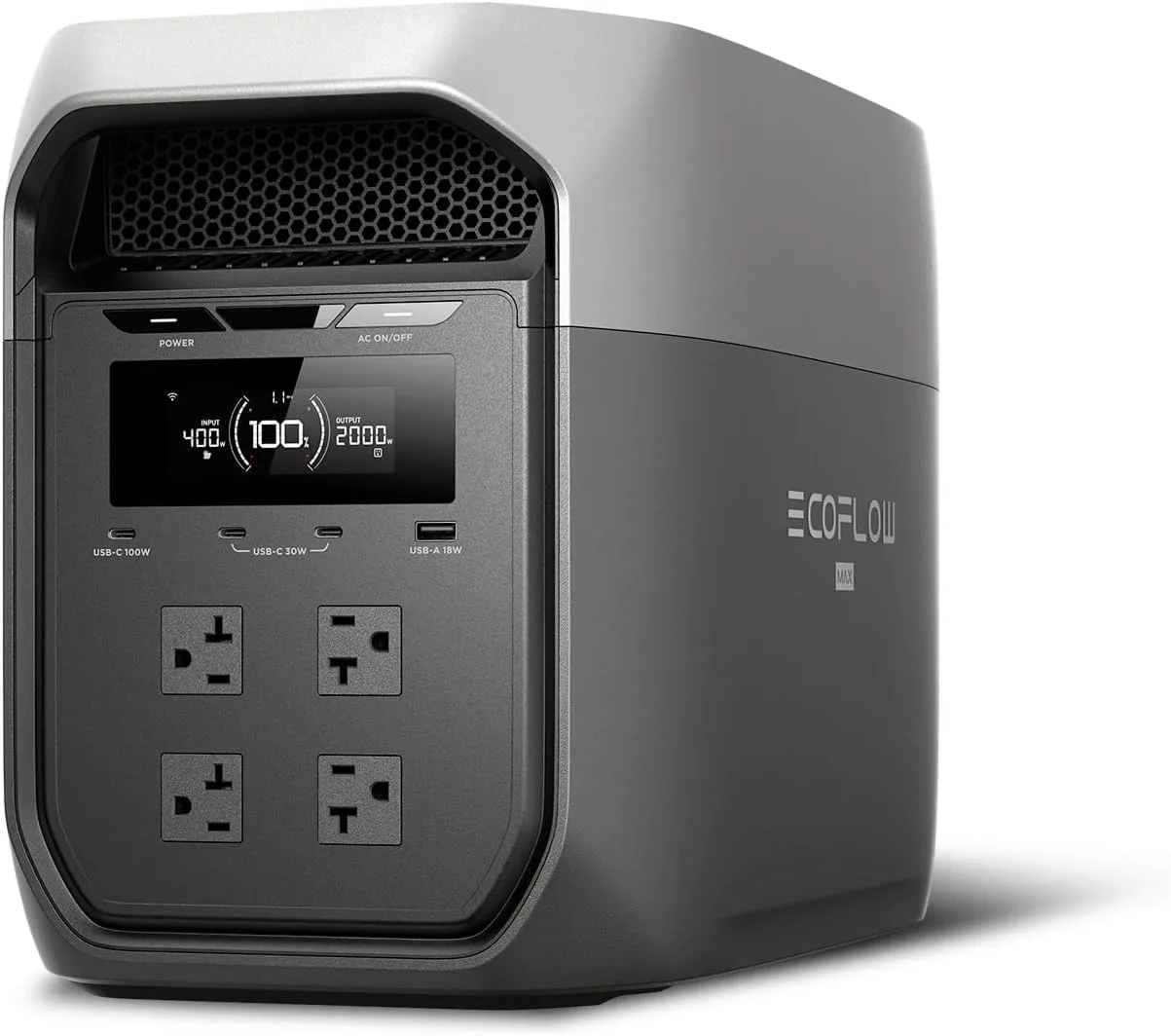
EcoFlow DELTA 3 Max Portable Power Station, 2048Wh LFP Battery
Highlights
- 2048Wh rated capacity
- 2400W continuous AC
- 4800W surge
- LiFePO4 chemistry
- Up to 500W solar input
- 44.8 lb (~20.3 kg)
Best for
- DELTA 3 Max: longer outages or higher continuous loads (still not whole-home wiring)
- RV / off-grid days where recharge speed matters as much as Wh
- Best parked near the vehicle or cabin — not a long carry to a tent
Strengths
- DELTA 3 Max: 2048Wh pack with 2400W continuous / 4800W surge — size loads to both numbers
- 44.8 lb (~20.3 kg) is a park-and-use chassis — plan a short path, not a trail hike
- 10ms-class UPS switchover on the listing — useful when a router restart would hurt
- Owners on file: Theme: Customers find this power station to be a top-quality system that charges super fast and provides long…
Watch-outs · not ideal when
- At 44.8 lb (~20.3 kg), DELTA 3 Max is a poor tent-hike companion — plan a cart or leave it in the vehicle
- High continuous output on DELTA 3 Max tempts big loads — Wh still runs out on kettles and A/C
- Rated 500W solar on DELTA 3 Max is optimistic; shade and cables cut real watts
- LiFePO4 helps longevity, but DELTA 3 Max still hates freezing charge temps on winter trips
Owner voices
Short takes from public retail reviews — paraphrased or translated when long or non-English; meaning kept close to the original.
“Theme: Customers find this power station to be a top-quality system that charges super fast and provides long-lasting power, with one customer noting it can run a TV for about 12 hours. They appreciate its ease of use…”
“Theme: Kitchen Appliances (18)”
“Theme: Power Outages (6)”
How capacity scales — and where the ceiling sits
Here is the honest answer for this model: the DELTA 3 Max does not publish an expansion path in the product data on file. There is no listed battery-pack add-on, no stated max-units-per-inverter figure, and no cost-per-added-kWh number to quote. So the 2,048 Wh you buy is the 2,048 Wh you have.
That matters more than it sounds. The expandable-station class — the units that let you bolt on extra packs — sells you a smaller base and a growth plan. This one sells you a fixed block of capacity at a lower entry price. If your plan is "start at 2 kWh and add packs as the family grows," this is the wrong shape of product, and I would rather say that plainly than imply an expansion story the listing does not support.
What you can scale instead is recharge. The listing claims 0–80% in about 1.13 hours on X-Stream AC charging, and owners consistently report a full refill in a little over an hour. In a multi-day outage, fast refill is the practical substitute for more battery — you top up during the windows when the grid is back.
- Base capacity: 2,048 Wh
- Max capacity per inverter: n/a (not on file)
- Max units / add-on pack cost: n/a (not on file)
- Recharge claim: 0–80% in ~1.13 h (listing); owners report full refill just over an hour
What the 5-year term actually promises
The listing states a 5-year service term and describes the LiFePO4 battery as built for roughly 10 years of daily use. Read those as two different claims. Five years is the coverage window. Ten years is a durability expectation, not a guarantee.
What I could not find on file is a full warranty document — no published performance guarantee, no stated end-of-term capacity threshold (the "will still hold X% after Y cycles" clause that better battery warranties carry). I am hedging here on purpose: the term is clear, the fine print is not on file, and I will not invent a capacity-retention figure to make the comparison look tidier than it is.
Against the class, five years is mid-pack. Several competitors in the 2 kWh LFP bracket publish similar or longer terms, and a few pair the term with an explicit cycle count and retention promise. If warranty depth is your deciding factor, ask EcoFlow for the written document before you buy — the listing bullet is not the same thing as the contract.
- Warranty term: 5 years (per listing)
- Cycle life claim: ~10 years of daily use described; no cycle count on file
- Performance guarantee: not published on file — request the written document
- Peer standing: mid-pack for the 2 kWh LFP class
Installation and connection reality
Out of the box this is a plug-and-play appliance: charge it, plug loads into the four AC outlets, done. No permit, no electrician, no wiring. That is the honest baseline, and it covers the majority of buyers.
The home-backup story is where it gets murkier. The listing cites a transfer time under 10 ms, and owners use it exactly that way — one high-helpful reviewer runs a PC plus modem and routers off one unit and a second unit upstairs, keeping the network alive through outages. That is UPS-style behavior at the outlet, not a house circuit.
Wiring it into a panel is a different project. A transfer switch or smart panel is required hardware, sold separately, and installed by a licensed electrician with a permit in most jurisdictions. The product data on file does not specify a supported transfer-switch model or a smart-panel integration for the DELTA 3 Max, so treat whole-home wiring as unconfirmed until EcoFlow publishes the compatibility list. For a fridge, a CPAP, a router stack, or a work-from-home desk, the outlet approach is enough. For a furnace blower or a well pump on a dedicated circuit, it is not.
- Transfer switch option: required accessory, sold separately; compatibility n/a (not on file)
- Smart panel option: n/a (not on file)
- DIY feasibility: plug-in loads yes; panel wiring no
- Permit and electrician: required for any panel-side install
Where it beats the peers
Power density is the headline win. A 2,400 W continuous inverter on a 2,048 Wh battery is a healthy ratio — it means a space heater, a microwave, or a power tool can start without the station folding, and the listing's 3,400 W X-Boost mode (a surge-style mode, not continuous AC) extends that to heavier motor loads on a short-term basis. Do not read 3,400 W as the continuous rating; 2,400 W is.
Recharge speed is the second real advantage. Just over an hour to full on AC is genuinely useful in a storm cycle, and it is the feature owners mention most often in the helpful-first reviews. The app and its storm-guard scheduling get consistent praise too — remote status checks without walking to the unit.
Then there is endurance on small loads. One owner ran a 12V portable fridge at fridge temps for a little over five days. That is the use case this station is quietly excellent at: modest, steady draws that add up to days rather than hours. And at 44.8 lb it is movable by one adult, which is not nothing in this capacity class.
On the federal tax credit: residential battery storage has historically qualified under the residential clean energy credit, but eligibility depends on installation and your tax situation. I am not going to tell you this purchase is covered — confirm with a tax professional before counting on it.
- 2,400 W continuous AC from 2,048 Wh — strong inverter-to-capacity ratio
- 0–80% in ~1.13 h on AC (listing); owners report full refill just over an hour
- ~5 days on a 12V fridge at fridge temps (owner report)
- 44.8 lb — one-person movable
- Tax credit: confirm eligibility with a tax professional; not asserted here
Where it falls short
The warranty gap is the first thing I would flag. Five years with no published capacity-retention guarantee is thinner than the best terms in this bracket, and you have to ask for the document. That is a real friction point, not a footnote.
The USB ceiling is the most corroborated owner gripe. The onboard USB-C tops out at 100 W, and one high-capacity owner specifically wished for a 140 W port. If your plan is fast-charging a laptop over USB-C, you will feel that limit — charge the laptop off the AC outlet instead and budget the inverter overhead.
Cost per kWh is where the math gets uncomfortable. At $1,199 for 2,048 Wh, the nameplate figure works out to about $0.59/Wh. Expandable stations often post a higher base $/Wh but a lower blended cost once you add packs; this one has no pack to add, so the $0.59 is the whole story. You are paying for inverter headroom and recharge speed, not for cheap stored energy.
And the install ambiguity is real: no published transfer-switch or smart-panel compatibility means whole-home wiring is a research project, not a spec sheet. If that is your goal, get the compatibility answer in writing before you spend.
- Warranty: 5 years, no published retention guarantee
- Required accessory cost: solar panels and any transfer hardware sold separately
- USB-C output: 100 W ceiling — the main owner complaint
- Nameplate cost: ~$0.59/Wh with no expansion path to dilute it
- Whole-home wiring: compatibility n/a (not on file)
Who should pay it — and who should walk
Buy it if you want a fixed 2 kWh block of LFP storage with real inverter headroom, fast AC refill, and UPS-style behavior at the outlet. The owner pattern fits: work-from-home desks, router stacks, a fridge or 12V cooler, CPAP, and multi-day small-load endurance. In the owner reports on file, the fast transfer kept a PC and network gear running through an outage, and the 12V fridge test stretched past five days — that is the shape of buyer this suits.
Skip it if you need expandable capacity, a published performance guarantee, or 140 W USB-C charging. Skip it too if your plan is whole-home backup through a panel — without a confirmed transfer-switch or smart-panel path, you are buying a very good outlet appliance and hoping it becomes infrastructure.
On financing: EcoFlow has historically offered installment options through its own store and select retailers, but terms change and I have no current rate sheet on file — check at checkout rather than budgeting from this paragraph.
The verdict, plainly: the DELTA 3 Max is a strong fixed-capacity station priced for its inverter and its recharge speed, not for its warranty depth or its growth path. If those two trade-offs match how you will actually use it, $1,199 is defensible. If you need either one, this is the wrong unit and the expandable class is where your money belongs.
- Best fit: outage backup for a desk, network stack, fridge, or CPAP; campers who want one big block
- Wrong fit: anyone planning pack expansion, panel-side whole-home wiring, or 140 W USB-C laptop charging
- Financing: check current terms at checkout — no rate sheet on file
Specs, side by side with the class
The table below is the fact card for this review. Every number in the prose above traces back to it, and the competitor column is the class standard rather than a second reviewed unit — I have not run a Jackery Explorer 2000 Plus or any other 2 kWh station through the same checks, so those cells stay n/a rather than getting invented.
| Spec | EcoFlow DELTA 3 Max Portable Power Station, 2048Wh LFP Battery | 2 kWh LFP class standard |
|---|---|---|
| List price | $1,199 | n/a (varies by model) |
| Capacity | 2,048 Wh | ~2,000–2,200 Wh typical |
| Continuous AC output | 2,400 W | ~2,000–2,400 W typical |
| Surge / boost mode | 3,400 W X-Boost (not continuous) | n/a |
| Battery chemistry | LiFePO4 | LiFePO4 common |
| Weight | 44.8 lb | n/a |
| Ports | AC×4; USB-C×1; USB-A×1 | n/a |
| USB-C output ceiling | 100 W (per owner reports) | n/a |
| Recharge (AC) | 0–80% in ~1.13 h (listing) | n/a |
| Transfer time | <10 ms (listing) | n/a |
| Warranty | 5 years (per listing) | 5 years common; some longer |
| Cycle life / retention guarantee | ~10 years daily use described; retention n/a (not on file) | n/a |
| Nameplate $/Wh | ~$0.59/Wh | n/a |
| Expansion | n/a (not on file) | Varies; many expandable |
| Solar input | n/a (not on file) | n/a |
| Tax credit | Confirm with a tax professional | n/a |
What owners keep saying
The listing aggregate sits at 4.7 from 650 ratings, which tells you the unit lands well — but that is a listing aggregate, not owner proof, and the helpful-first reviews in this pack skew positive enough that the critical picture is thin. I would rather say that than manufacture a balanced-sounding flaw list.
The owner themes below are consolidated here so the pros and cons sections above do not repeat them. Fast recharge is the theme that repeats most: owners describe a full refill in a little over an hour and treat it as the feature that makes the station practical rather than a novelty.
UPS-style use shows up in the high-helpful reviews specifically: PC, modem, and routers on one unit, a second unit upstairs, network staying alive through an outage. The app and storm-guard scheduling get mentioned alongside it.
Endurance on small loads is the quiet theme — a 12V fridge held for a little over five days at fridge temps, while one owner reported roughly six hours at full draw. Both are consistent with the capacity; the spread is about what you plug in.
The one corroborated complaint is the 100 W USB output, with an owner of a large battery bank wishing for 140 W. Portability gets a mention too, in the surprised tone people use when a 44.8 lb box turns out to be movable.
- Fast recharge: full refill just over an hour, repeatedly cited
- UPS-style backup: PC plus network gear through outages
- App and storm guard: remote monitoring praised
- Small-load endurance: ~5 days on a 12V fridge; ~6 hours at full draw
- Watch-out: 100 W USB-C ceiling
Off-grid and motor-load scenarios
Solar recharge sizing: the listing does not publish a solar input spec for the DELTA 3 Max, so I cannot quote a max panel wattage or a recharge time from the sun. What I can say is the sizing logic: to refill 2,048 Wh in a realistic solar day, you need panel wattage and sun hours that multiply out above the battery's capacity, plus margin for conversion losses. Without a published input ceiling, confirm the supported panel voltage and wattage with EcoFlow before buying panels — and treat solar as a supplement to AC refill, not a replacement for it, until that spec is on file.
Full-size fridge runtime estimate: the only fridge data on file is an owner running a 12V portable fridge at fridge temps for a little over five days. A full-size kitchen fridge draws more and cycles on and off, so a rough duty-cycle estimate from 2,048 Wh lands well short of that — think in terms of a day or two of backup rather than a week, and measure your own fridge's draw before relying on any number. The listing publishes no full-size fridge runtime, and I will not invent one.
Motor loads and X-Boost: the 2,400 W continuous inverter is the real limit. The 3,400 W X-Boost mode is a surge-style mode, not continuous AC, so it can help a power tool or a motor start on a short-term basis but should not be read as a 3,400 W running rating. For a circular saw or a small compressor, expect the start to be the hard part and the continuous draw to be what decides whether the station holds.
- Solar input spec: n/a (not on file) — confirm panel voltage/wattage with EcoFlow before buying panels
- Solar sizing logic: panel watts × sun hours must exceed 2,048 Wh plus conversion losses to refill in a day
- Full-size fridge: no published runtime; rough duty-cycle math from 2,048 Wh suggests a day or two, not a week
- X-Boost 3,400 W: surge-style, not continuous — 2,400 W is the running limit for motor loads
How I put this review together
I am a home-user reviewer working from the owner themes on file plus the listing specs for this unit — home-user checks, not lab-bench measurements, and no invented third-party lab score. Where the listing is silent (expansion, solar input, retention guarantee, transfer-switch compatibility), the answer in this review is n/a rather than a guess.
The weighting behind the verdict: price and cost per Wh 25%, output and capacity fit 25%, recharge and runtime behavior 20%, warranty and cycle-life terms 20%, owner themes 10%. Price and output carry the most weight because they decide whether the unit can do the job at all; warranty carries nearly as much because a 2 kWh battery is a five-to-ten-year purchase. Owner themes get the smallest share because the critical reviews in this pack are thin — I am not going to let a handful of complaints outweigh the spec sheet, or the reverse.
Avery Nolan is the founding editor at WattPicks, covering portable power station capacity, output, and price-per-Wh guidance across the catalogue — no lab claims.
As an Amazon Associate, WattPicks earns from qualifying purchases. Picks here are fit-led, not commission-led.
Frequently asked
How long will it run a full-size fridge?
The listing publishes no full-size fridge runtime, and the only fridge data on file is an owner running a 12V portable fridge at fridge temps for a little over five days. A full-size kitchen fridge draws more and cycles differently, so a rough duty-cycle estimate from 2,048 Wh lands at a day or two of backup rather than a week. Measure your own fridge's draw before relying on any number.
Can it replace a UPS for a desktop PC?
Owners use it that way, and the listing cites a transfer time under 10 ms. That is the claim on paper; whether it protects a specific power supply depends on your hardware, so treat it as a strong outlet-level substitute rather than a certified UPS replacement.
Why is the USB-C port only 100 W?
That is the published ceiling, and it is the main owner complaint — a 140 W port is what high-capacity owners wanted. Charge laptops from the AC outlets if you need more.
Does the 5-year warranty cover capacity loss?
No retention guarantee is published on file. The term is five years; the end-of-term capacity threshold is not stated, so ask EcoFlow for the written warranty document before relying on it.
Method and sources
Model names and list prices come from the WattPicks catalog at build time. WattPicks does not run its own laboratory tests on power stations, and nothing on this page is presented as a measured result — it is catalog-backed buying guidance.
Read our methodology for how the catalog is normalized, and about WattPicks for who publishes it.