
Jackery Explorer 500 v2 vs 1000 v2: Budget Backup Duel
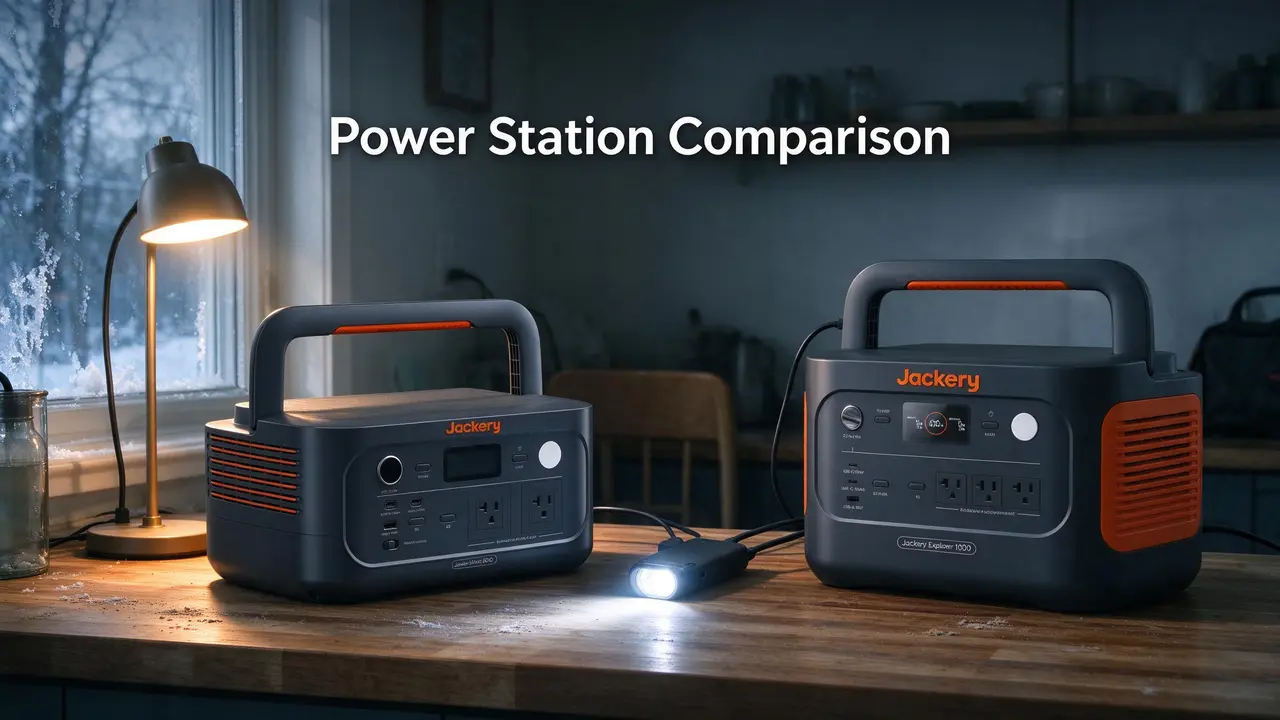
Two Jackery stations, $160 apart, betting on different things: a light 500 W box with a regulated 12V output, or a 1,500 W unit that can carry a fridge and a portable AC. Here is which one earns the money for a small outage kit.
Updated
At a glance
Two Jackery stations, $160 apart, betting on different things: a light 500 W box with a regulated 12V output, or a 1,500 W unit that can carry a fridge and a portable AC. Here is which one earns the money for a small outage kit.
- 500 v2: light, 12V-stable, cheap enough to own two
- 1000 v2: roughly 1.7× capacity, triple the continuous output, 10 lb heavier
Same money, different bets
The gap here is $160 at list: $399 for the Jackery Explorer 500 v2 Power Station, 512Wh/500W, AC Cable Included against $559 for the Jackery Explorer 1000 v2 Portable Power Station,1070Wh,1500W. That is close enough that the decision is not really about budget — it is about what you expect an outage to throw at you.
The 500 v2 bets on being light and steady: 14.1 lb, a 500 W inverter, and a regulated 12V DC output that owners lean on for DC fridges and radios. The 1000 v2 bets on headroom: 1,070 Wh, 1,500 W continuous, and enough AC outlets to run a refrigerator and a portable AC at once.
One boundary before we go further. This is a comparison for short outages, camping, and small-load backup. Neither unit is a whole-home solution, and neither should be wired to a transfer switch. If you are shopping for a panel-tied backup, this page is not that.
If you are a camper or a light-outage household, weight these three specs: continuous output, 12V DC stability, and carry weight. If you are a fridge-and-AC household, weight capacity, continuous output, and recharge speed instead.
What's in the box vs what you must buy: both include an AC charging cable; the 500 v2 adds a car charging cable, while the 1000 v2 does not include a 12V barrel adapter. Neither includes a solar panel. Budget for a 100W-class folding panel for the 500 v2, and a 12V cigarette adapter for the 1000 v2 if your gear is 12V-native.
- 500 v2: light, 12V-stable, cheap enough to own two
- 1000 v2: roughly 1.7× capacity, triple the continuous output, 10 lb heavier
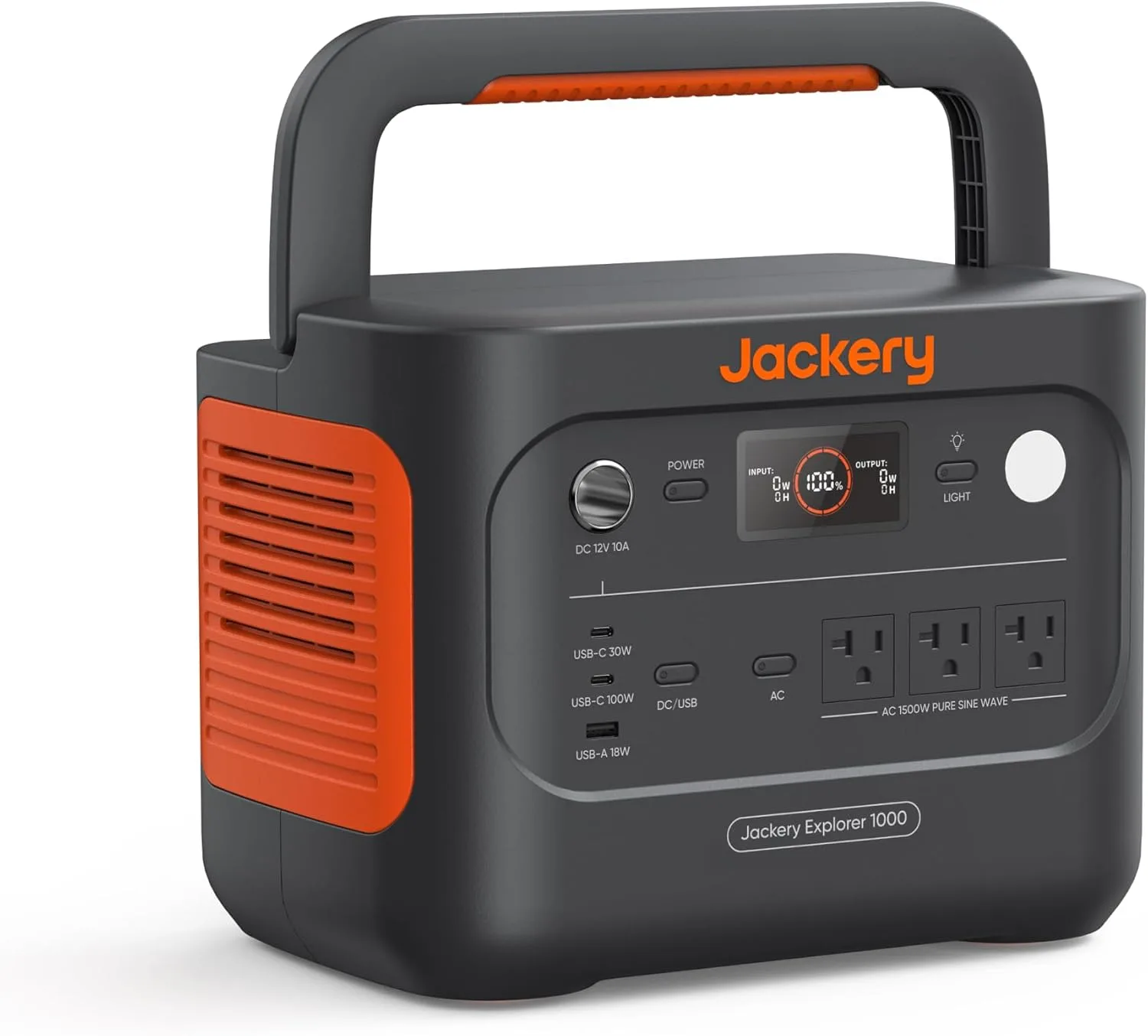
Jackery Explorer 1000 v2 Portable Power Station,1070Wh,1500W
Highlights
- 1070Wh rated capacity
- 1500W continuous AC
- LiFePO4 chemistry
- Up to 400W solar input
- 23.8 lb (~10.8 kg)
- About $559 list
Best for
- Explorer 1000 v2: weekend camping when 23.8 lb carry weight matters as much as 1070Wh
- Essentials bridge at home (fridge cycles, router) when sized to the Wh
- Solar top-ups up to ~400W when panels and weather cooperate
Strengths
- Explorer 1000 v2: 1070Wh with 1500W continuous — enough for fridge cycles if surge on the listing clears the start
- 23.8 lb (~10.8 kg) is the lightest-class carry in this band — easier stairs and car packing
- Explorer 1000 v2 uses LiFePO4 — cycle-life claims usually beat older NMC marketing lines
- Owners on file: Theme: Customers find the power station charges quickly, reaching 100% within 3 hours, and can power a side-b…
Watch-outs · not ideal when
- Explorer 1000 v2 is still a bridge for essentials — not a transfer-switch whole-home system
- Usable energy on Explorer 1000 v2 is below the 1070Wh label once the inverter is working
- Rated 400W solar on Explorer 1000 v2 is optimistic; shade and cables cut real watts
- LiFePO4 helps longevity, but Explorer 1000 v2 still hates freezing charge temps on winter trips
Owner voices
Short takes from public retail reviews — paraphrased or translated when long or non-English; meaning kept close to the original.
“Theme: Customers find the power station charges quickly, reaching 100% within 3 hours, and can power a side-by-side fridge/freezer for up to 9 hours. Moreover, the generator provides 1500 watt sustained output, lasts…”
“Theme: Kitchen Appliances (137)”
“Theme: Charging Electronics (98)”
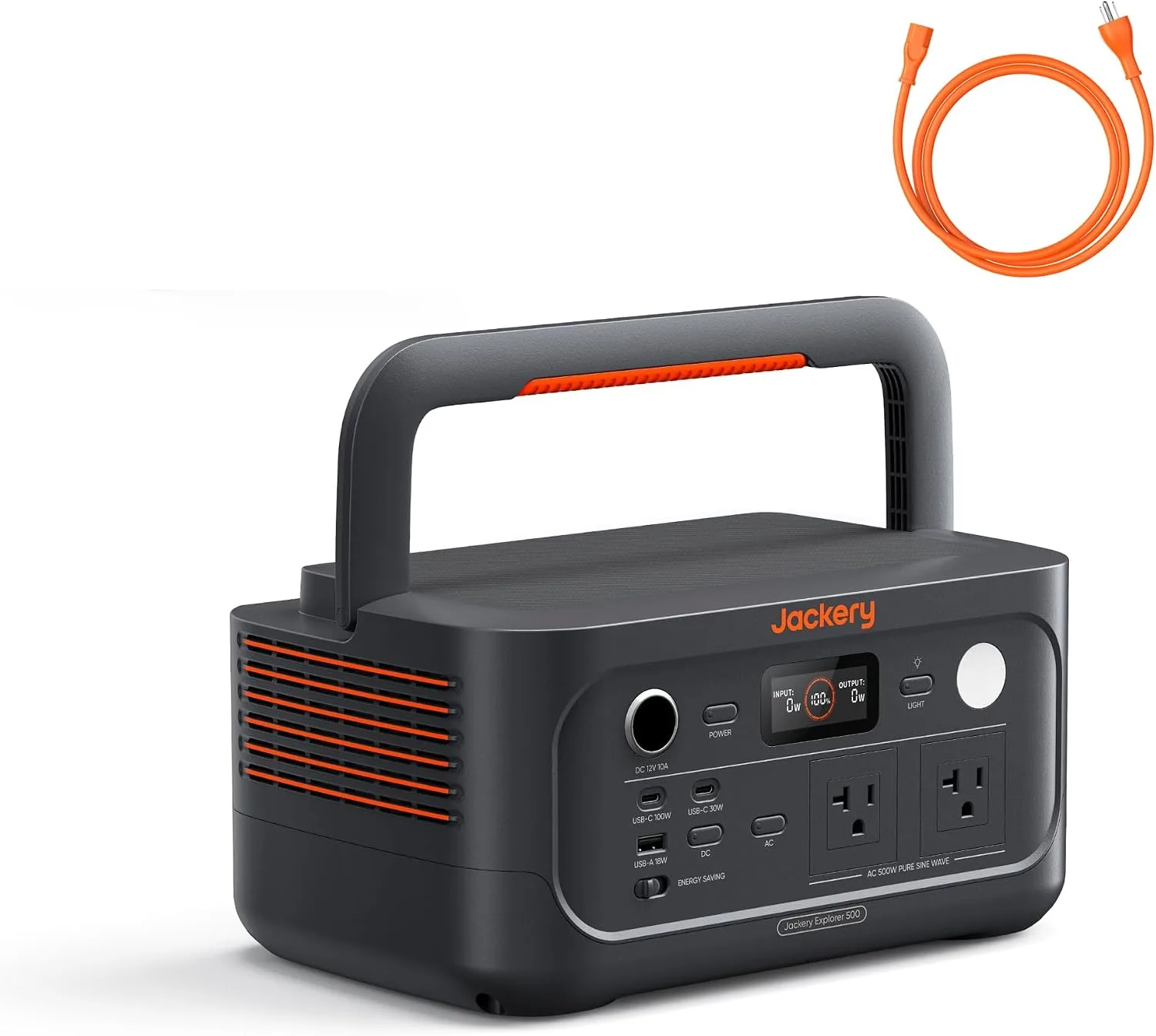
Jackery Explorer 500 v2 Power Station, 512Wh/500W, AC Cable Included
Highlights
- 640Wh rated capacity
- 500W continuous AC
- 1000W surge
- LiFePO4 chemistry
- Up to 200W solar input
- 14.1 lb (~6.4 kg)
Best for
- Explorer 600 v2: most Wh-per-dollar in this ~500Wh band for weekend fridge/CPAP math
- Car-camp carry at 14.1 lb when review depth matters as much as peak watts
- Skip if you need >500W continuous for small appliances that surge hard
Strengths
- Explorer 600 v2: 640Wh pack with 500W continuous / 1000W surge — size loads to both numbers
- 14.1 lb (~6.4 kg) is the lightest-class carry in this band — easier stairs and car packing
- 10ms-class UPS switchover on the listing — useful when a router restart would hurt
- Owners on file: Theme: Customers find the power station maintains 100% charge and is well worth the money, particularly notin…
Watch-outs · not ideal when
- Explorer 600 v2 is still a bridge for essentials — not a transfer-switch whole-home system
- 500W continuous will not hold heating elements or many compressor surges for long
- Rated 200W solar on Explorer 600 v2 is optimistic; shade and cables cut real watts
- LiFePO4 helps longevity, but Explorer 600 v2 still hates freezing charge temps on winter trips
Owner voices
Short takes from public retail reviews — paraphrased or translated when long or non-English; meaning kept close to the original.
“Theme: Customers find the power station maintains 100% charge and is well worth the money, particularly noting it saves on utility bills. The device provides ample power, with one customer reporting it ran a 32" TV an…”
“Theme: Phone Charging (331)”
“Theme: Refrigerator (208)”
Spec snapshot
Everything below comes from the listings and our catalogue card. The 500 v2's Amazon title reads "512Wh/500W" while the catalogue capacity is 640 Wh — I use the catalogue number throughout and flag the mismatch rather than average them. Ratings are listing aggregates, not owner proof.
Version/config note: the 512Wh vs 640Wh discrepancy on the 500 v2 appears to be a listing revision or a config difference between the Amazon title and the catalogue card. Confirm the capacity on the exact listing you buy before checkout; the 640 Wh figure is the one used for all comparisons here.
| Product | Price | Capacity (Wh) | Output (W) | Weight (lb) | Rating |
|---|---|---|---|---|---|
| Jackery Explorer 500 v2 Power Station, 512Wh/500W, AC Cable Included | $399 | 640 Wh | 500 W | 14.1 lb | 4.7 |
| Jackery Explorer 1000 v2 Portable Power Station,1070Wh,1500W | $559 | 1070 Wh | 1500 W | 23.8 lb | 4.7 |
Where the money went
Four places the extra $160 shows up, and one place it does not.
Capacity and output are the obvious pair. The 1000 v2 carries 1,070 Wh against 640 Wh, and its inverter is rated 1,500 W continuous versus 500 W. That is the difference between a station that runs a fridge and a fan and one that can also start a portable AC.
Ports favor the bigger unit on paper — three AC outlets and onboard USB-C against two AC outlets and one USB-C on the 500 v2. Owners of the smaller unit repeatedly mention wanting a second AC outlet and more USB-C, so if you are charging a family's worth of devices, this matters.
The 12V story runs the other way. The 500 v2 has a regulated 12V DC output that owners describe holding steady under a DC fridge load. The 1000 v2 has no 12V barrel port; you draw 12V from the cigarette socket with an adapter. If your gear is 12V-native, the cheaper unit is the better fit.
Recharge speed is the last split. The 1000 v2's fast AC mode gets owners back to full in roughly 1.5 hours in normal mode, with a one-hour emergency mode through the app. The 500 v2's listing claims 0–80% in 52 minutes on AC. Solar is the weak spot on both: the 500 v2 needs roughly a 100W panel before its charge controller will start, and the 1000 v2 caps solar input around 400W.
Add-on cost to budget for: a 100W-class folding panel for the 500 v2, and a 12V cigarette adapter for the 1000 v2 if your gear is 12V-native. Neither is included, and both are easy to forget until the first outage.
- Capacity: 640 Wh vs 1,070 Wh
- Continuous output: 500 W vs 1,500 W
- 12V DC: regulated output on the 500 v2; adapter needed on the 1000 v2
- Solar: ~100W minimum to start on the 500 v2; ~400W cap on the 1000 v2
The spec that decides it
If I had to pick one number, it is continuous output. A 500 W ceiling rules out most kitchen appliances and anything with a big motor surge. Owners of the 500 v2 report it refusing a countertop ice maker that drew under its rating — a reminder that motor loads and inverter headroom do not always line up with the sticker. The ice maker's compressor surge, not its running watts, is the likely culprit; test any motor load in the first week.
The 1,500 W ceiling on the 1000 v2 clears a refrigerator plus a portable AC in the same session, per owner reports. It still will not run a 1,700 W air fryer or a large sliding miter saw, so it is headroom, not unlimited power.
The second deciding number is weight. At 14.1 lb the 500 v2 is a one-hand carry between rooms; at 23.8 lb the 1000 v2 is a two-hand move you plan around. If the station lives in a closet and comes out twice a year, weight is noise. If it moves nightly, it is the whole decision.
Real owner trade-offs
The 500 v2's strongest owner theme is the regulated 12V output. One long-term owner ran a DC fridge/freezer overnight and reported the voltage held, the fridge never errored, and capacity remained above half. Another described running a portable camping fridge from evening into the next afternoon on a single charge.
The same unit draws consistent complaints about support. One owner with a DC output fault described weeks of back-and-forth and a request for video proof before a replacement. Another said a 60W panel would not start the charge controller at all, while a 100W panel worked. Treat both as things to test in the first week.
On the 1000 v2, the recurring theme is refrigerator backup with margin. One owner ran a fridge and a portable AC simultaneously without tripping, and used quiet mode overnight so the family could sleep. Another reported a 12V DC fridge dropping about 26% per night, recharging after the third night.
Its caveats are equally consistent. Owners note the missing 12V barrel port, the ~400W solar cap, and the app's Wi-Fi dropping overnight so the battery level has to be re-checked. A 1,700 W air fryer and a large miter saw both stalled it. None of that is surprising at this wattage, but it is the friction you live with.
Provenance note: these owner themes are drawn from the review corpus and forum threads on file for each SKU — a handful of detailed long-term accounts per unit, not a statistically representative sample. Treat them as directional, not as lab data.
- 500 v2 owners: 12V stability praised; support and small-panel charging criticized
- 1000 v2 owners: fridge-plus-AC headroom praised; 12V port gap and app quirks noted
Buy the one that…
Buy the Jackery Explorer 500 v2 Power Station, 512Wh/500W, AC Cable Included if your outage kit is lights, phones, a laptop, a fan, and a 12V fridge — and if you want to carry it one-handed. Confirm the capacity on the exact listing before checkout (the title says 512Wh, the catalogue says 640Wh). Skip it if you need to run a kitchen appliance, want more than two AC outlets, or expect to charge from a panel smaller than 100W.
Cheaper is better when your loads are 12V-native and light, and when the station will actually move with you. If that is you, the 500 v2 wins on fit, not just price.
Buy the Jackery Explorer 1000 v2 Portable Power Station,1070Wh,1500W if a refrigerator is the thing you refuse to lose, or if a portable AC in a heat wave is part of your plan. Skip it if 23.8 lb is more than you will actually move, if your gear is 12V-native, or if you were hoping to run high-surge tools.
One more decision rule: two 500 v2 units beat one 1000 v2 only if you need two separate locations or two independent 12V outputs. For a single fridge-plus-AC session, one 1000 v2 is the cleaner buy — you cannot parallel two 500 v2 units into a 1,000 W load.
And walk away from both if you are sizing for multi-day whole-home backup. At 640 Wh and 1,070 Wh these are short-outage and camping units; a multi-day plan needs a larger class of station (think 2,000 Wh and up) and a different wiring conversation.
Method note: these picks come from home-user checks grounded in the owner themes on file plus the listing specs — not lab-bench measurements. I am Avery Nolan, WattPicks founding editor, covering capacity, output, and price-per-Wh across the catalogue. Links here are Amazon Associates links; picks are fit-led, not commission-led.
Frequently asked
Can the 1000 v2 run my refrigerator overnight?
Owners report a fridge plus a portable AC running together, and one measured a 12V DC fridge at roughly 26% per night. A full-size fridge cycling on and off will draw more than that, so treat overnight as plausible for a small or efficient fridge, not guaranteed for a large one.
Will the 500 v2 charge from my 60W folding panel?
Probably not reliably. Owners report the charge controller needing roughly 100W of input before it starts; a 60W panel did not initiate charging in one detailed account.
Do I need an adapter for 12V gear on the 1000 v2?
Yes. It has no 12V barrel port, so 12V devices run from the cigarette socket with an adapter. The 500 v2 has a regulated 12V DC output and does not need one.
Method and sources
Model names and list prices come from the WattPicks catalog at build time. WattPicks does not run its own laboratory tests on power stations, and nothing on this page is presented as a measured result — it is catalog-backed buying guidance.
Read our methodology for how the catalog is normalized, and about WattPicks for who publishes it.