
EcoFlow DELTA Pro 3 vs Goal Zero Yeti PRO 4000: Home Backup Showdown
Two premium LFP stations, two very different trade-offs: the DELTA Pro 3 sells capacity and 240V output, the Yeti PRO 4000 sells fast transfer and a metal case. Here's which one earns a spot in your garage — and which one I'd walk away from.

Updated
At a glance
Two premium LFP stations, two very different trade-offs: the DELTA Pro 3 sells capacity and 240V output, the Yeti PRO 4000 sells fast transfer and a metal case. Here's which one earns a spot in your garage — and which one I'd walk away from.
Same money, different trade-offs
If you're shopping this pair, you've already decided a portable station — not a standby generator — is how you want to ride out an outage. The question is which trade-off you're making with roughly the same budget.
The EcoFlow DELTA Pro 3 Portable Power Station, 4096Wh leans on capacity and headroom: 4096 Wh on the nameplate, 4000 W continuous, and a 240V path that owners use for well pumps and central air. The Goal Zero Yeti PRO 4000 Portable Power Station, 4000 Watt Hour LiFePO4 leans on integration and speed: fast automatic transfer through Goal Zero's Haven transfer switches, a metal enclosure, and high solar input.
One boundary up front: this is a two-way comparison for people wiring a station into a home or RV circuit. If you want a grab-and-go camping battery, both of these are the wrong weight class — 113.5 lb and 138 lb respectively.
A note on how I read these: my checks here are home-user checks grounded in owner themes on file plus the listing specs, not lab-bench measurements. Prices and specs come from the product data; owner impressions are paraphrased, never pasted. One Amazon Associates disclosure: picks are fit-led, not commission-led.
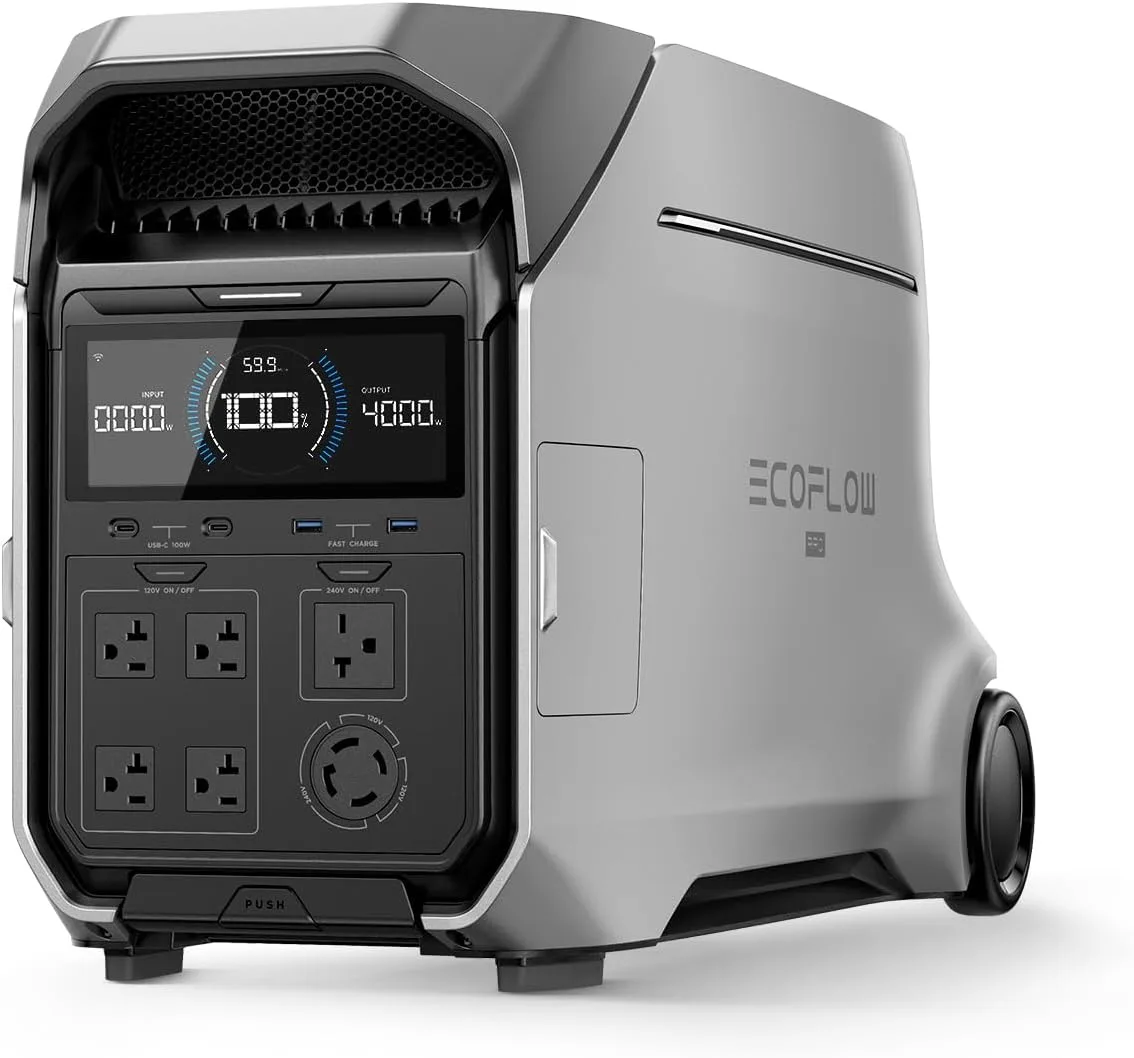
EcoFlow DELTA Pro 3 Portable Power Station, 4096Wh
Highlights
- 4096Wh rated capacity
- 4000W continuous AC
- 8000W surge
- LiFePO4 chemistry
- Up to 2600W solar input
- 113.5 lb (~51.5 kg)
Best for
- DELTA Pro 3: longer outages or higher continuous loads (still not whole-home wiring)
- RV / off-grid days where recharge speed matters as much as Wh
- Best parked near the vehicle or cabin — not a long carry to a tent
Strengths
- DELTA Pro 3: 4096Wh pack with 4000W continuous / 8000W surge — size loads to both numbers
- 113.5 lb (~51.5 kg) is a park-and-use chassis — plan a short path, not a trail hike
- 10ms-class UPS switchover on the listing — useful when a router restart would hurt
- About $3699 list in the Hub catalog — confirm live retail before you buy
Watch-outs · not ideal when
- At 113.5 lb (~51.5 kg), DELTA Pro 3 is a poor tent-hike companion — plan a cart or leave it in the vehicle
- High continuous output on DELTA Pro 3 tempts big loads — Wh still runs out on kettles and A/C
- Rated 2600W solar on DELTA Pro 3 is optimistic; shade and cables cut real watts
- LiFePO4 helps longevity, but DELTA Pro 3 still hates freezing charge temps on winter trips
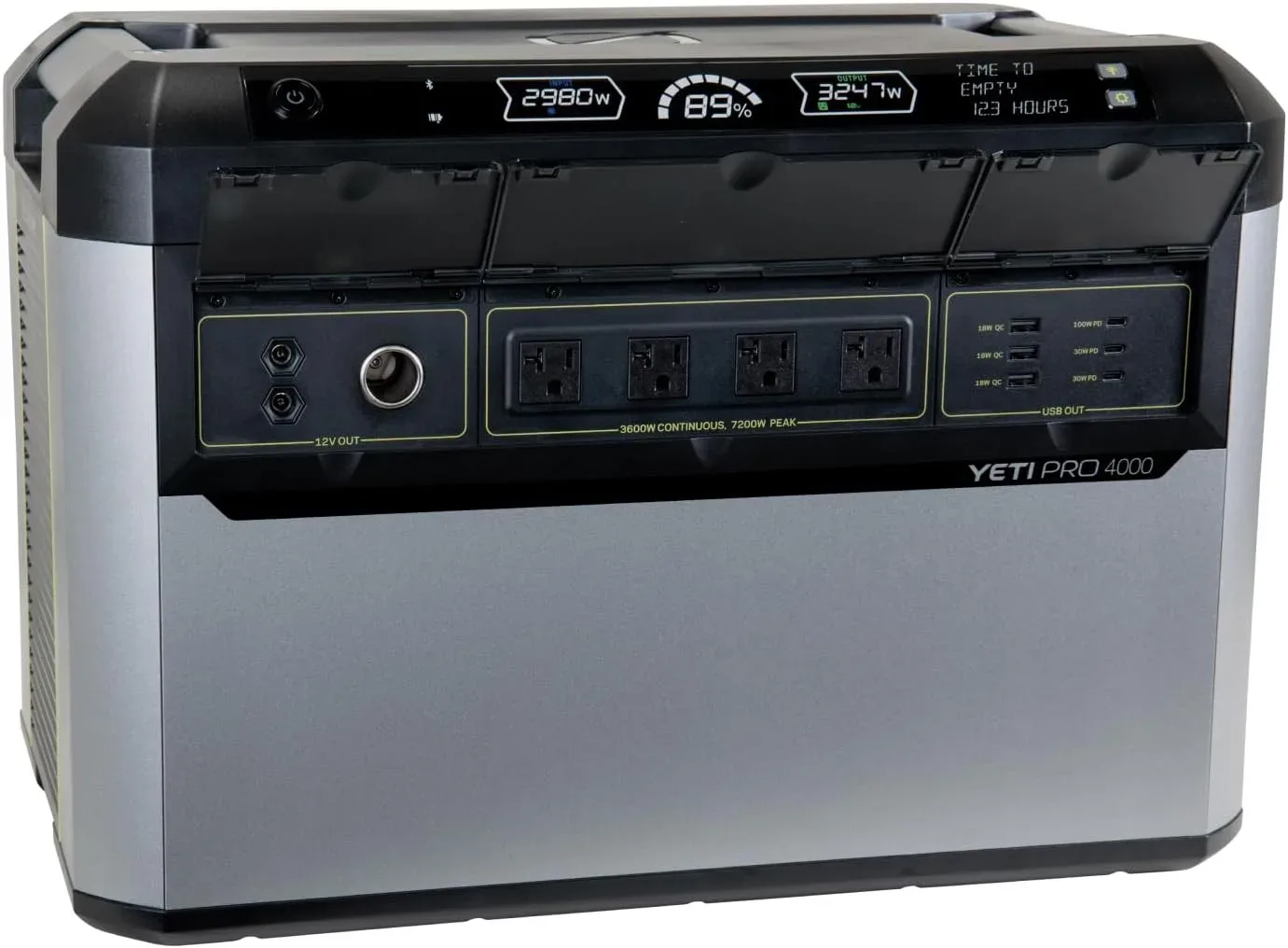
Goal Zero Yeti PRO 4000 Portable Power Station, 4000 Watt Hour LiFePO4 Battery, Expandable Solar Gen
Highlights
- LiFePO4 chemistry
- Goal Zero catalog listing
- Specs from manufacturer listings
Best for
- Goal Zero Yeti PRO 4000 Portable Power Station, 4000 Watt Hour LiFePO4 Battery, Expandable Solar Gen: longer outages or higher continuous loads (still not whole-home wiring)
- RV / off-grid days where recharge speed matters as much as Wh
- Users who will pair solar or expand rather than buy a second small pack
Strengths
- Goal Zero Yeti PRO 4000 Portable Power Station, 4000 Watt Hour LiFePO4 Battery, Expandable Solar Gen: capacity not published on file — compare only what the listing actually states
- Goal Zero Yeti PRO 4000 Portable Power Station, 4000 Watt Hour LiFePO4 Battery, Expandable Solar Gen: quiet battery output suits campsites with generator bans
- Goal Zero Yeti PRO 4000 Portable Power Station, 4000 Watt Hour LiFePO4 Battery, Expandable Solar Gen uses LiFePO4 — cycle-life claims usually beat older NMC marketing lines
- Owners on file: 5/5 · 19 helpful — I don't write many product reviews, but the GZ Yeti PRO 4000 has really impressed me. I wa…
Watch-outs · not ideal when
- Goal Zero Yeti PRO 4000 Portable Power Station, 4000 Watt Hour LiFePO4 Battery, Expandable Solar Gen is still a bridge for essentials — not a transfer-switch whole-home system
- No Wh on file for Goal Zero Yeti PRO 4000 Portable Power Station, 4000 Watt Hour LiFePO4 Battery, Expandable Solar Gen — do not invent runtime math from the product name
- Solar input unpublished for Goal Zero Yeti PRO 4000 Portable Power Station, 4000 Watt Hour LiFePO4 Battery, Expandable Solar Gen — do not assume a same-day off-grid refill
- Airline and pack limits may still block Goal Zero Yeti PRO 4000 Portable Power Station, 4000 Watt Hour LiFePO4 Battery, Expandable Solar Gen even when the weight looks friendly
Owner voices
Short takes from public retail reviews — paraphrased or translated when long or non-English; meaning kept close to the original.
“5/5 · 19 helpful — I don't write many product reviews, but the GZ Yeti PRO 4000 has really impressed me. I was looking for a power station to back my home, run my 30' travel trailer, and power the occasional backyard…”
“1/5 · 13 helpful — Why did you pick this product vs others?: DO NOT BUY!!! They do not have a customer service department anymore - Yeti Pro 4000 doesn't work. Won't hold charge no help - wasted money. Biolite purchas…”
“1/5 · 11 helpful — Well I have had this product for about 3 months now. When I first received it everything was fine and I was pleased. Have it in my Motorhome went out to check it was a storm was heading our way. I f…”
Spec snapshot
Both rows below are listing figures. The Yeti's list price isn't on file, so it reads n/a rather than a guess — and its 2400 Wh / 2400 W nameplate is what the card says, even though the model name says 4000.
| Product | Price | Capacity (Wh) | Output (W) | Weight (lb) | Rating |
|---|---|---|---|---|---|
| EcoFlow DELTA Pro 3 Portable Power Station, 4096Wh | $3699 | 4096 Wh | 4000 W | 113.5 lb | 4.3 |
| Goal Zero Yeti PRO 4000 Portable Power Station, 4000 Watt Hour LiFePO4 | n/a (not on file) | 2400 Wh | 2400 W | 138 lb | 3.4 |
Where the money went
Four configuration calls separate these two more than the headline numbers do.
Capacity and output. The DELTA Pro 3 carries 4096 Wh and 4000 W continuous — roughly 70% more stored energy than the Yeti's 2400 Wh on the card, and a higher continuous ceiling. For a fridge-plus-lights outage plan, that gap is the difference between one long night and a multi-day buffer.
Voltage and transfer. EcoFlow's 240V support is the feature owners actually lean on for well pumps and AC. Goal Zero's counterpunch is transfer speed through the Haven ecosystem — owners describe the house not noticing the switch. The catch: Haven is a separate purchase, not included, and the DELTA Pro 3's Smart Home Panel 2 is likewise sold separately.
Charging paths. The DELTA Pro 3 takes AC, dual solar inputs, generator, and EV charging, with charge-rate limits set in the app. The Yeti PRO 4000 is built around fast AC and very high solar input — owners report full recharges from a 30A plug in well under two hours.
Enclosure and expansion. Goal Zero ships a solid aluminum case and supports up to four Tank PRO expansion batteries per the listing. EcoFlow stacks its own extra batteries on top of the main unit — which, per owners, effectively turns it into a garage fixture once stacked.
- DELTA Pro 3: more Wh, more continuous W, 240V, app-tuned charge rate
- Yeti PRO 4000: metal case, fast Haven transfer, high solar ceiling
- Both: transfer hardware sold separately
- Both: heavy enough that wheels or a second person are part of the plan
The spec that decides it
For most buyers, it's the capacity line: 4096 Wh vs 2400 Wh. Run a fridge in the 100–200 W band plus a few hundred watts of lights, router, and a CPAP, and the DELTA Pro 3's extra stored energy buys you hours you'll feel on day two of an outage. The Yeti's 2400 Wh is workable for a short, disciplined outage — it's just a tighter envelope.
The second deciding number is continuous output: 4000 W vs 2400 W. If your plan includes a well pump, a central AC, or a 30A RV feed, the DELTA Pro 3's ceiling is the one that doesn't force you to sequence loads. The Yeti can run a trailer's AC and microwave together per owners — but that's a 30A circuit story, not a whole-panel story.
What the Yeti wins on isn't a single number; it's the transfer experience through Haven, which owners rate highly. If seamless switchover matters more to you than stored energy, that's the trade.
Runtime estimates: will it last your outage?
The central anxiety is runtime, so here's a rough guide. These are estimates based on the nameplate capacities (4096 Wh vs 2400 Wh) and typical load draws, not lab measurements. Real-world runtime varies with load efficiency, temperature, and depth of discharge. Use these as a planning starting point, not a guarantee.
Assumptions behind the table: about 85% usable depth of discharge (so plan on roughly 3480 Wh usable from the DELTA Pro 3 and 2040 Wh from the Yeti), plus a small inverter idle draw of roughly 20–30 W included in the estimated draw column. If you run loads closer to the continuous ceiling, efficiency drops and runtime shortens.
If you only track three numbers, track these: stored energy (Wh), continuous output (W), and the wattage of your critical loads. Everything else is secondary.
| Load scenario | Estimated draw | DELTA Pro 3 (4096 Wh) | Yeti PRO 4000 (2400 Wh) |
|---|---|---|---|
| Fridge + lights + router | ~200 W | ~20 hours | ~12 hours |
| Add CPAP | ~250 W | ~16 hours | ~9.5 hours |
| Fridge + lights + CPAP + small TV | ~350 W | ~11.5 hours | ~7 hours |
| RV 30A feed (AC + microwave, short bursts) | ~1500 W | ~2.3 hours | ~1.4 hours |
Real owner trade-offs
The DELTA Pro 3's owner base is large and mostly positive — 4.3 as a listing aggregate across 721 ratings (Amazon listing, as of the data on file) — and the themes cluster around backup and appliances. Owners describe feeding a house panel from the battery after a short generator recharge, running a 240V well pump, and a UPS pass-through that kept a desktop from rebooting. Stacking an extra battery to ride out a multi-day storm comes up more than once.
The caveats are consistent too. Weight is the loudest: 113.5 lb is a two-person lift, and stacking expansion batteries pins the unit in place. The app is close to mandatory for charge-rate limits — owners note that without dialing input down, a small generator or 15A circuit can be overloaded, and one owner tripped a truck inverter fuse in pass-through at full charge. The one that should give you pause: a high-helpful report of a locked BMS (Error 71) with no AC or DC output, followed by a weeks-long fight over hazardous-material return shipping. Rare, but it's exactly the failure you're buying insurance against.
The Yeti PRO 4000's review base is thin — 3.4 as a listing aggregate on 32 ratings (Amazon listing, as of the data on file) — so treat owner sentiment as directional, not settled. The positive themes are real: owners wiring it through Haven describe the TV and Wi-Fi not blinking during a simulated outage, and one ran an entire travel trailer including AC and microwave. The aluminum case and high solar input draw praise.
The negative themes group into three areas. Charging and output faults: several owners report fault codes during charging even at low amp settings and on the AC outputs; one unit charged to 100% despite an 85% cap. Build details: dust covers over the outlets aren't removable and feel fragile. Support risk: support has been uneven since the ownership transition — some owners got resolution after escalation, others were left waiting. That's a support-risk signal, not a hardware verdict.
Buy the one that…
…matches your outage, not the spec sheet. If your plan is a fridge, lights, router, and maybe a well pump or AC — and you want the most stored energy per dollar of the two — buy the EcoFlow DELTA Pro 3 Portable Power Station, 4096Wh. It's the safer choice for most buyers precisely because its owner base is deep enough to show you the failure modes, and its capacity gives you room to be imperfect about load math.
…prioritizes seamless transfer and a metal enclosure over raw capacity, and you're willing to buy the Haven hardware and accept a thinner track record — buy the Goal Zero Yeti PRO 4000 Portable Power Station, 4000 Watt Hour LiFePO4. It's a reasonable pick for an RV-plus-home setup where fast automatic switchover is the whole point.
Walk away from both if you need to carry the unit regularly, if you won't install transfer hardware, or if you expect a list price on the Yeti before you commit — that number isn't on file, and I won't invent one. And if a single high-helpful failure report with a rough warranty path would keep you up at night, neither of these is a zero-drama purchase; budget for the possibility that support takes persistence.
What it costs to actually back up a panel
The station is only part of the bill. To back up home circuits you'll add transfer hardware and, often, expansion batteries — and those costs aren't on file here, so treat the following as a checklist of what to price out, not a quote.
For the DELTA Pro 3: the Smart Home Panel 2 is a separate purchase, and each extra battery adds cost and weight. For the Yeti PRO 4000: Haven transfer switches are separate, and up to four Tank PRO expansion batteries are supported per the listing — each one a line item. Budget for the station plus transfer hardware plus at least one expansion battery if multi-day coverage is the goal, and confirm current pricing on the product pages before you commit.
Frequently asked
Can the DELTA Pro 3 run a 240V well pump?
Owners describe doing exactly that — feeding a house panel from the battery after a generator recharge, with a 240V well pump on the load. That's an owner report, not a lab measurement, and it assumes the pump's draw stays under the 4000 W continuous ceiling.
Does the Yeti PRO 4000 really deliver 4000 Wh?
The nameplate on the card reads 2400 Wh and 2400 W, despite the model name. Plan your runtime off 2400 Wh until Goal Zero publishes otherwise.
Do I need extra hardware to back up home circuits?
Yes, for both. Goal Zero's Haven transfer switches and EcoFlow's Smart Home Panel 2 are separate purchases — neither is included with the station.
Which is easier to move?
Neither, really. The DELTA Pro 3 is 113.5 lb and the Yeti is 138 lb. The Yeti's cart helps; the DELTA Pro 3's wheels help. Stairs are a two-person job either way.
How long will each run my fridge and essentials?
See the runtime estimates table above. As a rough guide, a 200 W load (fridge, lights, router) lasts about 20 hours on the DELTA Pro 3 and about 12 hours on the Yeti. Add a CPAP and you're looking at roughly 16 vs 9.5 hours. These are estimates, not guarantees.
What's the warranty and return policy?
Warranty and return terms are set by the manufacturer and retailer, and they can change. Check the current policy on the product page before you buy. Note that the DELTA Pro 3 owner report of a locked BMS involved a difficult hazardous-material return, so understand the return shipping process for large batteries before you commit.
Method and sources
Model names and list prices come from the WattPicks catalog at build time. WattPicks does not run its own laboratory tests on power stations, and nothing on this page is presented as a measured result — it is catalog-backed buying guidance.
Read our methodology for how the catalog is normalized, and about WattPicks for who publishes it.