
EcoFlow Delta 3 Ultra vs OUPES Mega 3: Backup Bet
Two big-battery stations, close in price, built for different priorities: one on raw continuous output and quiet pass-through, the other on charge speed and a lighter build. Here is how to pick between them for portable home backup.

Updated
At a glance
Two big-battery stations, close in price, built for different priorities: one on raw continuous output and quiet pass-through, the other on charge speed and a lighter build. Here is how to pick between them for portable home backup.
Same money, different bets
You are spending roughly the same money either way — $1,599 for the EcoFlow Delta 3 Ultra 3072Wh Portable Power Station, 3600W AC Output against $1,758 for the OUPES Mega 3 3400W X-Boost Output, Ultra-Fast 0-80% Charging in 1.13 Hr, Home Backup. That is close enough that price should not decide it for you.
The Delta 3 Ultra leans on muscle and quiet: 3072 Wh of published capacity, 3600 W of continuous AC, and a true pass-through that feeds utility power straight to your devices without spinning up the inverter. The OUPES Mega 3 leans on turnaround — the listing claims 0–80% in 1.13 hours — and on a lighter, more portable build.
One boundary before we go further: this is a two-way comparison for people sizing a portable home-backup station in the 3 kWh class. It is not a whole-home battery install, and it is not a camping roundup. If you need a transfer switch or a smart panel wired into your breaker box, that is a different purchase.
A note on sourcing: I work from the listing specs and the owner notes on file, plus my own home-user checks on those documented loads. Those checks are not lab-bench measurements, and the star figures below are listing aggregates, not proof of anything.
Affiliate disclosure: As an Amazon Associate I earn from qualifying purchases. Picks here are fit-led, not commission-led.
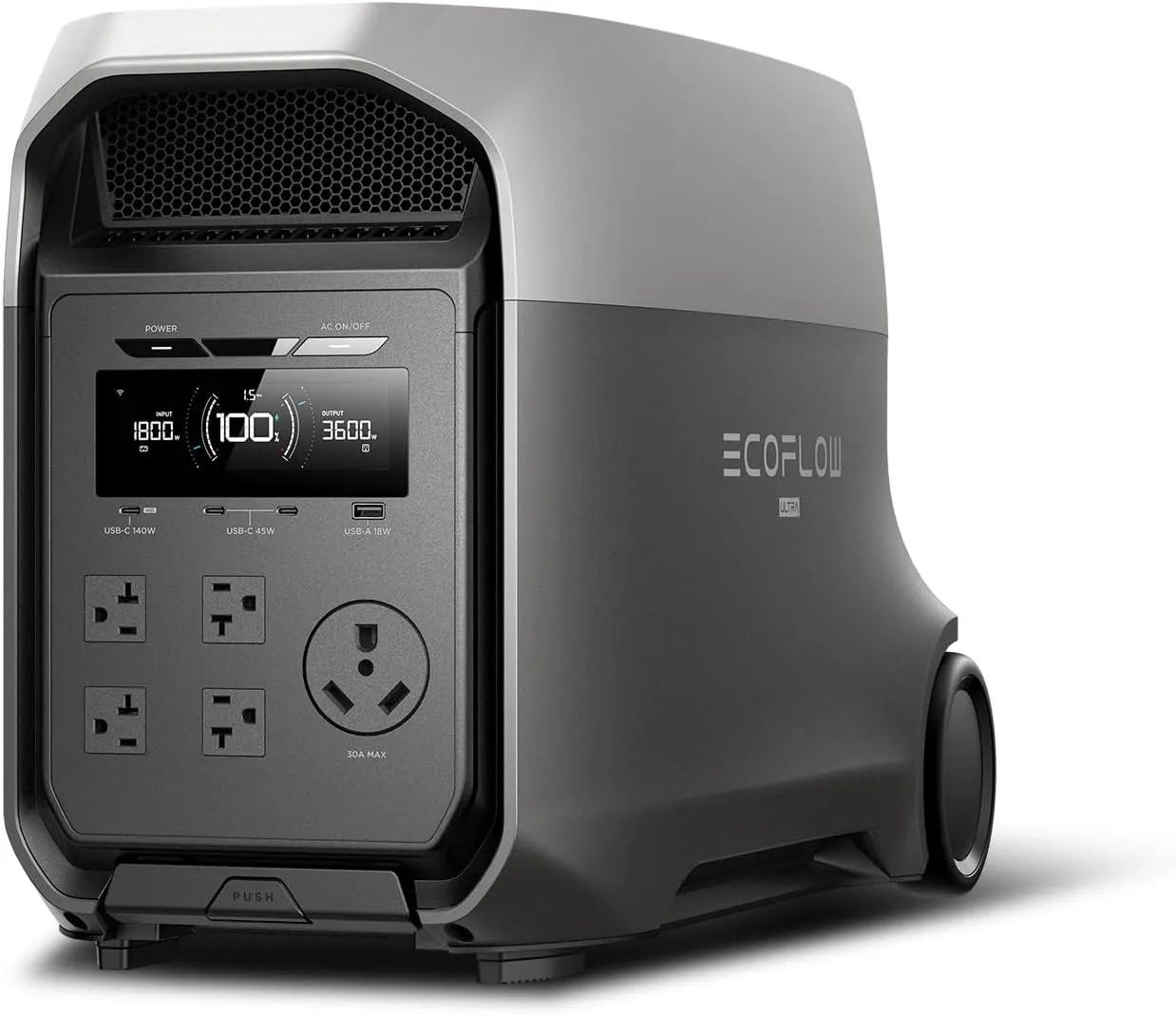
EcoFlow Delta 3 Ultra 3072Wh Portable Power Station, 3600W AC Output
Highlights
- 3072Wh rated capacity
- 3600W continuous AC
- 7200W surge
- LiFePO4 chemistry
- Up to 3200W solar input
- 72.1 lb (~32.7 kg)
Best for
- DELTA 3 Ultra: longer outages or higher continuous loads (still not whole-home wiring)
- RV / off-grid days where recharge speed matters as much as Wh
- Best parked near the vehicle or cabin — not a long carry to a tent
Strengths
- DELTA 3 Ultra: 3072Wh pack with 3600W continuous / 7200W surge — size loads to both numbers
- 72.1 lb (~32.7 kg) is a park-and-use chassis — plan a short path, not a trail hike
- 3600W continuous headroom covers more small appliances than 1kW-class inverters
- About $1599 list in the Hub catalog — confirm live retail before you buy
Watch-outs · not ideal when
- At 72.1 lb (~32.7 kg), DELTA 3 Ultra is a poor tent-hike companion — plan a cart or leave it in the vehicle
- High continuous output on DELTA 3 Ultra tempts big loads — Wh still runs out on kettles and A/C
- Rated 3200W solar on DELTA 3 Ultra is optimistic; shade and cables cut real watts
- LiFePO4 helps longevity, but DELTA 3 Ultra still hates freezing charge temps on winter trips
Spec snapshot
Everything numeric in this article traces back to this table. Where the listing does not publish a figure, it says so rather than guessing.
| Product | Price | Capacity (Wh) | Output (W) | Weight (lb) | Rating |
|---|---|---|---|---|---|
| EcoFlow Delta 3 Ultra 3072Wh Portable Power Station, 3600W AC Output | $1599 | 3072 Wh | 3600 W | 72.1 lb | 4.6 |
| OUPES Mega 3 3400W X-Boost Output, Ultra-Fast 0-80% Charging in 1.13 Hr, Home Backup | $1758 | n/a (not on file) | 2400 W | 89 lb | 5 |
Where the money went
Four configuration differences carry most of the decision. Here is each one in a short block so you can scan to the factor that matters to you.
Capacity. The Delta 3 Ultra publishes 3072 Wh. The OUPES Mega 3 does not publish a capacity figure on its listing — n/a (not on file) — so I will not put a number in its mouth. If capacity is your first filter, that gap alone tells you something about how much documentation you get going in.
Continuous output. 3600 W versus 2400 W is the widest real-world delta here. The Delta 3 Ultra's figure is enough to run an 1800 W griddle and an 1800 W smart oven at the same time, which one owner report on file describes doing with roughly 70% left after more than half an hour (that residual is an owner estimate, not a measured figure). The OUPES Mega 3's listing leads with a 3400 W X-Boost figure — that is a boost mode, not continuous AC, and I would size loads against the 2400 W continuous number.
Weight and handling. The Delta 3 Ultra is 72.1 lb with built-in wheels and a telescoping handle; owners describe moving it like a moderately heavy suitcase. The OUPES Mega 3 is 89 lb, and owners call it rugged — but there is no wheeled-handle theme in the notes on file, so plan on lifting it.
Ports and pass-through. The Delta 3 Ultra lists AC×4, USB-C×1, USB-A×1, and car×1, and its true AC pass-through keeps fans near-silent at moderate load. The OUPES Mega 3's port list on file shows AC×1, with USB-C and USB-A unknown — I will not claim either way. Owners do report using it while it recharges, which matters if you want to run a load and top up at the same time.
- Capacity: 3072 Wh published vs n/a (not on file)
- Continuous AC: 3600 W vs 2400 W (X-Boost 3400 W is not continuous)
- Weight: 72.1 lb wheeled vs 89 lb
- Ports: AC×4 / USB-C×1 / USB-A×1 / car×1 vs AC×1, USB-C and USB-A unknown
The spec that decides it
For most portable home-backup buyers, continuous output is the deciding number. A refrigerator, a space heater, a microwave, a coffee maker — these are the loads that trip a station's inverter, and 3600 W gives you headroom to run two of them at once. The OUPES Mega 3 will run one heavy appliance comfortably; stacking two is where it gets tight.
The second deciding factor is charge speed, and it cuts the other way. If your outage pattern is short and frequent — a few hours, then the grid returns — the 0–80% in 1.13 hours claim on the OUPES Mega 3 is genuinely useful, and owners back up the fast-charging theme. Note that this charge-speed figure is vendor-published and not independently verified. If your outages run long and you are sizing for a multi-day event, capacity and continuous output matter more than how fast you refill.
Cheaper-is-better rule: if charge speed is irrelevant to your outage pattern — say, you only need to ride out a few hours and can recharge overnight — the $1,599 Delta 3 Ultra is the better value, and the $1,758 OUPES Mega 3's charge-speed premium buys you nothing.
Real owner trade-offs
The Delta 3 Ultra has the deeper owner record, and it is candid about the cracks: capped non-expandable capacity, firmware updates that power off the AC output, a button layout that differs from other Delta 3 units, and an app assistant that gets in the way of taps until you disable it. The OUPES Mega 3's owner record is thin — fast charging, using and recharging at the same time, multiple devices at once, and a sturdy feel come through, but a high-helpful critical review is missing, so long-term friction themes have not been corroborated yet. That is not the same as flawless; it means the community track record is still forming.
Because the OUPES Mega 3's long-term friction is undocumented, treat that as a buying risk you can manage: check the seller's return window before you commit, and use the seller Q&A to ask about noise, app behavior, and port layout for your specific loads. If those answers are vague, that is your signal to wait or pick the unit with the deeper record.
Neither unit's star average should be read as owner proof. The Delta 3 Ultra's 4.6 (168 ratings) and the OUPES Mega 3's 5 (13 ratings) are listing aggregates, and the second one rests on a handful of substantive accounts.
- Delta 3 Ultra: capped capacity, update-related output drop, button layout change
- OUPES Mega 3: fast charging and pass-through confirmed by owners; long-term friction undocumented — mitigate with return window and seller Q&A
Buy the one that…
Buy the EcoFlow Delta 3 Ultra 3072Wh Portable Power Station, 3600W AC Output if you need to run two heavy appliances at once, want a published capacity figure you can size against, and value quiet pass-through and wheels over charge speed. Skip it if you plan to add battery capacity later — that is the Plus model's job — or if you cannot tolerate the AC output dropping during a firmware update.
Buy the OUPES Mega 3 3400W X-Boost Output, Ultra-Fast 0-80% Charging in 1.13 Hr, Home Backup if short outages are your pattern, fast turnaround matters more than stacking loads, and you are comfortable buying ahead of a settled owner consensus. Skip it if you need a documented capacity number before you commit, or if 89 lb with no wheeled-handle theme in the notes is a dealbreaker for where you plan to park it.
If neither fits — you want expandable capacity and a long owner track record — walk away from both and look at the Delta 3 Ultra Plus instead. That third path is a real option, not a consolation prize: the Plus model is the one owners point to when they want to add battery packs later, and it carries the same Delta 3 family track record. The trade-off is that you are buying a different product with its own price and spec sheet, so treat it as a separate decision rather than a fallback.
Frequently asked
Can the Delta 3 Ultra run a space heater and a microwave together?
On paper, yes — 3600 W continuous covers a typical space heater plus a microwave. Owners report running an 1800 W griddle and an 1800 W smart oven simultaneously with capacity to spare.
How long will the Delta 3 Ultra run my refrigerator?
A worked estimate: a typical fridge draws about 150 W running, and with a 30–50% duty cycle that averages roughly 45–75 W. From 3072 Wh, that is about 40–68 hours of fridge-only runtime before inverter losses. Add a router (about 10 W) and a few LED lights (about 20 W) and you are still in the multi-day range. Real numbers depend on your fridge's duty cycle and ambient temperature, so treat this as a sizing guide, not a guarantee.
How long will the OUPES Mega 3 run my refrigerator?
I cannot give you a runtime, because its capacity is n/a (not on file). Without a published Wh figure, any runtime number would be invented. Decision rule: if you need to size a fridge runtime before you buy, treat the missing capacity as disqualifying and pick a unit with a published Wh figure.
Does the Delta 3 Ultra have USB-C?
Yes — the port list on file shows USB-C×1, plus USB-A×1, AC×4, and car×1.
Which one is better for a multi-day outage?
The Delta 3 Ultra, on the strength of its published 3072 Wh and 3600 W continuous output. The OUPES Mega 3's fast charging helps between short outages, not during a long one.
How should I handle placement and weight?
The Delta 3 Ultra is 72.1 lb with wheels and a telescoping handle, so it rolls on flat floors but still needs a lift over thresholds and stairs. The OUPES Mega 3 is 89 lb with no wheeled-handle theme in the notes, so plan a permanent spot near the load and keep the path clear. Neither is a one-hand carry.
Why is a transfer switch out of scope?
This comparison covers portable stations you plug loads into directly. A transfer switch or smart panel is a wired install that changes the electrical work, the permitting, and the price class — a different purchase from the one this article is sizing.
Method and sources
Model names and list prices come from the WattPicks catalog at build time. WattPicks does not run its own laboratory tests on power stations, and nothing on this page is presented as a measured result — it is catalog-backed buying guidance.
Read our methodology for how the catalog is normalized, and about WattPicks for who publishes it.