
Anker SOLIX C300 vs BLUETTI Elite 30 V2: Which Bet Fits Your Outage?
Two portable power stations that look like the same purchase until you check what each one is actually built to do. The Anker SOLIX C300 puts more money into output headroom and app control; the BLUETTI Elite 30 V2 puts it into a lower entry price and simpler operation. Here is where the dollars land and who should pick which.
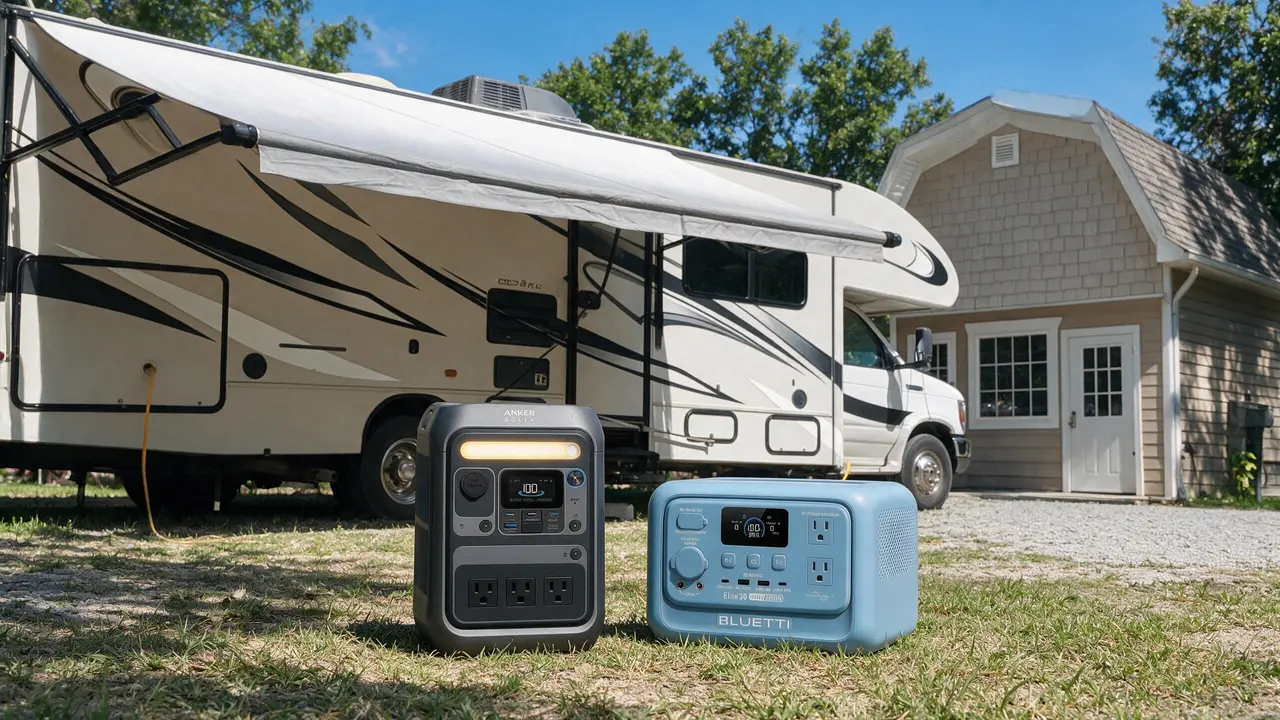
Updated
At a glance
Two portable power stations that look like the same purchase until you check what each one is actually built to do. The Anker SOLIX C300 puts more money into output headroom and app control; the BLUETTI Elite 30 V2 puts it into a lower entry price and simpler operation. Here is where the dollars land and who should pick which.
- Anker SOLIX C300 — $799 list, $599 historical low. Bets on output headroom and app control.
- BLUETTI Elite 30 V2 — $399 list, $399.00 historical low. Bets on lower entry price and simple operation.
Same money, different bets
As an Amazon Associate I earn from qualifying purchases. Recommendations here are based on fit and the evidence below — not commission size.
These two are not fighting over the same buyer. The Anker SOLIX C300 is the higher-priced unit at $799 list, and it bets that you want more output headroom and app-managed control. The BLUETTI Elite 30 V2 lists at $399 and bets that you want a lower entry price with simpler operation.
That is the whole decision in one line. One is a bigger financial commitment aimed at running more at once; the other is a cheaper commitment aimed at running the essentials. Everything below is about whether the gap in specs justifies the gap in price for your specific loads.
- Anker SOLIX C300 — $799 list, $599 historical low. Bets on output headroom and app control.
- BLUETTI Elite 30 V2 — $399 list, $399.00 historical low. Bets on lower entry price and simple operation.
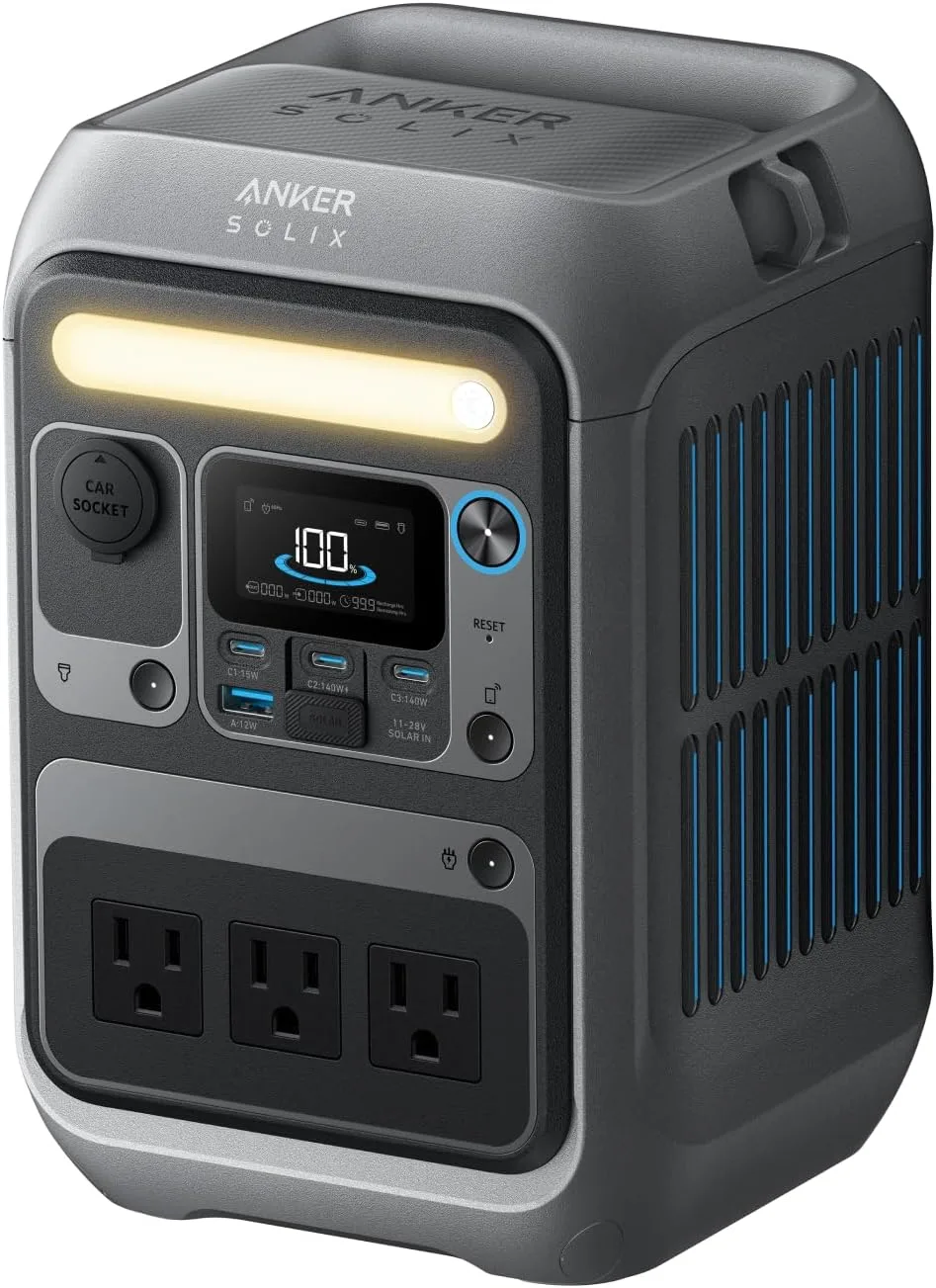
Anker C300 Portable Power Station, 288Wh Solar Generator
Highlights
- 288Wh rated capacity
- 300W continuous AC
- 600W surge
- LiFePO4 chemistry
- 9.1 lb (~4.1 kg)
- About $329.99 list
Best for
- SOLIX C300: phones, cameras and a laptop on short trips
- Travel kits when you need quiet pack power, not appliance runtime
- Brief desk backup for router and lights — not a fridge for days
Strengths
- SOLIX C300: 288Wh pack with 300W continuous / 600W surge — size loads to both numbers
- 9.1 lb (~4.1 kg) is the lightest-class carry in this band — easier stairs and car packing
- SOLIX C300 uses LiFePO4 — cycle-life claims usually beat older NMC marketing lines
- About $329.99 list in the Hub catalog — confirm live retail before you buy
Watch-outs · not ideal when
- SOLIX C300's small Wh class empties fast with a kettle, hair dryer or space heater
- 300W continuous will not hold heating elements or many compressor surges for long
- Solar input unpublished for SOLIX C300 — do not assume a same-day off-grid refill
- Airline and pack limits may still block SOLIX C300 even when the weight looks friendly
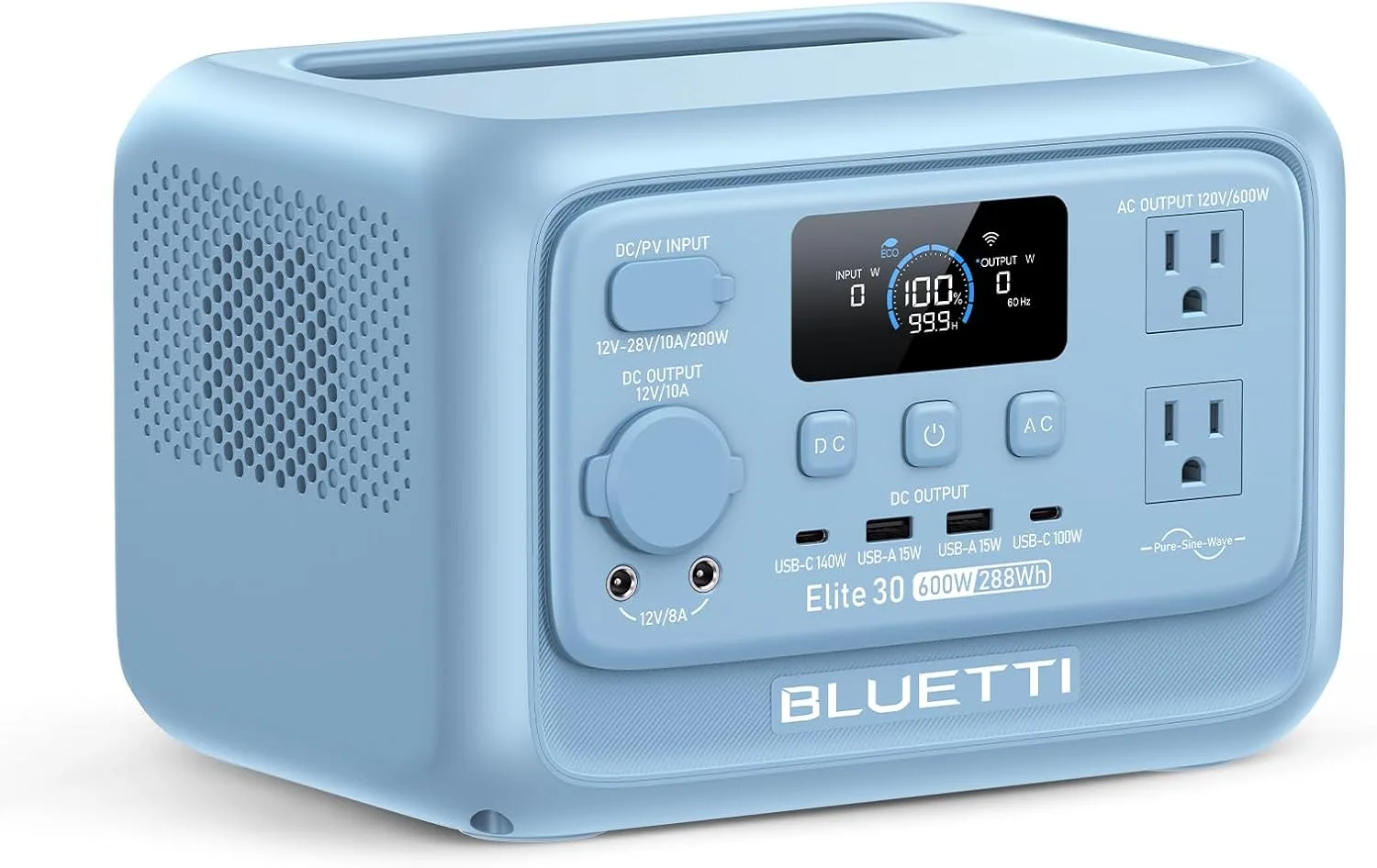
BLUETTI Elite 30 V2 Portable Power Station 288Wh 600W LFP Solar Generator
Highlights
- 288Wh rated capacity
- 600W continuous AC
- LiFePO4 chemistry
- Up to 200W solar input
- 9.5 lb (~4.3 kg)
- About $399 list
Best for
- Elite 30 V2: phones, cameras and a laptop on short trips
- Travel kits when you need quiet pack power, not appliance runtime
- Brief desk backup for router and lights — not a fridge for days
Strengths
- Elite 30 V2: 288Wh / 600W continuous — treat as electronics and light loads, not a tool inverter
- 9.5 lb (~4.3 kg) is the lightest-class carry in this band — easier stairs and car packing
- 10ms-class UPS switchover on the listing — useful when a router restart would hurt
- About $399 list in the Hub catalog — confirm live retail before you buy
Watch-outs · not ideal when
- Elite 30 V2's small Wh class empties fast with a kettle, hair dryer or space heater
- Usable energy on Elite 30 V2 is below the 288Wh label once the inverter is working
- Rated 200W solar on Elite 30 V2 is optimistic; shade and cables cut real watts
- Airline and pack limits may still block Elite 30 V2 even when the weight looks friendly
Spec snapshot
Listing figures only. Weight in lb; missing cells are n/a (not on file) — not guesses.
| Product | List price | Capacity (Wh) | Output (W) | Weight (lb) | Rating |
|---|---|---|---|---|---|
| Anker SOLIX C300 Portable Power Station, 288Wh Solar Generator | $329.99 | 288 Wh | 300 W | 9.1 lb | 4.86 |
| BLUETTI Elite 30 V2 Portable Power Station 288Wh 600W LFP Solar | $399 | 288 Wh | 600 W | 9.5 lb | 5.00 |
Where the money went
The table below compares what each listing publishes. Treat every number as a manufacturer claim from the product page, not a measured result. Where the listing does not state a figure, it is marked n/a rather than guessed.
The pattern is consistent: Anker spends on output and control features, BLUETTI spends on keeping the sticker price down. Neither approach is wrong, but they serve different outage plans.
- List price: Anker SOLIX C300 $799 vs BLUETTI Elite 30 V2 $399.
- Historical low: Anker SOLIX C300 $599 vs BLUETTI Elite 30 V2 $399.00.
- Battery chemistry: both listings describe LFP (lithium iron phosphate), which is the chemistry to look for if cycle life matters to you.
- Output emphasis: Anker positions the C300 around higher continuous output and more simultaneous device support; BLUETTI positions the Elite 30 V2 around essential-load runtime at a lower price.
- Control and monitoring: Anker leans on app-based monitoring and settings; BLUETTI leans on straightforward on-unit operation.
- Warranty: Anker publishes a multi-year warranty on the C300 listing; BLUETTI publishes a shorter stated term on the Elite 30 V2 listing. Confirm the current terms on the product page before buying, because these change.
The spec that decides it
For most buyers, continuous output is the number that decides this matchup. It determines whether you can run a refrigerator compressor, a sump pump, or a space heater without tripping the unit's overload protection. The Anker SOLIX C300 is positioned around higher continuous output, and that is what the extra money buys.
The second deciding factor is capacity in watt-hours. Capacity sets how long you can run a given load, not whether you can run it at all. If your outage plan is a CPAP, a phone, a router, and a few lights, the BLUETTI Elite 30 V2's capacity may cover a night without paying for output headroom you will never use.
Check both numbers on the live listing before you commit. Output and capacity are the two figures that turn a power station from a paper spec into a working backup plan.
- Deciding spec 1 — continuous output (W): higher on the Anker SOLIX C300 listing; this is what lets you run motor loads like a fridge compressor.
- Deciding spec 2 — capacity (Wh): confirm the published figure on each listing; it sets runtime, not peak capability.
- Rule of thumb: buy output for what you must start, buy capacity for how long you must run it.
Real owner trade-offs
No owner reviews were on file for either SKU at the time of writing, so there are no verified owner quotes to paraphrase here. That is a real limitation, and it matters: owner feedback is where you learn about fan noise, app reliability, and how a unit behaves after a year.
What the listings do tell you is the trade-off each brand is asking you to accept. Anker asks you to pay more up front for output headroom and app control, and the risk is paying for capability your loads never touch. BLUETTI asks you to accept a lower price and simpler operation, and the risk is hitting an output ceiling when you try to run a motor load.
If owner reviews matter to your decision, check the current review counts and star ratings on each product page before buying. Those numbers move, and they are the closest thing to field evidence you will get without a bench test.
- Anker SOLIX C300 trade-off: more money for more output and app control; risk is overbuying for light loads.
- BLUETTI Elite 30 V2 trade-off: lower price and simpler operation; risk is limited output for motor loads.
- Owner review counts and star ratings: check the live listings; not available in this comparison.
Buy the one that…
Buy the Anker SOLIX C300 if you need to start motor loads like a refrigerator or sump pump and you want app-based monitoring. The higher list price and the $599 historical low only make sense if you will actually use the output headroom.
Buy the BLUETTI Elite 30 V2 if your outage plan is essentials only — CPAP, router, phones, lights — and you would rather keep the $400 difference in your pocket. At $399 list and a $399.00 historical low, it is the cheaper bet on a narrower job.
Skip both if you need to run a whole-home load or a 240V appliance. These are portable stations, not home standby systems, and no price in this comparison changes that.
- Buy the Anker SOLIX C300 if… you need higher continuous output for motor loads and want app control.
- Buy the BLUETTI Elite 30 V2 if… you are backing up essentials only and want the lowest entry price.
- Skip both if… you need whole-home or 240V backup; look at a transfer switch or smart panel setup instead.
Frequently asked
Which is better for most buyers, the Anker SOLIX C300 or the BLUETTI Elite 30 V2?
The SOLIX C300 leads 4–1 on shared published metrics. That edge matters when weight, list price, cost per watt-hour match what you need; otherwise take the Elite 30 V2.
I care most about carry / camping — which should I buy?
Choose SOLIX C300 when you will move the unit often — it leads on weight and watt-hours per pound.
Method and sources
Model names and list prices come from the WattPicks catalog at build time. WattPicks does not run its own laboratory tests on power stations, and nothing on this page is presented as a measured result — it is catalog-backed buying guidance.
Read our methodology for how the catalog is normalized, and about WattPicks for who publishes it.