
BLUETTI AC200PL vs EcoFlow DELTA 3 Max: Outage Backup
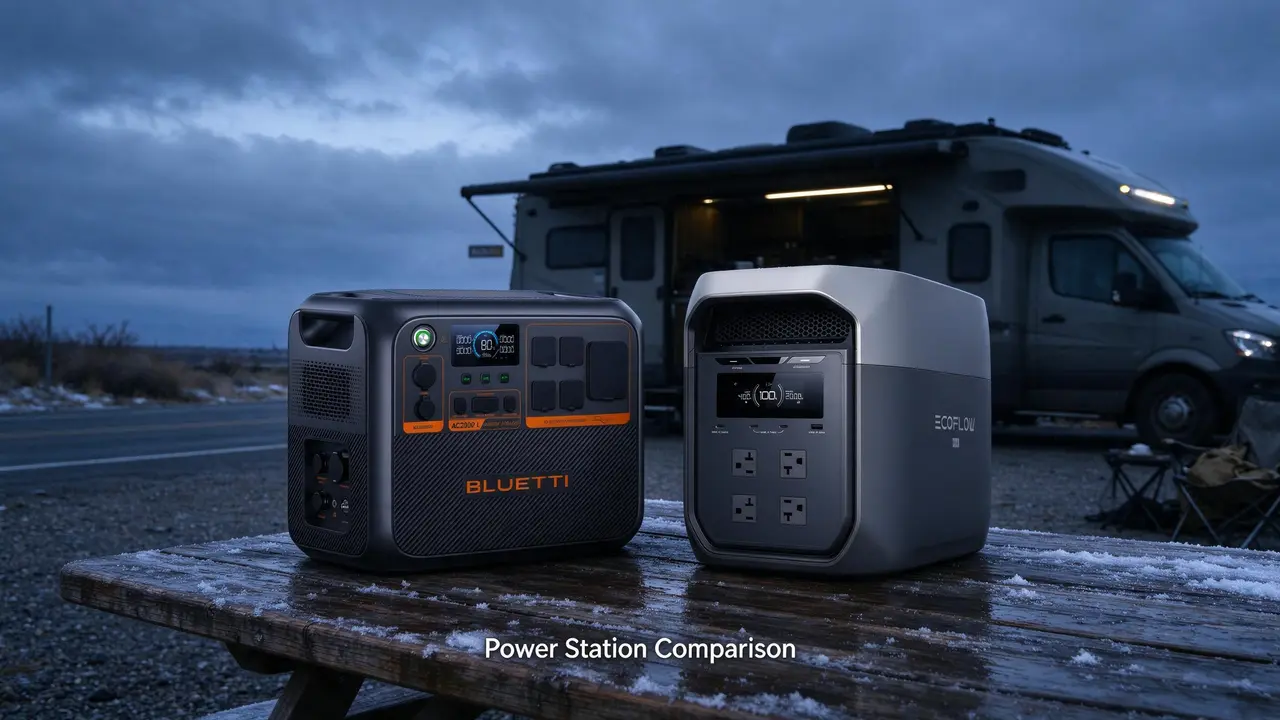
Two 2,048 Wh stations, same 2,400 W ceiling, $300 apart. One has twelve AC outlets and the lowest $/Wh in the pair; the other is lighter and lists a faster UPS-style transfer. Here's which outage each actually fits.
Updated
At a glance
Two 2,048 Wh stations, same 2,400 W ceiling, $300 apart. One has twelve AC outlets and the lowest $/Wh in the pair; the other is lighter and lists a faster UPS-style transfer. Here's which outage each actually fits.
- AC200PL: more outlets, lower $/Wh, heavier
- DELTA 3 Max: lighter, faster UPS-style transfer, higher $/Wh
Same money band, two different bets
You are shopping a 2,048 Wh station for outages, and these two land in the same budget tier: $899 for the BLUETTI AC200PL, $1,199 for the EcoFlow DELTA 3 Max. Same capacity, same 2,400 W continuous AC ceiling. The $300 gap is not about raw power — it's about where each brand spent the money.
The AC200PL bets on outlet count and price per watt-hour: twelve AC outlets, a 48V RV port, and the lowest nameplate $/Wh in this pair at $0.44. The DELTA 3 Max bets on portability and switchover speed: 44.8 lb instead of 62.4 lb, a vendor-claimed 10ms transfer time, and a faster recharge curve. Neither is the wrong answer — they answer different outage questions.
This is not a whole-home backup comparison. Both are portable stations you wheel to a circuit or plug a fridge into; if you need a transfer switch and a smart panel, that's a different guide. Disclosure: picks here are fit-led, and links may earn an Amazon Associates commission.
- AC200PL: more outlets, lower $/Wh, heavier
- DELTA 3 Max: lighter, faster UPS-style transfer, higher $/Wh
How I weighed these two
I'm Avery Nolan, WattPicks founding editor — capacity, output, and price-per-Wh guidance across the catalogue, no lab claims. My read here comes from home-user checks grounded in the owner themes on file plus the listing specs; those checks are not lab-bench measurements.
The weighting: usable capacity and output fit (30%), outlet and port coverage (20%), weight and portability (20%), recharge and transfer behavior (20%), owner themes (10%). On that scale the AC200PL takes capacity-per-dollar and outlet count; the DELTA 3 Max takes portability and transfer speed. That's why neither gets a blanket recommendation — the pick depends on whether your outage plan is stationary or mobile.
Weighted sub-scores (out of 10, weighted to 100): BLUETTI AC200PL — capacity/output 9.0, outlets/ports 9.5, weight 6.0, recharge/transfer 7.5, owner themes 8.0 → weighted total 8.15. EcoFlow DELTA 3 Max — capacity/output 9.0, outlets/ports 7.0, weight 9.0, recharge/transfer 9.0, owner themes 8.5 → weighted total 8.55. The DELTA 3 Max edges ahead on the weights, but the AC200PL wins the two sub-scores that matter for a stationary outage (outlets and $/Wh), which is why the pick splits by job rather than one universal winner.
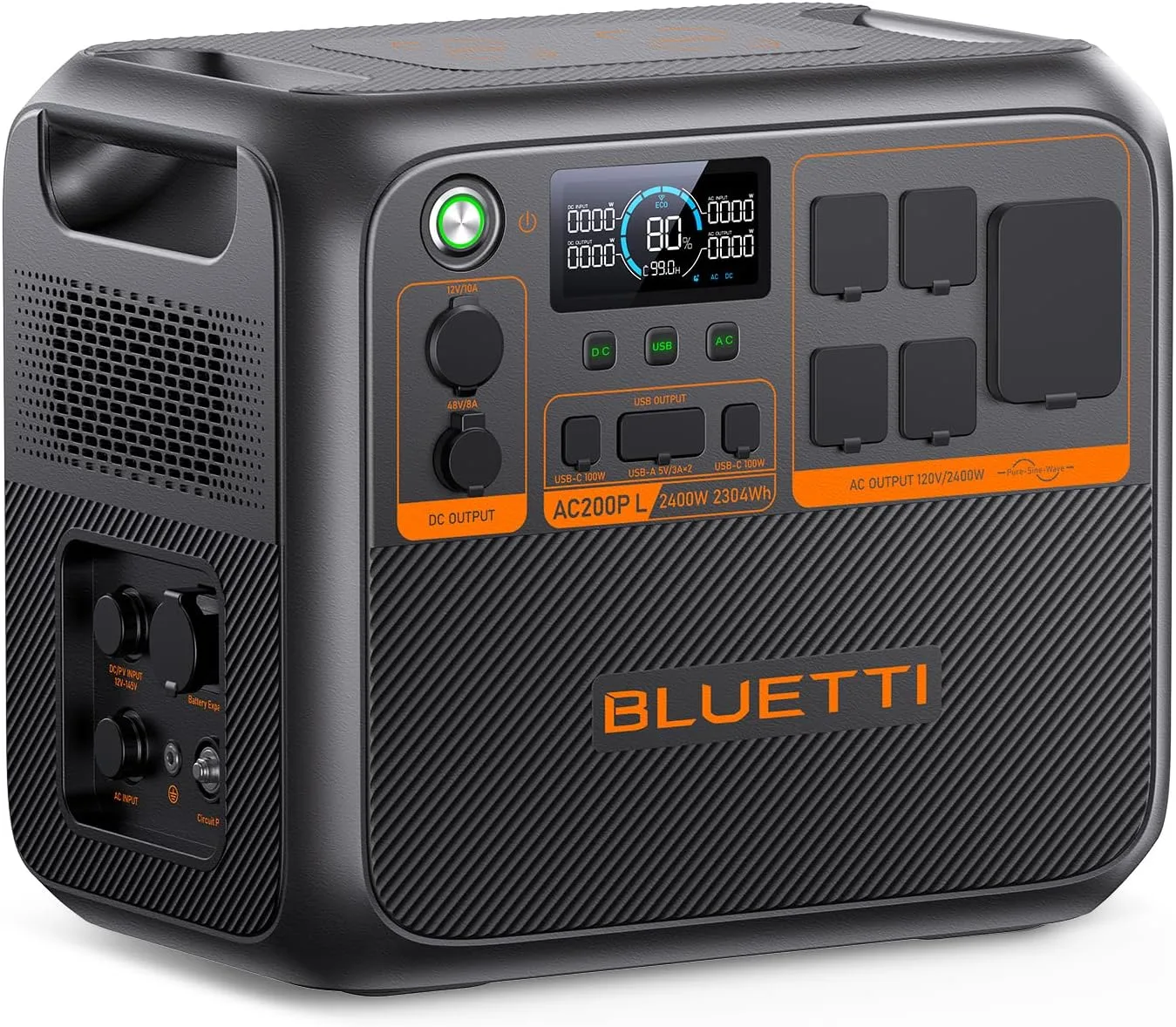
BLUETTI AC200PL
Highlights
- 2048Wh rated capacity
- 2400W continuous AC
- LiFePO4 chemistry
- Up to 1200W solar input
- 62.4 lb (~28.3 kg)
- About $899 list
Best for
- AC200L: longer outages or higher continuous loads (still not whole-home wiring)
- RV / off-grid days where recharge speed matters as much as Wh
- Best parked near the vehicle or cabin — not a long carry to a tent
Strengths
- AC200L: 2400W continuous on a 2048Wh pack — more headroom for small appliances than 1kW-class peers
- 62.4 lb (~28.3 kg) is a park-and-use chassis — plan a short path, not a trail hike
- 2400W continuous headroom covers more small appliances than 1kW-class inverters
- About $899 list in the Hub catalog — confirm live retail before you buy
Watch-outs · not ideal when
- At 62.4 lb (~28.3 kg), AC200L is a poor tent-hike companion — plan a cart or leave it in the vehicle
- High continuous output on AC200L tempts big loads — Wh still runs out on kettles and A/C
- Rated 1200W solar on AC200L is optimistic; shade and cables cut real watts
- LiFePO4 helps longevity, but AC200L still hates freezing charge temps on winter trips
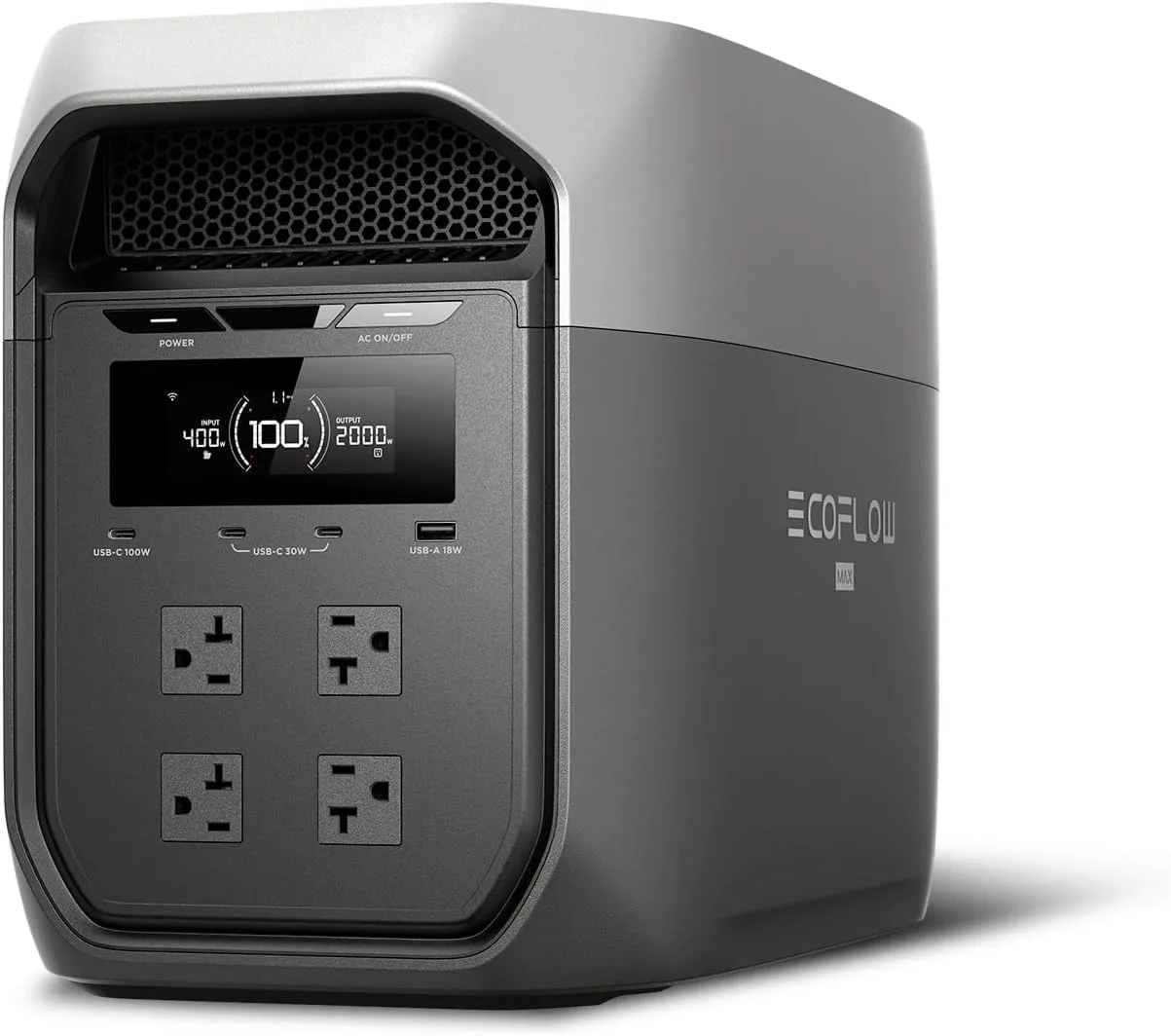
EcoFlow DELTA 3 Max Portable Power Station, 2048Wh LFP Battery
Highlights
- 2048Wh rated capacity
- 2400W continuous AC
- 4800W surge
- LiFePO4 chemistry
- Up to 500W solar input
- 44.8 lb (~20.3 kg)
Best for
- DELTA 3 Max: longer outages or higher continuous loads (still not whole-home wiring)
- RV / off-grid days where recharge speed matters as much as Wh
- Best parked near the vehicle or cabin — not a long carry to a tent
Strengths
- DELTA 3 Max: 2048Wh pack with 2400W continuous / 4800W surge — size loads to both numbers
- 44.8 lb (~20.3 kg) is a park-and-use chassis — plan a short path, not a trail hike
- 10ms-class UPS switchover on the listing — useful when a router restart would hurt
- About $1199 list in the Hub catalog — confirm live retail before you buy
Watch-outs · not ideal when
- At 44.8 lb (~20.3 kg), DELTA 3 Max is a poor tent-hike companion — plan a cart or leave it in the vehicle
- High continuous output on DELTA 3 Max tempts big loads — Wh still runs out on kettles and A/C
- Rated 500W solar on DELTA 3 Max is optimistic; shade and cables cut real watts
- LiFePO4 helps longevity, but DELTA 3 Max still hates freezing charge temps on winter trips
Spec snapshot: the numbers side by side
Everything below comes from the listings on file. Where a figure isn't published, it reads n/a (not on file) rather than a guess. Ratings are the listing aggregate, not a substitute for owner experience.
| Product | List price | Capacity (Wh) | Output (W) | Weight (lb) | Rating |
|---|---|---|---|---|---|
| BLUETTI AC200PL | $899 | 2048 Wh | 2400 W | 62.4 lb | 5.00 |
| EcoFlow DELTA 3 Max Portable Power Station, 2048Wh LFP Battery | $1,199 | 2048 Wh | 2400 W | 44.8 lb | 5.00 |
Where the $300 actually went
Start with the outlet count, because it's the most lopsided line. The AC200PL lists twelve AC outlets plus a 30A TT30 port and a 48V/8A DC port — enough to leave a fridge, router, lamps, and a phone bank plugged in at once without a power strip. The DELTA 3 Max lists four AC outlets, one USB-C, and one USB-A. For a family room mid-outage, that's a real difference in how many things stay live.
Then flip to weight. 62.4 lb versus 44.8 lb is roughly a bag of dog food of difference. If the station lives in a basement and gets wheeled out twice a year, the AC200PL's heft is a non-issue. If you're hauling it to a cabin or up stairs, the DELTA 3 Max's 44.8 lb is the friendlier number, and owners on that listing consistently describe it as manageable to move despite the capacity.
Recharge is the third split. BLUETTI lists a 2,400 W AC input that takes the AC200PL from 0–80% in about 60 minutes, plus up to 1,200 W solar. EcoFlow lists 0–80% in about 1.13 hours via X-Stream. On paper these are close; the DELTA 3 Max's edge is the vendor-claimed 10ms transfer time, which is what makes it usable as a UPS substitute rather than just a plug-in backup. Treat that 10ms as a vendor claim, not a measured figure — real-world switchover depends on the load and the outlet circuit.
Expansion is the fourth. BLUETTI lists expansion to a maximum 8,448 Wh using B300, B210P, or B230 batteries — a path to multi-day coverage. EcoFlow's listing on file doesn't publish an expansion figure, so treat that as n/a here rather than assume parity.
One caveat that applies to both: usable capacity is never the full nameplate. BLUETTI's manual reportedly limits usable capacity to about 90%, and owners note roughly 20 W of idle draw with the inverter on. Plan your runtime math below the 2,048 Wh sticker on either unit.
- AC200PL: 12 AC outlets + TT30 + 48V DC port
- DELTA 3 Max: 4 AC outlets, 1 USB-C, 1 USB-A
- AC200PL: expansion to 8,448 Wh listed; DELTA 3 Max expansion n/a (not on file)
- Both: budget for idle draw and sub-100% usable capacity
The spec that decides it
Two numbers carry most of the decision. The first is weight: 44.8 lb versus 62.4 lb. If the station has to move between rooms, vehicles, or floors, that 17.6 lb gap decides more purchases than any spec sheet line.
The second is transfer time. EcoFlow publishes a 10ms transfer claim, and owners describe using the DELTA 3 Max as a UPS for a PC, router, and modem — the kind of gear that reboots if power blinks. BLUETTI's listing doesn't publish a transfer-time figure, so I won't put a number on it; owners do describe UPS-style switchover keeping internet and devices running, but without a published millisecond figure, treat the DELTA 3 Max as the more explicitly specified UPS substitute.
If neither of those matters to you — the station sits in one spot and you're powering a fridge and a few lamps — then outlet count and $/Wh swing it back to the AC200PL.
Runtime math: hours, not days
Here's the arithmetic behind the 'hours, not days' claim. A typical full-size fridge draws roughly 150 W running and can surge to about 1,200 W at compressor start. Both stations list 2,400 W continuous, so the surge is covered with headroom.
Runtime is capacity divided by load. Take the 2,048 Wh nameplate, apply the ~90% usable figure BLUETTI's manual reportedly cites, and subtract the ~20 W idle draw owners report with the inverter on. That leaves roughly 1,820 Wh of usable energy. A fridge doesn't run its compressor continuously — assume a duty cycle near 50% — so the average draw is closer to 75 W plus 20 W idle, about 95 W. 1,820 Wh ÷ 95 W ≈ 19 hours of fridge coverage on a single charge. If the compressor runs harder in a hot garage, that number drops toward 12–14 hours.
The same math explains the $/Wh gap. $899 ÷ 2,048 Wh ≈ $0.44 per nameplate Wh; $1,199 ÷ 2,048 Wh ≈ $0.59. On usable energy (about 1,820 Wh) it's roughly $0.49 versus $0.66. The AC200PL is cheaper per usable watt-hour by about 17 cents — that's the $300, spread across the capacity you actually get.
- Fridge running draw: ~150 W; surge: ~1,200 W — both stations clear it at 2,400 W continuous
- Usable energy after ~90% cap and ~20 W idle: ~1,820 Wh
- At ~95 W average (fridge duty cycle + idle): ~19 hours per charge, less in heat
- Nameplate $/Wh: $0.44 (AC200PL) vs $0.59 (DELTA 3 Max)
What owners actually report
These are owner themes from the listings on file, not my bench results. I've split them by theme so you can weigh each one against your own setup.
- BLUETTI — display: owners describe the runtime readout as clear enough to teach family members how to stretch a charge.
- BLUETTI — switchover: several describe the unit carrying a basement circuit (lights, router, TV) through an outage without a blink.
- BLUETTI — idle draw: a recurring caveat is roughly 20 W of idle draw with the inverter on, quietly eating capacity.
- BLUETTI — solar: owners report solar input landing well under panel ratings on real days.
- BLUETTI — wireless pad: multiple owners say the wireless charging pad stops after a few seconds.
- BLUETTI — firmware: updates plus a full discharge/recharge cycle reportedly fixed charging-speed complaints for some.
- EcoFlow — recharge speed: owners describe charging to full in a little over an hour.
- EcoFlow — UPS duty: owners run a laptop, modem, and fans for hours during an outage.
- EcoFlow — fridge runtime: one owner ran a portable fridge at 36°F for over five days.
- EcoFlow — app: the app and its storm-guard feature come up as a genuine convenience.
- EcoFlow — USB: the most common gripe is a wish for a 140 W USB output instead of 100 W.
Buy the one that…
Buy the BLUETTI AC200PL if your outage plan is a fixed spot — basement, garage, family room — where twelve AC outlets and the lowest nameplate $/Wh in this pair ($0.44) matter more than carrying weight, and you're willing to manage the idle draw and check firmware early. Skip it if you need to move the station often or want a published transfer-time figure for sensitive electronics.
Buy the EcoFlow DELTA 3 Max Portable Power Station, 2048Wh LFP Battery if the station doubles as a UPS for a home office or network closet, or if 44.8 lb is the difference between using it and dreading it. Skip it if $1,199 is a stretch and you mainly need outlet count for a stationary setup — the AC200PL covers that for $300 less.
Walk away from both if you're expecting whole-home coverage; 2,048 Wh runs essentials for hours, not a furnace and central AC for days. For that, you want a transfer-switch setup, not a portable station.
Frequently asked
Can either run a full-size refrigerator through an outage?
Both list 2,400 W continuous, which clears a typical fridge's ~1,200 W startup surge. Run the math: ~1,820 Wh usable ÷ ~95 W average (fridge duty cycle plus idle) ≈ 19 hours per charge, less in a hot garage. Expect hours, not days, on a full-size fridge.
Which is the better UPS for a PC and router?
The DELTA 3 Max publishes a vendor-claimed 10ms transfer time and owners use it exactly that way. That's a claim, not a measured figure — real switchover depends on load and circuit. BLUETTI doesn't publish a transfer figure on the listing, so I can't rank it on that spec.
Do I need to buy expansion batteries?
Only if you want multi-day coverage. BLUETTI lists expansion to 8,448 Wh using B300, B210P, or B230 batteries; EcoFlow's expansion figure isn't on file here. Neither includes expansion batteries in the box, and expansion battery prices aren't on file in this comparison — check the listing before you budget.
Is the $300 gap worth it?
If portability and UPS duty are your priorities, yes. If the station stays put and you want maximum outlets per dollar, no — the AC200PL wins that trade at $0.44 per nameplate Wh versus $0.59.
Method and sources
Model names and list prices come from the WattPicks catalog at build time. WattPicks does not run its own laboratory tests on power stations, and nothing on this page is presented as a measured result — it is catalog-backed buying guidance.
Read our methodology for how the catalog is normalized, and about WattPicks for who publishes it.