
Jackery on Trustpilot: How to Read the 4.4 Score Before You Buy
Trustpilot's 4.4 score for Jackery is a company-service signal, not a product test. This guide shows you how to read the bipolar star mix, then applies that method to three Jackery models as worked examples.
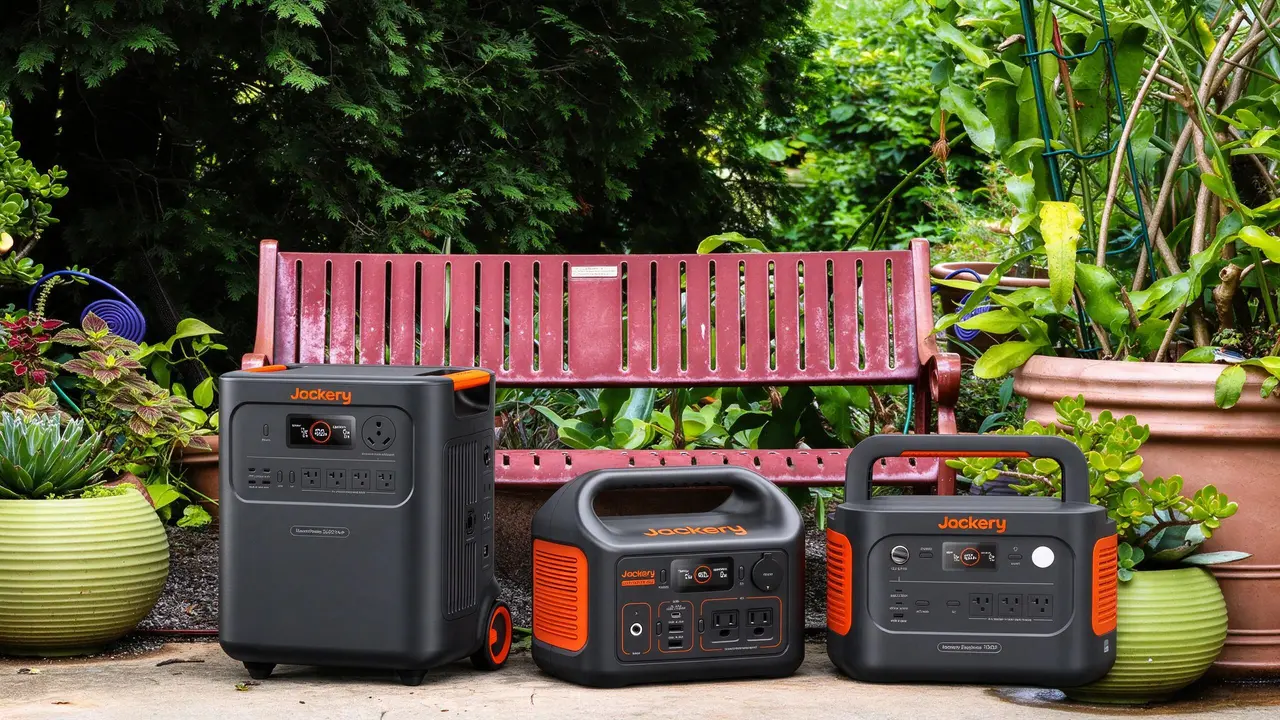
Updated
The short answer: Trustpilot measures the company, not the battery
As an Amazon Associate I earn from qualifying purchases. Commissions are paid by the retailer at no extra cost to you; they do not affect which models we recommend or how we rank them — fit and the evidence below decide that.
Jackery's Trustpilot page shows a TrustScore of about 4.4 out of 5 from roughly 1,160 reviews (Trustpilot company-page snapshot; not a WattPicks lab score) (Trustpilot company-page snapshot; not a WattPicks lab score). Figures are as shown on the Trustpilot page at the time of writing; Trustpilot scores shift, so check the live page before you buy. That sounds like a product rating. It isn't. Trustpilot reviews here are overwhelmingly about shipping speed, customer-service responsiveness, and whether a warranty claim got resolved — not about whether a 1,070 Wh station actually delivers 1,070 Wh under load.
The star mix is the real story: about 68% five-star, 6% four-star, 3% three-star, 3% two-star, and 20% one-star. That's a bipolar distribution — most people are delighted, a meaningful minority are furious, and almost nobody lands in the middle. A product that performs consistently tends to cluster around 4 stars; a company experience tends to split into love-it or hate-it. That split is your first clue about what you're reading.
So the useful question isn't "is Jackery good?" It's "what does this page tell me about service risk, and what does it not tell me about load fit?" The second half — Wh, continuous watts, chemistry, cost per Wh — you have to answer from spec sheets and owner notes on the product listings, not from Trustpilot.
This is a Trustpilot-reading guide with worked SKU examples, not a product review roundup. If you only want to interpret the score, read this section and the checklist section and stop there. If you're picking a model, continue — the rest of this guide translates the Trustpilot themes into three worked SKU examples.
- Trustpilot = fulfillment + customer-service signal, not a controlled product test.
- The 20% one-star tail is worth reading for patterns, not for a verdict on any single model.
- Paid Trustpilot subscription / claimed profile is noted on the page — neutral fact, not a scandal, but it means the page is actively managed and the review mix may reflect that.
How we read these reviews
Method: we split every review into two buckets — service (shipping, warranty, customer service) and product (does it run my load?). Trustpilot is strong on the first and weak on the second, so we weight the one-star tail for repeated patterns rather than single stories. Owner themes cited below come from the reviews on the product listings on file (Amazon listings for the Explorer 300, Explorer 1000 v2, and HomePower 3600 Plus); we name the listing note behind each claim. Listing star ratings are the aggregates shown on those listings, not independent lab scores.
Scoreboard scale: High = the spec or price clearly matches the job; Med = it works but with a real trade-off (watts, price, or install complexity). Applied to the three SKUs: Explorer 300 — High where list price and published capacity match the job, Med on continuous watts. Explorer 1000 v2 — High on continuous watts and ports, Med on price. HomePower 3600 Plus — High on capacity and whole-home output, Med on install complexity and weight. That is why the pick splits by job rather than one universal winner.
Worked example: a review that says "shipped fast, but the box was crushed and a cable was missing" goes in the service bucket (shipping damage) and tells you nothing about whether the unit runs a fridge. A review that says "ran my CPAP for four nights" goes in the product bucket — but only if the reviewer names the model and the load. Most Trustpilot reviews are service-bucket; that's why we don't treat the star average as a product score.
How the $/Wh figures in this guide were computed: list price divided by nameplate Wh, rounded to the nearest cent. They are a shopping shortcut, not a measure of usable energy after inverter losses or depth-of-discharge limits. Runtime math below also uses nameplate Wh before derating; where we apply a usable-energy factor, we say so.
Scoreboard on those weights — Jackery Explorer 300 Portable Power Station,292Wh (list $289): High where list price and published capacity match the job, Med on continuous watts; Jackery Explorer 1000 v2 Portable Power Station,1070Wh,1500W (list $559): High on continuous watts and ports, Med on price. That is why the pick splits by job rather than one universal winner.
What the praise actually clusters around
The positive reviews on file tend to mention three things: fast shipping, sale pricing, and customer service that replaces a failed unit without a fight. A recurring theme is whole-home or cabin backup — people running a HomePower 3600 Plus with a transfer switch, or pairing two 3600-class units to carry critical loads through a multi-day outage. That's a service-and-scenario story, and it lines up with what the bigger Jackery units are built to do.
There's also a steady drumbeat of Explorer 2000 and Explorer 1000 owners praising the form factor and the app. None of that is a bench measurement. It's owner satisfaction with the experience of buying and living with the thing — which is exactly what Trustpilot is good for.
- Shipping damage: check the box before you sign, especially for cable accessories.
- Price channel: compare Amazon vs. Jackery.com before checkout — the gap is real.
- Renewed-unit risk: if you get a warranty replacement, ask explicitly whether it's new stock.
Where the one-star reviews earn their keep
The friction themes are consistent enough to plan around. Shipping damage when cables aren't boxed separately comes up more than once. So does the observation that Amazon is often cheaper than Jackery.com — a pricing-channel annoyance, not a product defect. Website pop-ups and navigation complaints are cosmetic but frequent.
The one that matters for buyers: an Explorer 300 that failed after a few uses, was replaced under warranty, but arrived in a box marked "Renewed." That's a 3-star dissatisfaction story, and it's a fair caution — if you buy a small unit, confirm the replacement is new, not refurbished. Language-barrier and stress stories show up in the 1-star tail too. Read them as a signal that warranty support can take persistence, not as proof that every unit fails.
- Shipping damage: check the box before you sign, especially for cable accessories.
- Price channel: compare Amazon vs. Jackery.com before checkout — the gap is real.
- Renewed-unit risk: if you get a warranty replacement, ask explicitly whether it's new stock.
| Product | List price | Capacity (Wh) | Output (W) | Weight (lb) | Rating |
|---|---|---|---|---|---|
| Jackery Explorer 300 Portable Power Station,292Wh | $289 | 288 Wh | 300 W | 8.2 lb | 3.93 |
| Jackery Explorer 1000 v2 Portable Power Station,1070Wh,1500W | $559 | 1070 Wh | 1500 W | 23.8 lb | 4.75 |
| Jackery HomePower 3600 Plus Power Station, 3584Wh, 3600W AC Output | $1,899 | 3584 Wh | 3600 W | 77.2 lb | 4.60 |
Spec snapshot: the three models this page uses as examples
These are the three Jackery units we'll use to translate Trustpilot themes into buying decisions. Every number below comes from the product listings, not from Trustpilot. Ratings are the listing aggregates on file. The table above is the canonical spec table for this guide; we reference it rather than repeating it.
- Explorer 300: enough for phone/laptop charging, CPAP on DC, lights, small fans, short outages; not for fridge cycling, space heaters, or anything sustained above 300 W continuous.
- Explorer 1000 v2: enough for fridge cycling, CPAP, laptops, and small appliances under 1,500 W continuous; not for air fryers, space heaters, or anything above 1,500 W continuous.
- HomePower 3600 Plus: enough for whole-home critical loads with a transfer switch, multi-day outages, and cabin backup; not for solo camping, apartment use without a transfer switch, or anyone who can't lift 77 lb.
| Product | List price | Capacity (Wh) | Output (W) | Weight (lb) | Rating |
|---|---|---|---|---|---|
| Jackery Explorer 300 Portable Power Station,292Wh | $289 | 288 Wh | 300 W | 8.2 lb | 3.93 |
| Jackery Explorer 1000 v2 Portable Power Station,1070Wh,1500W | $559 | 1070 Wh | 1500 W | 23.8 lb | 4.75 |
| Jackery HomePower 3600 Plus Power Station, 3584Wh, 3600W AC Output | $1,899 | 3584 Wh | 3600 W | 77.2 lb | 4.60 |
Explorer 300: the small unit where the renewed-box caution bites
The Explorer 300 Portable Power Station, 288Wh is the cheapest way into the Jackery ecosystem at $289 list, and at 8.2 lb it's the one you'll actually carry. On paper it's a 288 Wh / 300 W unit — solid for a camping or CPAP backup box. The nameplate cost is $1.00/Wh, the highest of the three here, which is normal for small capacities.
Runtime math: a 20 W LED bulb draws 20 W, so 288 Wh ÷ 20 W = 14.4 hours at 100% depth of discharge — derate to about 85% usable and you get roughly 12 hours, which matches the owner note on the listing describing 12–14 hours on a 20 W LED. A CPAP on DC with the humidifier off typically draws well under 60 W; at 60 W, 288 Wh ÷ 60 W = 4.8 hours at full discharge, or about 4 hours at 85% usable — enough for one night, not four. The listing note describing four nights of CPAP on DC is an owner claim we can't verify; treat it as an outlier and size your own load before relying on it.
The Trustpilot lesson that maps here is the renewed-unit story. If your Explorer 300 fails and gets replaced, verify the replacement is new. The unit itself is fine for what it is — just don't expect 288 Wh to behave like 1,000. It's the right pick only if your loads are phones, lights, a fan, and a CPAP on DC; if a fridge is on your list, skip it.
Product-side anxieties to weigh: idle draw and inverter overhead mean the 288 Wh nameplate is not all usable, cold weather cuts lithium capacity further, and small units cycle more often if you use them daily — so expect shorter service life under heavy cycling than a larger LFP pack.
- Enough for: phone/laptop charging, CPAP on DC, lights, small fans, short outages.
- Not for: fridge cycling, space heaters, anything sustained above 300 W continuous.
- Watch: warranty replacements marked Renewed — ask for new stock.
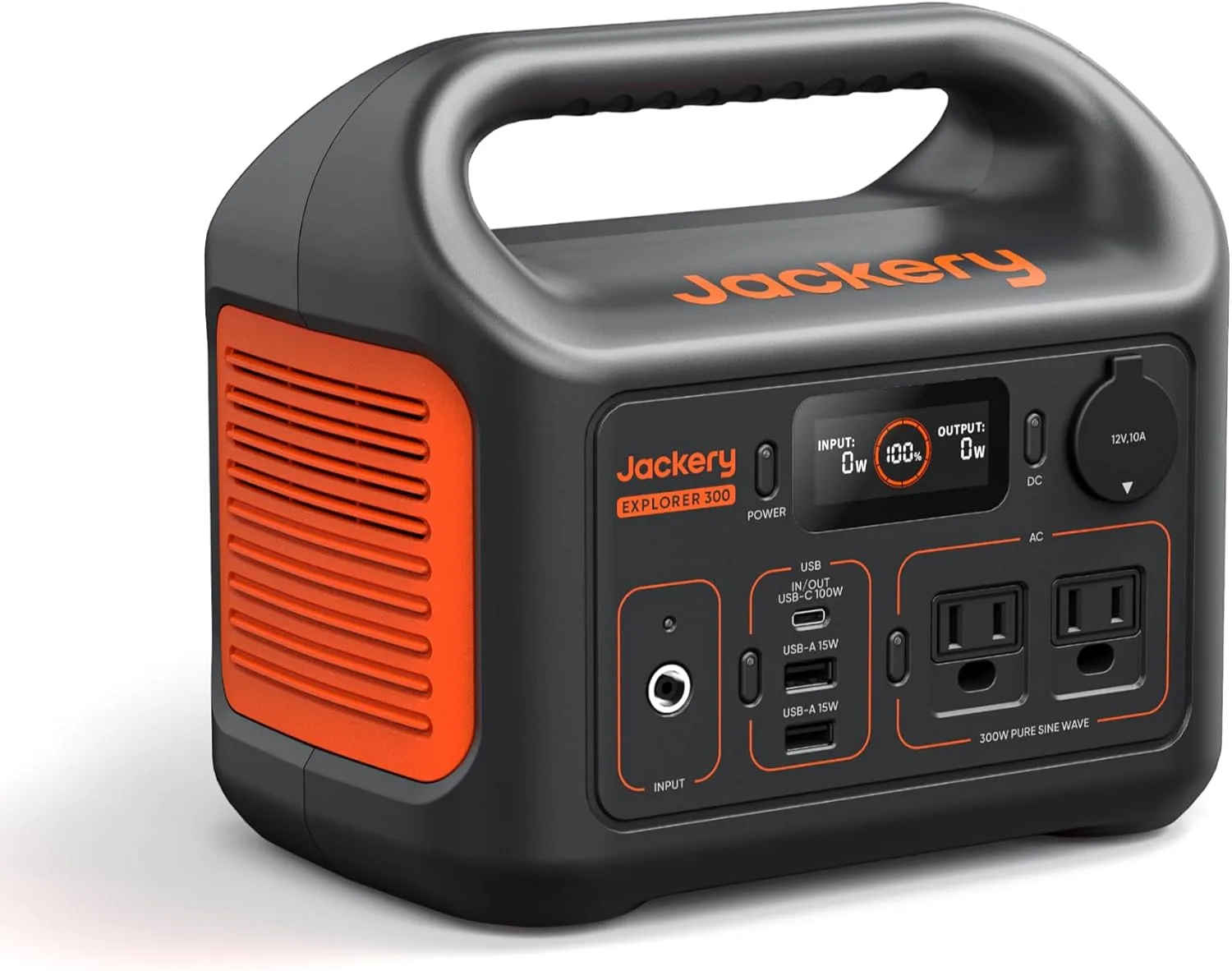
Jackery Explorer 300 Portable Power Station,292Wh
Highlights
- 288Wh rated capacity
- 300W continuous AC
- 600W surge
- LiFePO4 chemistry
- 8.2 lb (~3.7 kg)
- About $289 list
Best for
- Explorer 300 v2: phones, cameras and a laptop on short trips
- Travel kits when you need quiet pack power, not appliance runtime
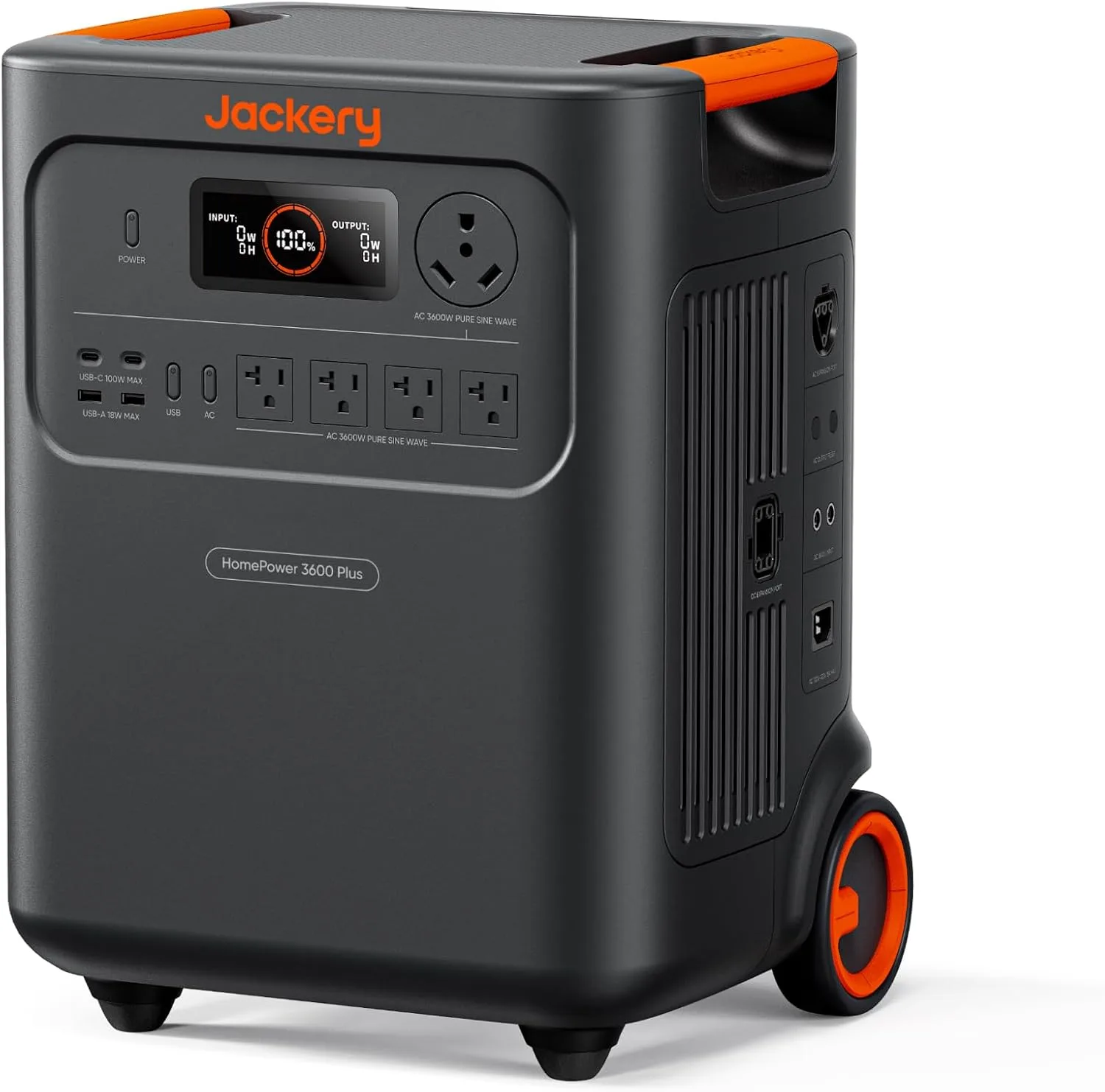
Jackery HomePower 3600 Plus Power Station, 3584Wh, 3600W AC Output
Highlights
- 3584Wh rated capacity
- 3600W continuous AC
- LiFePO4 chemistry
- 77.2 lb (~35.0 kg)
- About $1899 list
Best for
- HomePower 3600 Plus: longer outages or higher continuous loads (still not whole-home wiring)
- RV / off-grid days where recharge speed matters as much as Wh
Explorer 1000 v2: the mid-step where $/Wh math gets interesting
The Explorer 1000 v2 Portable Power Station, 1070Wh, 1500W is the value pivot in this lineup. At $559 list for 1,070 Wh, the nameplate cost is $0.52/Wh — essentially the same as the HomePower 3600 Plus at $0.53/Wh, a difference within rounding. It's also the unit that shows up most often in owner notes about running a fridge, a CPAP, or a small AC for a few hours.
Runtime math: a typical full-size fridge cycles its compressor, so average draw lands around 60–100 W even though peak is higher. At 1,070 Wh × 0.85 usable ÷ 80 W average, you get roughly 11 hours — which is why the listing note describing a side-by-side fridge/freezer for up to 9 hours is plausible but not guaranteed; your fridge's duty cycle decides it. A 1,700 W air fryer won't run — correct, that's above the 1,500 W continuous rating. The surge rating is for motor starts, not for sustained loads above 1,500 W.
Trustpilot praise for fast shipping and CS swaps applies here too. The friction theme that matters: Amazon is often cheaper than Jackery.com, so check both before you buy. At 23.8 lb it's portable in the "carry it to the car" sense, not the "hike with it" sense. Buy this one if fridge cycling or small-appliance backup is the job; skip it if you need whole-home circuits or sustained loads above 1,500 W.
Product-side anxieties: idle draw and inverter overhead trim usable capacity, cold-weather derating can cut effective Wh noticeably below the nameplate, and cycle life depends on chemistry and depth of discharge — check the listing's cycle-life note for the exact SKU before you plan years of daily use.
- Enough for: fridge cycling, CPAP, laptops, small appliances under 1,500 W continuous.
- Not for: air fryers, space heaters, anything above 1,500 W continuous.
- Watch: price channel — Amazon vs. Jackery.com gap is a recurring owner complaint.
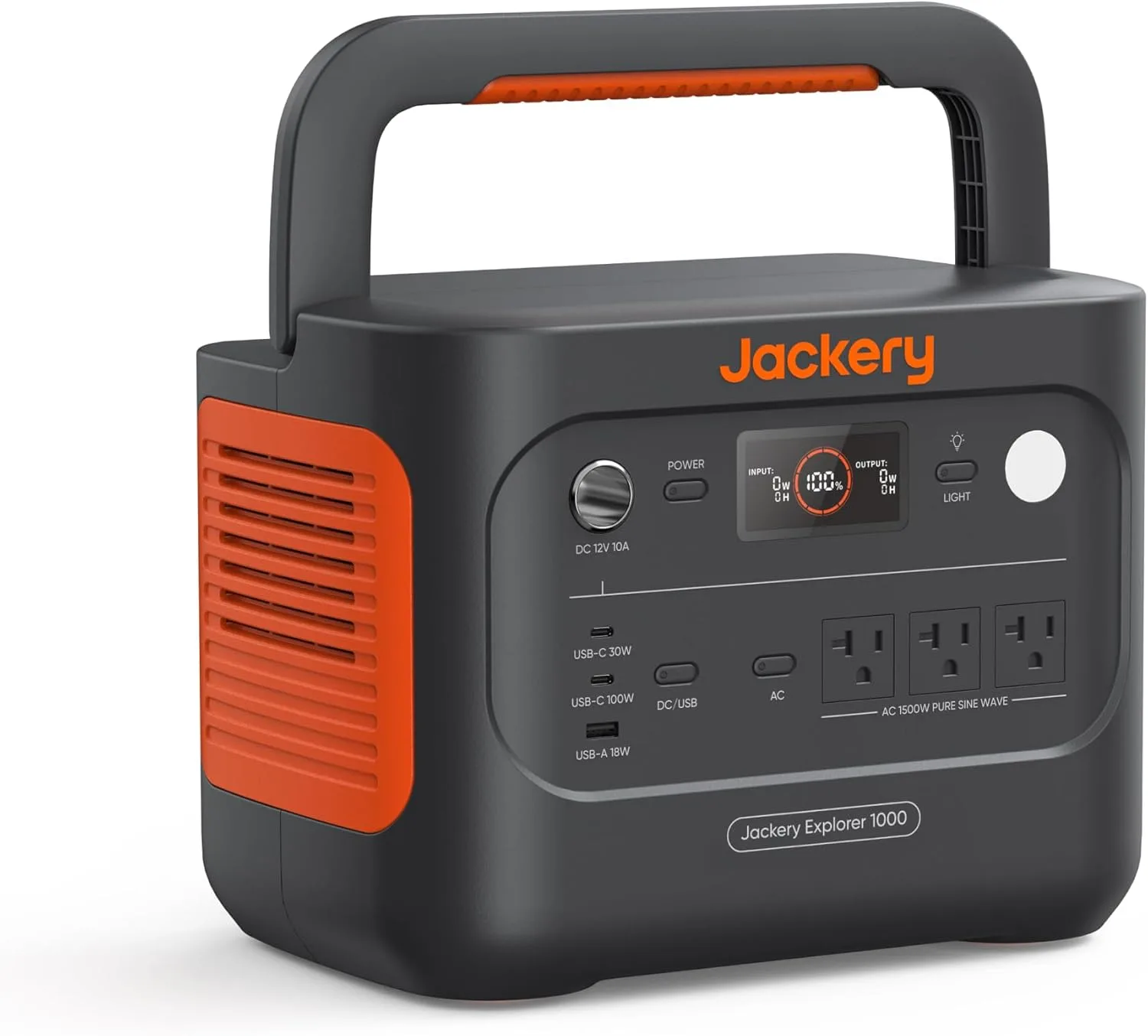
Jackery Explorer 1000 v2 Portable Power Station,1070Wh,1500W
Highlights
- 1070Wh rated capacity
- 1500W continuous AC
- LiFePO4 chemistry
- Up to 400W solar input
- 23.8 lb (~10.8 kg)
- About $559 list
Best for
- Explorer 1000 v2: weekend camping when 23.8 lb carry weight matters as much as 1070Wh
- Essentials bridge at home (fridge cycles, router) when sized to the Wh
HomePower 3600 Plus: the whole-home story Trustpilot actually validates
The HomePower 3600 Plus Power Station, 3584Wh, 3600W AC Output is where the Trustpilot praise gets specific. Multiple reviewers describe running it with a transfer switch or MTS to carry critical loads — furnace, fridge, freezer, internet — through multi-day outages. One Gulf Coast owner describes a dual-3600 setup for hurricane season. That's a service-and-scenario story, and it's the one place on the Trustpilot page where the product and the company experience line up cleanly.
On paper: 3,584 Wh, 3,600 W continuous, 77.2 lb with wheels and a telescopic handle. Nameplate cost is $0.53/Wh — essentially the same as the Explorer 1000 v2, which is unusual for a unit this size and the main reason it's worth considering if you need whole-home capacity.
Runtime math: a gas furnace blower plus a fridge and a freezer together might average 350 W. At 3,584 Wh × 0.85 usable ÷ 350 W, you get roughly 8.7 hours — close to the listing note describing about 10 hours for that combination, which is plausible if the furnace cycles less. The listing note describing a charge from 28% to 100% in under two hours is an owner claim we can't verify; check the published charge time on the listing before you plan around it.
The caveat: this is not a DIY-friendly install if you're wiring a transfer switch. The Trustpilot reviews that praise it are from people who either had an electrician or used the plug-and-play MTS path. If you're not comfortable with that, the 3600 Plus is overkill — the Explorer 1000 v2 will cover a fridge and a few lights. Budget tradeoff: the $1,899 unit price is only part of the total spend; a transfer switch plus electrician labor is a separate line item that varies by panel and local rates, so get a quote before you commit. If the installed total pushes past what whole-home backup is worth to you, the Explorer 1000 v2 at $559 is the cheaper path to fridge-and-lights coverage.
Product-side anxieties: idle draw and inverter overhead trim usable capacity, cold-weather derating can cut effective Wh below the nameplate, and cycle life depends on chemistry and depth of discharge — check the listing's cycle-life note for this SKU before you plan years of standby use.
- Enough for: whole-home critical loads with a transfer switch, multi-day outages, cabin backup.
- Not for: solo camping, apartment use without a transfer switch, anyone who can't lift 77 lb.
- Watch: install complexity — budget for an electrician if you're not using the MTS path.
How to read a bipolar Trustpilot page before you buy
Here's the three-step checklist we'd use. Step 1 — bucket the review: service (shipping, warranty, CS) or product (does it run my load?). Trustpilot is strong on the first and weak on the second. Step 2 — look at the one-star tail for patterns, not verdicts: if the same complaint shows up five times, it's a real risk; if it shows up once, it's an outlier. Step 3 — cross-check the product bucket against the listing specs and owner notes, which is where Wh, continuous W, and chemistry actually live.
Worked deconstruction of a one-star review: "Unit arrived with a cracked case, support took two weeks to respond, and the replacement was marked renewed." Bucket it — cracked case = shipping (service); two-week response = warranty friction (service); renewed replacement = fulfillment policy (service). Product signal: none. What to do with it: check the box before signing, keep photos, and ask in writing whether a replacement is new stock. That's a service-risk action, not a reason to doubt the battery.
For Jackery specifically, the pattern is: service is generally good but can take persistence, shipping damage happens, and the Amazon-vs-Jackery.com price gap is real. The product side is better answered by the spec sheet than by Trustpilot. A 4.4 TrustScore with a 20% one-star tail is a company that mostly delivers but occasionally frustrates — which is roughly what you'd expect from a large direct-to-consumer brand.
- Bucket the review: service vs. product.
- Read the one-star tail for repeated patterns, not single stories.
- Cross-check product claims against listing specs — Trustpilot won't tell you if 1,070 Wh runs your fridge.
Who should skip Jackery entirely
If you need same-week warranty resolution or you refuse a refurbished replacement, Jackery may not be the right brand for you. The one-star tail shows warranty support can take persistence, and the renewed-box story is a real caution. Buyers who want a local dealer or a brand with a no-questions-asked new-unit replacement policy should look elsewhere.
Reconciling the 20% one-star tail against failure-rate signals: the complaints cluster around shipping damage, warranty friction, and pricing-channel annoyance — not universal product failure. That's a service-risk signal, not proof that the hardware is unreliable. If you're comfortable with a bit of back-and-forth on a claim, the product side is better judged by the spec sheet and owner notes than by the star mix.
The bottom line
Trustpilot tells you Jackery is a company that mostly ships fast and honors warranties, with a vocal minority who hit shipping damage or warranty friction. It does not tell you whether 288 Wh runs your CPAP or whether 1,500 W starts your fridge compressor. For that, use the spec table above and the owner notes on each listing.
If you want the cheapest way into the ecosystem and you're carrying it, the Explorer 300 at $289 is fine — just verify any replacement is new. If you need fridge and small-appliance backup, the Explorer 1000 v2 at $559 is the value pick at $0.52/Wh. And if you're wiring a transfer switch for whole-home backup, the HomePower 3600 Plus at $1,899 is the one the Trustpilot reviews actually validate — with the caveat that install complexity and the electrician quote are on you.
Tie-breaker: if you're CPAP-only, the Explorer 300 covers it; if you're cycling a fridge, step up to the Explorer 1000 v2. If the electrician quote for a transfer switch pushes the installed total past what whole-home backup is worth to you, the Explorer 1000 v2 is the cheaper path to fridge-and-lights coverage.
Sources
Company-review snapshot: Trustpilot page for www.jackery.com (accessed for this draft). Aggregate TrustScore ~4.4 / ~1,160 reviews and the on-page star mix (~68% five-star / ~20% one-star) are third-party platform figures, not WattPicks lab results — recheck the live page before buying.
Product Wh / continuous W / list prices in the Spec snapshot follow Hub FACT LOCK for the shortlisted SKUs only.
Owner-note claims (12–14 h on a 20 W LED, four nights of CPAP on DC, side-by-side fridge up to 9 h, ~10 h furnace+fridge+freezer, 28%→100% charge under two hours) are attributed to the product listings on file and are not independently verified; treat them as owner claims and check the live listing before relying on them.
Frequently asked
Is Jackery's 4.4 Trustpilot score a product rating?
No — it's mostly a company-service and fulfillment signal. Product performance has to be checked against specs and owner notes.
Does the 20% one-star rate mean Jackery units fail often?
Not necessarily. The one-star reviews cluster around shipping damage, warranty friction, and pricing-channel complaints, not universal product failure.
Which Jackery model is the best value per Wh?
On nameplate $/Wh, the Explorer 1000 v2 and HomePower 3600 Plus are at parity within rounding ($0.52 vs $0.53/Wh). The Explorer 300 is $1.00/Wh, which is normal for small capacities.
Can I run a fridge on the Explorer 300?
No — at 288 Wh / 300 W it's for phones, lights, CPAP, and small fans. For fridge cycling, the Explorer 1000 v2 is the minimum.
What does Jackery's warranty say about new vs. refurbished replacements?
Check the current warranty terms on Jackery's site before you buy — the renewed-box story is a caution to confirm replacement stock, not a guarantee of policy. Published terms vary by model (for example, LFP models and the Explorer 300 may carry different lengths), so verify the exact term for the SKU you're buying on Jackery.com.
Method and sources
Model names and list prices come from the WattPicks catalog at build time. WattPicks does not run its own laboratory tests on power stations, and nothing on this page is presented as a measured result — it is catalog-backed buying guidance.
Read our methodology for how the catalog is normalized, and about WattPicks for who publishes it.