
How Long to Charge a Power Station With Solar
Solar recharge time is battery Wh divided by real panel input, minus roughly 20% in losses — the station's solar input cap matters as much as its capacity. Here are four units ranked by how fast they actually refill from the sun.
Updated
The solar math, before you shop
Here's the question that actually matters: how many hours of good sun does it take to refill the battery you're carrying? The arithmetic is boring and reliable — battery watt-hours divided by the real watts your panels deliver, then add back roughly 20% for conversion and charging losses. A 1,000 Wh bank fed a true 200 W of panel power lands near 6 hours of ideal sun; knock that down to 120 W on a hazy afternoon and you're looking at 10 hours, which is more than one day of usable light.
That's why solar input ceiling matters as much as capacity. A big battery with a low input cap charges slowly no matter how many panels you string together, and a small battery with a generous cap can refill before lunch. Panel pairing and angle do the rest — flat-mounted panels in partial shade routinely deliver half their rated wattage.
This guide is for campers, overlanders, and light off-grid users sizing a station around solar refill speed. It is not a whole-home backup ranking, and it is not a UPS comparison — if you need transfer-switch wiring or outage-grade runtime for a fridge and furnace, that's a different job.
Method & disclosure
As an Amazon Associate, WattPicks earns from qualifying purchases. Picks are fit-led, not commission-led — no brand pays for placement, and the ranking follows the weights below.
Specs (capacity, output, weight, list price, rating) come from the product listings. Solar input caps and owner-reported recharge times and quirks come from the review packs on file, not from the listings, and are labeled as such throughout. Review packs cover owner feedback collected through the most recent update window; treat them as directional, not lab-verified.
I'm Avery Nolan, founding editor at WattPicks. My checks here are home-user reads grounded in owner themes plus listing specs — not lab-bench measurements, and I'm not scoring these units on an invented third-party bench.
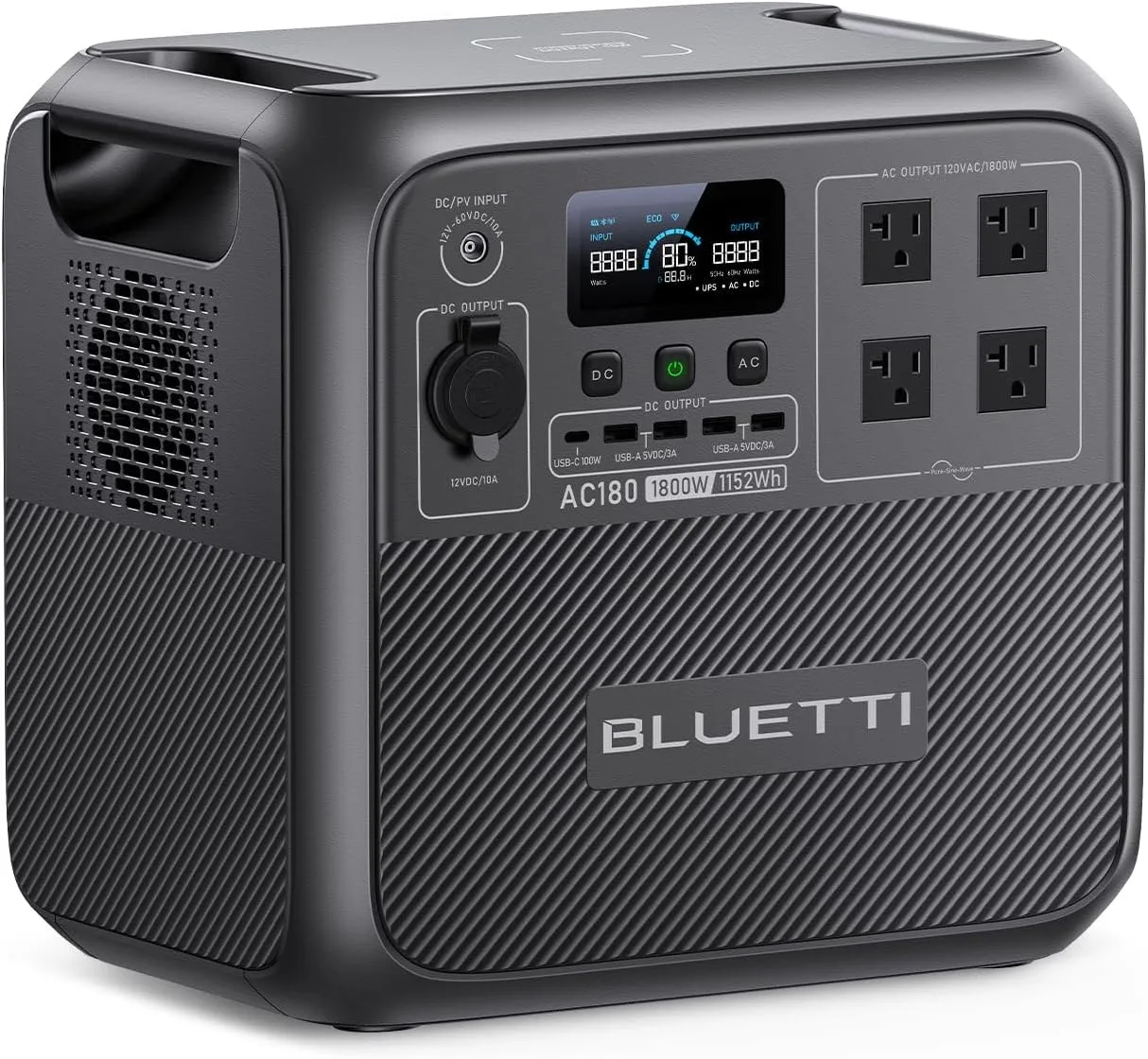
BLUETTI Portable Power Station AC180, 1152Wh LiFePO4 Battery Backup w/ 2 1800W
Highlights
- 1152Wh rated capacity
- 1800W continuous AC
- LiFePO4 chemistry
- Up to 500W solar input
- 35.3 lb (~16.0 kg)
- About $499 list
Best for
- AC180: most Wh per list dollar in mid-size LiFePO4 shortlists (~1152Wh)
- Home essentials when 1800W continuous matters more than a light carry
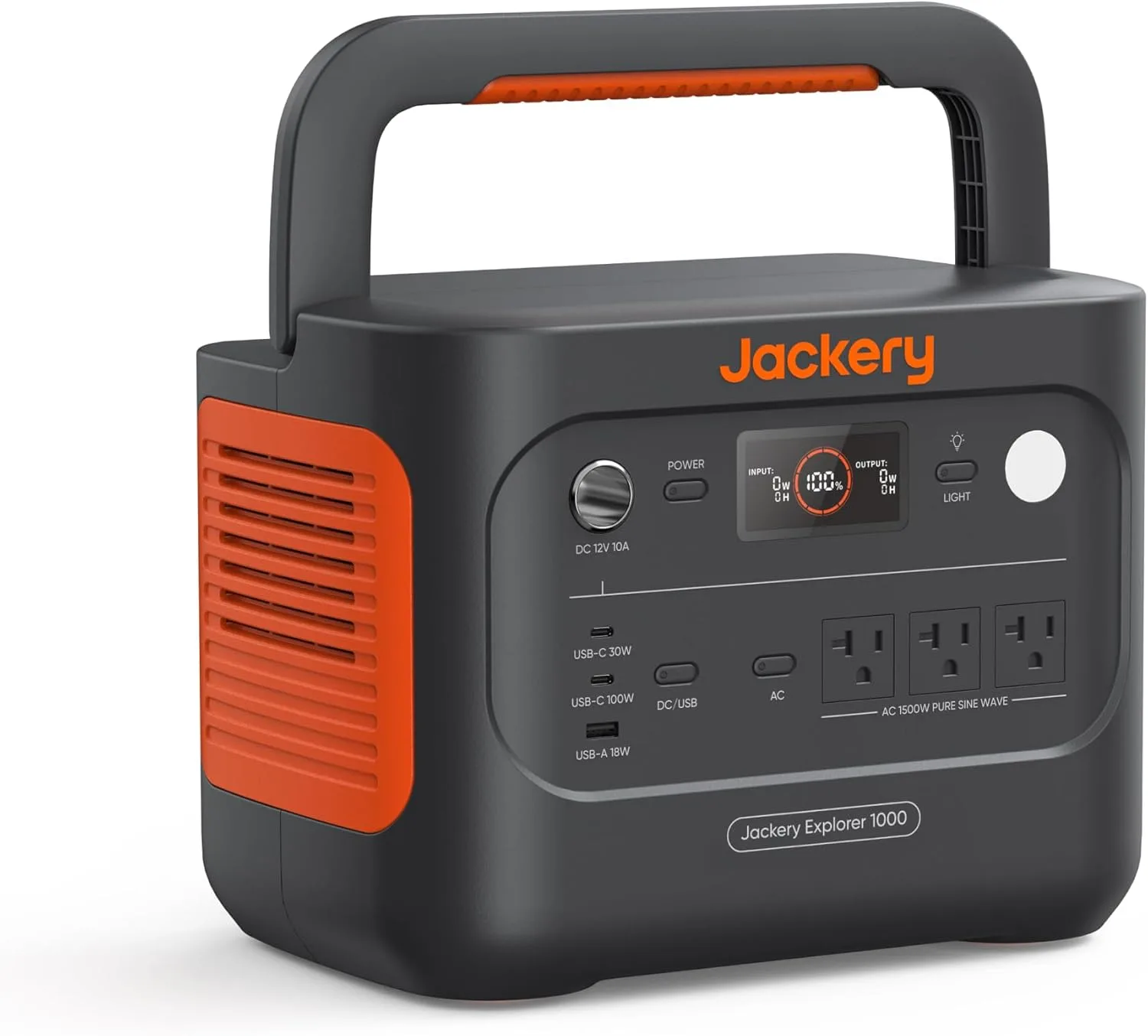
Jackery Explorer 1000 v2 Portable Power Station,1070Wh,1500W
Highlights
- 1070Wh rated capacity
- 1500W continuous AC
- LiFePO4 chemistry
- Up to 400W solar input
- 23.8 lb (~10.8 kg)
- About $559 list
Best for
- Explorer 1000 v2: weekend camping when 23.8 lb carry weight matters as much as 1070Wh
- Essentials bridge at home (fridge cycles, router) when sized to the Wh
Anker C2000 Gen 2 Portable Power Station, 2,048Wh
Highlights
- 2048Wh rated capacity
- 2400W continuous AC
- 4000W surge
- LiFePO4 chemistry
- Up to 800W solar input
- 41.7 lb (~18.9 kg)
Best for
- C2000 Gen 2: longer outages or higher continuous loads (still not whole-home wiring)
- RV / off-grid days where recharge speed matters as much as Wh
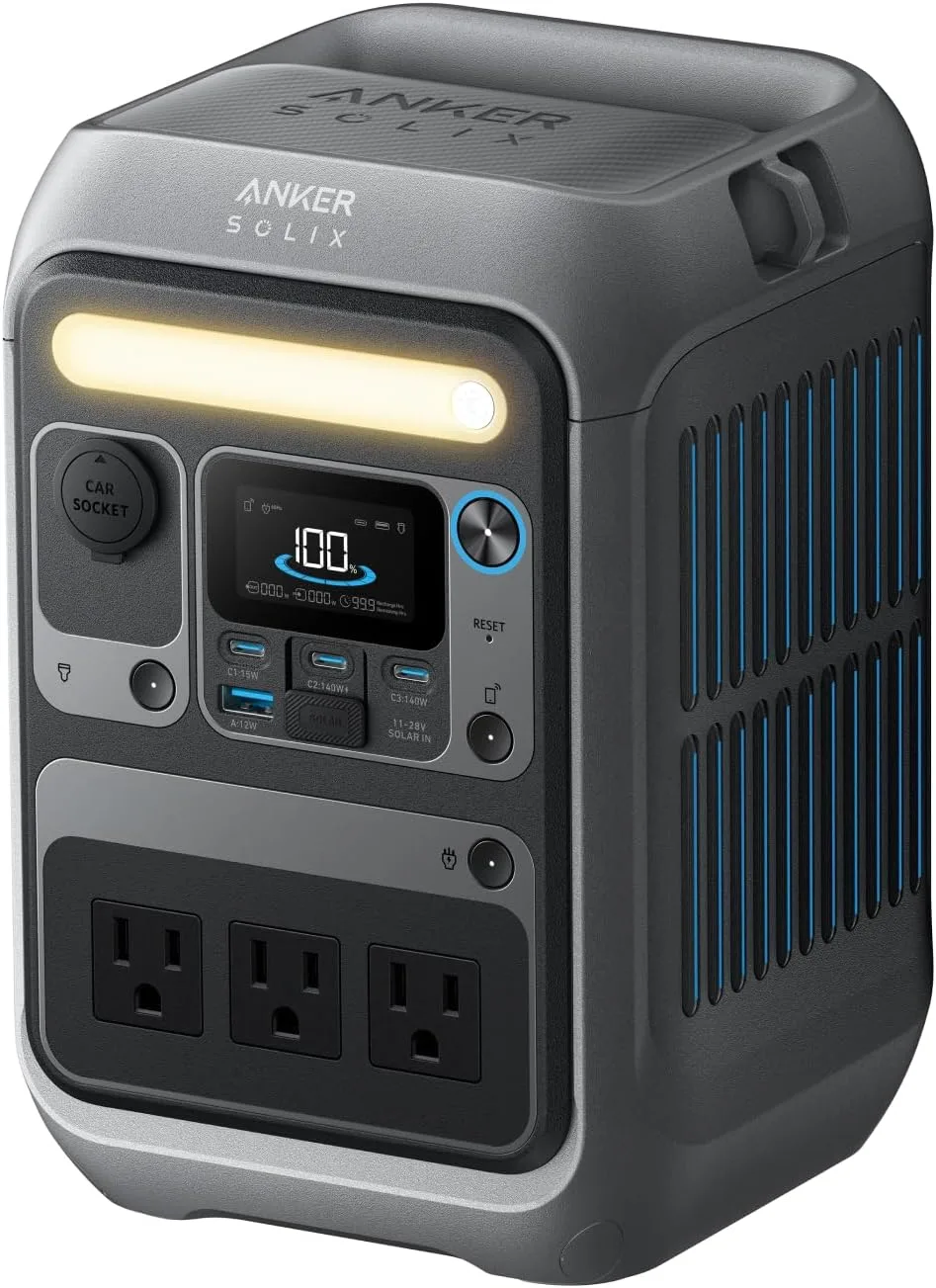
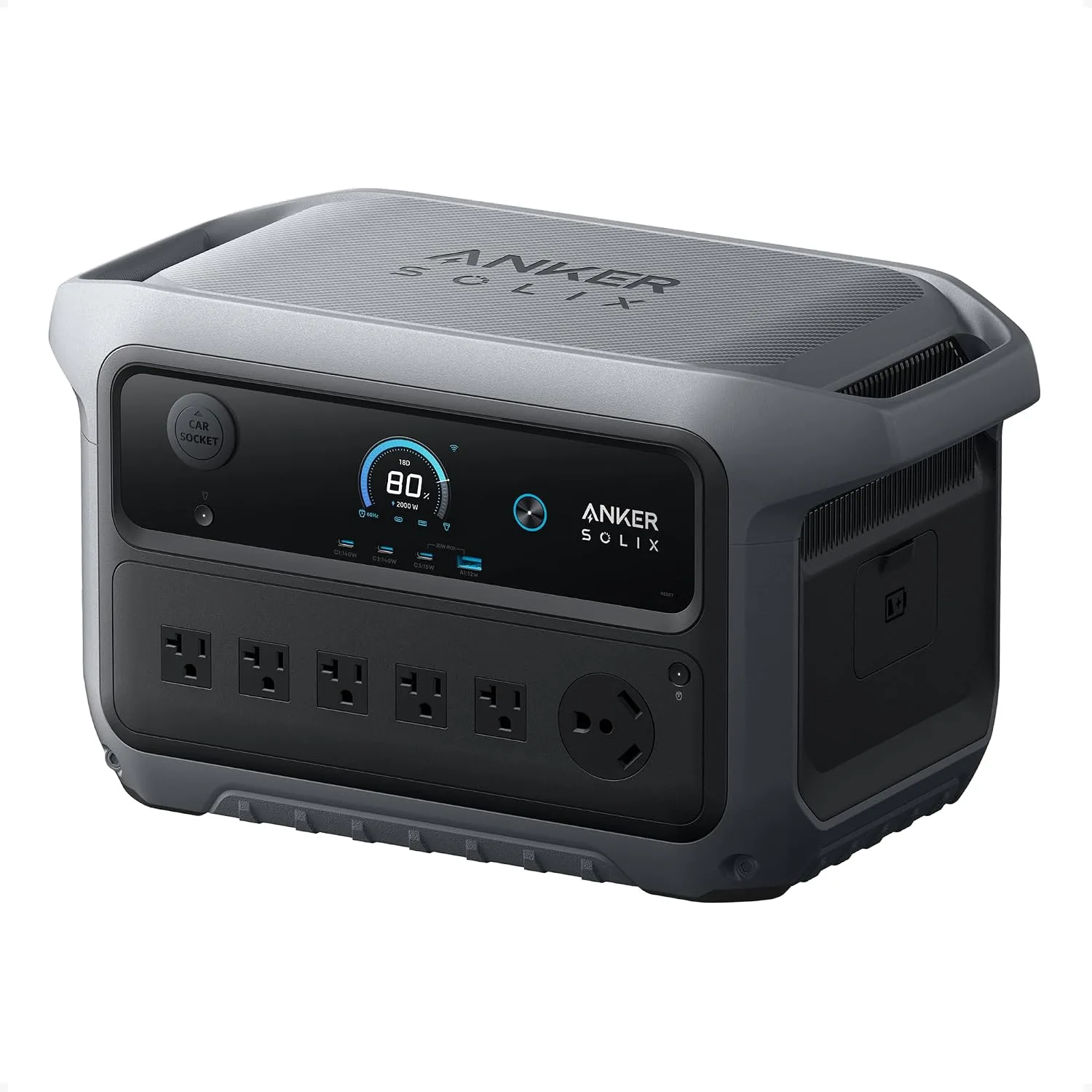
Anker C300 Portable Power Station, 288Wh Solar Generator
Highlights
- 288Wh rated capacity
- 300W continuous AC
- 600W surge
- LiFePO4 chemistry
- 9.1 lb (~4.1 kg)
- About $429.99 list
Best for
- SOLIX C300: phones, cameras and a laptop on short trips
- Travel kits when you need quiet pack power, not appliance runtime
How I weighted this job
Weights for this camping/off-grid angle: solar input ceiling and realistic recharge time 30%; capacity-to-weight ratio for hauling 20%; usable output for camp loads 20%; owner-reported reliability and quirks 20%; price-per-Wh at list 10%. Every percentage is scored below.
Why the order: on a solar-first trip, a station that can't absorb panel watts is dead weight no matter how big the battery is. Weight comes second because you carry it. Output third because camp loads are modest. Owner themes catch the quirks listings hide — idle draw, solar resume bugs, firmware calibration. Price-per-Wh is last because the cheapest bank that charges too slowly isn't cheap.
Tracing #1 vs #2: the BLUETTI AC180 edges out the Jackery Explorer 1000 v2 mainly on solar headroom — 500 W of published solar input against the Jackery's 400 W cap — and on list $/Wh ($0.43 vs $0.52). The Jackery claws back ground on weight (23.8 lb vs 35.3 lb) and a cleaner out-of-box experience; the AC180's ~20 W idle draw and ~90% usable capacity mean its real solar-to-use ratio is less flattering than the spec sheet. Close call, and the winner depends on whether you're carrying it or parking it.
Scoreboard on those weights:
• Jackery Explorer 1000 v2 (list $559, $0.52/Wh): High on weight and out-of-box experience, Med on continuous watts (1,500 W).
• BLUETTI AC180 (list $499, $0.43/Wh): High on continuous watts (1,800 W) and solar headroom, Med on price-per-Wh relative to the Jackery's lighter build.
• Anker C2000 Gen 2 (list $1,499, $0.73/Wh): High on capacity and output, Med on weight and price-per-Wh.
• Anker C300 (list $429.99, $1.15/Wh): High on portability, Med on capacity and solar input.
The Jackery's Med on continuous watts doesn't drop it below #2 because its 1,500 W ceiling still covers typical camp loads (fridge, fan, lights, laptop), and its weight and quiet-mode strengths carry more of the 30% solar/weight weighting than raw output does. The AC180 wins #1 on solar headroom and $/Wh; the Jackery wins on the carry-and-sleep job.
Quick picks: top, runner-up, also-consider
Top pick for solar-first camping: BLUETTI AC180. The 500 W solar input is the highest published ceiling in this four-unit set relative to its 1,152 Wh bank, and it's also the cheapest per listed Wh at $0.43. Owners report it charging fully in about two hours on AC and running a car fridge across a five-day trip. Plan around the ~20 W idle draw and the ~90% usable capacity — real runtime is lower than the math suggests.
Runner-up: Jackery Explorer 1000 v2 Portable Power Station,1070Wh,1500W. At 23.8 lb it's the lightest of the three mid-size units here, and the 400 W solar cap is workable for a 1,070 Wh bank. Owners praise the quiet mode for overnight fridge-and-fan duty. Skip it if you need to run a 1,700 W air fryer or a big sliding miter saw — it won't start them.
Also consider: Anker C2000 Gen 2 Portable Power Station, 2,048Wh if your trip is basecamp-style and you want serious capacity with a 2400 W solar cap. Skip it if you're moving it daily (41.7 lb) or expect to run high-draw appliances on a 15A household outlet — pass-through caps output at 15A.
And the Anker C300 Portable Power Station, 288Wh Solar Generator if you're hiking in and only need to top up phones, a laptop, and a light bar. Skip it if you need overnight fridge runtime or UPS-grade protection — owners report solar not resuming after sunrise without a replug.
| Product | List price | Capacity (Wh) | Output (W) | Weight (lb) | Rating |
|---|---|---|---|---|---|
| Jackery Explorer 1000 v2 Portable Power Station,1070Wh,1500W | $559 | 1070 Wh | 1500 W | 23.8 lb | 4.75 |
| BLUETTI AC180 | $499 | 1152 Wh | 1800 W | 35.3 lb | 4.85 |
| Anker C2000 Gen 2 Portable Power Station, 2,048Wh | $1,499 | 2048 Wh | 2400 W | 41.7 lb | 4.91 |
| Anker C300 Portable Power Station, 288Wh Solar Generator | $429.99 | 288 Wh | 300 W | 9.1 lb | 4.86 |
Spec snapshot
List prices only; deal stickers and historical lows are ignored on purpose so the comparison stays stable. Rating is the listing aggregate, not owner proof.
| Product | List price | Capacity (Wh) | Output (W) | Weight (lb) | Rating |
|---|---|---|---|---|---|
| Jackery Explorer 1000 v2 Portable Power Station,1070Wh,1500W | $559 | 1070 Wh | 1500 W | 23.8 lb | 4.75 |
| BLUETTI AC180 | $499 | 1152 Wh | 1800 W | 35.3 lb | 4.85 |
| Anker C2000 Gen 2 Portable Power Station, 2,048Wh | $1,499 | 2048 Wh | 2400 W | 41.7 lb | 4.91 |
| Anker C300 Portable Power Station, 288Wh Solar Generator | $429.99 | 288 Wh | 300 W | 9.1 lb | 4.86 |
The ranking, by solar refill speed
#1 — BLUETTI AC180 ($499). 1,152 Wh, 1,800 W continuous, 35.3 lb, 500 W published solar input. Running the article's own formula — 1,152 Wh ÷ 500 W × 1.2 ≈ 2.8 h best case — puts a full solar refill near 2.8 hours of ideal sun, and owners report the AC side hitting 100% in about two hours. Suits: campers who park the unit and want the fastest sun-to-full turnaround per dollar. Skip if: you'll carry it more than a few hundred feet — 35.3 lb is a two-hand lift — or you need it as a sensitive-electronics UPS; owners flag idle draw and a flaky wireless pad.
#2 — Jackery Explorer 1000 v2 Portable Power Station,1070Wh,1500W ($559). 1,070 Wh, 1,500 W continuous, 23.8 lb, 400 W solar cap. Same formula: 1,070 Wh ÷ 400 W × 1.2 ≈ 3.2 h best case. Owners report a 0–100% AC recharge in about 1 hour 40 minutes on normal mode, and quiet mode is genuinely sleep-friendly. Suits: tent campers and tailgaters who want a lighter bank with app control and overnight silence. Skip if: your camp load includes a 1,700 W air fryer or a 12-inch sliding miter saw — the 1,500 W continuous ceiling won't start them — or you need 12V barrel ports without an adapter.
#3 — Anker C2000 Gen 2 Portable Power Station, 2,048Wh ($1,499). 2,048 Wh, 2,400 W continuous, 41.7 lb, 800 W published solar cap. Same formula: 2,048 Wh ÷ 800 W × 1.2 ≈ 3.1 h best case. Owners report charging 25% to 100% in about an hour on AC during a hurricane outage and running a fridge for over a day with an expansion battery. Suits: basecamp and RV users who want capacity and can leave it on a cart. Skip if: you're moving it daily (41.7 lb), or you expect to run high-draw appliances while it's plugged into a 15A household outlet — pass-through caps output at 15A.
#4 — Anker C300 Portable Power Station, 288Wh Solar Generator ($429.99). 288 Wh, 300 W continuous, 9.1 lb, 100 W recommended solar panel. Same formula: 288 Wh ÷ 100 W × 1.2 ≈ 3.5 h best case. Owners report 3% to 100% in under an hour on AC, roughly four hours of laptop runtime, and about ten hours on network gear. Suits: hikers and day-trippers who need fast turnaround on small loads. Skip if: you need to run a fridge overnight or use it as a UPS for computers — owners report solar not resuming after sunrise without a replug, and frequent switching when used as a UPS.
- Size panels for the worst realistic sun day, not the best.
- Match panel array to the station's published input cap — extra panels past the cap are wasted.
- Turn AC/DC outputs off when idle; idle draw can halve usable runtime over a day.
- Run a full discharge/recharge cycle and check firmware on arrival.
What goes wrong with solar recharge
Three pitfalls show up again and again in the owner packs.
Panel wattage is not delivered wattage. A 200 W panel in real sun often delivers 120–160 W, and flat-mounted panels in partial shade do worse. Size your panel array for the worst realistic day, not the best.
Input caps bite silently. The C2000 Gen 2 caps solar at 800 W; the Jackery at 400 W; the C300 at 100 W recommended. Adding panels past the cap buys nothing.
Idle draw and usable-capacity limits eat your math. The AC180 draws about 20 W with the inverter on and only about 90% of rated capacity is usable, so a 1,152 Wh bank behaves more like 1,000 Wh in real small-load use. Turn outputs off when not in use.
One more: firmware and calibration. Several AC180 owners needed a full discharge/recharge cycle plus firmware updates before charging at full speed and reporting accurate levels. Do that on day one.
- Size panels for the worst realistic sun day, not the best.
- Match panel array to the station's published input cap — extra panels past the cap are wasted.
- Turn AC/DC outputs off when idle; idle draw can halve usable runtime over a day.
- Run a full discharge/recharge cycle and check firmware on arrival.
Who should pick something else
If you're sizing for whole-home outage backup — fridge, furnace, well pump, transfer switch — none of these four is the right tool. You want a stationary system with a smart panel or transfer switch, not a portable bank.
If your camp load includes an induction cooktop, a 1,700 W air fryer, or a 12-inch sliding miter saw, the Jackery Explorer 1000 v2 and the Anker C300 are out on continuous output alone; the AC180 and C2000 Gen 2 are the only candidates here, and even then you're running one high-draw appliance at a time.
If you need UPS-grade protection for a desktop, NAS, or network rack, skip the C300 — owners report it causing frequent switching — and treat the AC180's UPS function as a bonus, not a substitute for a dedicated UPS.
If portability is the whole point, the C300 at 9.1 lb is the only unit here you'd carry on a hike; the other three are car-to-campsite moves.
Owner themes on file
Short paraphrases from the review packs, matched to each unit's listed facts. These are the source for the quirks cited in the ranking above — not a second verdict.
Jackery Explorer 1000 v2: quiet mode for overnight fridge-and-fan duty and fast AC recharge are the consistent praise; recessed buttons and no 12V barrel ports are the recurring complaints.
BLUETTI AC180: UPS switchover and fast AC charging come up often; the loudest caveats are ~20 W idle draw, ~90% usable capacity, and a wireless pad that won't hold a charge.
Anker C2000 Gen 2: hurricane-outage fridge runtime and CPAP nights are the standout stories; owners flag the 15A pass-through limit, the 800 W solar cap, and the weight.
Anker C300: sub-hour AC charging and the built-in light bar get the most praise; solar not resuming after sunrise and UPS caution are the recurring gripes.
Frequently asked
How long does a 1,000 Wh power station take to charge on solar?
Roughly 6 hours of good sun at a true 200 W of panel input, plus about 20% for losses — so plan on a full day of decent light, not a morning. The Jackery Explorer 1000 v2 (1,070 Wh, 400 W cap) and BLUETTI AC180 (1,152 Wh, 500 W cap) both fit that math.
Can I add more solar panels than the input cap?
No benefit. The C2000 Gen 2 caps at 800 W, the Jackery at 400 W, the AC180 at 500 W, and the C300 recommends a 100 W panel. Extra panels past the cap don't speed up charging.
Will the Anker C300 recharge overnight and resume at sunrise?
Owners report it often doesn't — you may need to unplug and replug the panel in the morning. Budget for that manual step if you're relying on solar-only camping.
Which of these is cheapest per Wh?
The BLUETTI AC180 at $0.43/Wh on listed capacity, against $0.52 for the Jackery, $0.73 for the C2000 Gen 2, and $1.15 for the C300. That's listed-capacity math, not usable-Wh math — the AC180's ~90% usable capacity narrows the gap.
Method and sources
Model names and list prices come from the WattPicks catalog at build time. WattPicks does not run its own laboratory tests on power stations, and nothing on this page is presented as a measured result — it is catalog-backed buying guidance.
Read our methodology for how the catalog is normalized, and about WattPicks for who publishes it.