
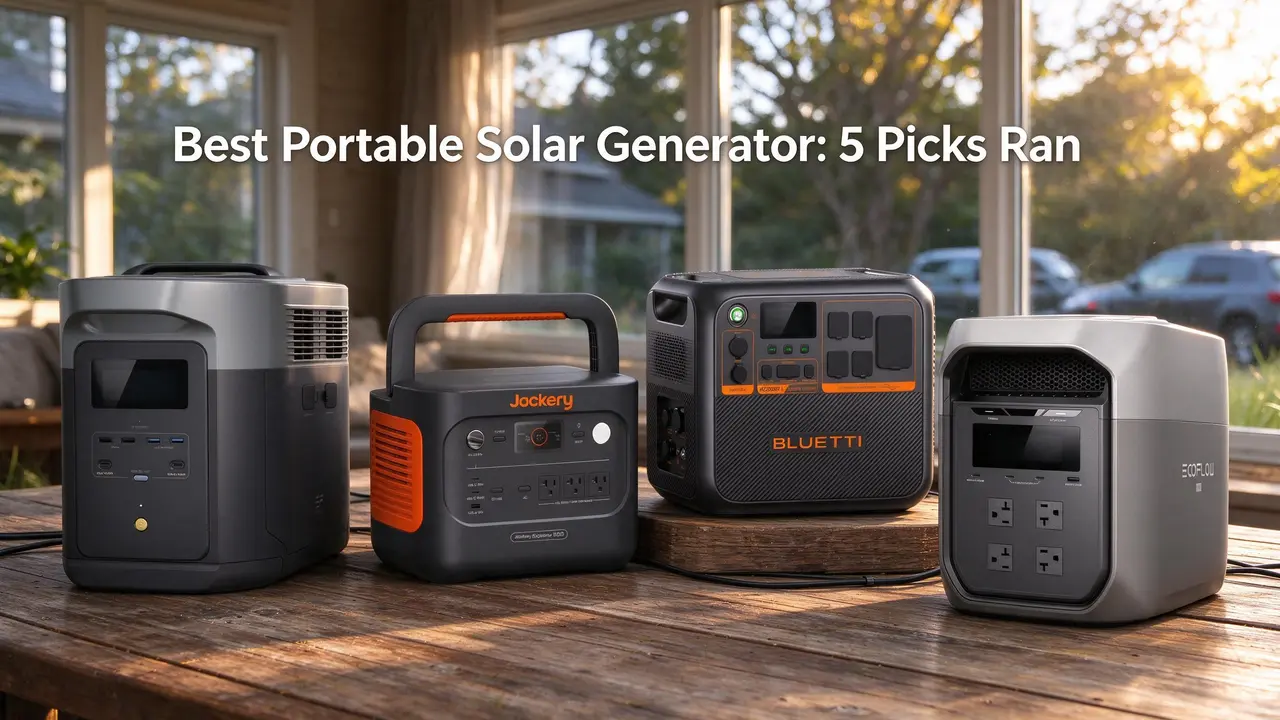
Best Portable Solar Generator: 5 Picks Ranked by Recharge
Solar recharge speed, usable capacity, and real portability decide which of these five stations earns a spot. The shortlist runs from a 23.8 lb weekend box to a 62.4 lb UPS-capable brick — and panels are almost always sold separately.
Updated
The buying question: which solar generator actually recharges fast enough to matter?
If you're shopping a portable solar generator, the spec sheet will tell you the battery size and the inverter watts. What it won't tell you is how fast the thing refills from panels on a real, imperfect day — and that number is what decides whether a station is a weekend toy or a genuine outage tool.
This shortlist is five stations I've followed through owner reports and listing specs, ranked by solar recharge headroom, usable capacity, and how much weight you're willing to move. It is not a whole-home backup guide — if you need a transfer switch and a 240V circuit, this isn't that page. And one boundary up front: none of these five ship with solar panels. Every panel pairing below is a separate purchase.
- Amazon Associates disclosure: picks are fit-led, not commission-led. As an Amazon Associate I earn from qualifying purchases.
- Method line: home-user checks grounded in owner themes on file plus listing specs — not lab-bench measurements.
Quick picks: the five, in order
Ranked by the weights below. Prices are list, not sale stickers.
- #1 EcoFlow DELTA 2 Max — $1399 — the solar headroom winner: up to 1,000W solar input (listing), 2,048 Wh, 2,400W AC, 50 lb.
- #2 Jackery Explorer 1000 v2 — $559 — the light, quiet weekend pick: 1,070 Wh, 1,500W AC, 23.8 lb.
- #3 BLUETTI AC200PL — $899 — the value-per-Wh and UPS pick: 2,048 Wh, 2,400W AC, 62.4 lb, $0.44/Wh nameplate.
- #4 EcoFlow DELTA 3 Max — $1199 — the lighter 2kWh with a 10ms UPS transfer: 2,048 Wh, 2,400W AC, 44.8 lb.
- #5 Anker C1000 — $599 — the compact fridge-lifeboat: 1,056 Wh, 1,800W AC, 28.4 lb.
How I ranked these five
I weighted four things, and I'll show the math because the weights are the whole argument. Solar recharge headroom gets 30% — the max solar input wattage on the listing, because a station that can't absorb a 400W panel is a station you'll be waiting on. Usable capacity and inverter output get 30% combined, since 2,048 Wh at 2,400W is a different tool than 1,056 Wh at 1,800W. Portability gets 20% — weight in lb, because the best station is the one you'll actually carry. Owner themes get 20%, drawn from high-helpful reviews on file, weighted toward repeated complaints over one-offs.
Why #1 beats #2: the DELTA 2 Max lists up to 1,000W of solar input and holds 2,048 Wh, so a 400W panel array refills it in a workable window; the Explorer 1000 v2 is a 1,070 Wh box with a smaller solar ceiling, and while it's dramatically lighter and cheaper, it can't absorb the same panel wattage. The DELTA 2 Max wins on recharge headroom and capacity; the Explorer wins on weight and price. That's the trade the ranking encodes.
One honesty note: I'm working from listing specs and owner reports, not lab-bench measurements. Where a manufacturer hasn't published a full solar-input curve, I say so rather than guess.
Scoreboard on those weights — here's how each pick rates on the two heaviest criteria, in plain terms:
- Solar recharge headroom — 30%
- Usable capacity + inverter output — 30%
- Portability (weight) — 20%
- Owner themes — 20%
- EcoFlow DELTA 2 Max: High on solar headroom (up to 1,000W input) and High on capacity/output (2,048 Wh / 2,400W); Med on portability at 50 lb.
- Jackery Explorer 1000 v2: Med on solar headroom (smaller ceiling); Med on capacity/output (1,070 Wh / 1,500W); High on portability at 23.8 lb.
- BLUETTI AC200PL: High on solar headroom (up to 1,200W input) and High on capacity/output (2,048 Wh / 2,400W); Low on portability at 62.4 lb.
- EcoFlow DELTA 3 Max: Med on solar headroom (check listing); High on capacity/output (2,048 Wh / 2,400W); Med on portability at 44.8 lb.
- Anker C1000: Med on solar headroom (check listing); Med on capacity/output (1,056 Wh / 1,800W); High on portability at 28.4 lb.
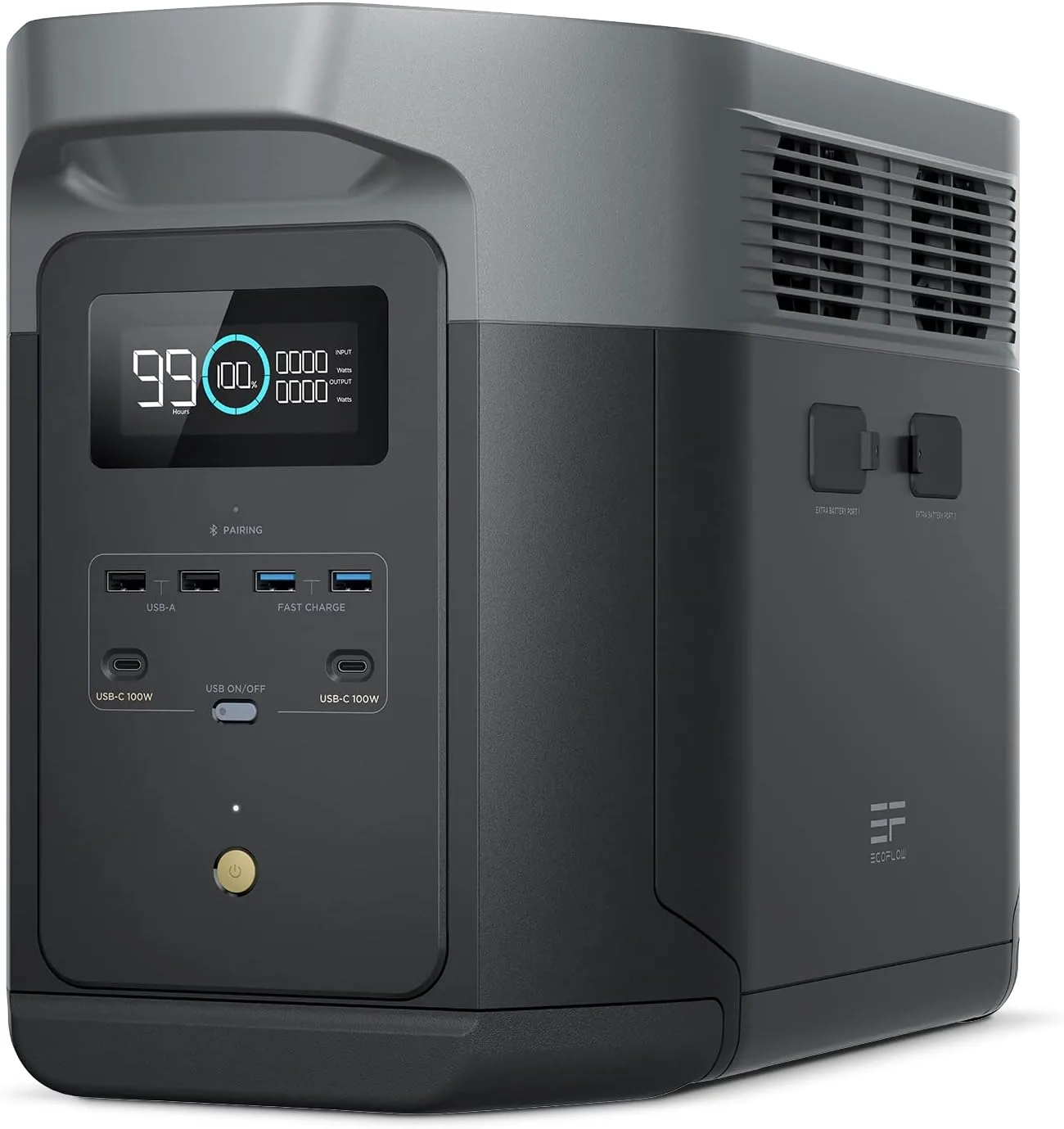
EcoFlow DELTA 2 Max
Highlights
- 2048Wh rated capacity
- 2400W continuous AC
- 4800W surge
- LiFePO4 chemistry
- Up to 1000W solar input
- 50 lb (~22.7 kg)
Best for
- DELTA 2 Max: longer outages or higher continuous loads (still not whole-home wiring)
- RV / off-grid days where recharge speed matters as much as Wh
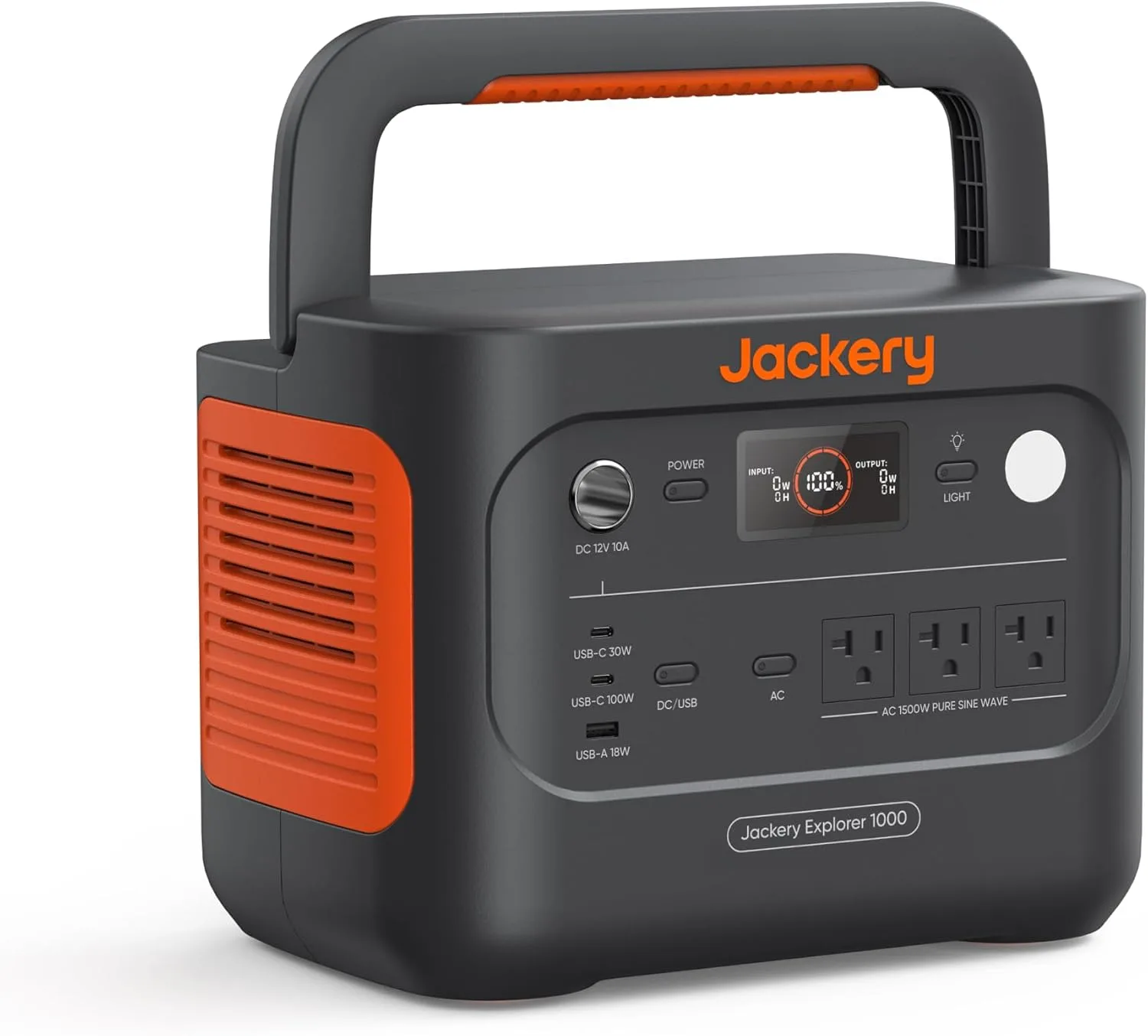
Jackery Explorer 1000 v2 Portable Power Station,1070Wh,1500W
Highlights
- 1070Wh rated capacity
- 1500W continuous AC
- LiFePO4 chemistry
- Up to 400W solar input
- 23.8 lb (~10.8 kg)
- About $559 list
Best for
- Explorer 1000 v2: weekend camping when 23.8 lb carry weight matters as much as 1070Wh
- Essentials bridge at home (fridge cycles, router) when sized to the Wh
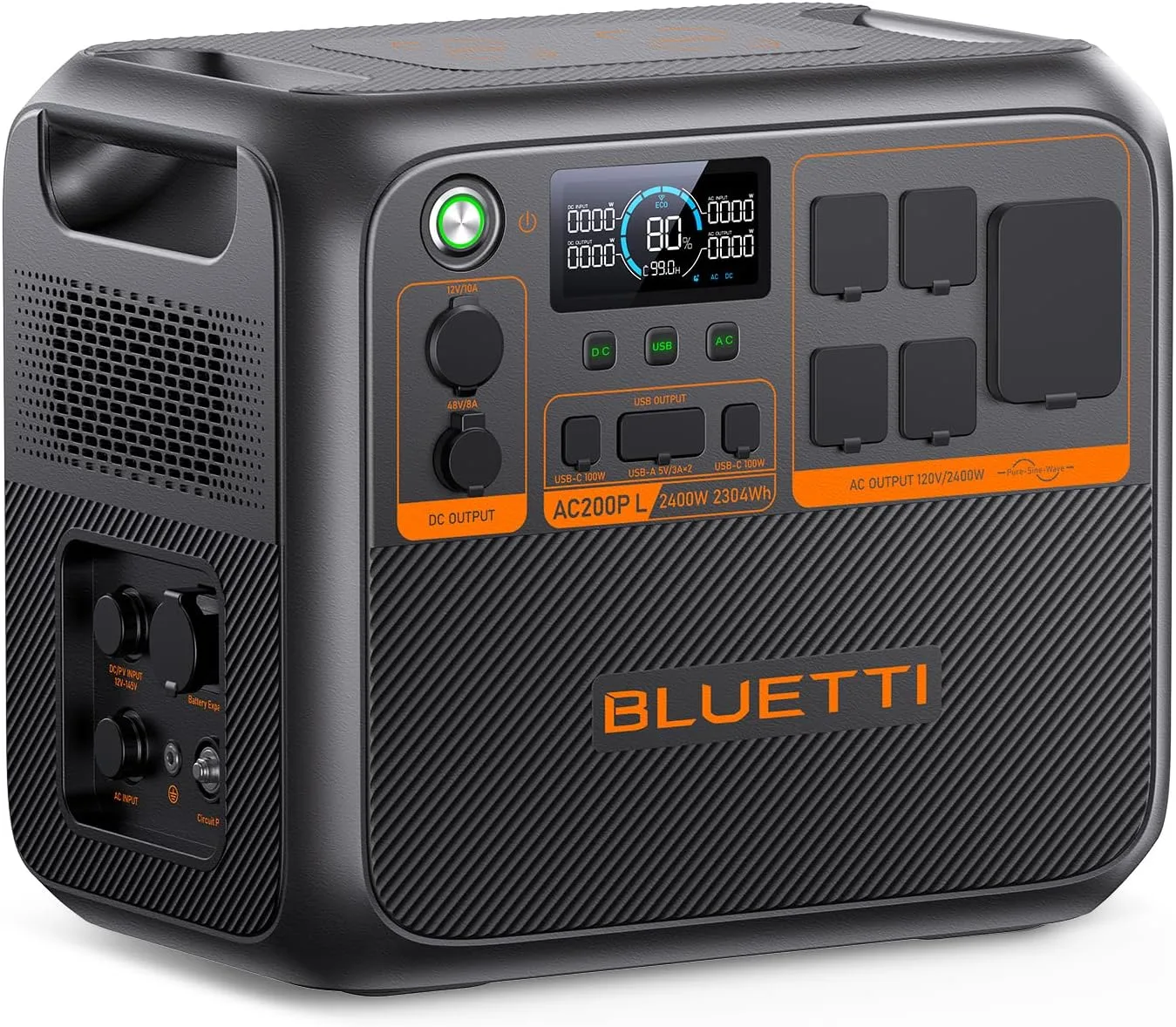
BLUETTI AC200PL
Highlights
- 2048Wh rated capacity
- 2400W continuous AC
- LiFePO4 chemistry
- Up to 1200W solar input
- 62.4 lb (~28.3 kg)
- About $899 list
Best for
- AC200L: longer outages or higher continuous loads (still not whole-home wiring)
- RV / off-grid days where recharge speed matters as much as Wh
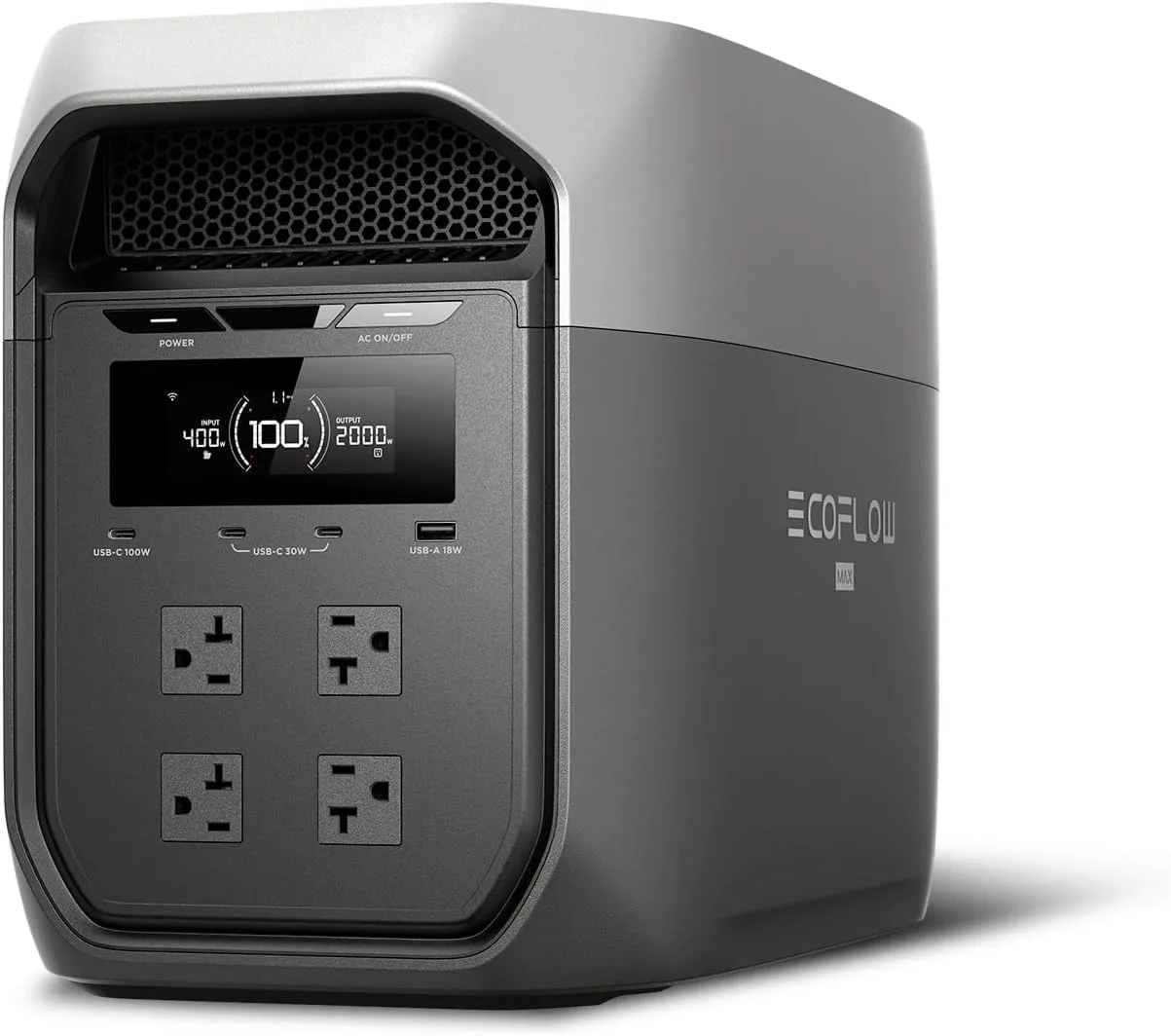
EcoFlow DELTA 3 Max Portable Power Station, 2048Wh LFP Battery
Highlights
- 2048Wh rated capacity
- 2400W continuous AC
- 4800W surge
- LiFePO4 chemistry
- Up to 500W solar input
- 44.8 lb (~20.3 kg)
Best for
- DELTA 3 Max: longer outages or higher continuous loads (still not whole-home wiring)
- RV / off-grid days where recharge speed matters as much as Wh
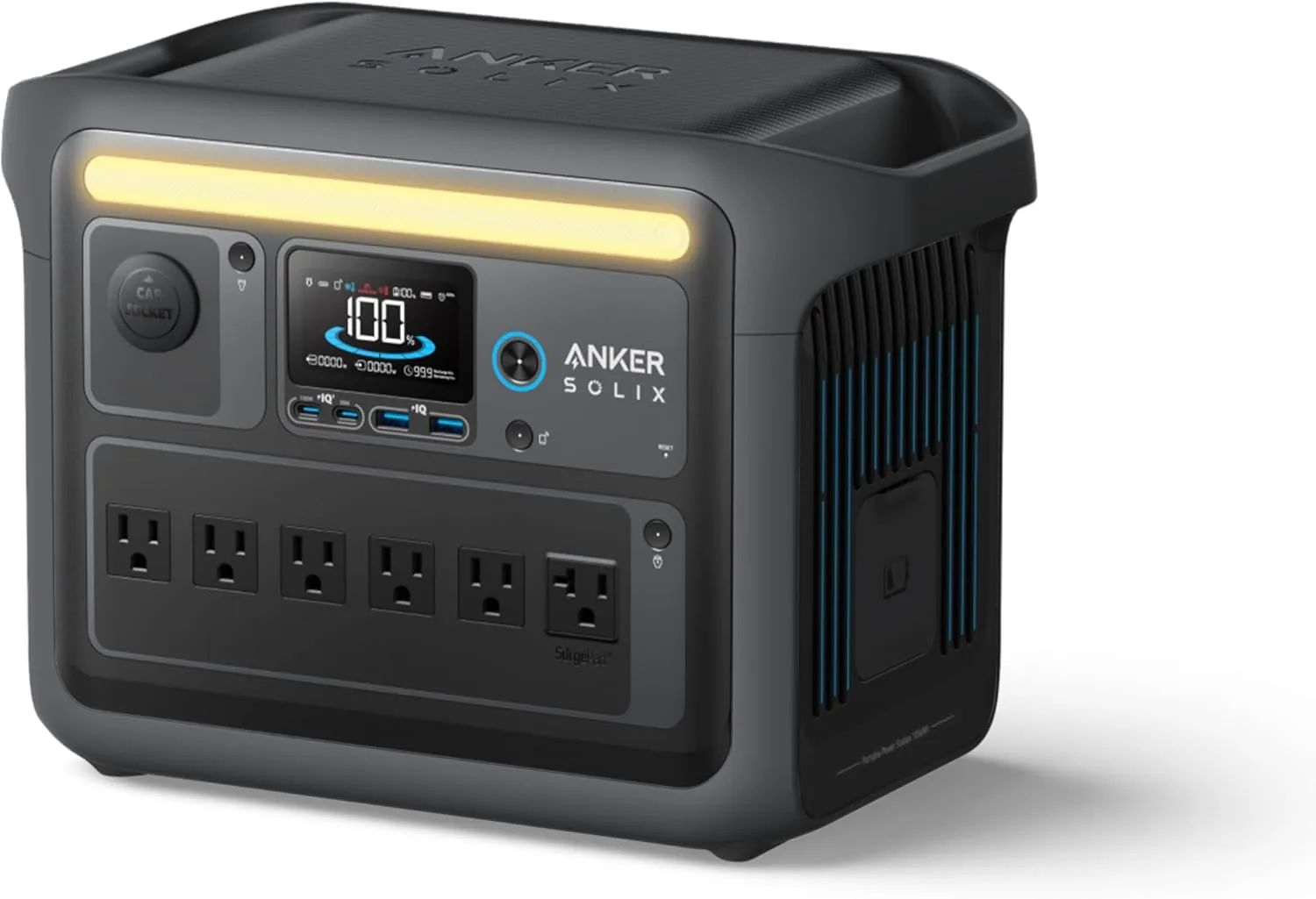
Anker C1000 Portable Power Station
Highlights
- 1056Wh rated capacity
- 1800W continuous AC
- LiFePO4 chemistry
- Up to 600W solar input
- 28.4 lb (~12.9 kg)
- About $599 list
Best for
- SOLIX C1000: small appliances and tools that need ~1800W continuous, not just phone charging
- Essentials bridge at home (fridge cycles, router) when sized to the Wh
Spec snapshot
List prices and listing specs. Star figures are listing aggregates, not owner proof. The solar-input column is the ranking metric made visible.
| Product | Price | Capacity (Wh) | Output (W) | Weight (lb) | Solar input ceiling | Rating |
|---|---|---|---|---|---|---|
| EcoFlow DELTA 2 Max | $1399 | 2048 Wh | 2400 W | 50 lb | up to 1,000W (listing) | 4.7 |
| Jackery Explorer 1000 v2 | $559 | 1070 Wh | 1500 W | 23.8 lb | lower ceiling; check listing | 4.7 |
| BLUETTI AC200PL | $899 | 2048 Wh | 2400 W | 62.4 lb | up to 1,200W (listing) | 4.5 |
| EcoFlow DELTA 3 Max | $1199 | 2048 Wh | 2400 W | 44.8 lb | check listing | 4.7 |
| Anker C1000 | $599 | 1056 Wh | 1800 W | 28.4 lb | check listing | 4.7 |
Why each one is here
Each entry gets a suits line and a skip line, tied to what the listing and owners actually say.
- #1 EcoFlow DELTA 2 Max — suits: you want the most solar headroom on this list (up to 1,000W input per the listing) and a 2,048 Wh / 2,400W box that owners run as a fridge lifeboat and furnace pass-through. Owners report the app's live draw and remote status as the best part of ownership, and one ran a stand-up freezer and mini-fridge well past the on-screen estimate because compressors cycle. Skip if: you need grab-and-go — it's 50 lb — or you plan to pair it with the brand's smart generator, where one high-helpful owner described repeated error codes and an auto-recharge feature that barely fired during a multi-day outage. Support escalation also drew repeated complaints.
- #2 Jackery Explorer 1000 v2 — suits: quiet, light camping and fridge duty. At 23.8 lb and 1,070 Wh it's the carry-friendly pick, and owners describe quiet mode letting them sleep with a fridge and fans running. A 12V car fridge in eco mode stretched for days on one charge. Skip if: you want to run high-wattage kitchen appliances — a 1700W air fryer and a 12-inch miter saw both tripped it in owner reports — or you need 12V barrel ports, which it lacks (you'll adapt off the cigarette socket).
- #3 BLUETTI AC200PL — suits: UPS duty and value. At $0.44/Wh nameplate it's the cheapest per nameplate Wh on this list, and owners describe wiring a basement circuit through it and pulling grid power with no flicker. Recharge is quick once calibrated. Skip if: your loads are small — owners flag roughly 20W of idle draw with the inverter on and about 90% usable capacity, so a 55W fan that math says runs 16 hours may quit closer to 10 or 11. It's also 62.4 lb, the heaviest here, and the wireless charging pad drew consistent complaints.
- #4 EcoFlow DELTA 3 Max — suits: a lighter 2kWh with a 10ms UPS transfer. At 44.8 lb it's meaningfully easier to move than the AC200PL, and owners report it carrying a router and modem through outages without a reboot and running a 12V car fridge at 36°F for a little over five days. Skip if: you need fast USB-C laptop charging — the USB output tops out at 100W and one owner wanted 140W — or you want a long owner track record; the high-helpful pool is still thin.
- #5 Anker C1000 — suits: short-term fridge/freezer backup and camping at 28.4 lb. Owners report a full-size garage fridge running about 36 hours and an 18 cu ft fridge running eight hours overnight in a real blackout with 38% left. Skip if: you need pass-through charging (it behaves like a UPS, stopping charge to serve loads) or you want a long AC cable — the included one is about 4–5 ft.
Panel pairing: which of these actually absorbs a 200W–400W array
This is the part the marketing names hide. A 400W panel only helps if the station's solar input ceiling is high enough to take it, and the listing specs here separate the field.
The DELTA 2 Max lists up to 1,000W of solar input across dual inputs, so a 400W array is well inside its ceiling. The AC200PL lists up to 1,200W solar input, also comfortably above a 400W panel. The DELTA 3 Max and Anker C1000 have solar ceilings I'd treat as adequate for a 200W–400W panel but not the headline; check the listing before you buy a big array. The Explorer 1000 v2 is the one to watch — owners describe a lower solar ceiling and a less-common solar port, so a 200W panel is the realistic pairing and a 400W array may be wasted on it.
None of the five include panels. Budget for the panel separately, and match panel wattage to the station's input ceiling rather than buying the biggest panel you can find.
- DELTA 2 Max: up to 1,000W solar input (listing) — 400W array fits comfortably.
- AC200PL: up to 1,200W solar input (listing) — 400W array fits comfortably.
- Explorer 1000 v2: lower solar ceiling and less-common port — 200W panel is the realistic pairing.
- DELTA 3 Max and Anker C1000: check the listing solar ceiling before sizing a 400W array.
Who should not buy the top pick
The DELTA 2 Max is #1 on this list, but it's the wrong buy for two clear groups.
First, anyone who needs to carry the station up stairs or into a tent regularly. At 50 lb it's a two-hand lift, and owners describe it as manageable rather than grab-and-go. If portability is your top weight, the Explorer 1000 v2 at 23.8 lb or the Anker C1000 at 28.4 lb is the better fit. Second, anyone planning to pair it with the brand's dual-fuel smart generator. One high-helpful owner described the generator spooling up and zeroing out with error codes, and the auto-recharge-below-threshold feature firing almost never during a multi-day outage. If generator integration is central to your plan, verify it works before an emergency — or pick a station whose generator pairing has a cleaner owner record.
If none of these fit
Two alternative directions. If your real need is whole-home backup with a transfer switch and a 240V circuit, none of these five is the right tool — that's a different category and a different guide. If your budget is tighter or your loads are smaller, a sub-1,000Wh station with a 200W panel is a more honest fit than stretching for a 2kWh box you'll rarely fill.
- Whole-home backup with a transfer switch: look at a home-backup guide, not a portable shortlist.
- Smaller loads and tighter budget: a sub-1,000Wh station plus a 200W panel beats an oversized box you won't cycle.
Owner themes worth knowing before you buy
Short theme summaries from high-helpful reviews on file, not raw review dumps.
- DELTA 2 Max: owners praise the app and fast AC recharge; repeated friction on smart-generator pairing and slow support escalation.
- Explorer 1000 v2: quiet mode and cooler runtime are the standouts; high-wattage appliances and the missing 12V barrel ports are the recurring limits.
- AC200PL: UPS switchover and value per Wh draw praise; idle draw (~20W) and the unreliable wireless charging pad are the repeated complaints.
- DELTA 3 Max: 10ms UPS transfer and app/storm guard are the highlights; the 100W USB ceiling and a thin long-term owner pool are the caveats.
- Anker C1000: fridge runtime and fast recharge are the strengths; short AC cable, dim top light, and flaky app pairing out of the box are the friction points.
Frequently asked
Can the DELTA 2 Max and AC200PL take a 400W panel?
Yes — both list solar input ceilings well above 400W (1,000W and 1,200W respectively). The Explorer 1000 v2 is the one to check before buying a 400W array.
Which is lightest for camping?
The Explorer 1000 v2 at 23.8 lb, then the Anker C1000 at 28.4 lb. The AC200PL at 62.4 lb is the heaviest and best treated as a park-it-and-leave-it unit.
Do any of these include solar panels?
No. All five are station-only; panels are a separate purchase.
Which is cheapest per nameplate Wh?
The BLUETTI AC200PL at $0.44/Wh — the lowest nameplate $/Wh on this list. That's nameplate, not usable-Wh math.
Method and sources
Model names and list prices come from the WattPicks catalog at build time. WattPicks does not run its own laboratory tests on power stations, and nothing on this page is presented as a measured result — it is catalog-backed buying guidance.
Read our methodology for how the catalog is normalized, and about WattPicks for who publishes it.