
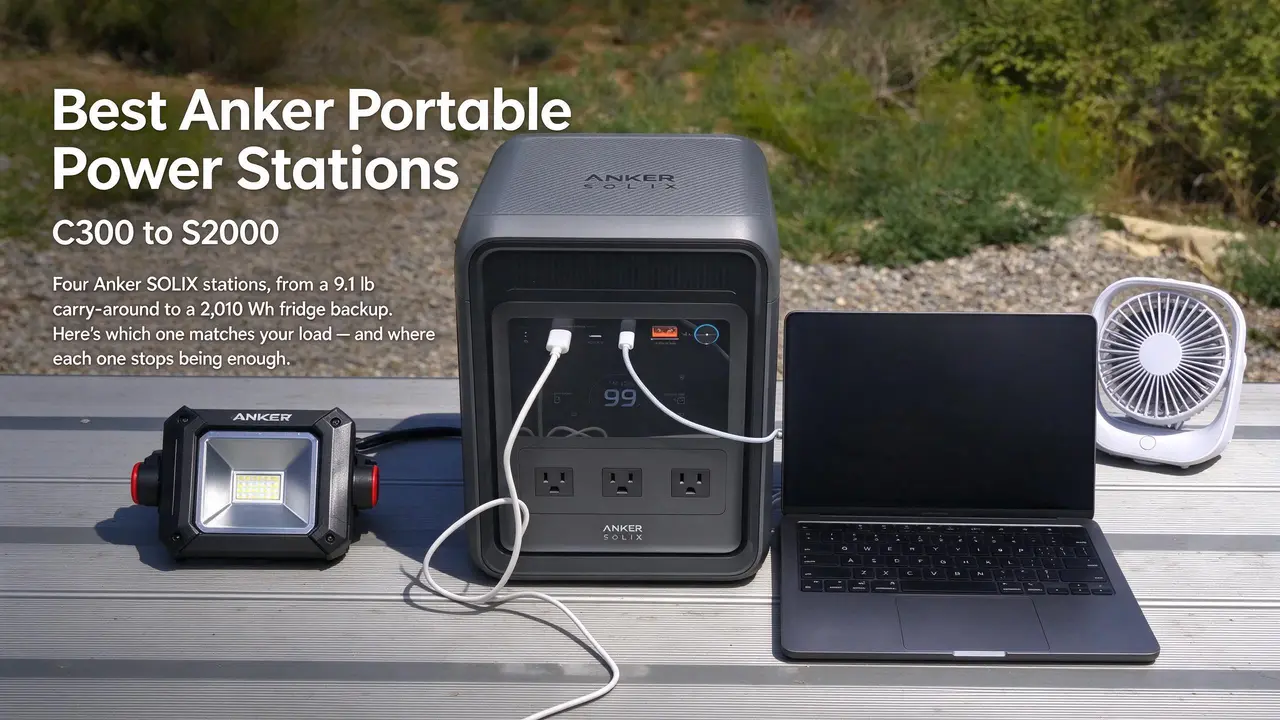
Best Anker Portable Power Stations: C300 to S2000
Four Anker SOLIX stations, from a 9.1 lb carry-along to a 2,010 Wh fridge backup. Here is which one fits your outage, your camper, or your desk — and which one is a waste of money for your load.
Updated
The load decides the station, not the badge
As an Amazon Associate I earn from qualifying purchases. Recommendations here are based on fit and the evidence below — not commission size.
Start with the appliance label, not the product name. A fridge that pulls 100–150 W running will eat a 288 Wh station in about two hours and a 2,010 Wh station in most of a day; a laptop at 45–65 W is a different problem entirely. Anker's four SOLIX sizes here span 288 Wh to 2,010 Wh and 300 W to 2,000 W continuous, and the price spread ($329.99 to $799.99) tracks capacity far more than it tracks features.
One boundary up front: this is a portable-station shortlist, not a home-battery or transfer-switch guide. None of these four is wired into your panel, and none replaces a generator for multi-day whole-home coverage. If you are shopping for a standby system, stop here and read about transfer switches instead.
Prices below are list prices, not deal stickers. Anker discounts these often, and a sale does not change what the unit can run. Disclosure: WattPicks earns from qualifying Amazon purchases; the ranking is fit-led, not commission-led.
- Single-appliance duty (under 300 Wh): phones, laptops, router, lights — the C300's lane.
- Overnight fridge or CPAP (around 1 kWh): the C1000 or C1000 Gen 2, depending on how fast you need to recharge.
- Room-level outage with high-watt appliances (around 2 kWh): the S2000, for window A/C or induction cooking.
How this list was built
I started from Anker's SOLIX line and kept four stations that a normal buyer might actually cross-shop: one carry-along, two ~1 kWh units, and one ~2 kWh unit. Everything else in the family either duplicated a slot or sat outside the capacity range this page is about.
Ranking weights: capacity-to-load fit 35%, continuous output headroom 20%, portability (weight and form) 15%, recharge speed 15%, and owner-reported reliability themes 15%. Price per Wh is folded into the capacity-fit score rather than scored separately, because a cheap station that cannot run your fridge is not a value.
Why #1 beats #2: the C1000 takes the top slot over the S2000 on the 35% fit weight. The S2000 wins on $/Wh and raw capacity, but 1,500 W continuous and 35.7 lb make it the wrong first purchase for someone whose actual load is a fridge, a router, and a laptop. The C1000 covers that load at 1,800 W and 28.4 lb for $200 less. The S2000 only overtakes it once your load includes a window A/C or an induction cooker.
The evidence is listing specs plus owner themes from the review packs on file — roughly 6,300 listing ratings across the four units. These are home-user checks against real loads, not lab-bench measurements, and I am not quoting a calibrated runtime figure for any of them.
Scoreboard on those weights (fit / headroom / portability / recharge / reliability): C1000 — 9 / 8 / 6 / 7 / 8, total 7.8. S2000 — 7 / 6 / 4 / 6 / 7, total 6.2. C1000 Gen 2 — 8 / 9 / 7 / 9 / 7, total 8.0. C300 — 5 / 4 / 10 / 6 / 7, total 5.9. The C1000 and Gen 2 are close on points; the C1000 wins on fit and price for a fridge-first buyer, while the Gen 2 wins on recharge speed and carry weight. That is why the pick splits by job rather than one universal winner.
Quick picks: which of the four to shortlist
Best overall for most people: the Anker SOLIX C1000 Portable Power Station. At $599 and 1,056 Wh it is the middle of the range in every sense, and it is the one station here that covers a fridge overnight without making you plan your day around it.
Best for carrying and desk UPS duty: the Anker SOLIX C300 Portable Power Station, 288Wh Solar Generator. At 9.1 lb and $329.99 it is the only one of the four you will genuinely toss in a bag, and owners report it holding a desktop through a pulled plug without a flicker.
Best for fast-recharge outage cycling: the Anker SOLIX C1000 Gen 2 Portable Power Station. Same capacity class as the C1000 but 2,000 W continuous, 24.9 lb, and a one-hour wall recharge that owners leaned on hard during a ten-day storm outage (owner-reported). It costs $799 list.
Best per watt-hour and best for big loads: the Anker SOLIX S2000 Portable Power Station, 2,010Wh. At $799.99 it is the cheapest per nameplate Wh of the four ($0.40/Wh) and the only one with the headroom to start an 8,000 BTU window A/C. It is also 35.7 lb and capped at 1,500 W continuous.
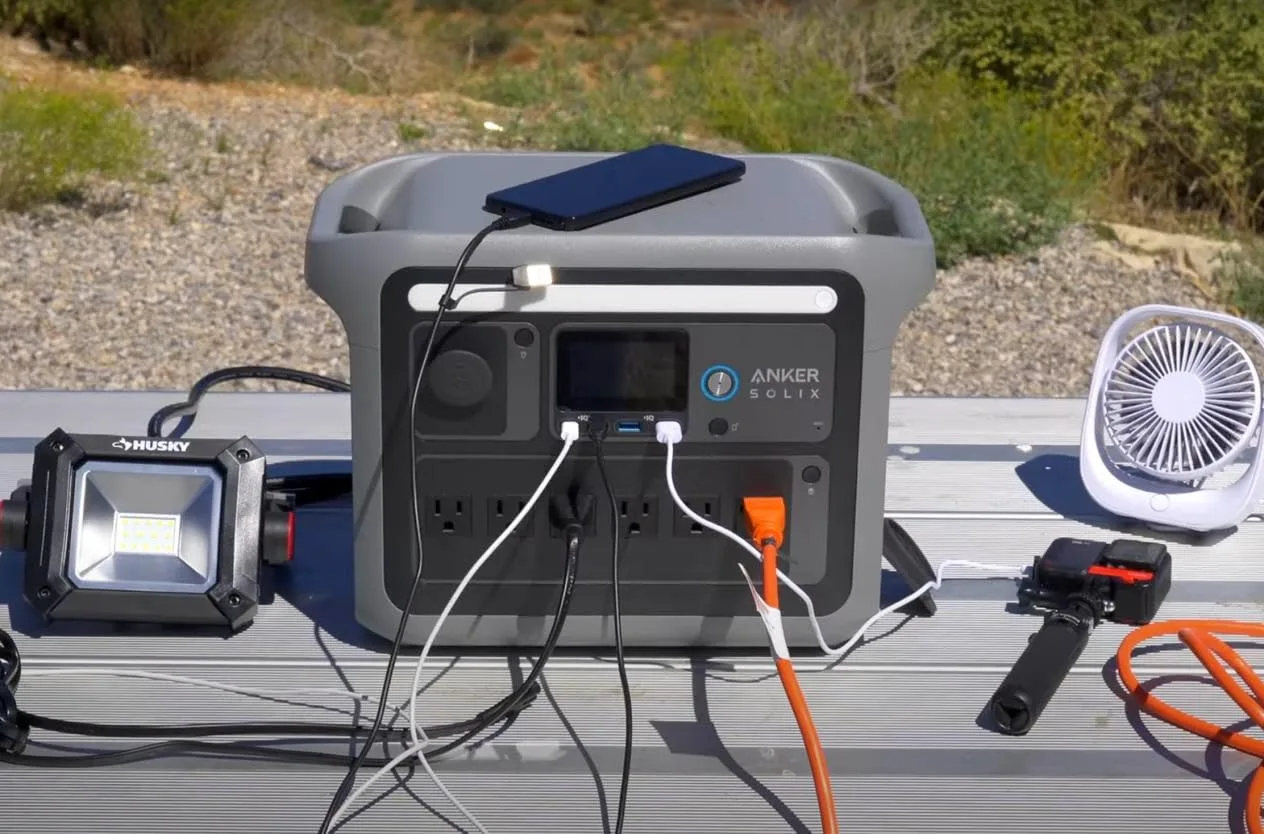
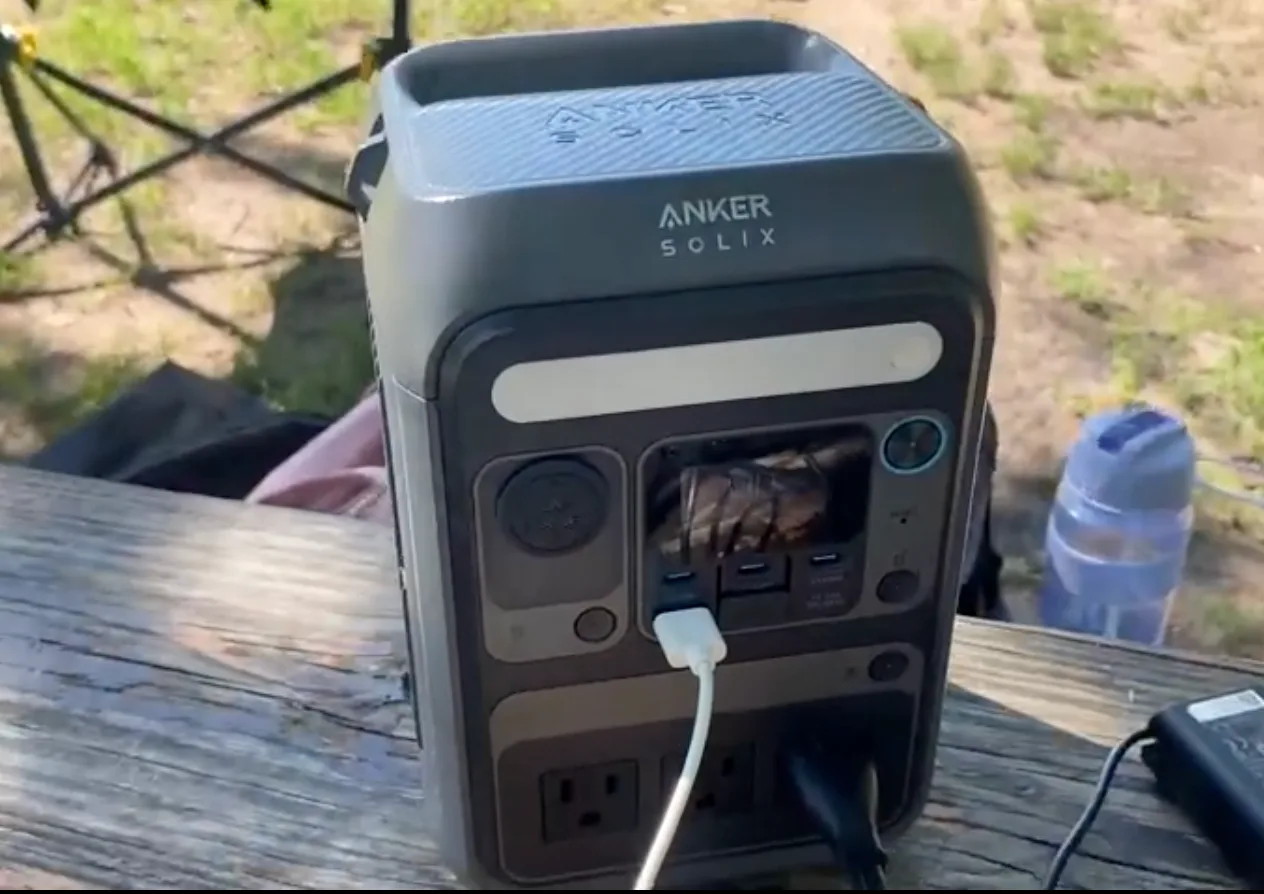
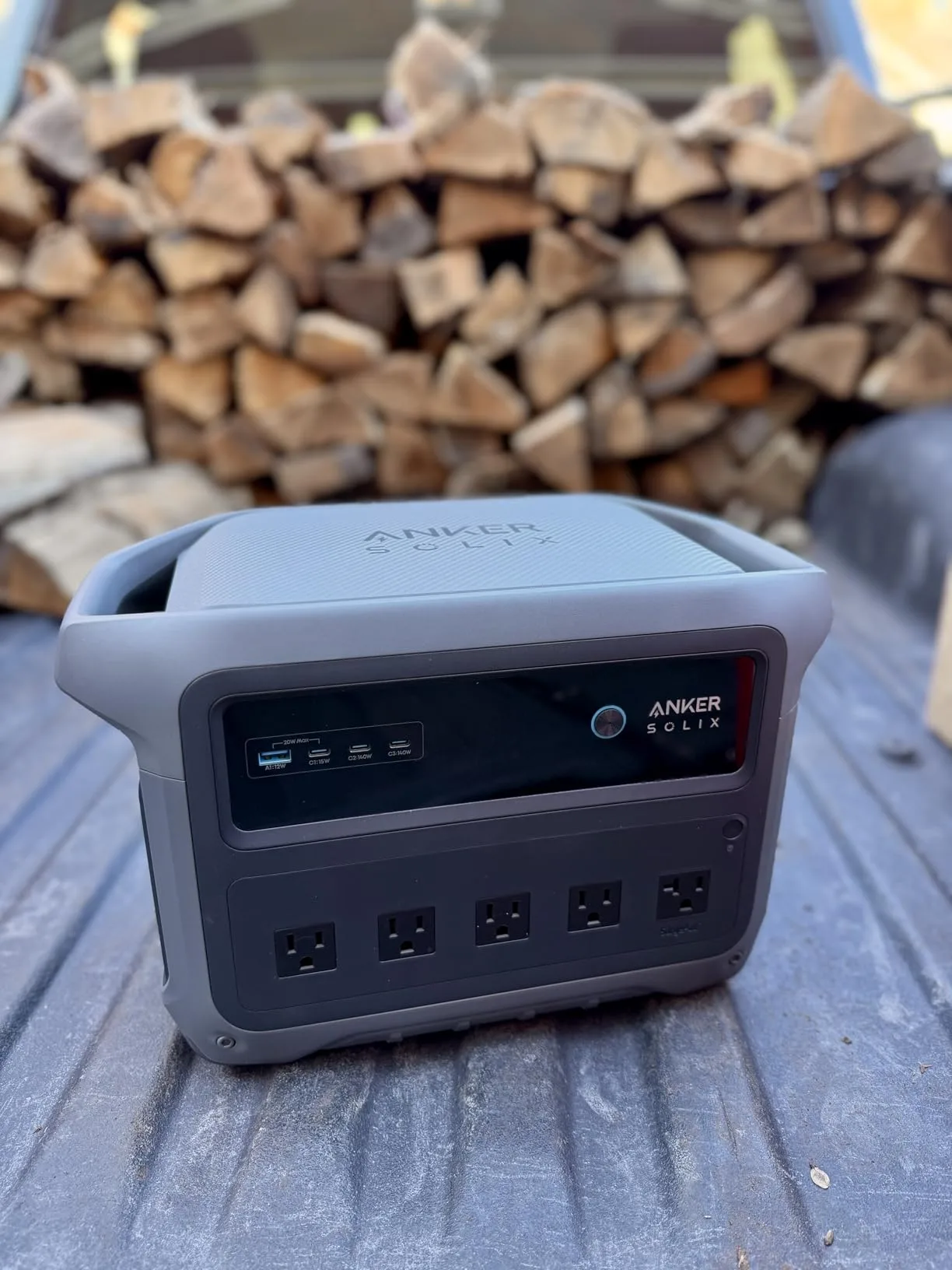
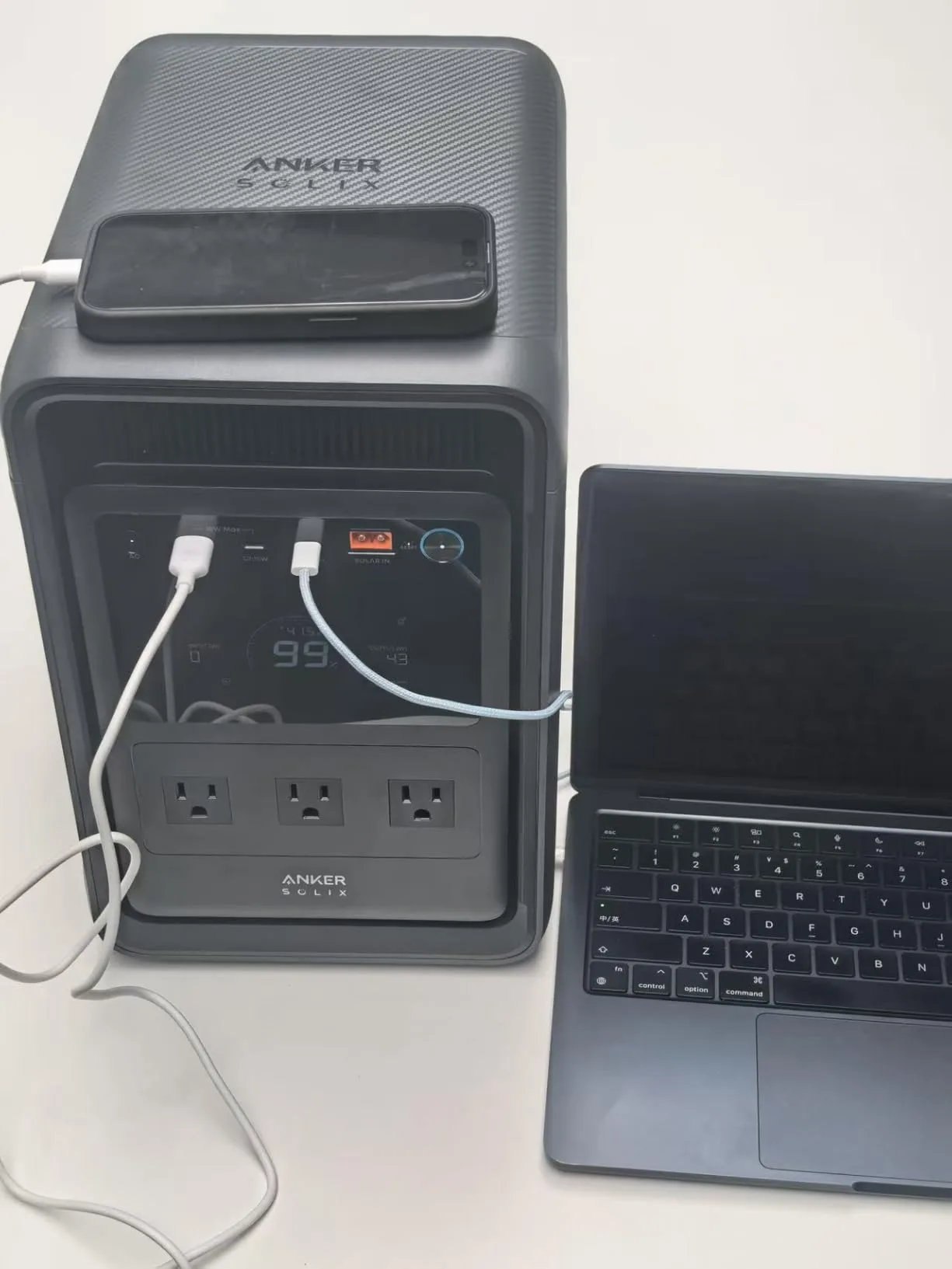
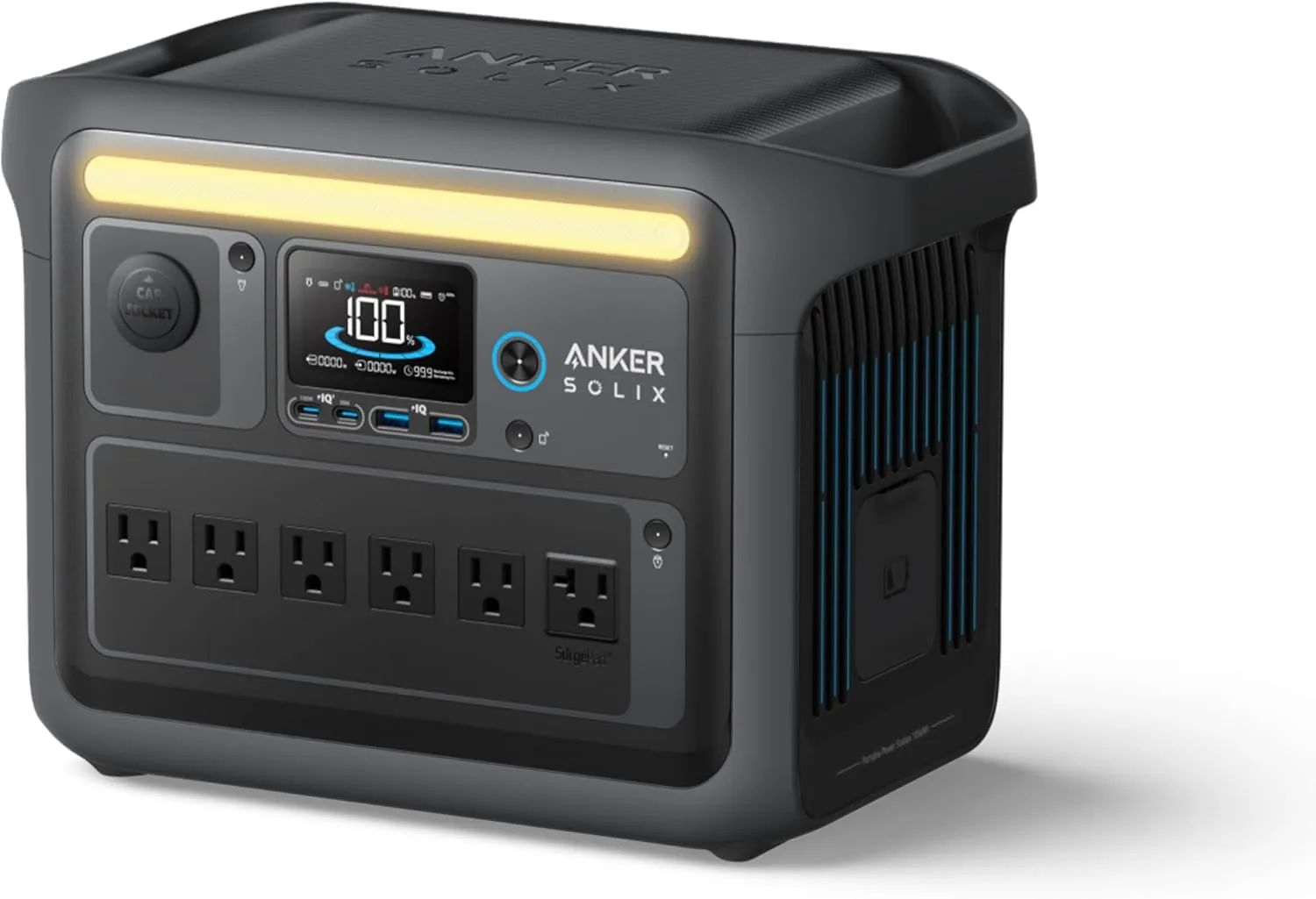
Anker C1000 Portable Power Station
Highlights
- 1056Wh rated capacity
- 1800W continuous AC
- LiFePO4 chemistry
- Up to 600W solar input
- 28.4 lb (~12.9 kg)
- About $599 list
Best for
- SOLIX C1000: small appliances and tools that need ~1800W continuous, not just phone charging
- Essentials bridge at home (fridge cycles, router) when sized to the Wh
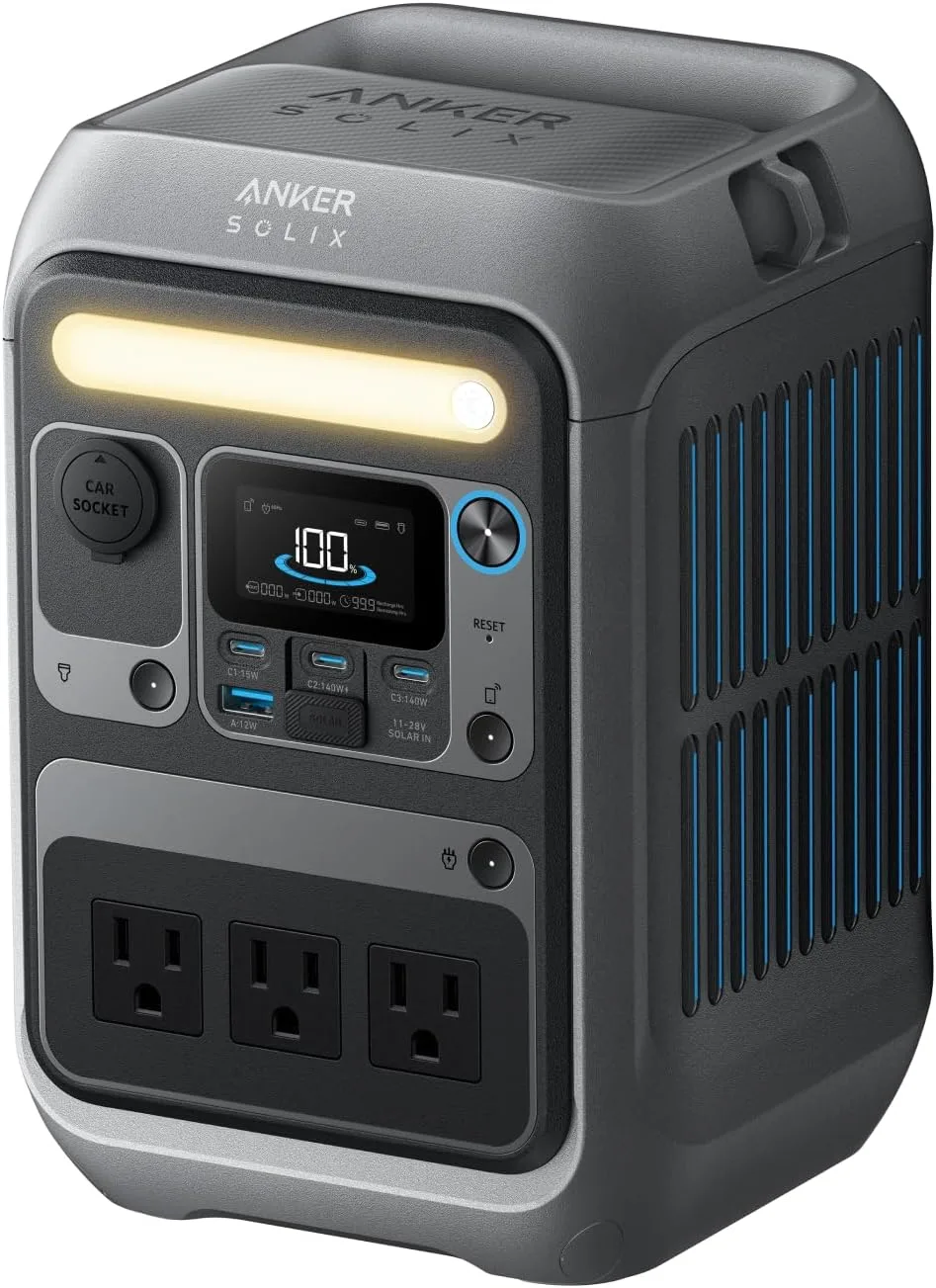
Anker C300 Portable Power Station, 288Wh Solar Generator
Highlights
- 288Wh rated capacity
- 300W continuous AC
- 600W surge
- LiFePO4 chemistry
- 9.1 lb (~4.1 kg)
- About $329.99 list
Best for
- SOLIX C300: phones, cameras and a laptop on short trips
- Travel kits when you need quiet pack power, not appliance runtime
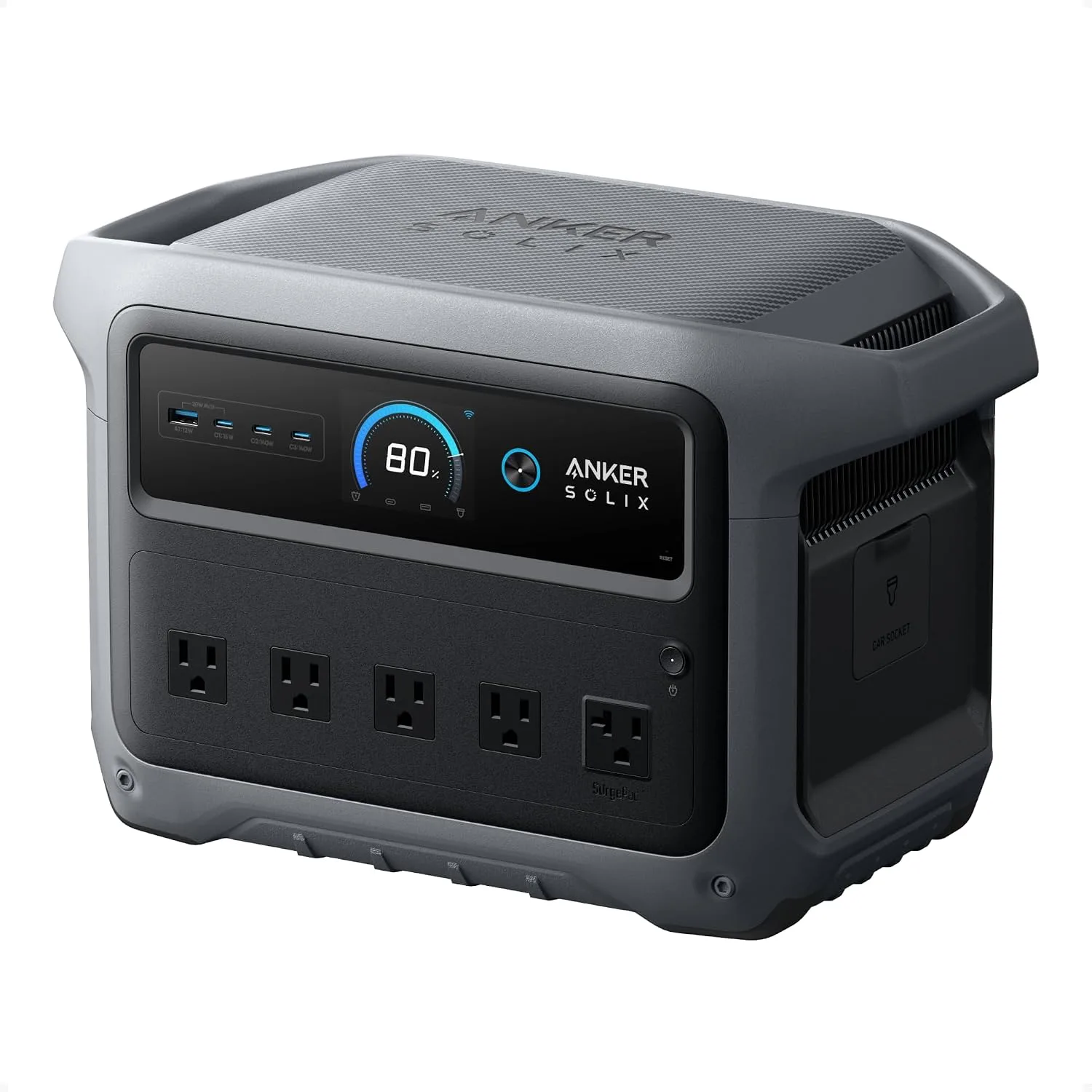
Anker C1000 Gen 2 Portable Power Station
Highlights
- 1024Wh rated capacity
- 2000W continuous AC
- 3000W surge
- LiFePO4 chemistry
- Up to 600W solar input
- 24.9 lb (~11.3 kg)
Best for
- C1000 Gen 2: weekend camping when 24.9 lb carry weight matters as much as 1024Wh
- Essentials bridge at home (fridge cycles, router) when sized to the Wh
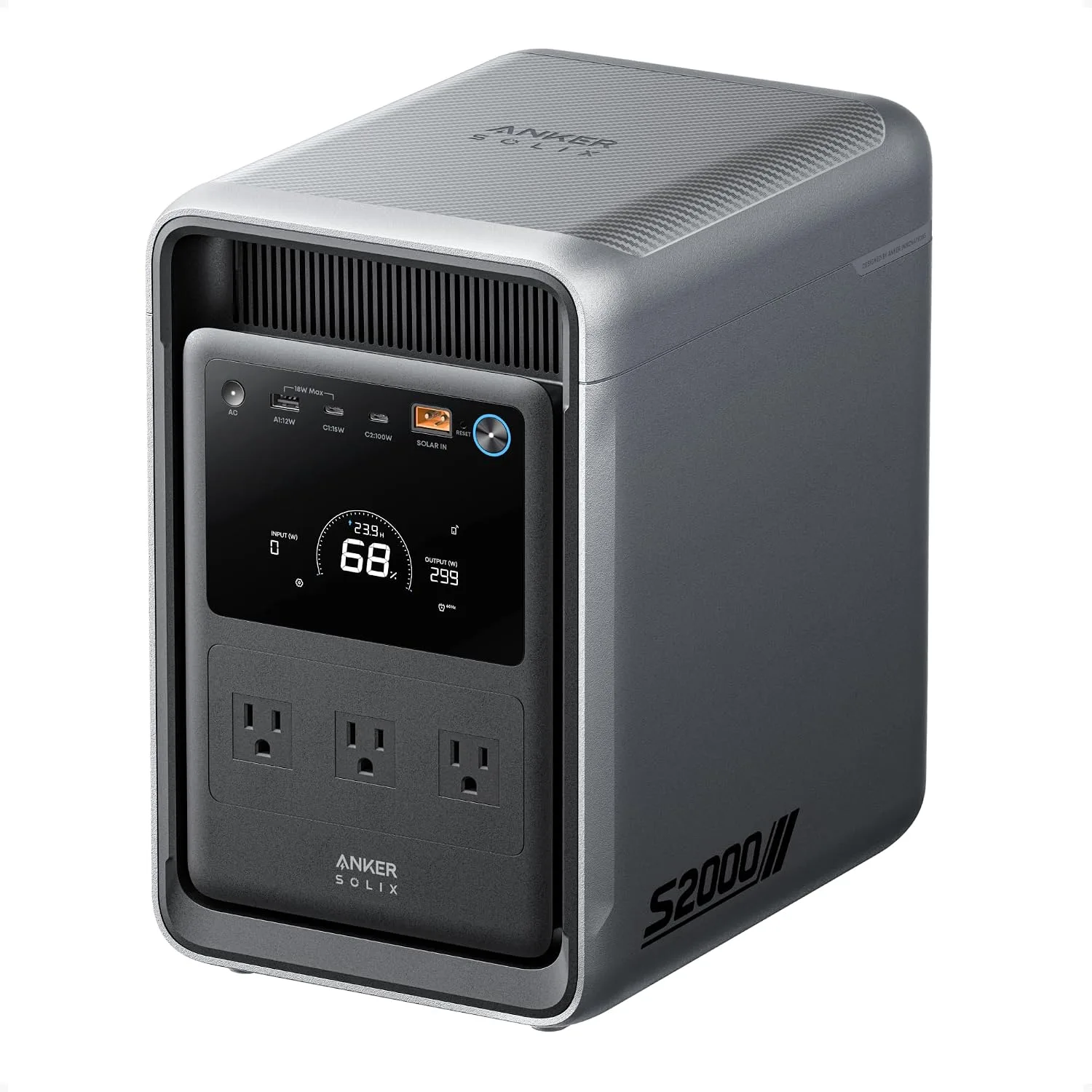
Anker S2000 Portable Power Station, 2,010Wh
Highlights
- 2010Wh rated capacity
- 1500W continuous AC
- 3000W surge
- LiFePO4 chemistry
- 35.7 lb (~16.2 kg)
- About $1199 list
Best for
- SOLIX S2000: longer outages or higher continuous loads (still not whole-home wiring)
- RV / off-grid days where recharge speed matters as much as Wh
Spec snapshot
List price, nameplate capacity, continuous AC output, and weight, straight from the listings. Surge and peak figures are not continuous output and are not shown here.
| Product | Price | Capacity (Wh) | Output (W) | Weight (lb) | Rating |
|---|---|---|---|---|---|
| Anker SOLIX C300 Portable Power Station, 288Wh Solar Generator | $329.99 | 288 Wh | 300 W | 9.1 lb | 4.6 |
| Anker SOLIX C1000 Portable Power Station | $599 | 1056 Wh | 1800 W | 28.4 lb | 4.7 |
| Anker SOLIX C1000 Gen 2 Portable Power Station | $799 | 1024 Wh | 2000 W | 24.9 lb | 4.7 |
| Anker SOLIX S2000 Portable Power Station, 2,010Wh | $799.99 | 2010 Wh | 1500 W | 35.7 lb | 4.7 |
Why each one is here
Ranked by the weights above. Each entry gets one worked runtime line so you can check it against your own appliance label — divide nameplate Wh by the load in watts, then knock off roughly 10–15% for inverter losses. That is the honest arithmetic; the owner reports below are what people actually saw.
- #1 Anker SOLIX C1000 Portable Power Station — $599, 1,056 Wh, 1,800 W, 28.4 lb. Worked line: 1,056 Wh ÷ 120 W fridge ≈ 8.8 hours at nameplate, so call it 7.5–8 hours of real fridge time per charge. Owner reports in the review packs on file range from about 12 hours on a larger kitchen unit with doors opening to roughly 36 hours on a cool garage fridge — the gap is duty cycle, not marketing. Suits: fridge backup, camper shore-power backfeed, generator-assisted outage cycling. Skip if: you will carry it up stairs weekly, or you want the stock AC cable to reach across a room — it is short.
- #2 Anker SOLIX S2000 Portable Power Station, 2,010Wh — $799.99, 2,010 Wh, 1,500 W, 35.7 lb. Worked line: 2,010 Wh ÷ 150 W fridge ≈ 13.4 hours at nameplate, roughly 11–12 hours real. Owner reports on file describe a 30-hour outage carried on a partial top-off, and an 8,000 BTU wall A/C started where a small generator bogged down. Suits: room-level outage backup, high-watt cooking appliances, UPS duty for a desktop. Skip if: you need an expansion battery or cigarette-lighter charging — neither is supported here.
- #3 Anker SOLIX C1000 Gen 2 Portable Power Station — $799, 1,024 Wh, 2,000 W, 24.9 lb. Worked line: 1,024 Wh ÷ 60 W CPAP-plus-phone load ≈ 17 hours at nameplate, about 14–15 hours real. Owner reports on file describe running a CPAP two nights plus air-mattress inflation on one trip and finishing with charge to spare, and cycling it daily through a ten-day storm outage on roughly one-hour recharges. Suits: fast-turnaround outage duty, CPAP camping, anyone who values 24.9 lb over 28.4 lb. Skip if: it will sit idle for months — owners report a few percent of self-discharge per month.
- #4 Anker SOLIX C300 Portable Power Station, 288Wh Solar Generator — $329.99, 288 Wh, 300 W, 9.1 lb. Worked line: 288 Wh ÷ 55 W laptop ≈ 5.2 hours at nameplate, about 4–4.5 hours real — which is exactly what owners measured. Suits: laptop and network-gear runtime, desk UPS for a desktop, tent and tailgate lighting. Skip if: anything with a heating element is on your list — an electric blanket on medium flattened it in about two hours.
What owners actually ran into
Themes from the review packs, weighted toward the comments other buyers marked helpful. These are paraphrases, not quotes, and the listing star averages (4.6–4.7) are aggregates — not proof of any individual experience.
- C1000: fridge runtime is the headline theme by a wide margin, followed by recharge speed and camper use. The recurring complaint is weight and that stubby AC cable.
- S2000: outage stories and UPS idle draw dominate. The honest gripes are no expansion battery, no 12V car socket, and a 400 W solar cap.
- C1000 Gen 2: one-hour recharge and CPAP camping come up repeatedly. Low-light solar input clicking on and off is the most-cited annoyance.
- C300: UPS passthrough and the built-in light bar get the most praise. The 288 Wh ceiling is the most-cited limitation, usually from people who bought it for the wrong job.
Who should not buy the top pick
The C1000 is the right answer for a lot of people, which makes it the wrong answer for a specific few.
Skip it if your outage plan includes a window A/C, an induction cooktop, or a well pump. At 1,800 W continuous you are near the ceiling on those loads, and the S2000's capacity is the better match even though its continuous rating is lower.
Skip it if portability is the whole point. 28.4 lb is a two-hand lift, and owners consistently say it feels heavier than the number suggests. The C300 or the Gen 2 at 24.9 lb is the saner carry.
And skip it if you want one purchase to cover both a desk UPS and a fridge for two days. That is a two-station problem, not a one-station one.
If none of these fit
Two directions worth considering before you buy anything in this range.
If your real need is a desk or network-closet UPS with a few minutes of ride-through, a purpose-built UPS is cheaper and the C300's UPS behavior is a bonus rather than the reason to buy. If your real need is multi-day whole-home coverage, none of these four is the tool — you are shopping generators and transfer equipment, and a 2,010 Wh station buys you hours, not days.
If you are between the C1000 and the Gen 2, the decision rule is simple: pay the $200 premium only if the one-hour recharge and the 3.8 lb weight saving change how you will actually use it. For a fridge in the garage, they do not.
The short version
Buy the C1000 if a fridge, a router, and a laptop are your outage load and you want one station to cover it at $599. Buy the S2000 if a window A/C or high-watt cooking is in the plan and you can live with 35.7 lb and no expansion battery. Buy the Gen 2 if fast recharge is the feature you will actually use, and the C300 if 9.1 lb is the whole reason you are shopping.
None of the four is a whole-home solution, and none of them should be bought on a sale price alone. Match the Wh to the label on the appliance, then pick the weight you are willing to lift.
Frequently asked
Can the C300 run a full-size refrigerator?
No. At 288 Wh and 300 W continuous, a 120 W fridge gets you roughly two hours at nameplate before inverter losses. It is a laptop-and-router station.
How long will the S2000 run a refrigerator?
Owners report a day or more depending on ambient temperature and door openings; the listing claims up to 35 hours. Work the math from your own fridge label — 2,010 Wh ÷ running watts, minus 10–15%.
Is the C1000 Gen 2 worth $200 more than the C1000?
Only if recharge speed or the 3.5 lb weight difference matters to you. The C1000 has more nameplate capacity (1,056 Wh vs 1,024 Wh), while the Gen 2's advantage is a higher continuous rating (2,000 W vs 1,800 W).
Which one is cheapest per Wh?
The S2000, at $0.40/Wh on nameplate. The C1000 is $0.57/Wh, the Gen 2 $0.78/Wh, and the C300 $1.15/Wh — you pay a premium for small and light.
Method and sources
Model names and list prices come from the WattPicks catalog at build time. WattPicks does not run its own laboratory tests on power stations, and nothing on this page is presented as a measured result — it is catalog-backed buying guidance.
Read our methodology for how the catalog is normalized, and about WattPicks for who publishes it.