
Anker SOLIX F3800 vs EcoFlow DELTA 3 Max: Which Home Backup Station Fits Your Outage Plan?
Two big-name home backup stations, two very different trade-offs: Anker sells expandable capacity and 240V pairing, EcoFlow sells fast charging and a lower entry price. Here is how to pick when the budget is capped and the loads are real.
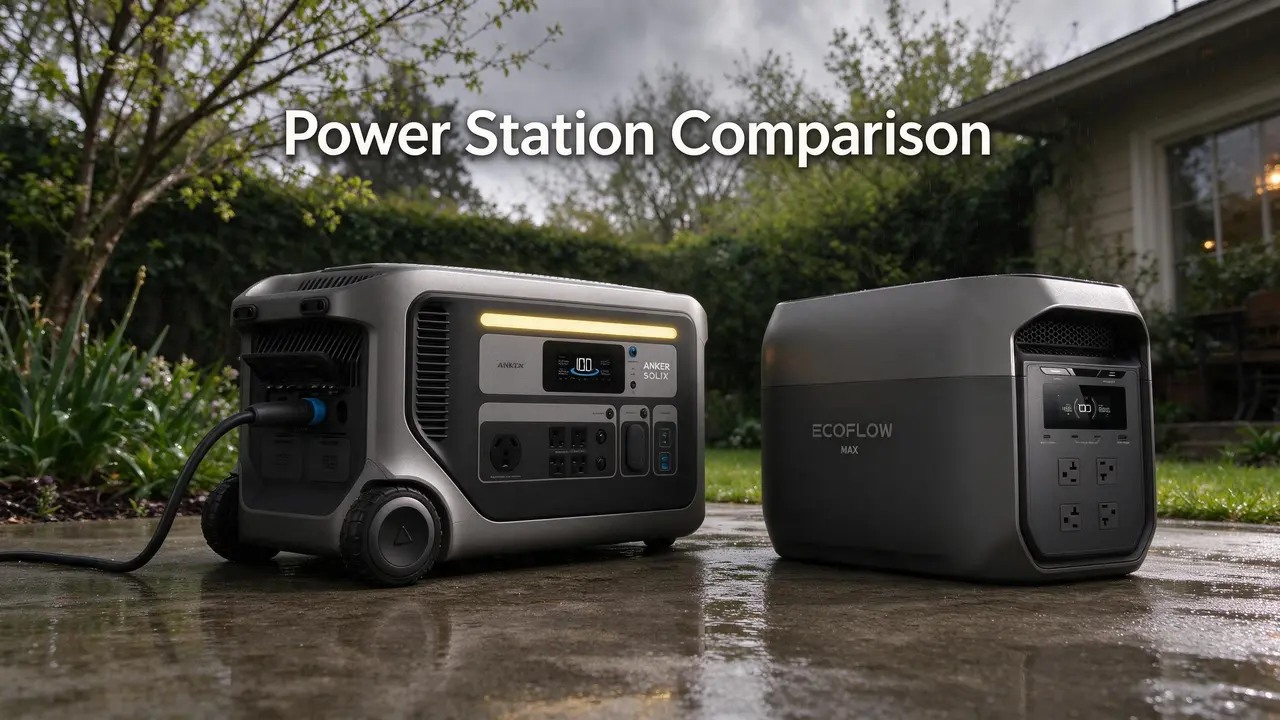
Updated
At a glance
Two big-name home backup stations, two very different trade-offs: Anker sells expandable capacity and 240V pairing, EcoFlow sells fast charging and a lower entry price. Here is how to pick when the budget is capped and the loads are real.
- Anker's play: more nameplate capacity, 240V pairing, expandability to 24kWh.
- EcoFlow's play: fast recharge, lower entry price, one box for home and travel.
Same money, different trade-offs
If you are sizing a home backup station against a capped budget, the honest answer is that these two do not compete on the same axis. The Anker 3,072Wh LiFePO4 Battery, Expandable to 24kWh, 6,000W Fast is a capacity-and-expansion play: a 3,600 W unit that pairs with a second station for 240V and scales toward 24kWh with add-on batteries. The 3400W X-Boost Output, Ultra-Fast 0-80% Charging in 1.13 Hr, Home Backup is a speed-and-price play: 2,400 W continuous, a 0–80% charge in about 1.13 hours, and roughly half the list price.
One boundary before we go further: this is not a generator-vs-generator shootout for whole-home rewiring, and it is not a review of transfer-switch hardware. It is a two-unit comparison for people deciding where a fixed budget goes — capacity headroom or recharge speed.
The Anker card lists at $3198.99; the EcoFlow at $1758. That gap is the whole argument, so read the rest as "what does the extra money buy, and who should not pay it."
- Anker's play: more nameplate capacity, 240V pairing, expandability to 24kWh.
- EcoFlow's play: fast recharge, lower entry price, one box for home and travel.
Methodology
I am a deep-use experience reviewer working from listing specs plus owner themes on file; these are home-user checks, not lab-bench measurements. For this comparison I weighted continuous output and 240V/expansion path at 40%, recharge speed at 25%, price at 20%, and owner evidence at 15%. The Anker wins the first weight clearly (3,600 W vs 2,400 W, plus the 240V hub); the EcoFlow wins recharge speed and price. Owner evidence is thin on both sides, so it did not swing the call — it only confirmed the EcoFlow's fast-charge theme.
Avery Nolan is WattPicks' founding editor, covering portable power station capacity, output, and price-per-Wh across the catalogue — no lab claims.
Disclosure: as an Amazon Associate, WattPicks earns from qualifying purchases. Picks here are fit-led, not commission-led.
Scoreboard on those weights — Anker 3,072Wh LiFePO4 Battery, Expandable to 24kWh, 6,000W Fast (list $3198.99): High on continuous output (3,600 W) and 240V/expansion path, Med on recharge speed (6,000 W only with generator + solar), Med on price ($3198.99). 3400W X-Boost Output, Ultra-Fast 0-80% Charging in 1.13 Hr, Home Backup (list $1758): High on recharge speed (0–80% in ~1.13 hr) and price ($1758), Med on continuous output (2,400 W). That is why the pick splits by job rather than one universal winner.
Spec snapshot
Everything below is from the listings. Where a number is not published, it says so rather than guessing — the EcoFlow capacity figure in particular is n/a (not on file), and I will not back-fill it from a marketing name.
Ratings shown are the listing aggregate, not owner proof. The Anker unit has a single rating on file; the EcoFlow has a small handful. Neither is a durability track record. Prices and ratings are as of publication.
| Product | Price | Capacity (Wh) | Output (W) | Weight (lb) | Rating |
|---|---|---|---|---|---|
| Anker 3,072Wh LiFePO4 Battery, Expandable to 24kWh, 6,000W Fast | $3198.99 | 3,072 Wh | 3600 W | 91.5 lb | 5 |
| 3400W X-Boost Output, Ultra-Fast 0-80% Charging in 1.13 Hr, Home Backup | $1758 | n/a (not on file) | 2400 W | 89 lb | 5 |
Where the money went
Four configuration differences actually move the decision, and they are not evenly distributed.
Output headroom. The Anker lists 3,600 W continuous against the EcoFlow's 2,400 W. That matters if your outage plan includes a well pump, a space heater, or a microwave plus fridge on the same circuit. The EcoFlow's 3,400 W X-Boost figure is a boost mode, not continuous — do not size a continuous load against it.
240V and expansion. The Anker ships with a Double Voltage Hub and pairs two stations for 240V, and the listing describes expansion toward 24kWh with add-on batteries. The EcoFlow listing does not publish a 240V pairing path or an expansion figure, so treat those as n/a rather than assume them.
Recharge speed. This is the EcoFlow's clear win: 0–80% in about 1.13 hours from the listing. The Anker counters with a 6,000 W combined generator-plus-solar input claim, which is fast in a different way — it needs a fuel generator in the mix, not just a wall outlet.
Price per Wh. On nameplate math the Anker works out to about $1.04/Wh ($3198.99 ÷ 3,072 Wh); the EcoFlow cannot be computed because capacity is not on file. I am not going to crown a per-Wh winner on a missing denominator.
- Anker: 3,600 W continuous, 240V pairing via included hub, expansion path to 24kWh.
- EcoFlow: 2,400 W continuous (3,400 W X-Boost is boost, not continuous), ~1.13 hr to 80%.
- Anker: 6,000 W recharge only with generator + solar combined.
- EcoFlow: lower list price, but capacity not published — no per-Wh comparison possible.
The spec that decides it
For most people reading this, one number settles it: continuous output. If your outage list includes anything above roughly 2,000 W running at once — a pump, a heater, a big microwave — the EcoFlow's 2,400 W continuous ceiling is the constraint, and the Anker's 3,600 W is the reason to pay more.
Here is a concrete outage load list to make that ceiling tangible. A 1,200 W space heater plus a 700 W fridge running at once is 1,900 W — the EcoFlow handles it. Add a 1,000 W microwave and you are at 2,900 W, which trips the EcoFlow's 2,400 W continuous limit but sits comfortably under the Anker's 3,600 W. A 1,500 W well pump plus a 700 W fridge is 2,200 W — still inside the EcoFlow, but with almost no margin for a second appliance. These are running-watt estimates, not measured draws; check your own appliance labels before you size.
The second deciding number is recharge time, and it cuts the other way. If your pattern is short outages and you want the box back to full between storms, the EcoFlow's 0–80% in about 1.13 hours is the practical feature you will feel every week. The Anker's fast-recharge claim depends on pairing a fuel generator with solar, which is a bigger setup than most people want for a two-hour outage.
Real owner trade-offs
The evidence here is lopsided, and I want to be blunt about it. The Anker unit has no owner reviews on file — so there is no repeated owner friction to report, and equally no owner confirmation of the expansion or 240V claims in daily use. Treat it as a listing-spec read until verified feedback exists.
The EcoFlow has a small but consistent owner pack. The recurring themes: fast charge and recharge, simple setup, several devices and appliances running at once, and the unit doubling as home backup and travel power. Owners also call out being able to use and recharge at the same time, and a sturdy feel in hand.
The caveat is thin consensus. A handful of reviews, mostly enthusiastic but light on measured runtime or load detail, does not validate long-term durability. If you need a multi-year owner track record before spending, neither unit gives it to you today.
- EcoFlow owners: fast recharge, easy controls, multi-device powering, rugged feel.
- EcoFlow caveat: small sample, no owner-measured runtime — durability unproven.
- Anker: no owner pack on file — no friction reported, but no confirmation either.
Buy the one that…
Buy the Anker 3,072Wh LiFePO4 Battery, Expandable to 24kWh, 6,000W Fast if your outage plan includes loads up to 3,600 W continuous, you want a 240V pairing path out of the box, or you intend to expand capacity over time toward 24kWh. Walk away if you are not going to use the expansion or the 240V hub — you are paying $3198.99 for headroom you will not touch. Note that this pick is spec-only: there are no owner reviews on file, so verify the expansion and 240V claims against your own setup before buying.
Buy the 3400W X-Boost Output, Ultra-Fast 0-80% Charging in 1.13 Hr, Home Backup if your critical loads stay under 2,400 W continuous, recharge speed matters more than capacity ceiling, and $1758 fits the budget without a second thought. Skip it if you need published capacity for per-Wh math or a 240V whole-home path — neither is on file.
Neither unit is a substitute for a transfer switch or smart panel install; both are portable stations you plug loads into. Size the station to your continuous load first, then let price and recharge speed break the tie.
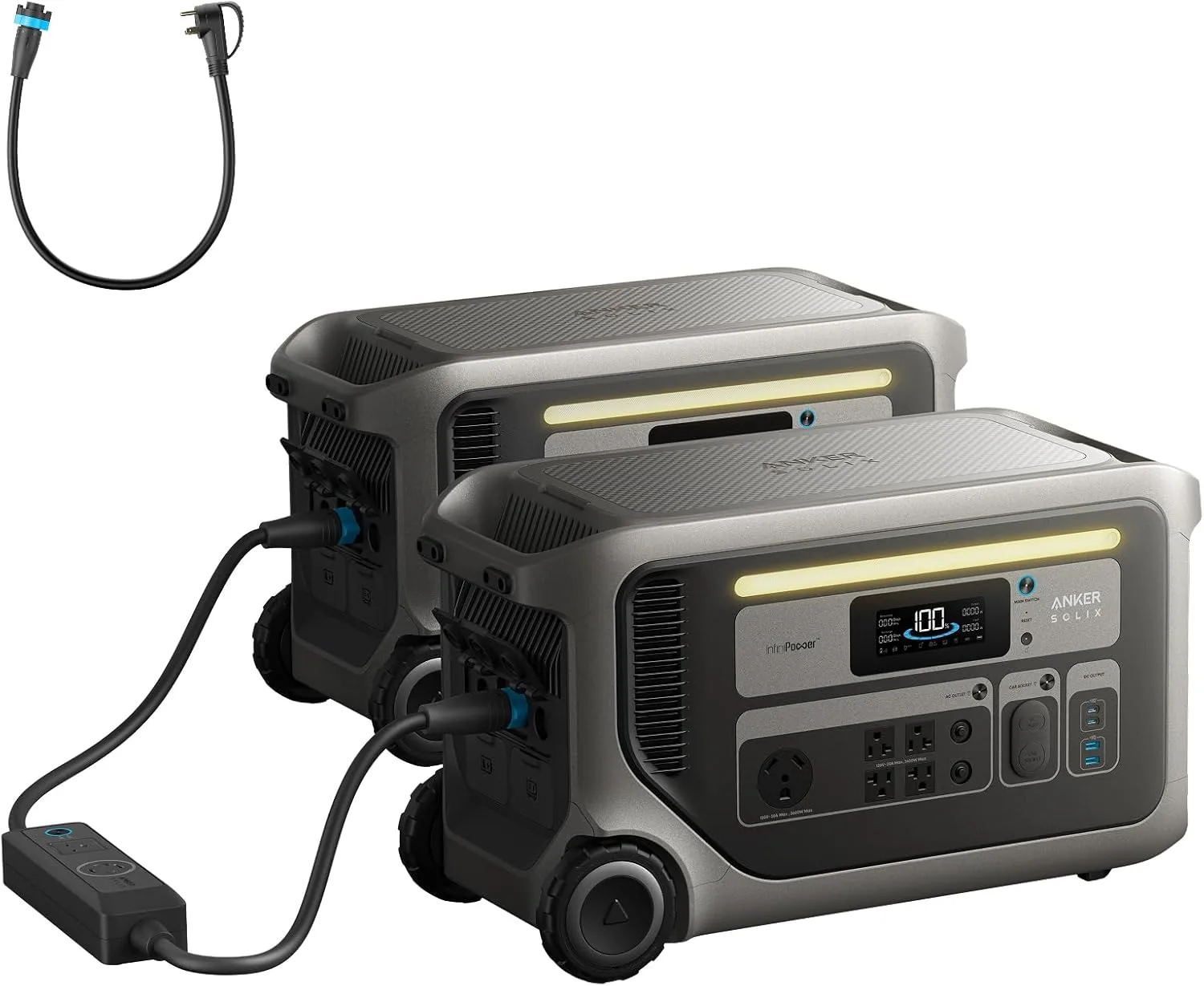
Anker 3,072Wh LiFePO4 Battery, Expandable to 24kWh, 6,000W Fast Recharging, Solar
Highlights
- 72Wh rated capacity
- 3600W continuous AC
- LiFePO4 chemistry
- 91.5 lb (~41.5 kg)
- About $3198.99 list
Best for
- SOLIX F3002: phones, cameras and a laptop on short trips
- Travel kits when you need quiet pack power, not appliance runtime
- Brief desk backup for router and lights — not a fridge for days
Strengths
- SOLIX F3002: 3600W continuous on a 72Wh pack — more headroom for small appliances than 1kW-class peers
- 91.5 lb (~41.5 kg) is a park-and-use chassis — plan a short path, not a trail hike
- 3600W continuous headroom covers more small appliances than 1kW-class inverters
- About $3198.99 list in the Hub catalog — confirm live retail before you buy
Watch-outs · not ideal when
- At 91.5 lb (~41.5 kg), SOLIX F3002 is a poor tent-hike companion — plan a cart or leave it in the vehicle
- Usable energy on SOLIX F3002 is below the 72Wh label once the inverter is working
- Solar input unpublished for SOLIX F3002 — do not assume a same-day off-grid refill
- Airline and pack limits may still block SOLIX F3002 even when the weight looks friendly
Frequently asked
Can the EcoFlow run a 240V well pump?
The listing does not publish a 240V pairing path, so treat that as n/a (not on file) rather than a yes. The Anker lists a Double Voltage Hub for 240V pairing.
How long will each run a fridge?
The Anker listing cites a 190 W fridge for 42 hours. The EcoFlow runtime is not published for a comparable load, so I will not invent one.
Is the EcoFlow's 3,400 W the same as continuous output?
No — the listing calls it X-Boost, and the continuous figure is 2,400 W. Size continuous loads against 2,400 W.
Which is cheaper per Wh?
The Anker works out to about $1.04/Wh on nameplate math ($3198.99 ÷ 3,072 Wh); the EcoFlow cannot be computed because capacity is not on file.
How can I verify the EcoFlow's capacity before buying?
Check the product listing's spec sheet or the manufacturer's official page for a published Wh figure. If it is still not listed, ask the seller directly — do not rely on the model name or marketing copy to infer it.
Method and sources
Model names and list prices come from the WattPicks catalog at build time. WattPicks does not run its own laboratory tests on power stations, and nothing on this page is presented as a measured result — it is catalog-backed buying guidance.
Read our methodology for how the catalog is normalized, and about WattPicks for who publishes it.