
Goal Zero Yeti 1500 vs Jackery Explorer 1500 Ultra
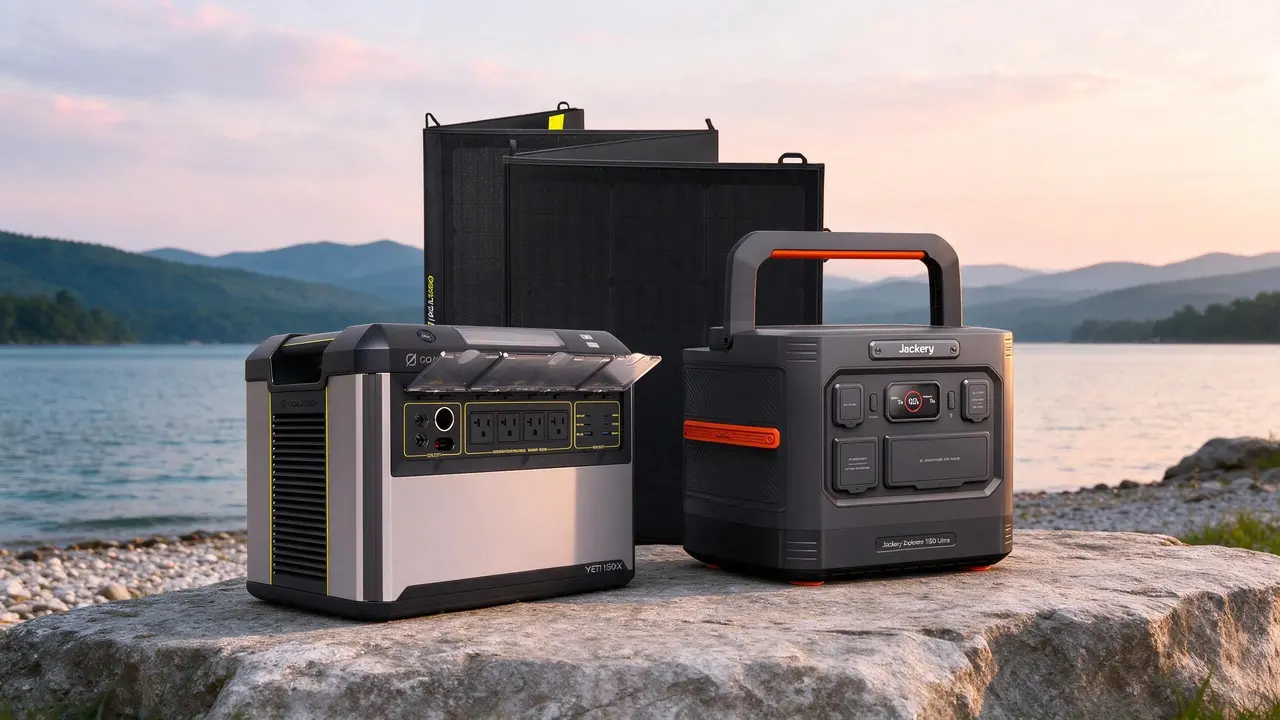
Two 1500Wh-class stations, two different bets: the Yeti 1500 spends on ports, fast wall charging, and an aluminum shell; the Jackery Explorer 1500 Ultra spends on lower price, lighter carry, and an IP65 enclosure. Here is who each one actually fits.
Updated
At a glance
Two 1500Wh-class stations, two different bets: the Yeti 1500 spends on ports, fast wall charging, and an aluminum shell; the Jackery Explorer 1500 Ultra spends on lower price, lighter carry, and an IP65 enclosure. Here is who each one actually fits.
- Jackery's bet: lower list price, lighter carry, IP65 dust/water sealing
- Goal Zero's bet: more outlets, higher continuous output, faster wall charging
Same money, different bets
At list, these two sit about $300 apart — $1,199 for the Jackery Explorer 1500 Ultra Portable Power Station,1536Wh,1800W AC against $1,499.95 for the Goal Zero Yeti 1500 Portable Power Station. Close enough that the decision is not really about budget. It is about what you want the extra money to buy.
The Jackery bets on price, carry weight, and a sealed enclosure: 38.6 lb, an IP65 rating with lids closed, and 1,536 Wh. The Goal Zero bets on ports and turnaround: 2,000 W continuous, four AC and four USB-C outlets, and owners reporting near-full wall recharges inside an hour.
This is a two-way pick, not a ranked shortlist. If you came for a whole-home solution, neither unit is that — these are circuit-level backup for a fridge, a CPAP, lights, and a router, not a panel-mounted standby system.
- Jackery's bet: lower list price, lighter carry, IP65 dust/water sealing
- Goal Zero's bet: more outlets, higher continuous output, faster wall charging
How I weighed these two
I am Avery Nolan, founding editor at WattPicks, covering portable power capacity, output, and price-per-Wh across the catalogue — no lab claims. My read here is grounded in the listing specs and the owner themes on file; those checks are not lab-bench measurements.
The weighting: continuous output and port fit 30%, recharge speed 20%, weight and enclosure 20%, price 15%, owner themes 15%. On that scale the Yeti wins on output and recharge, the Jackery wins on weight, enclosure, and price — which is why this is a use-case split rather than a single winner.
One disclosure: WattPicks earns from Amazon Associates links. Picks are fit-led, not commission-led.
Scoreboard on those weights — Jackery Explorer 1500 Ultra Portable Power Station,1536Wh,1800W AC (list $1199): High where list price and published capacity match the job, Med on continuous watts; Goal Zero Yeti 1500 Portable Power Station (list $1499.95): High on continuous watts and ports, Med on price. That is why the pick splits by job rather than one universal winner.
Spec snapshot
Everything below comes from the listings. Where a figure is not published, it reads n/a (not on file) rather than a guess. Ratings are the listing aggregate, not a verdict from owner evidence.
| Product | Price | Capacity (Wh) | Output (W) | Weight (lb) | Rating |
|---|---|---|---|---|---|
| Jackery Explorer 1500 Ultra Portable Power Station,1536Wh,1800W AC | $1199 | 1536 Wh | 1800 W | 38.6 lb | 5 |
| Goal Zero Yeti 1500 Portable Power Station | $1499.95 | 1505 Wh | 2000 W | 52.8 lb | 4 |
Where the money went
Four configuration differences explain most of the $300 gap, and none of them is a marketing label.
- Battery and cycle life: both list LiFePO4 rated to roughly 4,000 cycles to about 70% capacity. On paper this is a wash — you are not paying extra for chemistry here.
- Output headroom: the Yeti lists 2,000 W continuous with a 3,600 W surge; the Jackery lists 1,800 W continuous with a 3,600 W five-second peak and a 2,000 W peak held up to 15 minutes. That 200 W gap matters for tools and pumps that spike on startup.
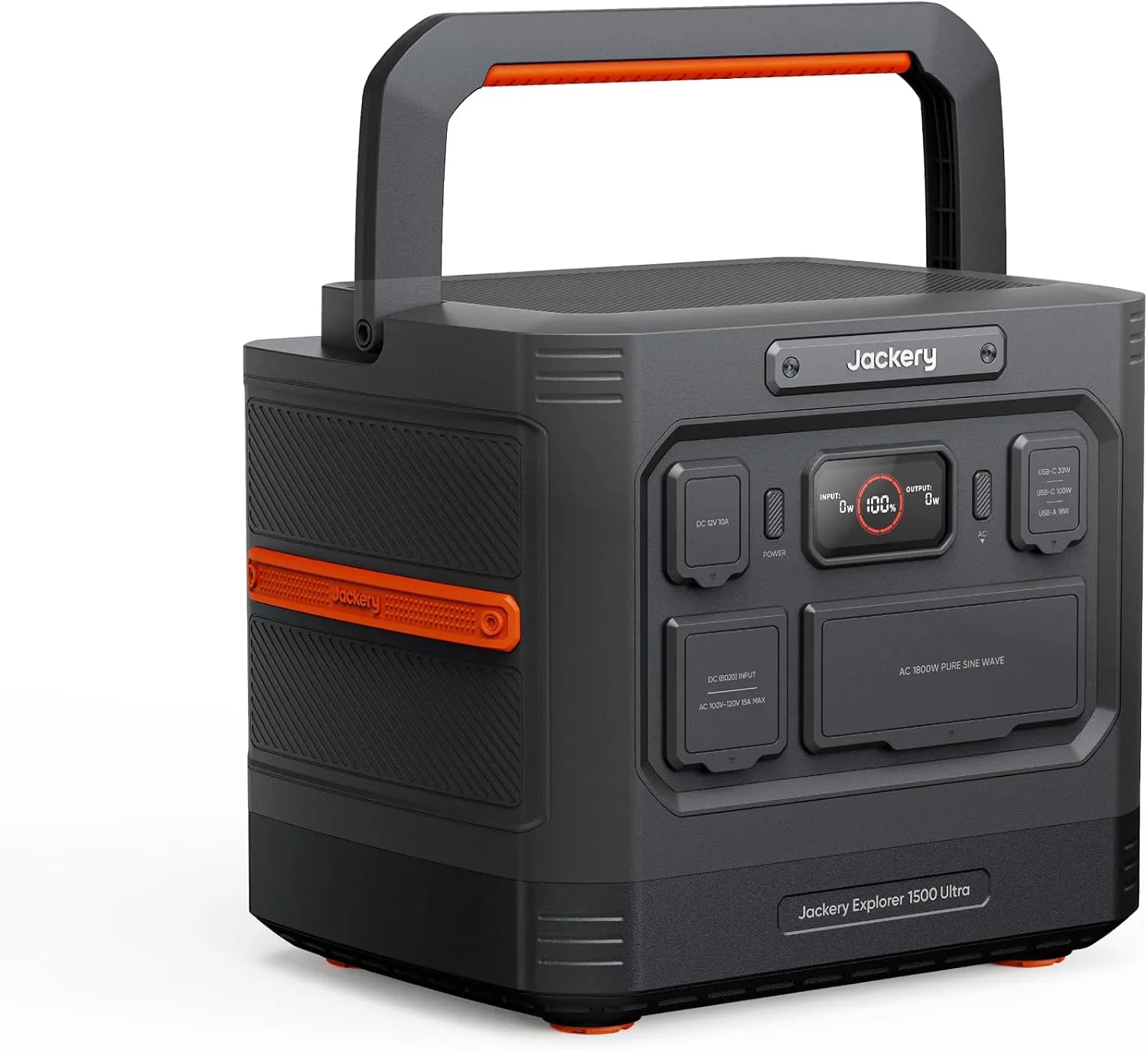
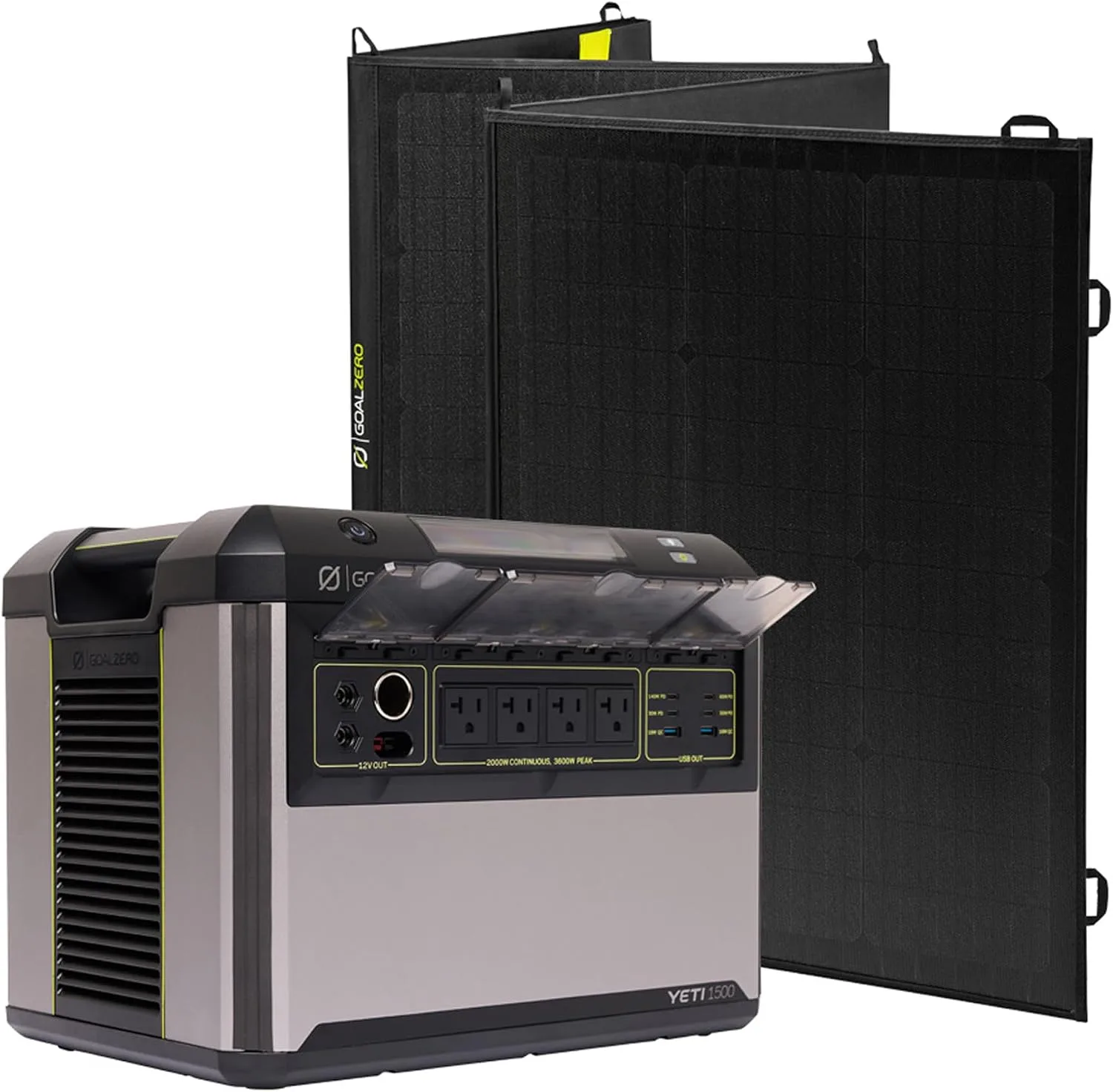
- Ports: the Yeti carries AC×4, USB-C×4, USB-A×2, and a 12V car outlet, including a 140W USB-C. The Jackery lists AC×3, USB-C×1, and a car outlet; its USB-A count is not published, so I will not claim either way.
- Enclosure and weight: the Jackery is IP65 with lids closed and 38.6 lb; the Yeti is IPX4 with an aluminum case and 52.8 lb. One is built to shrug off dust and rain, the other to survive being tossed in a trunk.
- Recharge speed: Goal Zero claims 0-80% from the wall in under an hour. Jackery claims a full AC charge in 1.5 hours and up to 800W solar. Both are quick; the Yeti is quicker on wall power.
The spec that decides it
Two numbers do most of the work. First, continuous output: 2,000 W versus 1,800 W. If your outage plan includes a sump pump, a space heater on a low setting, or a power tool that surges hard, the Yeti's extra headroom and four AC outlets let you run more at once without tripping the inverter.
Second, weight and sealing: 38.6 lb with IP65 versus 52.8 lb with IPX4. If the station lives in a garage, gets carried to a campsite, or sits through a dusty jobsite, the Jackery is the easier object to live with — and the cheaper one.
Capacity is effectively a tie: 1,536 Wh against 1,505 Wh is a rounding error at this scale. Do not let that 31 Wh decide anything.
- Pick on continuous W if you run motor loads or tools
- Pick on weight and IP rating if the unit travels or sits in weather
Real owner trade-offs
The Jackery review pack is thin — a handful of ratings — so treat this as early signal, not consensus. What is there is positive: one camper reported it held up in dusty, wet conditions, and a dog trainer ran fans and gear across full weekends. The only friction noted was price. No repeated reliability complaints surfaced, but with so few owners reporting I would not call it battle-tested.
- Camping owner: performed well in dusty and wet conditions
- Weekend trainer: ran fans and other gear all weekend without trouble
- Caveat: flagged as costing more than alternatives
Jackery Explorer 1500 Ultra Portable Power Station,1536Wh,1800W AC
Highlights
- 1536Wh rated capacity
- 1800W continuous AC
- LiFePO4 chemistry
- Up to 800W solar input
- 38.6 lb (~17.5 kg)
- About $1199 list
Best for
- Explorer 1500 Ultra: longer outages or higher continuous loads (still not whole-home wiring)
- RV / off-grid days where recharge speed matters as much as Wh
- Users who will pair solar or expand rather than buy a second small pack
Strengths
- Explorer 1500 Ultra: 1800W continuous on a 1536Wh pack — more headroom for small appliances than 1kW-class peers
- 38.6 lb (~17.5 kg) is a park-and-use chassis — plan a short path, not a trail hike
- 1800W continuous headroom covers more small appliances than 1kW-class inverters
- Owners on file: 5/5 · 3 helpful — This worked amazing on our camping trip! While it was more expensive, it works VERY well in…
Watch-outs · not ideal when
- 38.6 lb (~17.5 kg) is a two-hand lift; skip it if you walk more than a short path to camp
- High continuous output on Explorer 1500 Ultra tempts big loads — Wh still runs out on kettles and A/C
- Rated 800W solar on Explorer 1500 Ultra is optimistic; shade and cables cut real watts
- LiFePO4 helps longevity, but Explorer 1500 Ultra still hates freezing charge temps on winter trips
Owner voices
Short takes from public retail reviews — paraphrased or translated when long or non-English; meaning kept close to the original.
“5/5 · 3 helpful — This worked amazing on our camping trip! While it was more expensive, it works VERY well in dusting wet conditions.”
“5/5 · 1 helpful — It works well. We train dogs on most weekends and I can run fans and other things all weekend.”
Where the Yeti earns its premium — and where it doesn't
The Goal Zero owner evidence is deeper and more mixed. On the positive side, multiple owners describe wall charging close to full in under an hour, one watching 50% to 100% in under 30 minutes. Owners praise the aluminum case and easy-grip handles, and the port spread let one run an entire home work station off AC and DC at once. During a storm outage, one moved it from desk to fridge and kept both going; another ran an ice chest and fridge in shifts plus fans and a router for three days, topping up on solar. The free app gives a live read on draw, and owners called out the port lights and flap doors for dark or rainy setups.
The caveats are serious enough to name plainly. One owner hit error codes the manual did not explain, got only generic reset advice, and returned the unit. Separately, one owner reported the unit and charger overheating and smoking after two years of normal use — a safety watch-out I would not wave away. Weight is the mild, expected gripe: heavy, but no worse than the class.
- Fast wall recharge confirmed across several owners
- Port-hungry setups and multi-day outage coverage are its strength
- Caveat: unexplained error codes and a return in one report
- Caveat: one overheating/smoking report after two years — keep receipts and test early
Goal Zero Yeti 1500 Portable Power Station
Highlights
- 1505Wh rated capacity
- 2000W continuous AC
- 3600W surge
- LiFePO4 chemistry
- Up to 900W solar input
- 52.8 lb (~23.9 kg)
Best for
- Yeti 1500: longer outages or higher continuous loads (still not whole-home wiring)
- RV / off-grid days where recharge speed matters as much as Wh
- Best parked near the vehicle or cabin — not a long carry to a tent
Strengths
- Yeti 1500: 1505Wh pack with 2000W continuous / 3600W surge — size loads to both numbers
- 52.8 lb (~23.9 kg) is a park-and-use chassis — plan a short path, not a trail hike
- 15ms-class UPS switchover on the listing — useful when a router restart would hurt
- Owners on file: 5/5 · 6 helpful — Without a doubt Goal Zero's best power station yet. I've been a customer for many years and…
Watch-outs · not ideal when
- At 52.8 lb (~23.9 kg), Yeti 1500 is a poor tent-hike companion — plan a cart or leave it in the vehicle
- High continuous output on Yeti 1500 tempts big loads — Wh still runs out on kettles and A/C
- Rated 900W solar on Yeti 1500 is optimistic; shade and cables cut real watts
- LiFePO4 helps longevity, but Yeti 1500 still hates freezing charge temps on winter trips
Owner voices
Short takes from public retail reviews — paraphrased or translated when long or non-English; meaning kept close to the original.
“5/5 · 6 helpful — Without a doubt Goal Zero's best power station yet. I've been a customer for many years and always find the products to be durable and reliable. Happy to report this new station continues the trend.…”
“5/5 · 5 helpful — Enjoying using my Goal Zero Yeti 1500. The unit recharges in an hour or less and provides quiet power for several days. Running power tools and various chargers works flawlessly. End result is to use…”
“5/5 · 4 helpful — We love the Yeti 1500 Portable Power Station. When the power goes out, we no longer need to fire up the gas-powered generator and run a cord from outdoors. We simply plug in an appliance, light, comp…”
Buy the one that…
Buy the Jackery Explorer 1500 Ultra Portable Power Station,1536Wh,1800W AC if you want the lower list price, a lighter 38.6 lb carry, and an IP65 enclosure for camping, jobsites, or a garage shelf — and your loads stay under 1,800 W continuous.
Buy the Goal Zero Yeti 1500 Portable Power Station if you need 2,000 W continuous, four AC and four USB-C outlets, and the fastest wall turnaround in this pair — and you are willing to pay about $300 more, carry 52.8 lb, and keep an eye on early fault behavior given the owner reports.
Walk away from both if you are planning whole-home backup. These are portable stations for a fridge, lights, a router, and a CPAP — not a transfer-switch install. If that is the goal, start with our home backup sizing guide instead.
Frequently asked
Can either run a fridge during an outage?
Yes, within limits — owners ran a fridge on the Yeti in shifts alongside fans and a router. Neither is sized for a central AC or an electric range.
Which charges faster from the wall?
The Yeti, per Goal Zero's 0-80% in under an hour claim and owner reports; the Jackery lists a 1.5-hour full AC charge.
Is the Jackery's IP65 a real advantage?
If the unit sits outdoors or in dust, yes. The Yeti's IPX4 and aluminum case favor being tossed in a car rather than rained on.
Do both use LiFePO4?
Yes, both list LiFePO4 rated to about 4,000 cycles — so chemistry is not the tiebreaker here.
Method and sources
Model names and list prices come from the WattPicks catalog at build time. WattPicks does not run its own laboratory tests on power stations, and nothing on this page is presented as a measured result — it is catalog-backed buying guidance.
Read our methodology for how the catalog is normalized, and about WattPicks for who publishes it.